Synthesis: The Edited Future
The CRISPR toolbox has expanded far beyond simple cuts: base editing, prime editing, epigenome editing. Each new tool opens a new category of application — and a new category of ethical territory that hasn't been mapped yet.
Synthesis: The Edited Future
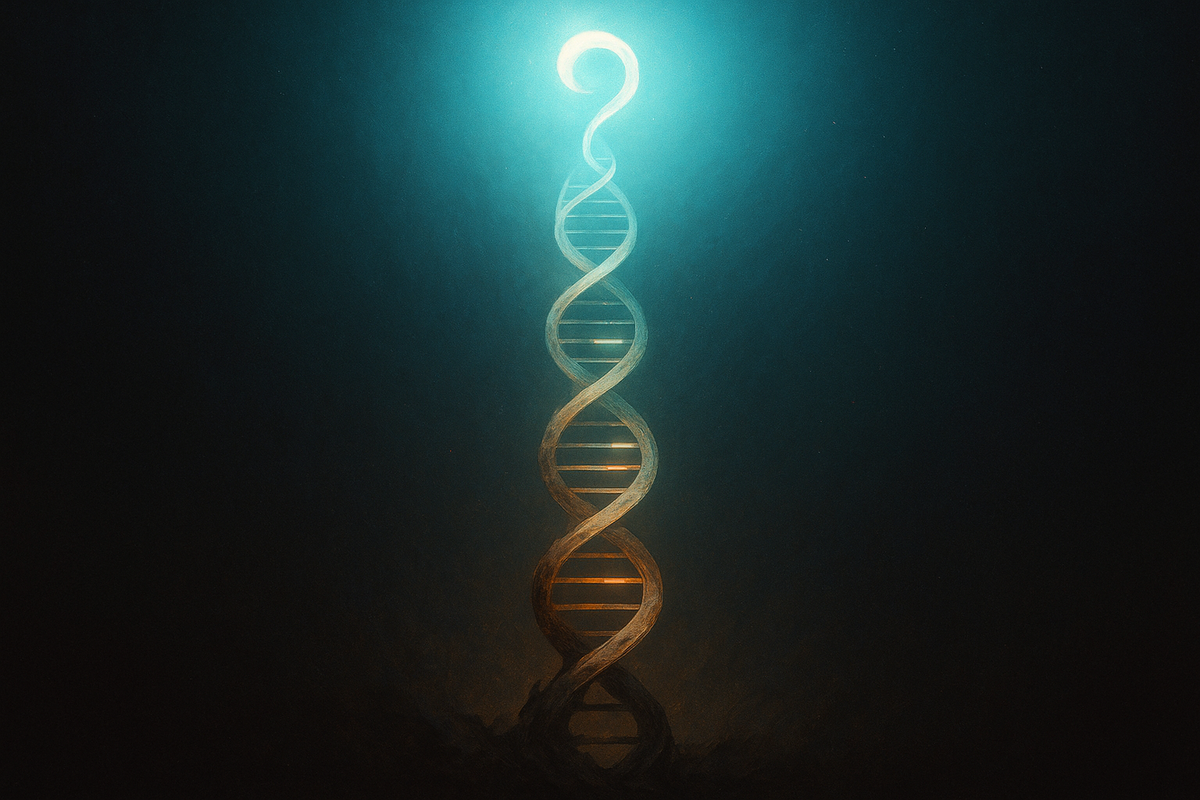
Life is self-maintaining information. That's the deep fact we've been dancing around throughout this series. A cell is a pattern that copies itself, corrects errors in its own code, and persists through time by constantly rebuilding its structure from genetic blueprints. A genome is a three-billion-letter instruction set that's been running continuously since the first replicator emerged from chemistry into biology. Evolution is the process by which those instructions get tested, refined, and propagated across geological time. For four billion years, the only way to change those instructions was mutation—random errors, most of them harmful, occasionally beneficial, always slow. Species adapted across millions of years. Individual organisms were stuck with whatever genome they inherited. CRISPR broke that. We can now edit the instructions while the system is running. Not through the blind iteration of natural selection, but through deliberate choice. Not across millions of years, but within a single lifetime. Not randomly, but precisely. This isn't just a new medical technology. It's a new relationship between information and biology, between human intention and evolutionary process. The source code of life has become rewritable. And we need to understand what that means.
The Arc of Precision (From Scissors to Word Processors)
The history of gene editing is a history of increasing precision. First came CRISPR-Cas9: molecular scissors. Point them at a sequence. They cut. The cell repairs the break sloppily, usually disrupting the gene. It's powerful—you can disable almost any gene you want—but it's blunt. Double-strand breaks are violent. The repair process is error-prone. You're not so much editing as vandalizing with surgical accuracy. Then came base editing: molecular pencils. Instead of cutting, you chemically convert one DNA letter into another. C becomes T. A becomes G. The strand stays intact. No double-strand break, no chaotic repair. You can fix point mutations—the single-letter typos that cause thousands of genetic diseases. Sixty percent of pathogenic point mutations became theoretically fixable. Then came prime editing: molecular word processors. Insert letters. Delete letters. Make any small change you want. No break. No template required. The editing machinery writes the change directly into the DNA. Eighty-nine percent of known pathogenic mutations became addressable. The trajectory is unmistakable: from cutting to rewriting, from destruction to precision, from hoping the cell fixes things correctly to writing exactly what you intend. Each step reduces the violence of the intervention. Each step increases the fidelity of the outcome. Each step moves closer to editing as pure information manipulation.
The Delivery Problem (Information Needs a Vehicle)
Here's the bottleneck that constrains everything: getting the editing machinery where it needs to go. CRISPR components are big. Guide RNAs. Cas9 proteins or mRNA encoding them. Sometimes DNA templates. These molecules don't easily cross cell membranes. They don't naturally home to specific organs. They trigger immune responses. The editing itself may be precise, but delivery is messy. For ex-vivo therapies like Casgevy—where you extract cells, edit them outside the body, and reinfuse them—delivery is manageable. You edit cells in a controlled lab environment. You can verify the edits before returning the cells to the patient. But ex-vivo only works for certain conditions. Blood diseases, where stem cells can be harvested and returned. Cancer immunotherapy, where T cells can be engineered and expanded. Most diseases don't fit this model. For in-vivo therapies—editing cells inside a living patient—delivery is the limiting factor. The liver is relatively easy; lipid nanoparticles get absorbed there naturally, which is why many early in-vivo trials target liver diseases. The brain, the muscles, the lungs, the heart? Much harder. Each organ has its own barriers, its own immune challenges, its own access routes. The next decade of gene editing isn't about inventing new editing tools. It's about inventing new delivery systems. Viral vectors that target specific tissues. Nanoparticles engineered for organ-specific uptake. Physical methods like electroporation or direct injection. This is the unsexy infrastructure work that will determine which diseases can actually be treated. The information revolution in biology is constrained by logistics. The source code is rewritable; the question is which cells can we reach.
The Three Timescales of Change
Gene editing operates on three distinct timescales, each with different implications: Somatic editing: Changes to an individual's body cells. This is what current therapies do—edit the patient's cells, cure the patient's disease, stop there. The edits don't pass to the next generation. If you treat sickle cell disease with Casgevy, your children might still inherit the sickle mutation from you. The cure is individual, not heritable. Somatic editing is the safest regime. If something goes wrong, it affects one person. The mistakes don't propagate. The intervention is bounded in time. Germline editing: Changes to eggs, sperm, or embryos. These edits become part of the individual's genome and pass to all future generations. Fix a disease in an embryo, and you fix it for that person's children, grandchildren, and descendants forever. Germline editing is where the stakes become infinite. A mistake propagates forever. An off-target effect becomes a hereditary burden. A well-intentioned fix might have consequences that don't manifest for generations. This is why the scientific consensus, post-He Jiankui, holds that germline editing isn't ready for clinical use. The technology needs to be more precise. The safety data needs to be more robust. The governance frameworks need to be more developed. Eventually, germline editing might be appropriate for preventing devastating heritable diseases—Huntington's, Tay-Sachs, severe genetic conditions with no other treatment. But not yet. Gene drives: Changes that spread through wild populations. This isn't just editing a genome; it's editing a species. Gene drives don't wait for natural selection. They propagate themselves across generations, potentially reaching every member of a population within years. Gene drives operate on evolutionary timescales compressed into human timescales. We could eliminate malaria mosquitoes. We could eradicate invasive species. We could alter ecosystems in ways that persist long after any humans who made the decision are gone. Each timescale expands the scope of intervention—and the scope of responsibility.
The Governance Gap (Who Decides?)
The technology is global. The governance is fragmented. Every country has its own regulations (or lack thereof) around gene editing. Some prohibit germline editing outright. Some permit research but not clinical applications. Some have vague rules or inadequate enforcement. The international consensus emerging from scientific bodies is advisory, not binding. This creates arbitrage opportunities. He Jiankui did his germline editing in China, where oversight was weaker. If gene drives are developed, they'll likely be deployed first in countries with less regulatory caution—potentially affecting ecosystems that cross borders. The problem isn't that governance is absent. It's that governance is slow, national, and reactive, while technology is fast, global, and generative. By the time regulators understand a new capability, researchers are already developing the next one. Some propose international treaties—a CRISPR equivalent of nuclear non-proliferation agreements. But gene editing is far more accessible than nuclear weapons. You can't control the spread of knowledge once it's published. You can't inspect every lab. The technology is dual-use by default. What might work better: shared norms, transparent research, mandatory registries of experiments, and international bodies that coordinate response to misuse. Not control, but visibility. Not prohibition, but accountability. The edited future will be governed by norms as much as laws. The question is who shapes those norms—and whether they hold.
The Enhancement Question (Where's the Line?)
Medicine treats disease. Enhancement improves on the normal baseline. Gene editing blurs the boundary. If you edit a gene to prevent Huntington's disease, that's clearly therapy. If you edit a gene to increase height in a child who would have been average, that's clearly enhancement. But what about editing to prevent high cancer risk? To optimize immune function? To extend lifespan? The genome-wide association studies (GWAS) that identify genetic variants associated with traits are already mapping the landscape. We know variants associated with intelligence, height, disease resistance, athletic performance. The knowledge exists. The editing tools exist. The question is whether we use them—and who gets access if we do. The standard bioethicist worry: enhancement will be available only to the rich, creating genetic haves and have-nots. Designer babies for those who can afford them. A new species of genetically optimized elites. The counterargument: enhancements will diffuse, like all technologies. Vaccines were once elite; now they're universal. IVF was once boutique; now it's routine. Gene editing enhancements, if they prove valuable, will eventually become accessible—perhaps even mandated for public health reasons. Neither scenario is certain. What's certain is that the line between therapy and enhancement will be tested, repeatedly, as capabilities expand. We're already editing humans. The only question is where we stop.
What Remains Human
Here's the question under all the other questions: what does it mean to be human when the human genome becomes editable? We've always modified ourselves. Clothing, tools, agriculture, medicine, education. The species that exists today is as much a product of culture and technology as of natural evolution. Gene editing is one more intervention—more fundamental in mechanism, but continuous with everything that came before. Some argue that editing the genome crosses a line that other interventions don't. That there's something sacred about the genetic inheritance we received from our ancestors. That modifying the "essence" of humanity threatens our humanity itself. Others argue that there's nothing special about genetic stability. The genome changes anyway—through mutation, through drift, through the constant churn of reproduction. We're not preserving a fixed essence; we're participating in an ongoing process. Intelligent modification is just a faster, more directed version of what evolution was already doing. The truth is probably somewhere in between. Some genetic modifications will feel deeply human—curing devastating diseases, reducing suffering, extending healthy life. Others will feel like violations—optimizing children for competitive advantage, creating genetic castes, editing away variations that don't need editing. The genome isn't sacred. But it isn't trivial either. It's the substrate of inheritance, the code that connects us to ancestors and descendants. Editing it changes not just individuals but the trajectory of lineages. The edited future isn't posthuman. It's more human—more intentional, more responsible, more aware of what we're passing on.
The Cursor Is Blinking
We started this series with a metaphor: the source code of life became editable. The cursor is blinking. The only question is what we type next. That's still true. But having spent seven articles exploring the tools, the applications, the successes, the disasters, and the ongoing uncertainties, we can be more specific about what we're typing into. We're typing into a four-billion-year-old codebase that we only partially understand. We're making changes that propagate in ways we can't fully predict. We're intervening in the maintenance processes that keep living systems coherent—and coherence, once disrupted, isn't easily restored. But we're also typing with increasing precision. The tools are getting better. The safety data is accumulating. The governance frameworks, however inadequate, are developing. The first CRISPR therapies are curing patients who had no other options. The choice isn't between editing and not editing. That threshold has already been crossed. The choice is between editing wisely and editing recklessly—between thoughtful intervention and technological hubris—between expanding human capability and respecting the limits of human knowledge. The gene editing revolution is happening. It can't be stopped. It can only be steered. Victoria Gray can hug her children without fearing the next pain crisis. Emily Whitehead is alive when she should be dead. Somewhere, a researcher is designing the gene drive that might end malaria—or the off-target mutation that might not manifest for decades. The code is open. The tools are live. What we do next determines what kind of edited future we get.
The Questions That Remain
- How do we make gene therapies accessible to the billions who need them, not just the thousands who can afford them?
- How do we govern a technology that any competent lab can access?
- What conditions justify germline editing—and who decides?
- How do we protect against misuse without stifling beneficial research?
- What does consent mean for people who don't exist yet—future generations whose genomes we might alter?
- Can we develop robust safety testing for interventions whose effects might take decades to manifest?
- What role should patients and communities have in shaping how these technologies are deployed?
These aren't questions with easy answers. They're questions that will be answered—implicitly or explicitly—by the choices researchers, regulators, patients, and societies make over the coming decades. The edited future isn't determined by technology. It's determined by us.
Further Reading
- Doudna, J.A. & Sternberg, S.H. (2017). A Crack in Creation: Gene Editing and the Unthinkable Power to Control Evolution. Houghton Mifflin Harcourt.
- Isaacson, W. (2021). The Code Breaker: Jennifer Doudna, Gene Editing, and the Future of the Human Race. Simon & Schuster.
- National Academies of Sciences, Engineering, and Medicine (2017). Human Genome Editing: Science, Ethics, and Governance. The National Academies Press.
- Davies, K. (2020). Editing Humanity: The CRISPR Revolution and the New Era of Genome Editing. Pegasus Books.
This concludes the CRISPR Revolution series. Return to the series hub: "The CRISPR Revolution."


Comments ()