CRISPR: The Gene Editing Revolution
CRISPR-Cas9 didn't come from a lab — it came from bacteria's billion-year immune war against viruses. Repurposed as a gene-editing tool, it can now cut and splice any genome with a precision that would have seemed impossible a decade ago.
CRISPR: The Gene Editing Revolution
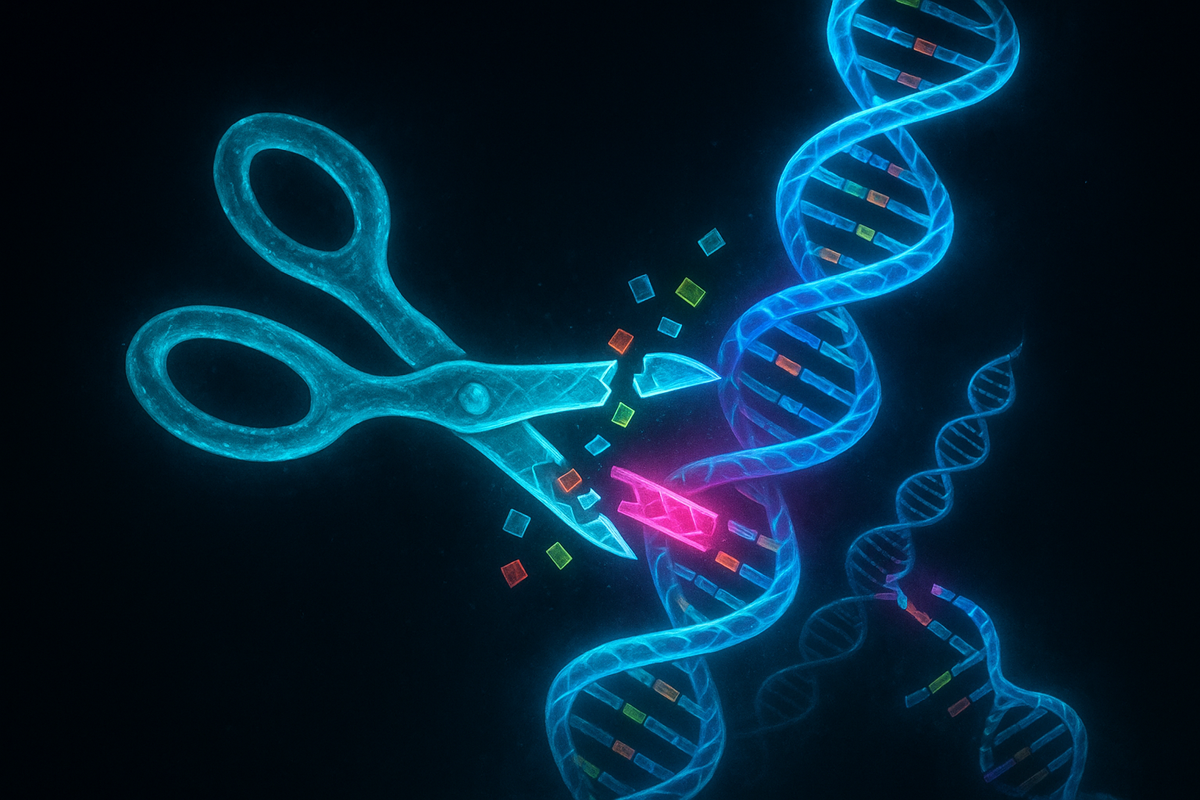
Bacteria have been at war with viruses for three billion years. Think about that timeline. Bacteria were fighting off invaders before there were plants, before there were animals, before there was oxygen in the atmosphere. And somewhere in that unimaginably long arms race, they evolved something remarkable: an immune system that remembers. When a bacterium survives a viral attack, it does something clever. It grabs a piece of the virus's genetic code—just a short snippet, maybe twenty or thirty letters—and stores it in its own genome. Like keeping mugshots of every criminal who ever broke into your house. The next time that virus shows up? The bacterium recognizes it, hunts it down, and cuts its DNA to pieces. Bacteria have been running antivirus software longer than multicellular life has existed. And in 2012, two scientists figured out how to hijack it. Jennifer Doudna at Berkeley and Emmanuelle Charpentier in Sweden realized that this ancient bacterial defense system could be reprogrammed. You could design a guide that pointed to any DNA sequence you wanted—in bacteria, in plants, in mice, in humans—and the system would cut there. Snip. Done. They had turned a three-billion-year-old immune system into a pair of programmable molecular scissors. The source code of life had become editable.
The Most Elegant Hack in Biology
Okay, let's get into the actual mechanics, because they're beautiful. The CRISPR system has two parts. First: a guide RNA—a short piece of genetic material that matches whatever sequence you want to target. This is your address. Your search query. Your mugshot. Second: a protein called Cas9. Cas9 is the scissors. It doesn't know or care what it's cutting. It just follows the guide, finds the matching sequence, and makes a double-strand break right through the DNA helix. That's it. That's the whole trick. Target. Cut. What happens after the cut is where it gets interesting. When you break both strands of DNA, the cell panics. Double-strand breaks are emergencies—left unrepaired, they can kill the cell or cause cancer. So the cell immediately activates its repair machinery. And here's where you, the scientist, get to choose your own adventure. Option 1: Break the gene. The cell's quickest repair method, called non-homologous end joining, is fast but sloppy. It glues the broken ends back together, but often adds or deletes a few nucleotides in the process. If this happens in the middle of a gene, it usually destroys that gene's function. Gene: disabled. This is useful when you want to turn something off—silence a disease-causing gene, knock out a cancer driver, eliminate a viral sequence. Option 2: Rewrite the gene. If you provide a DNA template along with the CRISPR machinery, the cell can use a different repair pathway—homology-directed repair—to copy your template into the break site. Now you're not just cutting; you're editing. You can fix a disease-causing mutation, insert a new sequence, swap one version of a gene for another. Point. Cut. Repair. The cell does the hard work for you. George Church, the legendary Harvard geneticist who was one of the first to use CRISPR in human cells, described it as "a Swiss Army knife that works on every genome—except better, because you can reprogram it just by changing the RNA."
The Patent War That Almost Broke Science
Here's where the story gets ugly. Doudna and Charpentier published their breakthrough in August 2012. But their work was in test tubes, using purified bacterial components. The question everyone was asking: would it work in human cells? Human cells are vastly more complex than bacteria. Different repair machinery, different chromatin structure, different everything. Five months later, Feng Zhang at the Broad Institute in Cambridge published a paper showing that CRISPR worked beautifully in human cells. And his institution immediately filed for patents—paying extra for expedited review. What followed was one of the most vicious intellectual property fights in biotech history. Billions of dollars were at stake. Whoever controlled the fundamental CRISPR patents would collect royalties on every commercial application—every therapy, every agricultural product, every research tool. The Broad argued that making CRISPR work in human cells was a non-obvious inventive leap, worthy of its own patent. Berkeley, representing Doudna and Charpentier, argued that the human cell application was obvious—anyone would have tried it. Patent lawyers. Interference proceedings. International jurisdictions. Stock prices of three different biotech companies swinging wildly with each ruling. The Nobel Committee, when they finally weighed in with the 2020 Chemistry Prize, sided with Doudna and Charpentier. Zhang was left out—a decision that still sparks arguments at scientific conferences. But here's what matters: while the lawyers fought, the science kept moving. The researchers kept collaborating. The technology kept improving. By the time anyone sorted out who owned what, CRISPR had already changed the world.
From Lab Bench to Hospital Bed (Faster Than Anyone Expected)
December 2023. Eleven years after the original paper. The FDA approved Casgevy for sickle cell disease—the first CRISPR therapy to reach the market for a genetic condition. A disease that has tortured human beings since before recorded history, cured by editing a patient's own cells. Victoria Gray was the first American patient treated in the clinical trial. She'd lived her entire adult life punctuated by sickle cell crises—episodes of excruciating pain when her rigid, crescent-shaped blood cells jammed in her blood vessels, starving her tissues of oxygen. Hospitalizations measured in weeks. A lifetime of transfusions and painkillers that managed but never solved the underlying problem. Four years after her CRISPR treatment, she hasn't had a single crisis. Here's the elegant part: Casgevy doesn't actually fix the sickle cell mutation. It uses a workaround. Humans have a gene for fetal hemoglobin—a version of the oxygen-carrying protein that's active before birth and then gets switched off. People with sickle cell have defective adult hemoglobin, but their fetal hemoglobin genes are perfectly fine. Casgevy disables a genetic switch called BCL11A that normally suppresses fetal hemoglobin after birth. Turn off the suppressor, and fetal hemoglobin floods back. The defective adult hemoglobin gets diluted. The cells stop sickling. It costs $2.2 million per patient. And it might be a bargain. Lifetime treatment costs for a sickle cell patient—transfusions, hospitalizations, emergency care, lost productivity—often exceed that number. One payment versus decades of suffering. One edit versus a lifetime of disease. But the economics are brutal for different reasons. Sickle cell predominantly affects Black communities in the U.S. and sub-Saharan Africa. The people who most need this therapy are the ones least able to afford it. $2.2 million in Burkina Faso isn't a treatment cost—it's a cruel joke. The technology is here. The delivery is still catching up.
What Else Is Coming (The Pipeline Is Insane)
Sickle cell is just the beginning. The clinical trials underway right now read like science fiction: Inherited blindness. Editas Medicine is injecting CRISPR directly into patients' eyes to fix mutations causing Leber congenital amaurosis. This is in-vivo editing—changing genes inside the body rather than extracting cells, editing them, and putting them back. The first patients are already seeing better. Cancer. Multiple companies are engineering immune cells to recognize and kill tumors. CAR-T therapy—which we'll cover in detail later in this series—has already produced remissions in patients who had exhausted every other option. HIV. Here's a wild one: Excision BioTherapeutics is trying to cut the AIDS virus directly out of infected cells. HIV integrates into your genome; it becomes part of you. CRISPR could, theoretically, find those viral sequences and delete them. Not suppress the virus. Cure it. Heart disease. Verve Therapeutics is using a refined version of CRISPR called base editing to permanently disable genes that raise cholesterol. One injection. Lifetime protection. They're already in human trials. Muscular dystrophy. The dream is to restore the dystrophin protein that Duchenne patients lack. The challenge is getting CRISPR into enough muscle cells to make a difference. Progress is slow but real. The bottleneck isn't the editing anymore. It's delivery. CRISPR components are big molecules—they don't easily cross cell membranes. The liver is easy because it naturally absorbs lipid nanoparticles from the bloodstream. The brain, the muscles, the lungs? Those require new delivery technologies we're still inventing. But every year, the delivery problem gets smaller and the list of treatable conditions gets longer.
The Elephant in the Genome
Okay. We need to talk about the thing no one wants to talk about. CRISPR can edit the cells of a patient who gives informed consent. It can also edit embryos. It can edit the cells that become eggs and sperm. And edits to those cells—germline edits—get passed down to every subsequent generation. Forever. On November 25, 2018, a Chinese scientist named He Jiankui uploaded videos to YouTube announcing that he had created the world's first gene-edited human babies. Twin girls, born from embryos he had modified with CRISPR. He had targeted a gene called CCR5, attempting to make them resistant to HIV. He smiled at the camera like he expected applause. He received international condemnation instead. The scientific community wasn't horrified because germline editing is inherently evil—many researchers believe it will eventually be appropriate for preventing devastating genetic diseases. They were horrified because He had done it recklessly, secretly, without proper safety testing, for a goal that didn't justify the risks. He Jiankui went to prison for three years. But the questions his experiment raised haven't gone away. Those twin girls—Lulu and Nana, as they're called—are walking around in the world right now, their genomes permanently altered in ways we don't fully understand. Nobody knows what the long-term effects will be. Nobody knows if the edit worked as intended. Nobody knows if there were off-target mutations in other parts of their DNA. They're an uncontrolled experiment with legs. And the technology that created them is available to any competent molecular biologist with access to an IVF clinic. The barriers aren't technical. They're ethical and legal. And those vary wildly across countries and cultures. If we can edit embryos to prevent Huntington's disease—a devastating, fatal condition with 100% penetrance—should we? What about less severe conditions? What about enhancements? Height, intelligence, athletic ability? Where's the line? Who draws it? These aren't hypothetical questions. The technology exists. The decisions are being made. The only question is whether we'll make them wisely.
What This Series Will Explore
This is the first article in a series on the CRISPR revolution—the science, the applications, the fights, the fears, and the futures. Coming up: Base editing and prime editing—David Liu's next-generation tools that can rewrite DNA without making dangerous double-strand breaks. The He Jiankui scandal—what happened, why it mattered, and what it means for the future of germline editing. Gene drives—the technology that could eliminate malaria by rewriting entire mosquito populations, or cause ecological catastrophe if we get it wrong. The sickle cell cure—Victoria Gray's story and the brutal treatment journey that produced it. Off-target effects—what can go wrong when your molecular scissors cut in the wrong place. And CAR-T therapy—where gene editing meets cancer immunology. We'll end with a synthesis: what all of this means for coherence, for the self-maintaining patterns that define living systems. Gene editing is, at its core, an intervention in biological information processing. Cells maintain themselves through genetic programs refined over billions of years. We're now rewriting those programs in real time, faster than any natural selection process could evaluate our changes. We've been given edit access to the source code of life. The cursor is blinking. The only question is what we type next.
Further Reading
- Jinek, M. et al. (2012). "A programmable dual-RNA-guided DNA endonuclease in adaptive bacterial immunity." Science. (The original paper that started it all)
- Doudna, J.A. & Charpentier, E. (2014). "The new frontier of genome engineering with CRISPR-Cas9." Science.
- Isaacson, W. (2021). The Code Breaker: Jennifer Doudna, Gene Editing, and the Future of the Human Race. Simon & Schuster.
- Doudna, J.A. & Sternberg, S.H. (2017). A Crack in Creation: Gene Editing and the Unthinkable Power to Control Evolution. Houghton Mifflin Harcourt.
This is Part 1 of the CRISPR Revolution series. Next: "Base Editing and Prime Editing: Beyond Cut and Paste"—how David Liu invented tools that rewrite DNA letter by letter, without ever breaking the strand.


Comments ()