Off-Target Effects: When CRISPR Cuts in the Wrong Place
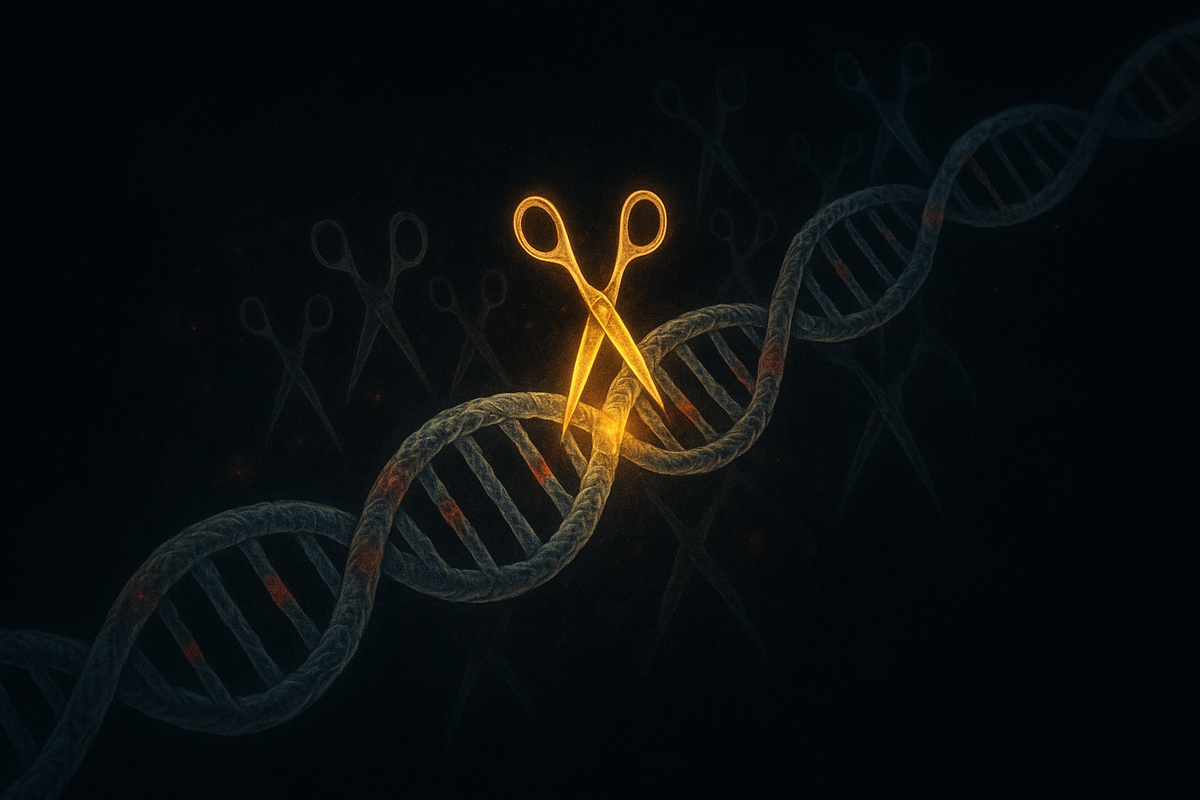
CRISPR is precise, but not perfect. Off-target cuts — edits landing in the wrong part of the genome — are the central safety challenge standing between CRISPR and widespread clinical use.
Off-Target Effects: When CRISPR Cuts in the Wrong Place
Here's what keeps CRISPR researchers up at night: You design a guide RNA to target a specific gene. Twenty letters of genetic code. You've checked it carefully. The target is unique in the genome—or at least, unique enough. You run your experiment. The cut you wanted happens. Success. But Cas9 also found another sequence that was almost identical—maybe 18 out of 20 letters matching—and it cut there too. You didn't intend that. You didn't even know it happened until you looked. If that off-target cut landed in a harmless region, no problem. The genome has three billion letters; most of them aren't doing anything important. But if that cut landed in a tumor suppressor gene? Or disrupted a critical developmental pathway? Or inserted a mutation that won't manifest for twenty years? That's the off-target problem. CRISPR is precise—but it's not perfect. And in medicine, imperfect can be catastrophic.
The Detection Problem (Finding What You Weren't Looking For)
If off-target cuts happen, how do you find them? This is harder than it sounds. You can't just sequence the entire genome of every treated cell and look for unexpected mutations—that would be astronomically expensive and statistically noisy. Normal cells accumulate random mutations all the time. Distinguishing CRISPR-induced damage from background noise requires clever methods. Computational prediction: Before you even run an experiment, algorithms scan the genome for sequences similar to your guide. They flag potential off-target sites based on the number and position of mismatches. Tools like CRISPOR, Cas-OFFinder, and Benchling's design software help researchers choose guides with fewer predicted off-target sites. But computational predictions are imperfect. They can miss sites that Cas9 actually cuts. They can flag sites that Cas9 ignores. The algorithms get better every year, but they're still approximations. Cell-free assays: GUIDE-seq, CIRCLE-seq, DISCOVER-Seq—these methods detect actual Cas9 cutting events in cell populations. They work by various tricks: integrating short DNA tags at cut sites, capturing circular DNA products, or identifying the repair proteins that cluster at breaks. Each has strengths and weaknesses. None is comprehensive. Whole-genome sequencing: For therapeutic applications, especially in humans, there's no substitute for looking at what actually happened. Researchers sequence the genomes of edited cells and hunt for unexpected mutations. But this requires knowing what you're looking for—which means you're back to relying on predictions to narrow the search. The honest summary: we've gotten much better at finding off-target cuts, but we can't guarantee we've found all of them.
How Bad Can It Get? (The Catastrophe Scenarios)
Most off-target cuts are probably harmless. The genome is mostly non-coding—regions between genes, repetitive sequences, evolutionary relics. A random cut in a random place will usually hit nothing important. But "usually" isn't good enough for medicine. Cancer risk: The nightmare scenario is an off-target cut that disables a tumor suppressor gene like TP53 or BRCA1. Tumor suppressors are the brakes on cell division; lose them, and cells can start dividing uncontrollably. A treatment intended to cure one disease could trigger cancer years later. This isn't theoretical. In early gene therapy trials using viral vectors (before CRISPR), some patients developed leukemia because the viral DNA integrated near cancer-promoting genes. The field was set back by a decade. CRISPR researchers are acutely aware that a similar catastrophe could destroy public trust in gene editing. Chromosomal rearrangements: When Cas9 makes a double-strand break, the cell's repair machinery tries to fix it. Usually, the repair is local—the broken ends get glued back together, maybe with a few letters added or deleted. But sometimes, especially if multiple breaks happen simultaneously, the repair machinery makes mistakes. Pieces of chromosomes can get swapped. Large deletions can occur. Entire chromosome arms can be lost. In 2020, a study found that some human embryos edited with CRISPR showed massive chromosomal damage—deletions spanning thousands of base pairs, sometimes whole chromosome segments. This wasn't an off-target effect in the traditional sense; it was a consequence of how cells (mis)handle double-strand breaks. The finding added fuel to arguments that germline editing isn't ready for clinical use. Mosaicism: Cells don't all get edited at the same time. In early embryos, CRISPR often acts after the first cell division, meaning some cells carry the edit and some don't. This mosaicism can make therapeutic outcomes unpredictable. And if off-target effects happen mosaically—some cells cut at site A, others at site B—the safety analysis becomes impossibly complicated.
The Progress Report (How the Field Is Responding)
The off-target problem isn't new. Researchers have been attacking it since CRISPR was first demonstrated. And they've made remarkable progress. Better Cas9 variants: The original Cas9 from Streptococcus pyogenes is good, but not optimized for precision. Protein engineers have created variants like eSpCas9, HiFi Cas9, and Sniper-Cas9 that are more discriminating—they cut on-target sequences efficiently but are much less tolerant of mismatches. These high-fidelity variants sacrifice some cutting speed for improved accuracy. Alternative nucleases: Cas9 isn't the only game in town. Cas12a (formerly Cpf1) recognizes different target sequences and may have different off-target profiles. Newer systems like CasX and CasΦ are still being characterized. Each nuclease has its own specificity patterns, and researchers can choose the one best suited to their target. Base editors and prime editors: David Liu's base editing and prime editing technologies (covered earlier in this series) avoid double-strand breaks entirely. No break means no chaotic repair, no chromosomal rearrangements, no large deletions. Base editors have their own off-target concerns—they can sometimes edit off-target DNA bases or even RNA—but the failure modes are different and arguably gentler than Cas9's. Guide RNA optimization: Better algorithms, bigger datasets, machine learning—the tools for designing guides have improved dramatically. Researchers can now select guides with minimal predicted off-target activity, test multiple guides in parallel, and choose the cleanest option. Delivery improvements: Many off-target effects happen because Cas9 hangs around in the cell too long. The longer it's active, the more chances it has to cut in the wrong place. Newer delivery methods use transient expression—Cas9 protein or mRNA that gets degraded within hours or days, limiting the window for off-target damage. The net result: off-target effects in therapeutic applications have dropped dramatically. The CRISPR therapies that have reached clinical trials—like Casgevy for sickle cell—show minimal detectable off-target activity. We're not at zero, but we're getting closer. Here's what that progress looks like in practice: In 2023, researchers at the Broad Institute were testing a guide RNA for a liver disease therapy. Their computational tools flagged a potential off-target site on chromosome 12—a region near a gene involved in cell cycle regulation. Exactly the kind of place you don't want unintended cuts. They tested it. The high-fidelity Cas9 variant they were using showed no detectable cutting at that site. The original Cas9 would have cut it about 2% of the time. That's the difference a decade of engineering makes—a potential safety disaster converted to a non-event through better tools. The therapy moved forward. The patients never knew how close the early designs had come to a problematic cut. That's what "getting better" means: the scary scenarios are getting caught before they happen.
The Irreducible Uncertainty (What We Can't Know)
Here's the uncomfortable truth: we can never prove that a therapy has zero off-target effects. We can search comprehensively. We can use the best detection methods. We can sequence genomes and find nothing. But absence of evidence isn't evidence of absence. Off-target cuts might be too rare to detect in a study of hundreds or thousands of cells. They might occur only in certain cellular contexts. They might lurk undetected until they cause problems decades later. Cancer, in particular, is a disease of rare events. A single cell acquiring the right (wrong) mutations can become a tumor. If CRISPR therapy causes one off-target cut in one tumor suppressor gene in one cell out of millions—that's undetectable in the short term and potentially lethal in the long term. The regulators at the FDA and EMA grapple with this constantly. How do you approve a therapy when you can't be certain of its long-term safety? The answer, in practice, is to accept uncertainty—to weigh the known benefits against the unknown risks, monitor patients for years, and be prepared to act if problems emerge. It's the same calculus that applies to any powerful medicine. Chemotherapy causes cancer. Immunosuppressants cause infections. Every treatment is a tradeoff. CRISPR isn't special in this regard—it's just that the tradeoffs operate at the level of DNA, which feels more fundamental and more permanent. We've accepted imperfect safety in medicine before. CRISPR is asking us to accept it again, at a new level.
The Practical Hierarchy (What Actually Matters)
In therapeutic applications, not all off-target concerns are equal. There's a rough hierarchy of worry: Germline editing: Maximum concern. Any off-target effects will be inherited by future generations. The cells that become eggs and sperm must be pristine. This is the main reason the scientific consensus holds that germline editing isn't ready for clinical use—even if on-target effects are perfect, we can't be confident enough about off-target safety. In-vivo editing: High concern. When you deliver CRISPR directly into a patient's body, you can't sort through the cells afterward. If some cells get edited correctly and others get off-target damage, the damage stays. For in-vivo therapies, delivery specificity matters as much as editing specificity—you need to get the CRISPR machinery only into the cells you want to edit. Ex-vivo editing: Lower concern. When you extract cells, edit them outside the body, and reinfuse them, you can test the edited cells before they go back into the patient. You can sequence a sample, screen for off-target mutations, and discard batches that look problematic. This is why the first approved CRISPR therapies use ex-vivo approaches—the quality control is better. Research applications: Minimal concern. In a laboratory experiment, an off-target cut is just noise. You design controls. You validate results. You interpret findings cautiously. Nobody's life depends on getting it exactly right the first time. The field is working its way up this hierarchy. Ex-vivo therapies are approved and working. In-vivo therapies are in trials. Germline editing remains the frontier—possible but not yet responsible.
Living with Imperfection
The off-target problem won't be "solved" in the sense of being eliminated. It will be managed—minimized, characterized, accepted within limits. This is how medicine always works. Every drug has side effects. Every surgery has risks. The question is never "Is this perfectly safe?" but "Is it safe enough, given what it treats?" For a patient with sickle cell disease—facing a lifetime of pain, hospitalizations, and early death—the small risk of off-target effects from Casgevy is acceptable. The math favors the cure. For a healthy embryo with a cosmetic genetic variant, the math doesn't favor editing at all. The target determines the tolerance. CRISPR researchers have reduced off-target effects by orders of magnitude since the technology first appeared. They'll continue improving. But perfection was never the standard. The standard is good enough to help without causing greater harm. And by that standard, CRISPR is already there for some patients. It will be there for more soon.
Further Reading
- Tsai, S.Q. & Joung, J.K. (2016). "Defining and improving the genome-wide specificities of CRISPR-Cas9 nucleases." Nature Reviews Genetics.
- Kosicki, M. et al. (2018). "Repair of double-strand breaks induced by CRISPR-Cas9 leads to large deletions and complex rearrangements." Nature Biotechnology.
- Zuccaro, M.V. et al. (2020). "Allele-Specific Chromosome Removal after Cas9 Cleavage in Human Embryos." Cell.
- Doudna, J.A. (2020). "The promise and challenge of therapeutic genome editing." Nature.
This is Part 6 of the CRISPR Revolution series. Previous: "Sickle Cell Cured." Next: "CAR-T: When Gene Editing Meets Cancer"—engineering a patient's own immune cells to hunt tumors. The most personalized medicine ever created.


Comments ()