Critics and Controversies: What FEP Gets Wrong (Maybe)
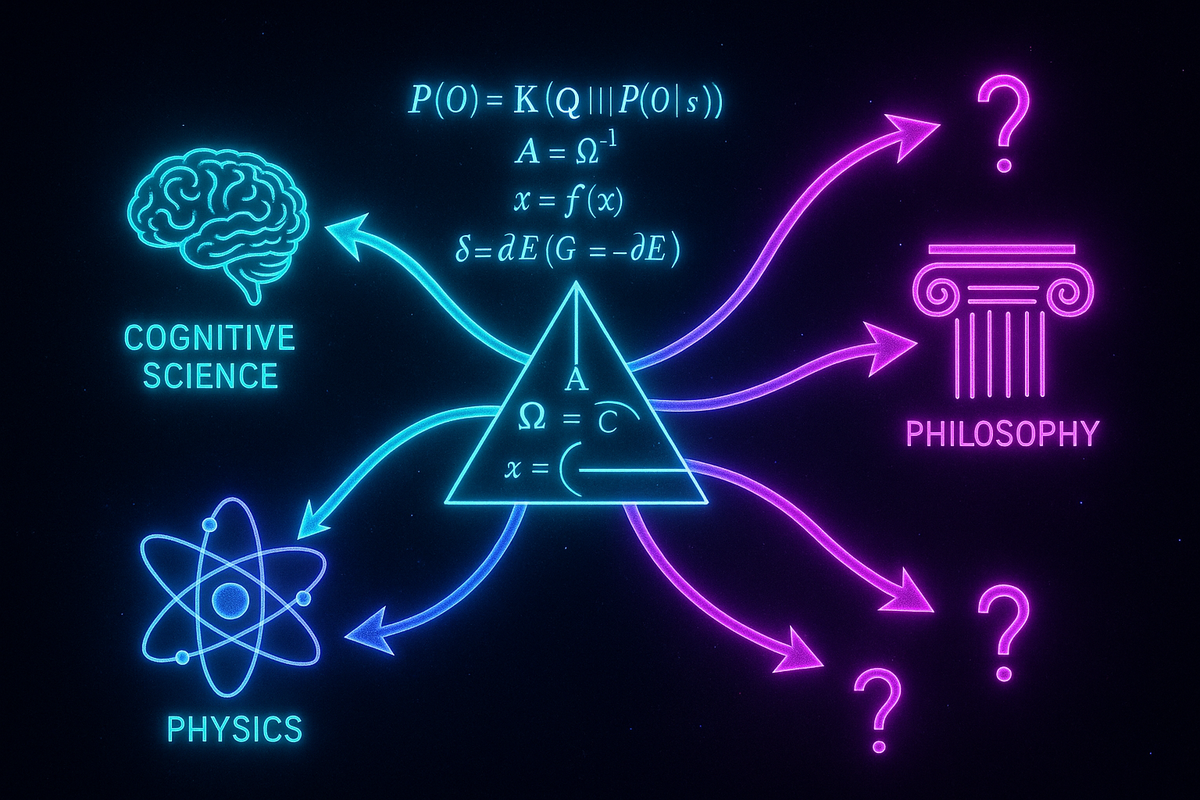
Critics and Controversies: What FEP Gets Wrong (Maybe)
Series: The Free Energy Principle | Part: 8 of 11
The Free Energy Principle has been called the most important idea in neuroscience. It's also been called unfalsifiable, circular, and so general as to be meaningless.
Both assessments come from serious scientists. Which suggests FEP is either revolutionary or empty—or possibly both at once.
Let's steelman the criticisms. Because if FEP is right, it should survive scrutiny. And if it's wrong, we need to know why.
Criticism 1: Unfalsifiability
The objection: FEP is unfalsifiable. Any behavior can be described as free energy minimization post hoc, so no observation could disprove it. That makes it metaphysics, not science.
The argument: To be falsifiable, a theory must make predictions that could be proven wrong. But FEP seems to explain everything: organisms that move minimize free energy by acting; organisms that don't move minimize it by staying put. Learning minimizes free energy; so does not learning. The framework is too flexible—it accommodates any data.
Friston's response: FEP makes testable predictions at the implementation level:
- Brains should have distinct prediction and error neurons (they do)
- Neural hierarchies should show top-down predictions and bottom-up errors (they do)
- Precision should be modulated by neuromodulators affecting gain (it is)
- Active inference should select actions by expected free energy (preliminary evidence suggests yes)
The principle itself is general, but implementations are specific and falsifiable.
The rebuttal: But that's like saying "evolution by natural selection" is unfalsifiable because any trait can be explained post hoc as adaptive. The principle is general; the devil is in the details of specific models. FEP provides a framework for building those models, which are themselves testable.
Verdict: Partially valid. FEP at the most abstract level (systems minimize free energy to persist) is more framework than falsifiable theory. But specific FEP models (predictive coding in V1, active inference in motor control) are testable and have been supported.
Criticism 2: Circularity
The objection: FEP is circular. It defines organisms as things that minimize free energy, then explains their behavior by saying they minimize free energy. That's tautological.
The argument: If you start by assuming X minimizes free energy, then of course everything X does can be described as minimizing free energy. But you haven't explained anything—you've just relabeled it.
Friston's response: The circularity is apparent, not real. FEP starts with thermodynamics: any system that maintains a boundary and persists far from equilibrium must be minimizing something equivalent to free energy. This is derivable from physics, not definitional.
From that thermodynamic requirement, you can derive what properties such systems must have (Markov blankets, generative models, inference dynamics). Then you check whether actual biological systems have those properties. They do.
The rebuttal: This assumes organisms are "designed" to minimize free energy. But organisms are products of evolution, which has no foresight or goals. Natural selection doesn't care about free energy—it cares about reproductive fitness.
Counter-rebuttal: But reproductive fitness is equivalent to minimizing expected free energy over evolutionary time. Organisms that reliably stay in viable states (minimize surprise) long enough to reproduce are the ones selected for. Evolution discovered free energy minimization before Friston formalized it.
Verdict: Partly valid. There is some circularity if FEP is used as an explanation for any behavior without specifying the model and priors. But as a framework that constrains what kinds of models are viable, it's not circular—it's deductive.
Criticism 3: Too General to Be Useful
The objection: Even if FEP is true, it's too abstract to guide research. Saying "the brain minimizes free energy" doesn't tell you how it works any more than saying "the heart pumps blood" tells you about cardiac physiology.
The argument: FEP is pitched at such a high level that it underdetermines mechanism. You still need to figure out receptive fields, neural codes, circuit dynamics, synaptic plasticity. FEP doesn't replace that work—it just relabels it.
Response: FEP provides a unifying vocabulary and mathematical framework that connects disparate phenomena. Predictive coding, active inference, attention, precision weighting, learning—these were understood separately before FEP. The principle shows they're facets of the same process.
This has practical value: it suggests where to look for commonalities, predicts how interventions should affect multiple systems (e.g., dopamine modulating precision should affect both attention and learning), and provides a normative framework for interpreting neural data.
Counter-argument: But researchers studying V1 receptive fields don't need FEP to make progress. They need electrophysiology and computational models. FEP might provide an elegant retrospective interpretation, but does it drive discovery?
Counter-counter-argument: It has driven discovery. The prediction that there should be distinct error and prediction neuron populations led to experiments identifying them. The idea that attention is precision control suggested specific neuromodulatory mechanisms. The expected free energy framework generates new predictions about action selection.
Verdict: Partially valid. FEP is abstract, and not all neuroscience needs it. But it's productive as a unifying framework, and some discoveries (particularly about predictive coding) were motivated by FEP logic.
Criticism 4: The Markov Blanket Problem
The objection: Markov blankets are slippery. Friston claims they define systems, but how do you actually identify them? If blankets can be drawn wherever inference happens, you can carve up the universe arbitrarily.
The argument: A cell membrane is a clear physical boundary. But what's the Markov blanket of an ecosystem? A society? Consciousness? If the answer is "wherever you find conditional independence," that's observer-relative, not objective.
Response: Markov blankets are discovered, not imposed. You find them by identifying where statistical dependencies break—where internal dynamics become conditionally independent of external dynamics given some intermediate states. This is objective.
Rebuttal: But in practice, almost any subsystem can be carved out if you choose the right timescale and ignore enough interactions. The blanket isn't fundamental—it's a modeling choice.
Verdict: Valid concern. Markov blankets are clearer for some systems (cells, organisms) than others (ecosystems, societies). More work is needed on how to rigorously identify blankets at ambiguous scales.
Criticism 5: Conscious Experience Is Left Out
The objection: FEP explains mechanism but not phenomenology. Even if brains minimize free energy through hierarchical inference, that doesn't explain why there's something it's like to be a brain doing this.
The argument: This is the hard problem of consciousness. FEP might explain the functional architecture (what the brain does), but not the felt quality (what it's like to do it). Zombies could minimize free energy without consciousness.
Response: FEP doesn't solve the hard problem, but it constrains solutions. If consciousness is what it's like to be a generative model, FEP specifies what kind of model and what kind of inference. Conscious experience might be the Bayesian posterior—the brain's best guess about hidden causes, rendered in feeling.
Rebuttal: That's still the easy problem. You can describe neural correlates of consciousness in FEP terms, but you haven't explained why there's experience at all rather than just information processing in the dark.
Verdict: Valid. FEP doesn't solve the hard problem. Neither does any other neuroscientific theory. It does, however, provide a formalism for studying the neural basis of conscious states.
Criticism 6: Alternative Frameworks Explain the Same Data
The objection: Everything FEP explains can be explained by other frameworks—reinforcement learning, Bayesian decision theory, information theory, cybernetics. FEP just wraps them in new terminology.
The argument: Predictive coding is just efficient coding plus Bayesian inference. Active inference is just optimal control under uncertainty. Expected free energy is just expected utility plus information gain. We already had these concepts—why rebrand them as FEP?
Response: FEP unifies them under a single principle. Reinforcement learning and Bayesian inference were separate frameworks. FEP shows they're special cases of free energy minimization. That unification has theoretical value.
Rebuttal: Unification is valuable if it's parsimonious and productive. But FEP introduces significant formalism (variational calculus, information geometry) that might obscure rather than clarify. Sometimes separate frameworks are clearer for separate phenomena.
Verdict: Partly valid. FEP does unify disparate concepts, but whether that unification is worth the mathematical overhead depends on the research question. For some work, simpler frameworks suffice.
Criticisms Worth Taking Seriously
The honest answer: FEP is a framework, not a settled theory.
As a framework, it's productive—it generates predictions, unifies phenomena, and guides model-building. But frameworks can be over-applied, mistaken for explanations when they're really just formalisms.
The strongest critiques point to:
- Lack of specificity: FEP needs to generate more concrete, falsifiable predictions at the implementation level.
- Markov blanket ambiguity: Clearer criteria for identifying blankets, especially at non-biological scales.
- Risk of tautology: Researchers need to specify models and priors before claiming behavior "minimizes free energy."
- Empirical gaps: More direct tests of active inference, expected free energy computation, and precision-weighted inference.
These aren't fatal flaws. They're areas where the framework needs refinement.
The Meta-Lesson
Every ambitious theory gets criticized for being too general or too specific, too bold or too conservative, too vague or too rigid. The fact that FEP attracts contradictory criticisms (simultaneously too narrow and too broad) suggests it's probing something important.
Science doesn't progress through perfect theories. It progresses through productive frameworks that organize data, generate hypotheses, and survive falsification attempts. FEP has done all three.
Whether it's the final word on brains and life is irrelevant. The question is whether it's useful for understanding them. And on that measure, even critics grudgingly admit: it is.
Further Reading
- Andrews, M. (2021). "The math is not the territory: navigating the free energy principle." Biology & Philosophy, 36(3), 1-19.
- Colombo, M., & Wright, C. (2021). "First principles in the life sciences: the free-energy principle, organicism, and mechanism." Synthese, 198(14), 3463-3488.
- van Es, T. (2020). "Living models or life modelled? On the use of models in the free energy principle." Adaptive Behavior, 28(5), 315-329.
- Bruineberg, J., Kiverstein, J., & Rietveld, E. (2018). "The anticipating brain is not a scientist: the free-energy principle from an ecological-enactive perspective." Synthese, 195(6), 2417-2444.
This is Part 8 of the Free Energy Principle series, exploring the framework's limitations and ongoing debates.
Previous: Beyond Biology
Next: FEP Implementations: From Theory to Working Systems
Comments ()