CrossFit Cults and Yoga Studios: Fitness as Ritual Container
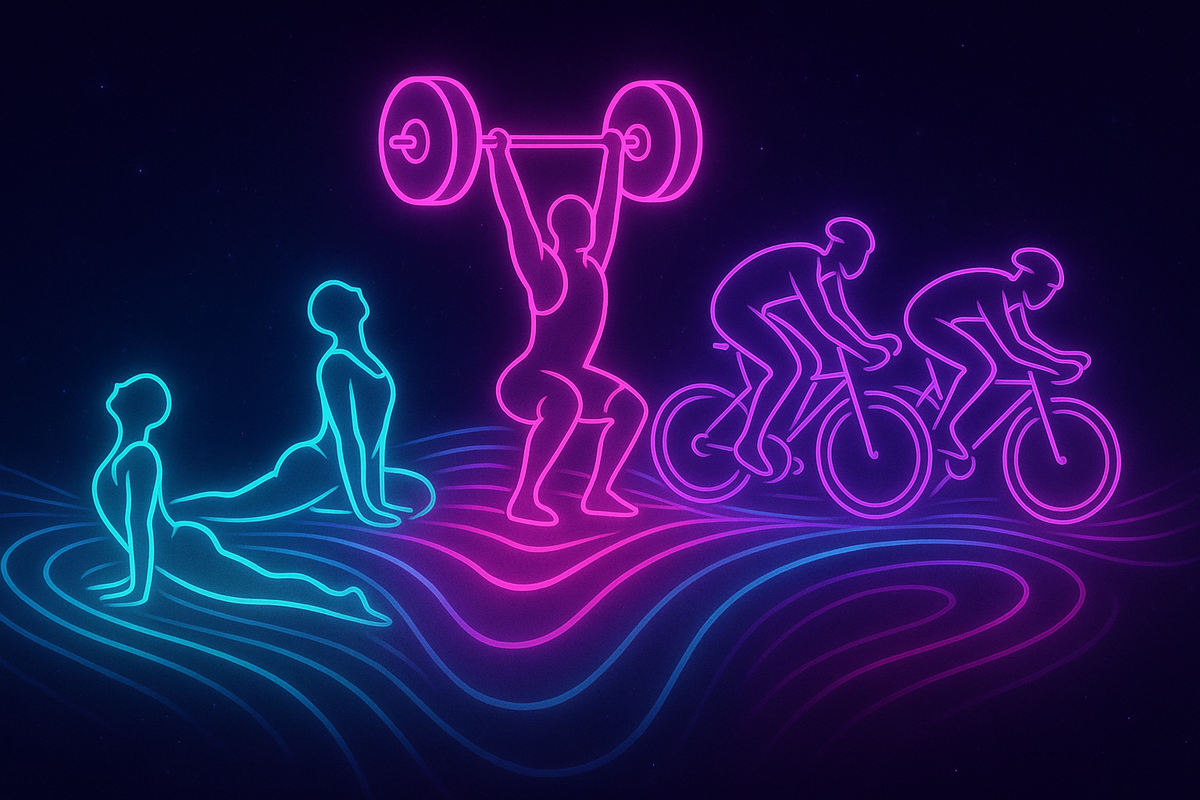
CrossFit boxes and yoga studios feel weirdly cult-like — and that's not an accident. They're functioning ritual containers, using entrainment, shared suffering, and synchronized movement to generate coherence.
CrossFit Cults and Yoga Studios: Fitness as Ritual Container
Series: Ritual Entrainment | Part: 7 of 11
"Why does my yoga studio feel like church?" she asked, half-joking but genuinely confused. She'd been attending the same 6 AM class for two years. Same instructor, many of the same faces, identical sequence of poses, consistent breathing cues. She wasn't religious, didn't believe in chakras, rolled her eyes at "namaste." But she never missed class. And when she did, she felt off for days.
Across town, a CrossFit box was finishing the WOD (workout of the day). Twenty people had just pushed through "Fran"—21 thrusters and pull-ups, then 15, then 9, as fast as possible. Now they lay on the floor, gasping, high-fiving, comparing times. The coach led them through a structured cool-down, then gathered them for announcements about the upcoming competition and next week's nutrition challenge.
These aren't just gyms. They're ritual containers—functioning systems for collective entrainment disguised as fitness. The workouts are real, but the transformation isn't just physical. People join for abs and PRs (personal records). They stay for something else entirely.
They stay for the coherence.
Why "Cult-Like" Is Technically Accurate
Critics call CrossFit a cult. Devotees bristle at the accusation. Both are missing the point: CrossFit is cult-like because it successfully implements ritual technology that traditional religions use. Not accidentally—structurally.
A cult (from Latin cultus, "care, cultivation") is just intensive collective practice. The pejorative modern sense conflates "cult" with "harmful high-control group." But structurally, the term is accurate: both CrossFit and problematic cults use synchronized collective practice to generate strong group bonding and identity formation.
What makes a group a harmful cult versus a beneficial ritual community is whether it:
- Allows free exit
- Avoids financial exploitation
- Maintains member autonomy
- Integrates with broader life
- Operates transparently
Most fitness communities pass these tests. But they absolutely leverage the same entrainment mechanisms that make cults powerful.
The Ritual Structure of Group Fitness
Walk into a group fitness class and you'll find all four elements of the universal ritual toolkit:
Coordinated movement. Everyone performs the same exercises simultaneously. In yoga, this is synchronized flow through poses. In CrossFit, simultaneous reps of barbell movements or running. In spin class, coordinated pedaling at called-out resistance levels. Mirror neurons activate, motor cortex entrains, individual movements synchronize.
Rhythmic structure. Music provides the beat (spin, Zumba, dance fitness). Breathing cues create rhythm (yoga, Pilates). Count-based reps impose temporal structure (CrossFit, boot camp). The rhythm couples nervous systems, creating temporal synchronization across participants.
Vocal synchronization. Instructors call cues; participants respond (sometimes verbally, always motorically). In some traditions, there's actual chanting (om in yoga, military-style call-and-response in boot camps). Even without explicit vocalization, coordinated breathing creates respiratory entrainment.
Shared consumption. Post-workout protein shakes, smoothie bars, coffee meet-ups. Not central to the practice, but present in successful fitness communities. Eating together after synchronized exertion creates metabolic alignment and extends the bonding window.
This isn't accident. Successful fitness formats have been selected for retention and enthusiasm. What retains members isn't just effectiveness—solo workouts can be effective. What creates loyalty is the ritual structure that generates collective coherent states.
CrossFit: Evangelical Intensity Through Suffering
CrossFit occupies the high-intensity end of fitness ritual. WODs are designed to push participants to voluntary failure—the point where you physically cannot continue. This is crucial.
Shared suffering creates exceptionally strong bonding. When you struggle through brutal physical challenges together, endorphin release combines with collective achievement to create powerful positive associations with the group.
Military training understands this: boot camp is deliberately designed to be difficult beyond pure functional necessity. The shared ordeal creates unit cohesion that individual training cannot match.
CrossFit boxes explicitly structure around this:
The WOD is announced. Everyone does the same workout on the same day. You can scale it, but the basic structure is shared. This creates common experience and comparable performance.
Workouts are timed or counted. Objective metrics allow comparison and competition, but crucially, everyone finishes. Fast or slow, scaled or Rx (as prescribed), you complete it. The last person finishing gets the loudest cheers.
Public performance. You do your WOD in front of others. They watch, they count your reps, they cheer. This creates accountability and witnesses—the group validates your suffering and achievement.
Leader-participant dynamic. The coach occupies the priest role—expert in the doctrine (movement patterns), guide through the ordeal, source of modification and encouragement. Authority is clear but earned through demonstrated mastery.
Progressive difficulty and initiation. Beginners start with fundamentals. More complex movements (muscle-ups, handstand walks) are unlocked through skill development. This creates levels and progression—like belt ranks in martial arts or degree systems in lodge traditions.
Community events beyond workouts. Competitions, social gatherings, nutrition challenges. The ritual extends beyond the immediate practice into lifestyle identity.
The result: extraordinarily high retention and member enthusiasm. People become CrossFitters, not just people who work out. The identity is central, the community is family, the practice is non-negotiable.
This is how religions work. CrossFit just replaced theology with thrusters.
Yoga: The Contemplative Path Through Movement
Yoga studios operate differently—more contemplative, less aggressive, but equally ritualistic.
Consistent sequence. Many traditions (especially Ashtanga, Bikram) use identical sequences every class. You're not showing up to see what the teacher chose today—you're performing the same liturgy. The predictability is the point. Repetition allows automation, freeing attention for internal awareness.
Sacred space markers. Studios are aesthetically distinct from ordinary space—specific lighting, altar-like arrangements, shoes removed at threshold, silence or soft music. These signal: you're entering different territory. Ordinary social rules don't apply.
Explicit breath-movement coordination. Vinyasa flow ties each movement to inhale or exhale. This forces respiratory entrainment to the sequence and to the group. Within minutes, breathing synchronizes across the room.
Minimized verbal instruction. Unlike CrossFit's constant coaching, yoga often uses silence or minimal cues once students know the sequence. This creates meditative quality—less thinking, more feeling, deeper proprioceptive awareness.
Ritual opening and closing. Classes begin with centering (often om chant, intention-setting) and end with savasana (corpse pose, final relaxation) and closing rituals. Clear boundaries mark ritual time-space.
Teacher as guide, not coach. Yoga instructors aren't drill sergeants. They're facilitating inner experience, not driving external performance. The authority is softer but still present—they hold the space, set the pace, determine the structure.
The intensity is lower than CrossFit, but sustainability is higher. People practice yoga for decades. The entrainment is gentler, allowing integration into daily life rather than weekend-warrior intensity.
Different ritual strategy, same underlying mechanism: synchronized movement, rhythmic breath, shared space, consistent structure, community identity.
SoulCycle and the Manufactured Transcendence
SoulCycle represents the explicit commercialization of fitness-as-ritual. They didn't stumble into ritual technology—they engineered it consciously.
Candlelit rooms. Dim lighting with focused spots creates sacred aesthetic. You can see the instructor (altar focus) but peripheral vision of other participants is reduced. This paradoxically enhances felt connection—you're synchronized without visual monitoring.
Curated playlists synchronized to intensity. Music builds through the class like a DJ set—warm-up, build, peak, cool-down. Song choices are deliberate: emotionally resonant tracks timed to maximum physical intensity create powerful association.
Choreographed movement. Not just pedaling—coordinated upper-body movements, synchronized gestures, moments where everyone does the same push-up or tap-back simultaneously. Pure motor entrainment.
Explicit language of transcendence. Instructors talk about "the ride" as journey, transformation, family, release. They frame the experience in quasi-spiritual terms without specific religious content. "Come as you are, leave transformed."
Community cultivation. Regular front-row riders, instructor followings, studio-specific culture. People become SoulCycle devotees, traveling to specific instructors, scheduling life around class times.
The criticism of SoulCycle is often about the cost ($35-40 per class in major cities) or the performative spirituality. But the criticism misses what they successfully achieved: industrial-scale production of collective effervescent states through fitness.
Traditional religions required elaborate infrastructure (cathedrals, trained clergy, centuries of institutional development) to reliably generate transcendent experiences. SoulCycle does it in 45-minute sessions with bikes, music, and good lighting.
That's not fake—it's engineered. And it works.
Why Fitness Ritual Succeeds Where Religion Declines
Secular culture dismantled religious infrastructure but didn't eliminate the need for collective coherent states. Fitness ritual succeeds because it provides the function without requiring belief in supernatural claims.
No metaphysical commitments required. You don't have to believe chakras are real to benefit from yoga. You don't have to accept any theology to do CrossFit. The practice works on your nervous system regardless of your ontological framework.
Measurable benefits beyond the ritual. You get stronger, more flexible, healthier. The physical transformation validates the practice in ways religious claims can't empirically demonstrate. The ritual benefits (community, meaning, transcendence) come alongside objective improvements.
Cultural compatibility. Fitness is high-status in secular culture. Investing time and money in physical optimization is valorized, not suspect. You can talk about your workout at work in ways you can't talk about church.
Accessible entry. Most cities have multiple studios, gyms, boxes within reach. Cost varies, but access is broader than traditional religious communities, especially for mobile, urban, secular populations.
Flexible intensity. You can attend drop-in classes without deep commitment, or structure your entire life around training. Traditional religion often requires binary commitment (member or not). Fitness allows gradation.
Identity without dogma. You can identify as a yogi or CrossFitter without subscribing to creeds. The identity comes from practice, not belief.
The result: fitness communities capture populations that explicitly reject traditional religion while still needing ritual, community, and collective meaning-making.
The Shadow Side: When Fitness Becomes Pathology
Like any powerful technology, fitness ritual can go pathological.
Exercise addiction. When missing a workout creates genuine distress beyond physical detraining, when injury doesn't prevent training, when social relationships suffer for training schedule—ritual has become compulsion. The coherence the practice provides becomes the only available source of meaning.
Orthorexia and body dysmorphia. When fitness communities reinforce extreme body ideals or rigid dietary dogmas, the health benefits invert. The community's expectations override individual wellbeing.
Financial exploitation. Some studios create dependency then maximize extraction—expensive memberships, required gear, pressure to attend workshops and retreats. The cult becomes cult in the pejorative sense.
Toxic hierarchy and abuse. When instructor-student power dynamics aren't bounded, abuse becomes possible—financial, emotional, sexual. The vulnerability that makes ritual powerful also creates exploitation risk.
Isolation from broader life. When the fitness community becomes your entire social world, exit becomes extremely costly. The ritual that was supposed to enhance life becomes a prison.
Healthy communities have guardrails: transparent pricing, multiple instructors, explicit ethics policies, integration with broader life, respect for rest and injury. Pathological communities exhibit high-control group characteristics: financial opacity, guru worship, all-or-nothing commitment demands, us-versus-them mentality.
The line isn't always clear. But awareness of the mechanism helps: when ritual generates dependence rather than autonomy, exploitation rather than empowerment, isolation rather than integration—it's crossed into dysfunction.
What Fitness Ritual Reveals About Human Needs
The explosive growth of boutique fitness—CrossFit, SoulCycle, yoga studios, F45, Orangetheory, Barry's Bootcamp—reveals something profound about late-modern secular culture.
We're not post-ritual. We're desperate for ritual.
The secular rationalist worldview assumed that once people understood religion was myth, they'd move on to purely rational individual existence. But humans don't work that way. We're not just rational agents maximizing utility. We're nervous systems that need regular entrainment with collectives to maintain coherence.
Strip away church and the need doesn't disappear—it finds new containers. Fitness, fandom, political movements, online communities. All of them attempting to fill the ritual void that secularization created.
Fitness succeeds where other substitutes often fail because it provides the complete package:
- Regular practice (sustainability)
- Physical space (embodiment)
- Collective synchronization (entrainment)
- Progressive structure (development)
- Community identity (belonging)
- Tangible benefits (validation)
It's not church with the serial numbers filed off. It's conscious or unconscious reinvention of the functional core of religious community without supernatural overhead.
The question isn't whether humans will seek collective ritual. They will. The question is what containers will emerge, and whether those containers will serve human flourishing or exploit human needs.
Fitness ritual at its best provides: community without dogma, transcendence without theology, transformation that's both felt and measured. At its worst: commodified meaning, manufactured dependency, expensive simulacra.
Understanding the mechanism—that these are entrainment technologies generating collective coherence—allows conscious choice rather than unconscious participation.
This is Part 7 of the Ritual Entrainment series, exploring how rhythmic practices synchronize nervous systems and generate collective meaning.
Previous: The Rave and the Revival: Electronic Music as Entrainment Technology
Next: Digital Rituals: Can Entrainment Work Without Bodies in the Same Room
Further Reading
- Dawson, M. C. (2017). "Crossfit: Fitness cult or reinventive institution?" International Review for the Sociology of Sport, 52(3), 361-379.
- Sassatelli, R. (2010). Fitness Culture: Gyms and the Commercialisation of Discipline and Fun. Palgrave Macmillan.
- Jain, A. (2014). Selling Yoga: From Counterculture to Pop Culture. Oxford University Press.
- Andreasson, J., & Johansson, T. (2014). "The fitness revolution: Historical transformations in the global gym and fitness culture." Sport Science Review, 23(3-4), 91-112.
- Crossley, N. (2006). "In the gym: Motives, meaning and moral careers." Body & Society, 12(3), 23-50.
Comments ()