Definite Integrals: Computing Exact Areas
You can estimate the area under a curve with rectangles—but a definite integral does it exactly, turning an infinite process into a single precise answer.
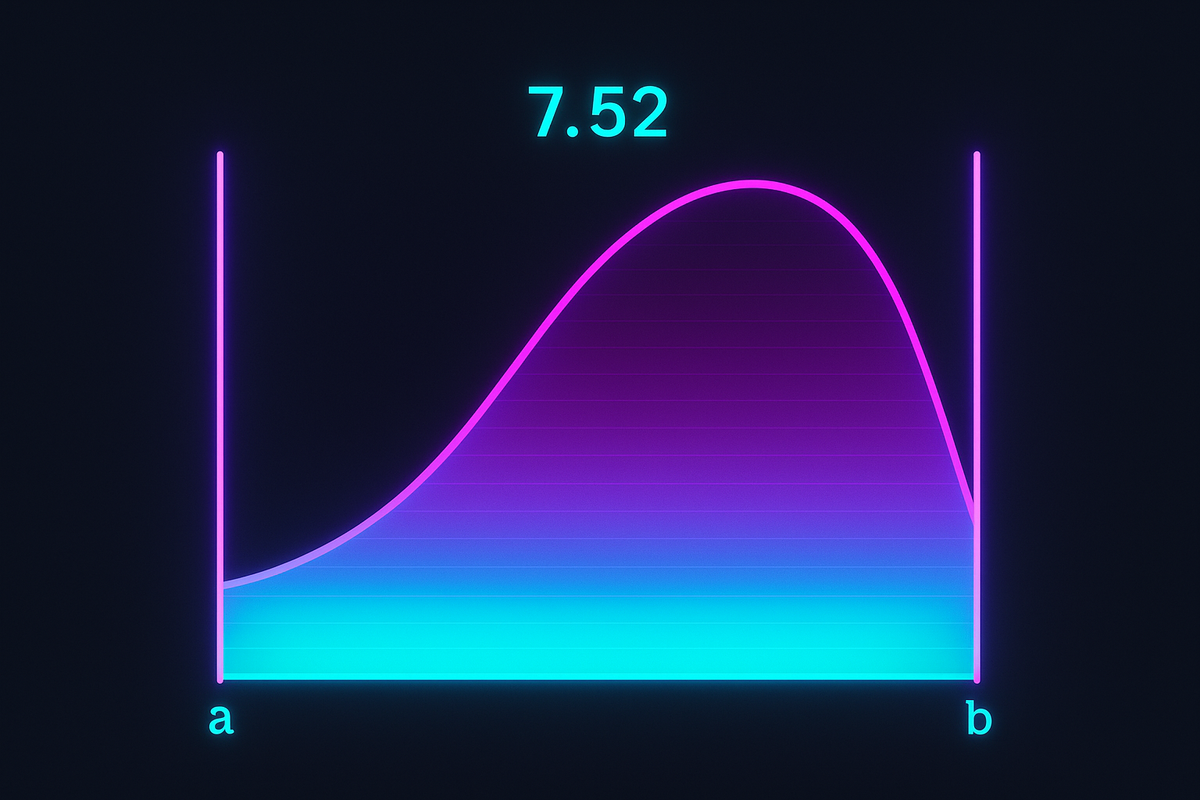
A definite integral gives you a number, not a function.
Where indefinite integrals answer "what function has this derivative?", definite integrals answer "what is the total accumulation between these bounds?"
The result is specific, concrete, computable. Not F(x) + C. Just a number.
The Definition
The definite integral from a to b is:
∫ₐᵇ f(x) dx
Two interpretations, both valid:
- Area: The signed area between f(x), the x-axis, and the vertical lines x = a and x = b.
- Accumulation: The total accumulation of f(x) over the interval [a, b].
The Fundamental Theorem connects this to antiderivatives:
∫ₐᵇ f(x) dx = F(b) - F(a)
where F'(x) = f(x).
Signed Area
The integral counts area with sign.
- Area above the x-axis contributes positive.
- Area below the x-axis contributes negative.
This is crucial. If you integrate sin(x) from 0 to 2π, you get zero — not because there's no area, but because the positive and negative regions cancel.
∫₀^(2π) sin(x) dx = [-cos(x)]₀^(2π) = (-cos(2π)) - (-cos(0)) = -1 - (-1) = 0
If you want total area regardless of sign, integrate |f(x)| instead:
∫₀^(2π) |sin(x)| dx = 4
Computing Definite Integrals
Step 1: Find an antiderivative F(x) of f(x).
Step 2: Evaluate at bounds: F(b) - F(a).
Step 3: The constant C cancels, so ignore it.
Example: ∫₁³ (2x + 1) dx
Antiderivative: F(x) = x² + x
Evaluate: F(3) - F(1) = (9 + 3) - (1 + 1) = 12 - 2 = 10.
That's the area under y = 2x + 1 from x = 1 to x = 3.
Properties of Definite Integrals
Linearity: ∫ₐᵇ [f(x) + g(x)] dx = ∫ₐᵇ f(x) dx + ∫ₐᵇ g(x) dx ∫ₐᵇ k·f(x) dx = k · ∫ₐᵇ f(x) dx
Additivity over intervals: ∫ₐᵇ f(x) dx + ∫ᵦᶜ f(x) dx = ∫ₐᶜ f(x) dx
Integrate in pieces, add results. This is how you handle functions that change behavior.
Reversing limits: ∫ₐᵇ f(x) dx = -∫ᵦᵃ f(x) dx
Swapping a and b negates the integral. Area traversed "backward" is negative.
Zero-width integral: ∫ₐᵃ f(x) dx = 0
No interval, no area.
Geometric Examples
Triangle: f(x) = x from 0 to 2.
∫₀² x dx = [x²/2]₀² = 4/2 - 0 = 2
Check: Triangle with base 2, height 2 has area ½ · 2 · 2 = 2. ✓
Rectangle: f(x) = 3 from 1 to 5.
∫₁⁵ 3 dx = [3x]₁⁵ = 15 - 3 = 12
Check: Rectangle with width 4, height 3 has area 4 · 3 = 12. ✓
Parabola: f(x) = x² from 0 to 1.
∫₀¹ x² dx = [x³/3]₀¹ = 1/3 - 0 = 1/3
No simple geometric check, but calculus handles it effortlessly.
Average Value
The average value of f(x) on [a, b] is:
f_avg = (1/(b-a)) · ∫ₐᵇ f(x) dx
This is the height of a rectangle with the same area as the region under f.
Example: Average value of x² on [0, 3].
∫₀³ x² dx = [x³/3]₀³ = 9
f_avg = (1/3) · 9 = 3
On [0, 3], the average value of x² is 3.
When Antiderivatives Are Hard
Not every definite integral requires finding F(x) explicitly.
Numerical methods: Simpson's rule, trapezoidal rule, and computer algorithms can approximate ∫ₐᵇ f(x) dx to any desired precision.
Symmetry: If f is odd and the interval is symmetric about 0, the integral is 0.
∫₋₂² x³ dx = 0 (x³ is odd)
Comparison: If you can bound f(x), you can bound its integral.
If 0 ≤ f(x) ≤ g(x) on [a, b], then: 0 ≤ ∫ₐᵇ f(x) dx ≤ ∫ₐᵇ g(x) dx
The Mean Value Theorem for Integrals
If f is continuous on [a, b], there exists some c in (a, b) such that:
f(c) = (1/(b-a)) · ∫ₐᵇ f(x) dx
The function achieves its average value somewhere in the interval.
Geometrically: there's a horizontal line at height f(c) such that the rectangle it forms has the same area as the region under the curve.
Definite Integrals as Functions of Bounds
Define:
A(x) = ∫ₐˣ f(t) dt
This is a function of x — the accumulated area from a to x.
By the Fundamental Theorem (Part 1):
A'(x) = f(x)
The rate at which area accumulates equals the function value.
This perspective is key for variable limits and differential equations.
Substitution with Definite Integrals
When you substitute u = g(x), the bounds change too.
∫ₐᵇ f(g(x)) · g'(x) dx = ∫_{g(a)}^{g(b)} f(u) du
Example: ∫₀¹ 2x · e^(x²) dx
Let u = x². Then du = 2x dx. When x = 0: u = 0. When x = 1: u = 1.
∫₀¹ 2x · e^(x²) dx = ∫₀¹ eᵘ du = [eᵘ]₀¹ = e - 1
The bounds transform with the substitution. You never go back to x.
Common Pitfalls
Forgetting sign: ∫₋₁¹ x³ dx = 0, not some positive value.
Odd functions integrate to zero over symmetric intervals.
Ignoring where f is negative: ∫₀^(2π) sin(x) dx = 0, but total area is 4.
For total unsigned area, integrate |f(x)|.
Substitution bounds: After substitution, use new bounds. Don't substitute u back to x and then use old bounds.
Physical Applications
Distance from velocity: If v(t) is velocity, then ∫ₜ₁^(t₂) v(t) dt is displacement from t₁ to t₂.
Work from force: If F(x) is force as a function of position, then ∫ₐᵇ F(x) dx is work done.
Total charge from current: If I(t) is current, then ∫₀ᵀ I(t) dt is total charge transferred.
The integral of a rate equals the total change. This is the physical meaning of the Fundamental Theorem.
Further Reading
- Thomas, G. & Finney, R. Calculus and Analytic Geometry. Excellent worked examples.
- Apostol, T. Calculus, Vol. 1. Rigorous treatment.
- MIT OpenCourseWare 18.01 — Free calculus lectures with problems.
This is Part 4 of the Integrals series. Next: "U-Substitution" — the most common integration technique.
Part 4 of the Calculus Integrals series.
Previous: Indefinite Integrals: Finding Antiderivatives Next: U-Substitution: The Chain Rule in Reverse
Comments ()