What Is Delta G? The Sign That Decides Everything
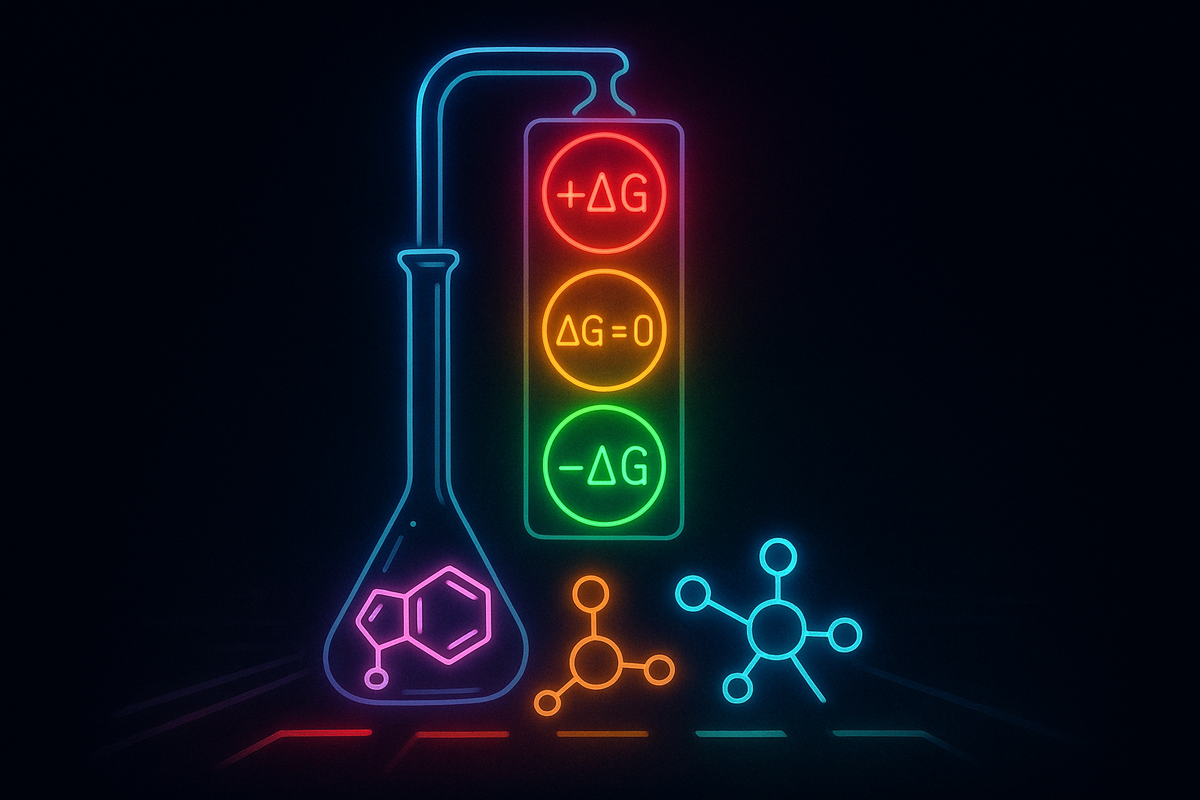
One sign decides whether a reaction happens: negative ΔG drives processes forward spontaneously; positive ΔG requires energy input. This thermodynamic traffic light governs everything from metabolism to industrial chemistry.
What Is Delta G? The Sign That Decides Everything
In chemistry, most numbers are just numbers. Concentrations. Temperatures. Rate constants. They describe the system but don't tell you what happens next.
Delta G is different. The sign of ΔG decides what happens. Negative: reaction proceeds. Positive: reaction doesn't proceed. Zero: equilibrium.
No other quantity has this binary power. ΔG is the thermodynamic traffic light.
The Three Verdicts
ΔG < 0: Spontaneous (Exergonic)
The reaction can proceed forward without external energy input. Products are thermodynamically more stable than reactants. The system "wants" to go this direction.
Examples: - Combustion (burning fuel) - Rusting (iron + oxygen → rust) - ATP hydrolysis in cells - Ice melting above 0°C
ΔG > 0: Non-spontaneous (Endergonic)
The reaction cannot proceed forward without external energy input. Reactants are thermodynamically more stable than products. The system "wants" to stay put or go backward.
Examples: - Photosynthesis (requires sunlight) - Protein synthesis (requires ATP) - Charging a battery - Ice melting below 0°C (doesn't happen spontaneously)
ΔG = 0: Equilibrium
No net change. Forward and reverse reactions are balanced. The system has found its thermodynamic resting point.
Examples: - Ice/water mixture at exactly 0°C - Saturated solution (dissolving = crystallizing) - Any reversible reaction at its equilibrium point
The pebble: ΔG is a one-bit answer to the question "will this happen?" Negative is yes. Positive is no. Zero is stalemate.
What ΔG Actually Measures
ΔG measures the maximum useful work a reaction can perform at constant temperature and pressure.
When ΔG = -100 kJ/mol, the reaction can theoretically do 100 kJ of useful work per mole. This is the energy "freed up" by the reaction—hence "free energy."
When ΔG = +100 kJ/mol, you need to supply 100 kJ of work per mole to make the reaction go.
In practice, you never capture all the free energy as work. Some is lost to inefficiency. But ΔG sets the ceiling.
The Magnitude Matters
The sign tells you direction. The magnitude tells you strength.
Small |ΔG| (close to zero): - Reaction is easily reversible - Equilibrium lies somewhere in the middle - Small changes in conditions flip the direction
Large |ΔG| (far from zero): - Reaction is essentially irreversible - Equilibrium lies far toward products (if ΔG << 0) or reactants (if ΔG >> 0) - Hard to reverse without major energy input
Typical magnitudes in biochemistry: - ATP hydrolysis: ΔG ≈ -30 kJ/mol (moderately favorable) - Glucose oxidation: ΔG ≈ -2870 kJ/mol (extremely favorable) - Ion gradient formation: ΔG ≈ +10-20 kJ/mol (unfavorable but achievable via coupling)
The pebble: ΔG is not just yes/no—it's how emphatic the yes or no is. The bigger the number, the harder to argue with.
Standard ΔG° vs Actual ΔG
A crucial distinction that trips up students:
ΔG° is the standard free energy change. It applies at: - 25°C (298 K) - 1 atm pressure - 1 M concentration for all species
ΔG is the actual free energy change under your conditions.
They're related by:
ΔG = ΔG° + RT ln Q
Where Q is the reaction quotient (actual concentrations/pressures).
This means: - A reaction with ΔG° > 0 can still proceed if Q is small enough - A reaction with ΔG° < 0 can be stopped if Q is large enough
The standard value is a reference point. The actual value decides what happens.
ΔG and Equilibrium
At equilibrium, ΔG = 0 and Q = K (equilibrium constant). Substituting:
0 = ΔG° + RT ln K
ΔG° = -RT ln K
This is one of chemistry's most powerful equations. It connects: - Thermodynamics (ΔG°) - Equilibrium (K) - Temperature (T)
Rearranged:
K = e^(-ΔG°/RT)
Large negative ΔG° → large K → products dominate at equilibrium Large positive ΔG° → small K → reactants dominate at equilibrium
At 298 K: - ΔG° = -10 kJ/mol → K ≈ 57 - ΔG° = -30 kJ/mol → K ≈ 180,000 - ΔG° = -50 kJ/mol → K ≈ 500 million
The pebble: Every factor of -5.7 kJ/mol in ΔG° multiplies K by 10. That's the exchange rate between energy and equilibrium.
The Reaction Quotient Q
Q measures where you are relative to equilibrium:
Q = [products]/[reactants] (with appropriate exponents)
- Q < K: System is product-poor, will shift right, ΔG < 0 - Q > K: System is product-rich, will shift left, ΔG > 0 - Q = K: System is at equilibrium, ΔG = 0
The equation ΔG = ΔG° + RT ln Q says: your current position (Q) relative to standard (where Q = 1 by definition) determines ΔG.
Common Misconceptions
"Spontaneous means fast"
No. Spontaneous means thermodynamically favorable. Diamonds are thermodynamically unstable (ΔG > 0 for diamond → graphite), but the rate is essentially zero. Kinetics and thermodynamics are separate.
"Endothermic reactions can't be spontaneous"
Wrong. If ΔS is positive enough, TΔS can overcome positive ΔH. Melting ice above 0°C is endothermic (absorbs heat) but spontaneous.
"ΔG° tells you if a reaction happens"
Not quite. ΔG° tells you about standard conditions. The actual ΔG (which depends on concentrations) determines spontaneity. A reaction with positive ΔG° can still proceed if concentrations are right.
"Equilibrium means nothing happens"
At equilibrium, forward and reverse reactions occur at equal rates. There's dynamic activity, but no net change. The system isn't dead—it's balanced.
ΔG in Biology
Cells are ΔG management systems.
Favorable reactions (ΔG < 0) are harnessed to drive unfavorable ones (ΔG > 0). The currency is ATP, with ΔG ≈ -30.5 kJ/mol for hydrolysis.
Protein synthesis has ΔG > 0 (non-spontaneous). But coupled to ATP and GTP hydrolysis, the overall process has ΔG < 0.
Ion pumps push ions against concentration gradients (ΔG > 0). Coupled to ATP hydrolysis, they proceed.
The pebble: Biology doesn't violate thermodynamics—it does thermodynamic accounting. Every unfavorable reaction is paid for by a favorable one.
ΔG in Electrochemistry
For electrochemical cells:
ΔG = -nFE
Where: - n = number of electrons transferred - F = Faraday constant (96,485 C/mol) - E = cell potential (voltage)
Positive voltage → negative ΔG → spontaneous (galvanic cell, produces electricity) Negative voltage → positive ΔG → non-spontaneous (electrolytic cell, requires electricity)
Batteries discharge when ΔG < 0, storing that free energy as electrical work. Recharging reverses the reaction, requiring energy input.
Temperature Dependence
From ΔG = ΔH - TΔS, we see ΔG depends on temperature.
If ΔS > 0: Higher T makes ΔG more negative (more spontaneous) If ΔS < 0: Higher T makes ΔG more positive (less spontaneous)
This is why some reactions that don't proceed at room temperature become spontaneous when heated—the entropy term grows.
The temperature where ΔG = 0 (equilibrium, phase transition) is T = ΔH/ΔS.
Reading a ΔG Table
Standard free energies of formation (ΔG°f) are tabulated for pure substances at 25°C.
By convention: ΔG°f = 0 for elements in their standard states (O₂ gas, C graphite, Fe metal).
For a reaction: ΔG°rxn = Σ ΔG°f(products) - Σ ΔG°f(reactants)
This lets you predict spontaneity from tables, without calorimetry.
ΔG as Landscape
Imagine a free energy landscape—a surface where height represents G.
- Reactants and products are valleys - Transition states are mountain passes - ΔG is the height difference between valleys - Activation energy is the height of the pass
ΔG tells you which valley is lower. The activation energy tells you how hard it is to get there. Catalysts lower the pass without changing the valleys.
The pebble: Thermodynamics (ΔG) determines the destination. Kinetics (activation energy) determines the route.
Why ΔG Is King
Other thermodynamic quantities describe the system. ΔG decides its fate.
- ΔH tells you about heat exchange - ΔS tells you about disorder - ΔG tells you what actually happens
At constant T and P—the conditions of most chemistry—ΔG is the master variable. Minimize it, and you've found where the system settles.
Further Reading
- Atkins, P. & de Paula, J. (2014). Physical Chemistry. Oxford University Press. - Berg, J. M., Tymoczko, J. L., & Stryer, L. (2015). Biochemistry. W. H. Freeman.
This is Part 3 of the Gibbs Free Energy series. Next: "[Spontaneous Reactions: When ΔG Goes Negative](/spontaneous-reactions-gibbs/)"


Comments ()