Detecting Life on Other Worlds: Assembly Theory's Cosmic Implications
What if we could detect life anywhere in the cosmos without knowing what it's made of? Assembly theory offers exactly that: a molecule's assembly index — how hard it was to build — may be life's universal fingerprint.
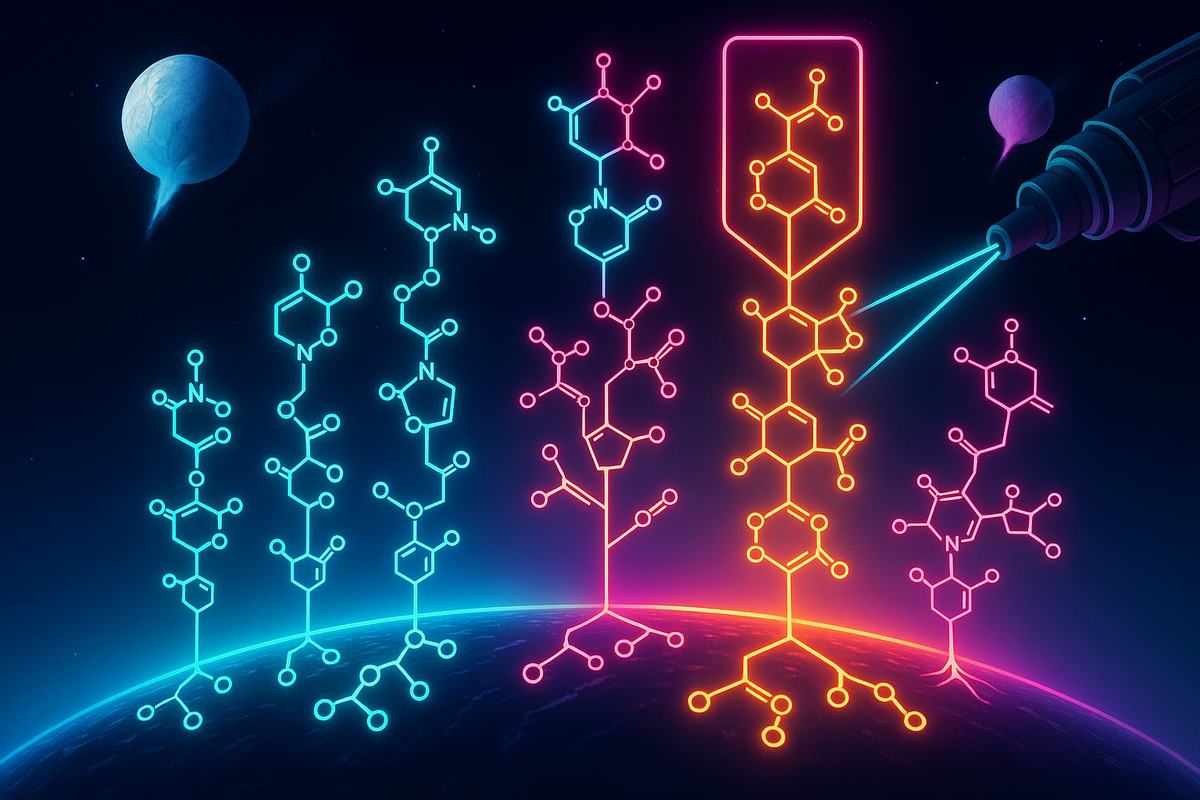
Detecting Life on Other Worlds: Assembly Theory's Cosmic Implications
Series: Assembly Theory | Part: 7 of 9
The Viking landers touched down on Mars in 1976 with a simple mission: find life. They carried sophisticated instruments designed to detect metabolic signatures—feeding bacteria radioactive carbon-14, watching for labeled gas production. The results were ambiguous. Positive at first, then contradictory. Nearly fifty years later, scientists still debate what Viking detected. The problem wasn't the instruments. The problem was that we didn't have a universal definition of what life actually is.
Assembly theory offers something radical: a way to detect life anywhere in the universe without knowing what form it takes. No assumptions about DNA, metabolism, or even carbon chemistry. Just one simple question: how hard was this object to make?
If the assembly index is high enough, something must have built it. Something alive.
The Biosignature Problem
Traditional approaches to detecting life look for familiar signatures. Oxygen in an atmosphere. Phosphine on Venus. Organic molecules in a meteorite. Each approach makes assumptions about what life does or what it's made of.
This works if alien life resembles Earth life. But what if it doesn't?
Sara Seager at MIT catalogued thousands of potential biosignature molecules beyond the standard oxygen-methane combo. William Bains explored "weird life" scenarios—silicon-based, ammonia-solvent, radiation-eating. The more we think about biochemical possibility space, the less confident we become that we'd recognize life when we see it.
Assembly theory sidesteps this entire problem. It doesn't care what life is made of. It cares about what life does: generate complex objects that couldn't exist otherwise.
A molecule with assembly index 15 didn't form by chance. Geochemistry tops out around AI 4-6. Biology begins where geology ends—somewhere around AI 15, where random processes become statistically impossible as explanations.
Lee Cronin puts it starkly: "Assembly theory gives us a quantitative signature of the difference between living and non-living matter that doesn't depend on our parochial Earth-based assumptions."
What Assembly Index Measures in Space
Imagine a mass spectrometer on a rover. It samples dust, ice, atmospheric particles. For each molecule detected, it doesn't just identify the chemical formula—it computes how many steps are required to build that molecule from available precursors.
Simple molecules: Water (H₂O), methane (CH₄), carbon dioxide (CO₂)—these form through basic chemistry. Low assembly indices. Expected anywhere chemistry happens.
Moderately complex molecules: Amino acids, simple sugars, aromatic hydrocarbons—these can form abiotically in certain conditions. Assembly indices in the 5-10 range. Interesting but not conclusive.
Highly complex molecules: Long-chain polymers with specific sequences, molecules with multiple chiral centers all oriented the same way, compounds requiring dozens of precise synthesis steps—these hit assembly indices of 15 or higher. This is the signature of selection. Something chose these configurations over the astronomically larger space of chemical possibilities.
Cronin's team demonstrated this principle with mass spectrometry data from Earth samples. Abiotic processes produced molecules clustering below AI 10. Biological samples showed clear populations at AI 15 and above, extending to AI 30+ for complex metabolites.
The distribution itself is diagnostic. Not just one high-AI molecule—that could be a fluke—but a population of molecules all exceeding the abiotic threshold. That's life's signature: persistent production of the improbable.
Beyond Molecules: Object-Level Detection
But assembly theory doesn't stop at molecules. The framework scales to any object with discernible structure.
Consider a hypothetical alien artifact—a pyramid on Mars, a geometric pattern in Titan's methane lakes, an unexplained radio structure. Assembly theory asks: what's the minimum number of assembly steps to produce this?
A rock formation might look striking but have low assembly index—erosion and fracture patterns can produce apparently organized structures through simple iterative processes. A genuine artifact would show high assembly index: multiple distinct materials, precise interfaces, structural elements serving non-thermodynamic functions.
Sara Walker emphasizes this point: "Assembly theory works for anything you can describe as composed of parts arranged in a particular way. DNA, circuit boards, cave paintings—the question is always the same: how many steps to build this?"
This becomes crucial for detecting life we can't sample chemically. Imagine detecting structures on Europa's surface through telescope imagery. Can't touch it, can't mass-spec it. But you can analyze structural complexity. If those patterns require 20+ distinct construction steps, something is building them. Something that persists through time, copying its methods.
The Threshold Question: Where Does Life Begin?
Assembly theory proposes AI ≥ 15 as the threshold where biology becomes the most parsimonious explanation. This isn't arbitrary—it's derived from combinatorial explosion.
The number of possible molecules of a given mass grows exponentially with assembly index. By AI 15, you're selecting one configuration from trillions of possibilities. No known abiotic process maintains that kind of selectivity without copying mechanisms.
But the threshold has nuance.
Context matters. A molecule with AI 12 found in isolation might be abiotic. The same molecule appearing in thousands of copies, all identical, suggests something is reproducing that structure. Assembly theory's real power isn't a single number—it's the distribution of assembly indices in a sample set.
Planetary environment matters. A reducing atmosphere might push abiotic complexity higher than an oxidizing one. A world with liquid methane versus liquid water changes what chemistry can do spontaneously.
The threshold is a heuristic, not a law. The profound insight is that some threshold exists—some point where "chance" stops being credible and "selection + replication" becomes necessary.
Marshall et al. (2021) demonstrated this empirically: examining organic samples from carbonaceous chondrites (definitely abiotic) versus bacterial cultures (definitely biotic), the cutoff between distributions appeared consistently around AI 15. Meteorites: nothing above AI 10. Bacteria: abundant signals at AI 15-30.
The SETI Application: Technosignatures as High-Assembly Objects
SETI traditionally looks for narrow-band radio signals—artificial-seeming patterns in noise. But assembly theory suggests a broader criterion.
Any technosignature is, by definition, a high-assembly object. A radio transmitter requires thousands of assembly steps: refined metals, semiconductor junctions, resonant cavities, power supplies. Detecting the byproducts of such manufacturing—atmospheric pollutants with AI 20+, artificial isotope ratios in waste products—might be easier than catching a deliberate broadcast.
Adam Frank and collaborators explored this in the context of planetary atmospheres. Industrial civilizations produce chemicals that don't occur naturally: chlorofluorocarbons, nitrogen trifluoride, synthetic polymers. These molecules have high assembly indices and no abiotic pathway. Detecting them in an exoplanet's spectrum would be evidence not just of life, but of technological life.
Assembly theory makes this rigorous. It's not "this seems artificial." It's "this object has AI 50+, requiring coordinated construction across dozens of stages, sustained over time. Nothing without memory and copying mechanisms does this."
The Great Filter becomes searchable. We're not looking for radio signals. We're looking for the thermodynamic signature of systems that build improbable things reliably.
Enceladus and Europa: Where to Look First
NASA's upcoming missions to Enceladus and Europa carry instruments designed for molecular analysis. Assembly theory gives them a new interpretive framework.
Enceladus shoots plumes of subsurface ocean water into space. Cassini already detected complex organics in those plumes—amino acids, hydrocarbon chains. The question: do these organics show the assembly index distribution characteristic of life?
A mass spectrometer optimized for assembly analysis would compare the AI distribution in plume samples to known abiotic and biotic distributions. Finding a population of molecules at AI 15+ would be transformative. Not definitive—contamination, instrument artifacts, unknown abiotic pathways must be ruled out—but transformative.
Europa Clipper and JUICE will sample Europa's surface and potential plumes. Ice with embedded organics. The same question applies: what's the assembly index distribution?
Chris McKay has long argued that life detection requires multiple independent lines of evidence. Assembly theory provides one such line—a quantitative, assumption-minimal metric that complements traditional biosignature searches.
Finding high-AI molecules doesn't tell you what the life is. It just tells you something is there, doing the work of fighting entropy through selection and replication.
The Venus Question: Life in the Clouds?
The phosphine detection on Venus (disputed, controversial, possibly retracted) sparked intense debate. Phosphine on Earth is primarily biogenic—produced by anaerobic bacteria. But Venus's surface is hellish. If the signal is real, life would have to exist in the cloud layers, where temperatures and pressures are Earthlike.
Assembly theory reframes the question. Forget phosphine's origin on Earth. What's the assembly index of phosphine in Venusian conditions? Can high-temperature sulfuric acid chemistry produce it abiotically with the observed abundances?
If phosphine requires AI 12+ in Venus's atmosphere and no known abiotic process achieves that, the life hypothesis gains weight. If there's a plausible abiotic pathway at AI 6, it's less compelling.
Sara Seager's team is developing missions to sample Venusian clouds directly. With assembly-aware analysis, you'd look not just for specific molecules but for the signature distribution. Are there molecules clustering above the abiotic threshold? Is the distribution consistent with ongoing production by replicating systems?
Venus becomes a test case: can assembly theory distinguish ambiguous biosignatures from false positives?
False Positives and Edge Cases
No framework is perfect. Assembly theory faces challenges.
Crystallization can produce high-copy-number objects with specific structures. Salt crystals, snowflakes, mineral formations—these are selected by thermodynamic constraints. Do they have high assembly index?
No. Crystals are low-assembly despite appearing complex. The pattern repeats because the energetic landscape has a deep minimum, not because something is copying information. Assembly index measures the number of distinct construction steps, not mere repetition.
Abiotic polymers might pose trickier problems. Formamide-based chemistry can produce long-chain molecules through iterative condensation reactions. If these chains reach sufficient length, could they hit AI 15 without biology?
Possibly. This is where distribution matters. A few long-chain molecules in a soup of shorter ones suggests abiotic elongation. A narrow distribution of molecules all at AI 18-22, present in abundance, suggests selection for that specific range. Biology doesn't just make complex things—it makes the same complex things repeatedly.
Cronin acknowledges this: "The threshold isn't absolute. It's probabilistic. We're making an inference: given this assembly index distribution, what's the most likely explanation? Life becomes the best explanation when alternatives require increasingly contrived assumptions."
Connecting to Coherence and the Free Energy Principle
Assembly theory and the Free Energy Principle converge on alien life detection.
Friston's framework defines life as anything maintaining a Markov blanket—a statistical boundary between internal states and external chaos. Life minimizes surprise by persisting in improbable states.
Assembly theory operationalizes this. High-assembly objects are improbable. Maintaining them requires work. That work requires a system with memory (to encode construction steps) and energy throughput (to execute them). Exactly what the Free Energy Principle describes.
A high-AI molecule detected on Enceladus is evidence of a system maintaining an improbable configuration—minimizing free energy in molecular configuration space. You've detected a Markov blanket, even if you can't see the organism inside it.
In AToM terms, this is coherence across time. Life is what keeps doing the improbable thing, reliably. Assembly index is the trace it leaves—complexity that shouldn't persist but does.
M = C / T: Meaning equals coherence over time. An alien artifact with AI 40 has meaning—it's the product of a system coherent enough to sustain multi-step construction across temporal gaps. Random processes don't have that kind of memory. Life does.
Practical Implementation: The Assembly Spectrometer
Cronin's team is building mass spectrometers optimized for assembly index computation. Traditional instruments identify molecules. Assembly-aware instruments would compute construction pathways, estimate minimum assembly steps, and generate distribution statistics.
This isn't science fiction. The algorithms exist. The challenge is computational—exploring combinatorial spaces of molecular synthesis is hard—but tractable for molecules up to ~1000 Da, covering most biosignature candidates.
A planetary rover with this capability could autonomously flag samples with anomalous AI distributions. No need to transmit full spectra to Earth for human interpretation. The instrument itself knows what "life-like complexity" looks like.
Future missions might carry assembly-focused instruments:
- Mars Sample Return: analyze returned samples for AI distribution
- Dragonfly (Titan): search for high-AI organics in lakes and dunes
- Enceladus Orbilander: direct plume sampling with assembly analysis
- Exoplanet spectroscopy: look for atmospheric molecules with biosignature AI
Each mission becomes a test of the framework. Does the threshold hold across different chemistries? Does the distribution signature generalize? Can we distinguish contamination from genuine alien biosignatures?
The Philosophical Stakes: What Does Detection Mean?
If assembly theory works—if we detect a clear AI ≥ 15 population on Enceladus—what have we found?
Not necessarily cells. Not necessarily DNA. Possibly not even discrete organisms.
We've found a system that builds improbable things through selection and copying. That's the minimal definition of life assembly theory offers.
It might be chemical networks with autocatalytic closure—self-sustaining reaction cycles that reproduce their own catalysts. It might be surface-bound metabolic films. It might be something entirely outside our conceptual categories.
Stuart Kauffman's autocatalytic sets, Hyman Hartman's subsurface chemolithotrophs, Dirk Schulze-Makuch's "weird life"—all become detectable if they produce high-assembly molecules.
The framework is agnostic about mechanism. It only cares about outcome: complexity that requires memory to maintain.
This is both liberating and humbling. Liberating because we don't need to guess what alien life looks like. Humbling because detection doesn't give us understanding—just confirmation that something is there, doing the work of life.
Where This Leaves Us
Assembly theory transforms astrobiology from a search for familiar patterns to a search for universal signatures. It's not perfect. Thresholds are context-dependent. False positives are possible. But it offers something crucial: a quantitative, assumption-minimal criterion for life.
You don't need to know how alien biochemistry works. You don't need to assume water, carbon, or metabolism. You just ask: are there objects in this environment that are too complex to exist by chance, appearing in distributions consistent with selection and replication?
If yes, something is alive there.
The next decade will test this. Europa Clipper launches soon. Dragonfly follows. Mars Sample Return brings material home for the most sophisticated analysis ever conducted on extraterrestrial samples.
We're not just looking anymore. We're measuring. Assembly theory gives us a ruler for life's complexity, calibrated to work anywhere chemistry happens.
Somewhere in those samples, in those spectra, in those distributions of molecular assembly indices—we might find the signal. Not a radio beacon. Not a fossil microbe. Just the unmistakable signature of a universe doing the one thing only life does: making the improbable reliably, over and over, refusing to dissolve into equilibrium.
That's what we're looking for. And now, maybe, we know how to recognize it.
This is Part 7 of the Assembly Theory series, exploring how complexity arises, persists, and might be detected across the universe.
Previous: From Molecules to Meaning: Can Assembly Theory Scale to Cognitive Systems?
Next: Where Assembly Meets Free Energy: Two Theories of What It Takes to Persist
Further Reading
- Cronin, L., & Walker, S. I. (2016). "Beyond prebiotic chemistry." Science, 352(6290), 1174-1175.
- Marshall, S. M., et al. (2021). "Identifying molecules as biosignatures with assembly theory and mass spectrometry." Nature Communications, 12(1), 3033.
- Seager, S., et al. (2016). "Biosignature gases in H₂-dominated atmospheres on rocky exoplanets." The Astrophysical Journal, 819(2), 140.
- Walker, S. I., & Davies, P. C. W. (2013). "The algorithmic origins of life." Journal of the Royal Society Interface, 10(79), 20120869.
- Frank, A., et al. (2022). "The detectability of life using oxygen in the near-infrared spectrum of Earth." The Astronomical Journal, 164(3), 117.
- McKay, C. P. (2004). "What is life—and how do we search for it in other worlds?" PLoS Biology, 2(9), e302.
Comments ()