Determinism to Chaos: How Physics Changed Plot
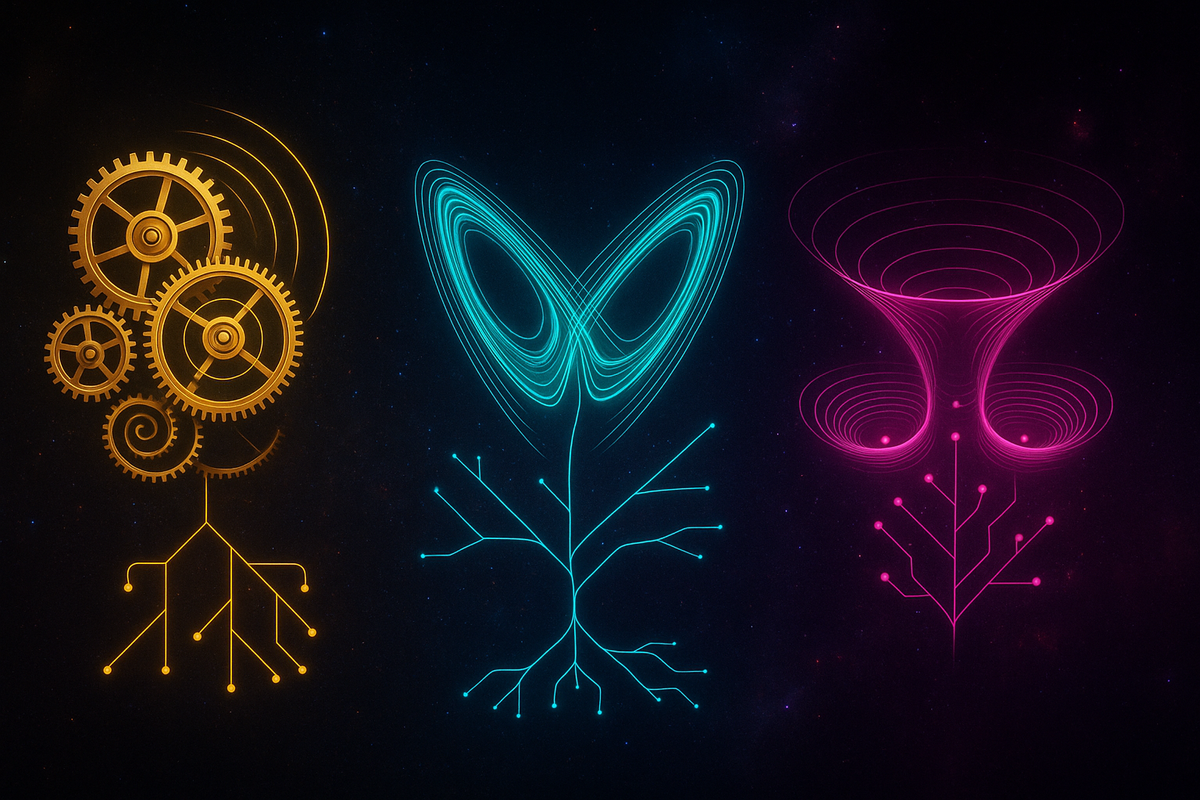
The plots we write mirror the physics we believe. Clockwork determinism gave us novels where fate was traceable. Chaos theory gave us stories where small choices cascade into unpredictable futures. The history of narrative is secretly a history of scientific worldviews.
Determinism to Chaos: How Physics Changed Plot
In 1814, the mathematician Pierre-Simon Laplace proposed a thought experiment.
Imagine an intellect that knew the position and momentum of every particle in the universe. This intellect—Laplace's Demon—could calculate the entire future and reconstruct the entire past. Every event would be predictable. Nothing would be contingent.
"For such an intellect, nothing would be uncertain, and the future, just like the past, would be present before its eyes."
This was the clockwork universe. And it dominated scientific imagination for over a century. It also shaped fiction.
Then something changed. Chaos theory revealed that even deterministic systems could be practically unpredictable. The butterfly flapped its wings, and the paradigm shifted.
The physics changed. The plots changed with it.
The Clockwork Plot
In a deterministic universe, narrative has a certain structure.
Causes precede effects predictably. If you know the initial conditions, you know the outcome. Suspense comes from the protagonist not knowing what we (or fate) already knows.
Agency is illusory but still dramatic. The hero acts as if they have choices, but the narrative destiny is set. Oedipus tries to escape his fate and thereby fulfills it.
Resolution is inevitable. The clockwork runs forward. Mysteries are solved. Order is restored. The mechanism completes its cycle.
Think of classical detective fiction. Sherlock Holmes operates in a clockwork universe. Given sufficient information, the solution can be deduced. The crime was caused; the cause can be traced. The narrative satisfaction comes from watching the mechanism revealed.
Think of 19th-century realism. Balzac's Comédie Humaine treats society as a mechanism. Given character and circumstance, outcomes follow. The novelist's job is to show how the machine works.
The clockwork plot reflects clockwork physics: sufficient cause yields necessary effect.
The Cracks Appear
Even before chaos theory formalized the problem, cracks appeared in the clockwork narrative.
Dostoevsky's underground man refused to be predictable. "Twice two is four is no longer life, gentlemen, but the beginning of death." The soul rebels against determinism.
Kafka's bureaucracies operated by rules that couldn't be traced. Joseph K. never learns what he's accused of. The mechanism exists, but it's inaccessible.
Modernist fragmentation (Joyce, Woolf, Faulkner) broke narrative causation. Events happen without clear connection. Consciousness flows without mechanical logic.
These weren't chaos theory—they predated it by decades. But they registered something: the clockwork model felt inadequate to experience. Life didn't feel like a deducible mechanism. The fiction was reaching toward a different paradigm before the science formalized it.
Enter Chaos
In the 1960s and 70s, mathematicians and physicists formalized what artists had sensed: deterministic systems can be practically unpredictable.
Edward Lorenz discovered that weather simulations diverged wildly with tiny changes in initial conditions. The butterfly effect wasn't metaphor—it was mathematics.
Technically, the universe could still be deterministic. Laplace's Demon, with infinite precision, could still calculate everything. But no finite observer could. The sensitivity to initial conditions meant that even deterministic systems became unpredictable in practice.
This mattered for narrative. If small causes could have huge effects, then: - Outcomes weren't inevitable - Actions at key moments could tip the system - The future was genuinely open, even in a law-governed universe
The clockwork still ran—but its output was unknowable in advance.
The Butterfly Plot
Chaos theory entered fiction gradually, then everywhere.
Jurassic Park (1990, Crichton) makes Ian Malcolm its prophet: "Life finds a way." The park fails not because of malice or incompetence but because complex systems are unpredictable. Small failures cascade. Control is illusion.
Run Lola Run (1998, Tykwer) shows three versions of the same twenty minutes, diverging from tiny variations. A dog on a staircase changes everything. The film is a chaos theory experiment in narrative form.
Sliding Doors (1998) branches on whether Helen catches a train. Two timelines unfold from a moment's difference. The butterfly flaps.
The butterfly plot differs from the clockwork plot in structure: - Contingency is real. Outcomes genuinely depend on details that could have been otherwise. - Prediction fails. Even knowing the rules doesn't tell you the outcome. - Turning points matter. The narrative hinges on moments where tiny variations produce divergent futures.
What Changed
The shift from clockwork to butterfly wasn't just aesthetic. It reflected a different metaphysics.
Clockwork: The future is implicit in the present. Agency is experienced but not real. The hero enacts what was always going to happen.
Butterfly: The future is sensitive to the present. Agency might be real—or at least might matter. The hero's actions at key moments genuinely determine outcomes.
This changes the emotional register of fiction.
In clockwork fiction, there's a tragic grandeur. You know the end. You watch it approach. Oedipus cannot escape. The Titanic will sink. The doom is known.
In butterfly fiction, there's anxious contingency. You don't know the end. Small things might matter. Lola might make it. She might not. The tension is genuine uncertainty, not dramatic irony.
Complexity Fiction
Beyond simple chaos, a new paradigm emerged: complexity theory.
Complex adaptive systems—economies, ecosystems, societies—don't just show sensitive dependence. They show emergence, self-organization, feedback loops, attractors.
This generated new plot structures:
Network narratives (Crash, Babel, Magnolia) show interconnected characters whose actions ripple through the system. No single protagonist—the network is the protagonist.
Institutional fiction (The Wire) shows how organizations constrain individuals. The cops and criminals are locked in a system neither can escape. The attractor basin holds them.
Systems collapse narratives show cascading failures—financial systems, ecosystems, civilizations—where the system's own dynamics doom it. Not individual failure but systemic inevitability.
Complexity fiction is neither clockwork nor butterfly. It's basin fiction—stories about systems with multiple possible states (attractors) where actions might shift which basin you end up in, but once you're in one, the dynamics constrain you.
The Physics in the Plot
Let's be precise about the mapping:
Newtonian/Laplacian mechanics → Clockwork plots → Deterministic causation, inevitable resolution, agency as dramatic illusion
Chaos theory → Butterfly plots → Sensitive dependence, contingent outcomes, moments that matter
Complexity theory → Basin plots → Emergent dynamics, systemic constraint, attractors you can't escape once entered
These aren't perfect correspondences. Fiction has its own logic. But the structural parallels are striking.
When physics said the universe was a clock, fiction gave us plots that ticked toward inevitable conclusions. When physics said the universe was a butterfly, fiction gave us plots that hinged on contingent moments. When physics said the universe was a complex system, fiction gave us plots about inescapable dynamics.
The imagination tracked the paradigm.
The Reader's Experience
Why does this matter for readers?
Because the paradigm shapes what you expect from narrative—and whether narratives satisfy.
Readers trained on clockwork plots expect resolution. The mystery will be solved. The threads will be tied up. The machine will complete its cycle. When this doesn't happen, they feel cheated.
Readers trained on butterfly plots expect contingency. They want to feel that outcomes could have been different. That the turning points were real. When everything feels inevitable, they feel manipulated.
Readers trained on basin plots expect systemic explanation. They want to understand the dynamics that produced the outcome. When causes feel arbitrary, they feel confused.
You read with the paradigm you've absorbed. And different paradigms make different plots satisfying.
The Contemporary Moment
Current fiction reflects the complexity paradigm.
Climate fiction (The Ministry for the Future, The Overstory) deals with systems so complex that individual action seems futile, yet tipping points might still matter.
AI fiction grapples with emergent intelligence—systems whose behavior can't be predicted from their rules.
Social media fiction explores network effects, feedback loops, virality—how information systems produce outcomes no one intended.
The plots mirror the problems. When the challenge is systemic, fiction becomes systemic. When the physics is complexity, the narrative is complexity.
Reading Paradigmatically
Here's the practice: when you read science fiction, ask what physics is operating.
Is the future determinable from the present? (Clockwork) Do small variations produce divergent outcomes? (Butterfly) Are there attractor states that constrain once entered? (Basin)
The answer will tell you what kind of story you're in—and what the story believes about choice, consequence, and the possibility of change.
Read the plot. See the physics.
Further Reading
- Gleick, J. (1987). Chaos: Making a New Science. Viking. - Hayles, N. K. (1990). Chaos Bound: Orderly Disorder in Contemporary Literature and Science. Cornell University Press. - Mitchell, M. (2009). Complexity: A Guided Tour. Oxford University Press.
This is Part 2 of the Science Fiction Mirror series. Next: "[Dune and Attractor Basins: Paul Had to Do Jihad](/dune-attractor-basins/)."
Comments ()