Diamonds and Graphite: Thermodynamics vs Kinetics
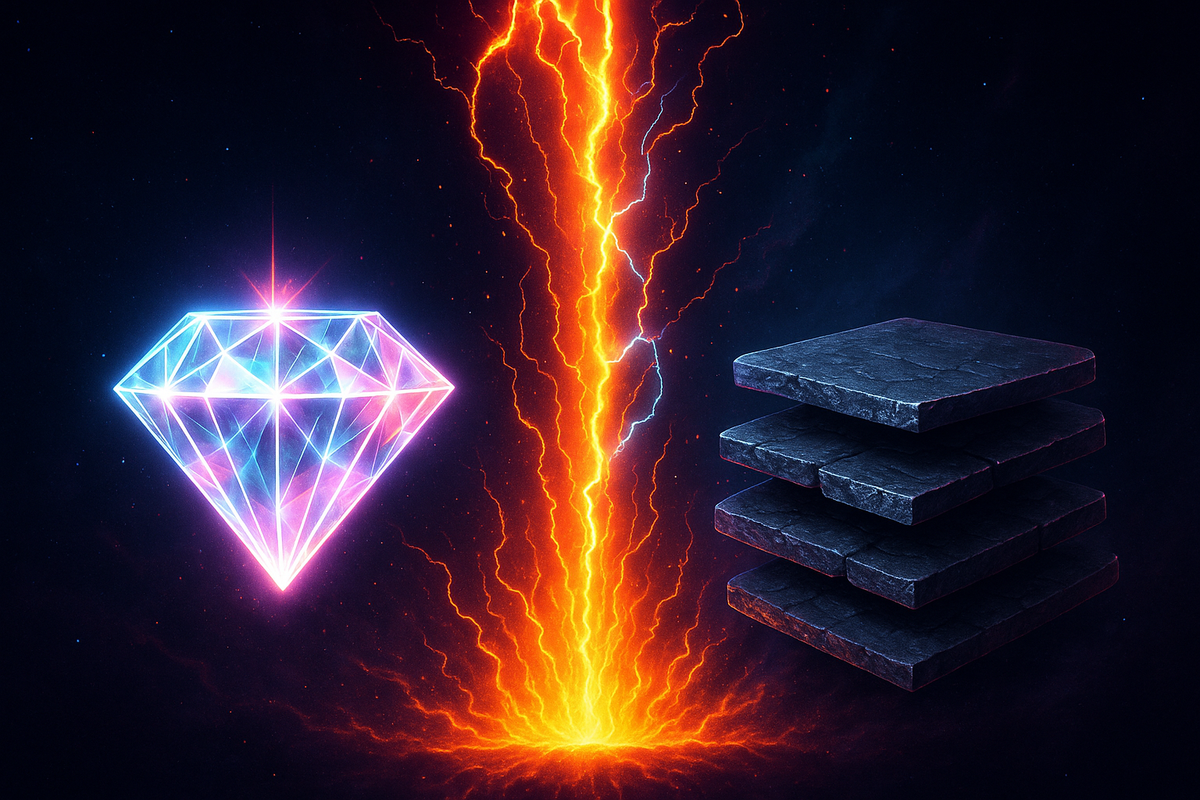
Thermodynamics says your diamond ring should be turning into graphite. Kinetics explains why it isn't. The difference between what should happen and what does happen is one of chemistry's most instructive lessons.
Diamonds and Graphite: Thermodynamics vs Kinetics
At room temperature and pressure, graphite is more stable than diamond. The free energy of graphite is lower by about 2.9 kJ/mol.
This means every diamond should spontaneously transform into graphite. Your engagement ring should slowly become pencil lead.
It doesn't. Diamonds persist for billions of years. They're "forever" not because thermodynamics favors them, but because kinetics forbids the transformation.
This tension between thermodynamics and kinetics shapes the material world. What should happen isn't always what does happen—at least not on human timescales.
Thermodynamic Stability
At standard conditions (298 K, 1 bar):
G(graphite) < G(diamond)
ΔG = G(diamond) - G(graphite) = +2.9 kJ/mol
Diamond is thermodynamically unstable relative to graphite. The transformation to graphite is spontaneous (ΔG < 0 for diamond → graphite).
But "spontaneous" in thermodynamics doesn't mean "fast." It means "energetically favorable if barriers could be overcome." The barrier here is enormous.
The pebble: Thermodynamics tells you the destination. Kinetics tells you if you'll arrive before the universe ends.
The Kinetic Barrier
To transform diamond to graphite, you must rearrange carbon atoms from tetrahedral (sp³) bonding to planar (sp²) bonding. This requires:
1. Breaking strong C-C bonds (bond energy ~350 kJ/mol) 2. Reforming bonds in new geometry 3. Reorganizing the entire crystal structure
The activation energy is ~540 kJ/mol—huge. At room temperature, the rate constant is essentially zero:
k = A × exp(-E_a/RT)
With E_a = 540 kJ/mol and T = 298 K: k ≈ 10^-70 per second
A diamond would need ~10^70 seconds to transform. The universe is only ~10^17 seconds old. Diamonds are kinetically trapped far from equilibrium.
Metastability
Diamond is metastable—a local minimum in free energy, but not the global minimum.
Think of a ball in a valley on a hillside. The global minimum is at the bottom of the hill. But the ball sits in a small depression partway down. To reach the bottom, it must first climb out of the local valley—that requires energy input.
Diamond sits in such a local minimum. Graphite is lower, but the barrier between them is insurmountable at room temperature.
Metastable states are everywhere: - Supercooled water (liquid below 0°C) - Tempered steel (trapped martensitic phase) - Amorphous silicon (metastable vs crystalline) - Life itself (organisms far from equilibrium)
The material world is full of things that "shouldn't" exist but do because kinetics protects them.
Making Diamonds: Fighting Thermodynamics
To make diamond stable, you need conditions where G(diamond) < G(graphite).
From the phase diagram of carbon: - At ~1.5 GPa (15,000 atm), the transition temperature is ~1700 K - At higher pressures, lower temperatures suffice
Diamond is favored at high pressure because it's denser than graphite. Pressure favors the compact phase:
(∂G/∂P)_T = V
Diamond has smaller molar volume, so its G increases less with pressure than graphite's.
Natural diamonds: Formed deep in Earth's mantle (150-700 km), where pressure is 4.5-6 GPa and temperature is 900-1400°C. Brought to surface rapidly by volcanic eruption (kimberlite pipes), fast enough that they don't convert to graphite.
Synthetic diamonds: High-pressure, high-temperature (HPHT) synthesis mimics mantle conditions. ~5 GPa, ~1500°C, with metal catalysts to speed the transformation.
CVD diamonds: Chemical vapor deposition grows diamond films at low pressure by depositing carbon atoms from plasma. Kinetic tricks (hydrogen etching removes graphite faster than diamond) favor diamond growth despite thermodynamic preference for graphite.
Why Graphite Is Stable
Graphite's structure: planar sheets of hexagonal carbon rings (graphene layers), weakly bonded between layers by van der Waals forces.
Diamond's structure: 3D tetrahedral network, every carbon bonded to four neighbors with strong covalent bonds.
Graphite has: - Higher entropy (layers can slide, more vibrational modes) - Lower enthalpy at low pressure (sp² bonds are slightly stronger per electron)
At standard conditions: ΔH = H(diamond) - H(graphite) = +1.9 kJ/mol ΔS = S(diamond) - S(graphite) = -3.4 J/(mol·K)
Both favor graphite: lower enthalpy AND higher entropy.
ΔG = ΔH - TΔS = 1.9 - (298)(-0.0034) = +2.9 kJ/mol
Graphite wins on both counts at standard conditions.
Temperature Effects
How does ΔG change with temperature?
ΔG(T) = ΔH - TΔS
Since ΔS < 0 (diamond has lower entropy), the -TΔS term is positive and grows with T.
At higher temperatures, diamond becomes even less stable relative to graphite. Heat a diamond in inert atmosphere, and at ~1500°C, graphitization begins—kinetics finally allows the transition.
In air, diamond burns to CO₂ around 700°C. Combustion is faster than graphitization.
The pebble: Temperature is kinetics' friend. Enough heat, and thermodynamics gets its way. Diamonds at 1500°C finally become what they always should have been.
Other Carbon Phases
Carbon's phase diagram is rich:
Graphite: Stable at low pressure, forms sheets Diamond: Stable at high pressure, tetrahedral network Lonsdaleite: Hexagonal diamond, found in meteorites Fullerenes: Spherical molecules (C60, etc.) Carbon nanotubes: Rolled graphene sheets Amorphous carbon: Disordered, mixed bonding
Each has its own free energy, stability range, and kinetic barriers. Carbon's versatility comes from the nearly equal stability of sp², sp³, and mixed hybridizations.
Industrial Implications
Cutting tools: Synthetic diamonds are harder than graphite (obviously). HPHT and CVD methods produce industrial diamonds cheaply.
Electronics: Diamond has exceptional thermal conductivity, wide bandgap, high carrier mobility. Diamond semiconductors are emerging for high-power electronics.
Coatings: Diamond-like carbon (DLC) coatings provide hardness and low friction. Metastable, but kinetically stable enough for practical use.
Graphene: Single graphite layers have extraordinary electronic and mechanical properties. Thermodynamically, graphene prefers to stack into graphite—isolation requires kinetic tricks.
Understanding the diamond-graphite system guides development of these technologies.
Kinetics as Design Principle
Metastability isn't a problem—it's a tool.
Steel metallurgy: Different heat treatments create different metastable phases (martensite, bainite, pearlite) with different properties. All would relax to equilibrium ferrite + cementite eventually, but kinetic trapping gives us choices.
Amorphous metals: Metallic glasses form when cooling is fast enough to prevent crystallization. Metastable, but with unique properties (high strength, corrosion resistance).
Pharmaceuticals: Many drugs are metastable polymorphs. The stable form might not dissolve well or absorb properly. Metastable forms are deliberately manufactured and stabilized.
The pebble: Metastability is nature's hack. You can have materials that thermodynamics forbids, if you can trap them faster than they can escape.
Relaxation Timescales
How long does metastability last?
Diamond at room temperature: Essentially forever (10^70+ years) Supercooled water at -10°C: Minutes to hours without nucleation sites Amorphous silicon: Years to decades at room temperature Tempered steel: Stable for practical purposes, degrades over centuries
The relaxation timescale τ scales as:
τ ~ exp(E_a/RT)
Small changes in activation energy E_a or temperature T cause exponential changes in lifetime. This is why metastable materials can be "forever" at one temperature and "instant" at another.
Biological Metastability
Life exploits metastability:
Proteins: The folded state is the thermodynamic minimum, but denatured proteins can be kinetically trapped (aggregates, misfolded states).
ATP: Kinetically stable despite thermodynamic favorability of hydrolysis. Life depends on this—ATP in water is metastable for hours, long enough for cellular use.
DNA: The double helix is thermodynamically favored at body temperature, but replication requires temporary denaturation. Enzymes control when kinetics allows the helix to open.
Organisms: Living systems are far from thermodynamic equilibrium. Death is thermodynamic relaxation; life is kinetic persistence against that gradient.
Philosophical Coda
The diamond-graphite system teaches a general lesson: reality is not always at equilibrium.
Most of what you see around you—crystals, glasses, organisms, stars, the early universe—is metastable. Given infinite time, everything would reach maximum entropy. But "infinite time" isn't available.
The universe evolves along kinetically accessible paths, not necessarily toward global minima. Local minima, metastable states, kinetic traps—these shape the world as much as thermodynamic gradients do.
The pebble: Diamonds are a reminder that the universe is young. Given enough time, thermodynamics wins. But in the meantime, kinetics gives us a world of persistent improbabilities.
Summary
Thermodynamics says diamond should become graphite. Kinetics says not anytime soon.
- ΔG determines what's thermodynamically favored (graphite) - Activation energy determines what's kinetically accessible (diamond persists) - High pressure shifts the thermodynamic winner to diamond - High temperature speeds kinetics, allowing transformation
Metastability is not failure—it's opportunity. The material world exists in the gap between thermodynamic prediction and kinetic reality.
The pebble: Every diamond is a thermodynamic debt, accruing for billions of years, never called due. Kinetics is the most patient creditor.
Further Reading
- Bundy, F. P. et al. (1996). "The pressure-temperature phase and transformation diagram for carbon." Carbon, 34(2), 141-153. - Field, J. E. (1992). The Properties of Natural and Synthetic Diamond. Academic Press.
This is Part 10 of the Gibbs Free Energy series. Next: "[Membrane Potentials: Free Energy Across the Cell](/membrane-potential-gibbs/)"


Comments ()