Digital Transmission: Possibilities and Limits of Virtual Lineage
Bandwidth isn't just bits per second — it includes touch, co-regulation, and shared physical space. This piece applies information theory and neuroscience to ask what actually travels through a screen, and what gets lost in compression.
Digital Transmission: Possibilities and Limits of Virtual Lineage
Series: Esoteric Transmission | Part: 9 of 10
When the pandemic forced Buddhist meditation centers to close their doors in March 2020, something interesting happened. Teachers who had never considered virtual instruction suddenly found themselves giving dharma talks to screens. Students who had driven hours for weekly sits now clicked a Zoom link from their bedrooms. And everyone wondered the same thing: Does this still work?
The question isn't new. For as long as esoteric traditions have existed, they've wrestled with what can and cannot cross distances. Letters. Books. Recordings. Now: video calls, Discord servers, course platforms. Each new medium raises the same challenge: what gets lost when bodies aren't in the same room?
This isn't nostalgia. It's engineering. If transmission works through entrainment—if teachers pass coherence states through direct coupling with students—then the medium matters. Not all channels carry the same bandwidth. Some frequencies don't survive compression.
So what actually travels through fiber optic cable? And what requires physical presence?
What Digital Media Can Carry
Let's start with what works.
Explicit instruction translates perfectly. If you can write it down, you can send it digitally. Technique descriptions. Conceptual frameworks. Reading lists. The exoteric layer—the publicly shareable content—moves through digital channels without loss. A YouTube dharma talk conveys the same information as an in-person lecture, often with better production value and the ability to pause and rewind.
Modeling and demonstration work surprisingly well through video. Watching someone demonstrate a mudra, show a posture, walk through a breathing pattern—these transmit effectively if the video quality is adequate. The mirror neuron system activates when watching skilled action whether the person is physically present or on a screen. Instructional content has migrated to YouTube for good reason: the signal gets through.
Asynchronous guidance via text—especially when students can submit questions and receive personalized responses—often exceeds what happens in large in-person gatherings where individual attention is rare. The careful, considered written response from a teacher can carry more useful information than a brief exchange after a crowded talk.
Community structure survives digitally, sometimes better than in physical space. Discord servers create persistent containers for discussion. Shared practice schedules coordinate distributed individuals. Online communities allow for more frequent touch points than weekly physical meetings, maintaining connection across time zones and geographies.
Conceptual transmission—the mapping of frameworks, the navigation of ideas, the linking of concepts to experience—happens effectively through well-crafted writing and recorded talks. Much of what passes as esoteric teaching is actually conceptual orientation that translates to text.
These aren't trivial. A student who absorbs clear instruction, watches skilled demonstration, receives personalized written guidance, and participates in consistent community has access to substantial resources. For many traditions and many students, this suffices for significant progress.
But it doesn't carry everything.
What Requires Physical Presence
State transmission—the direct entrainment to coherence configurations that the student can't yet access independently—has severe bandwidth limitations through digital media.
Here's why: Entrainment happens through multi-channel coupling. When you sit in a room with someone in a particular state, your nervous system receives information through multiple simultaneous channels: visual (their micro-expressions, postural adjustments, breathing rhythm), auditory (not just words but prosody, timing, silence), proprioceptive (the felt sense of shared space), energetic (the poorly-named but phenomenologically real sense of another's state), and contextual (the totality of environmental cues that frame the interaction).
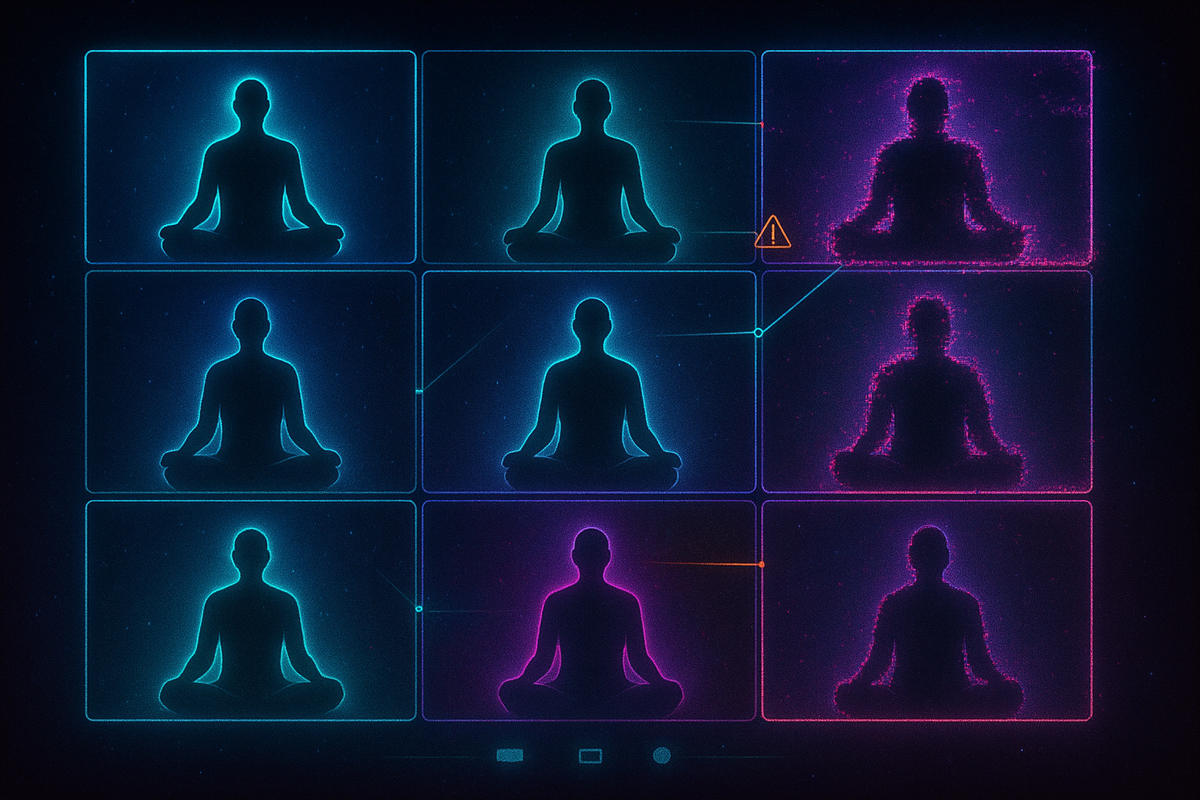
Video captures visual and auditory but compresses both. Microexpressions blur. Timing lags. Prosody flattens. The proprioceptive, energetic, and contextual channels drop out entirely.
This matters most for states that are orthogonal to the student's current range—configurations they've never accessed and thus can't recognize or reproduce from description alone. When the teacher embodies a state that the student has never experienced, the student needs direct exposure to the full signal to entrain. They're not following instructions; they're being pulled into a new region of state-space through coupling.
Darshan—the practice of simply being in the presence of a realized being—doesn't translate to screens. Not because of mysticism, but because it's fundamentally about entrainment through co-presence. The student isn't learning information; they're experiencing an attractor state that their system resonates with when given direct access. This requires physical proximity the same way tuning forks require acoustic coupling.
Embodied adjustment—the hands-on correction of posture, the physical repositioning of breath, the manual guidance of movement—obviously requires touch. But it's not just mechanical. The teacher's touch carries information about the state they're inviting the student into. Their hands aren't just adjusting angles; they're demonstrating the quality of attention, the type of engagement, the specific relaxation or activation pattern. This is teaching through the haptic channel, and it doesn't compress to video.
Threshold crossing—the initiation moments when something fundamentally shifts—seems to require witness. The student needs to know that someone saw the transition, that it happened in relationship, that they aren't alone in the new territory. Digital presence creates an uncanny valley here: close enough to feel like it should work but missing something essential. The phone call where someone shares a crisis hits differently than a text thread, but both are distant from physical presence at a critical moment.
Subtle transmission—the stuff traditions call "pointing out instructions," "direct introduction," or "transmission of the essence"—appears to require bandwidth that current media don't provide. These are moments when the teacher somehow conveys something that isn't in the words, isn't in the visible behavior, but happens through the totality of the encounter. Whether you call this energy, presence, or multi-channel coherence coupling, it seems to need the full stack.
The Lineage Question
Does digital teaching create lineage?
Lineage serves multiple functions. It's quality control (you learned from someone who learned from someone traceable to source), accountability (there's a chain of relationships that creates responsibility), preservation (techniques and understandings maintained across generations), and authority (recognition that grants permission to teach).
All of these can function digitally, with modifications:
Quality control works if the evaluation methods work. If a tradition's transmission can be verified through demonstrated capacity—the student can do the thing, access the state, teach effectively—then the medium of instruction matters less than the outcome. Some lineages have always emphasized proof over proximity.
Accountability requires relationship infrastructure. Digital communities can create this through persistent interaction, public teaching that creates reputation effects, and nested responsibility structures. But it requires deliberate design rather than automatic inheritance from physical proximity.
Preservation arguably works better digitally. Video archives capture teachings with higher fidelity than memory and oral transmission. Written documents distribute without degradation. The risk isn't loss but proliferation without quality curation.
Authority is the sticking point. Traditional lineages confer teaching authority through explicit transmission—you receive permission from your teacher who received it from theirs. This can happen digitally (the teacher sends a message, holds a ceremony via video), but it feels attenuated. Not because of technical limitation but because authority derives partly from having undergone the full process, including the aspects that required physical presence.
A student who learns primarily through digital media but never sits week-long retreats in physical proximity to teachers, never receives hands-on adjustment, never experiences the full-bandwidth transmission of an initiation—have they received the tradition?
Maybe. It depends on what the tradition actually is.
If the tradition is a set of techniques and concepts, digital transmission is complete. If the tradition is access to certain states, digital transmission works for students who can follow maps without needing to be pulled. But if the tradition is initiation into a particular way of being that requires direct exposure to someone who embodies it—then digital media hits hard limits.
Different traditions will answer this differently based on what they understand themselves to be transmitting.
Hybrid Models That Actually Work
The most functional approaches combine digital and physical strategically:
Digital for infrastructure, physical for intensification. Online communities maintain consistent practice and teaching between periodic in-person intensives. The Zoom sangha keeps you practicing; the annual retreat provides transmission depth.
Digital for accessibility, physical for initiation. Teachings are available online, reaching students who would never access physical lineage holders. When students reach capacity and commitment, they travel for concentrated physical study. This inverts traditional structures (find teacher first, then learn) but extends access while preserving transmission integrity.
Digital for many, physical for few. Most students receive digital instruction. Those who demonstrate capacity and calling receive invitations to closer physical study. This mirrors traditional guru-student models where most followers received group teaching while intimate transmission went to prepared individuals.
Digital for preliminary, physical for advanced. Early stages of practice—learning techniques, establishing consistency, building conceptual frameworks—happen digitally. Advanced stages—refining subtle states, receiving pointing-out instructions, navigating energetic crises—require physical presence. The medium matches the bandwidth requirements.
Text for concepts, video for modeling, audio for atmosphere, real-time for relationship, in-person for state transmission. Using each medium for what it actually carries best rather than treating all content as equivalent.
None of these are compromises. They're engineering decisions about how to match transmission channels to what's being transmitted.
What's Being Lost (And What's Being Gained)
The honest assessment requires looking at both sides.
Lost: The ambient learning that happens from extended physical proximity. The way living near a teacher means absorbing how they handle daily life, not just formal practice. The osmotic transmission that happens through extended immersion in a community practicing together. The full-bandwidth state entrainment that requires co-presence. The threshold moments that need physical witness.
Gained: Access for students who could never relocate or travel. Ability to study with multiple teachers without geographic constraint. Permanent archives that preserve teachings with unprecedented fidelity. Asynchronous learning that accommodates different life circumstances. Written instruction that can be more precise than oral teaching. Community connections that persist through life transitions.
The trade-offs aren't equal in all directions. For traditions where physical proximity and extended immersion are the primary technology—where you're supposed to move to the monastery, live near the teacher, spend years in close proximity—digital media can't replace what's lost.
But for traditions where formal instruction and periodic intensive practice constitute the main transmission—where students have always lived at distance and visited occasionally for teaching—digital tools often improve the infrastructure while changing the core transmission less than expected.
And for entirely new modes of teaching designed for digital media from the ground up—where the teaching is architected around what these channels actually carry—we're seeing emergent forms that don't map cleanly to traditional categories.
The Real Thing Problem
The hard question: How do you know if the transmission you're receiving digitally is complete?
You look at outcomes. Not what the teacher claims, not how the packaging feels, but what actually develops in students:
- Can they access the states the practice claims to produce?
- Do they demonstrate the capacities the tradition is meant to cultivate?
- Can they teach others effectively, transmitting what they've received?
- Over years, does the practice produce the transformation it describes?
If yes, the transmission is working regardless of medium. If no, the transmission has failed regardless of how traditional or physically proximate it was.
The risk isn't that digital transmission doesn't work. The risk is that partial transmission looks complete until you need the missing pieces. You learn the techniques. You understand the concepts. You have the community. But you never receive the state transmission that makes the practice actually function at depth. And you don't know what you're missing because you've never experienced it.
This was always a risk. Students sitting in physical presence of teachers have received incomplete transmission for millennia. Digital media don't create this problem; they change its manifestation.
The solution is the same as it always was: Find teachers whose students demonstrate real transformation. Practice until you access the states the tradition points to. Test the teaching against lived reality. And when you hit limits, seek the transmission you're missing.
Sometimes that will require physical presence. Sometimes it won't. But digital media don't eliminate the need for discernment—they make it more critical.
The Future That's Already Here
The next generation of practitioners won't debate whether digital transmission works. They'll grow up in hybrid environments where online and physical practice interweave seamlessly. They'll learn to recognize which transmission requires which bandwidth. They'll build new containers that use digital infrastructure for what it carries best while preserving in-person practice for what requires physical presence.
Some traditions won't survive this transition. Not because digital media are inferior but because what those traditions were actually transmitting required physical lineage structures that can't translate. That's loss worth grieving.
But other traditions will discover that their transmission is more robust than assumed—that what seemed to require physical presence was actually embedded in techniques, concepts, and states that travel through digital channels. And they'll reach students who would never have accessed the teaching otherwise.
And entirely new traditions will emerge that are designed for the digital environment—that use video, text, audio, community platforms, and periodic physical gathering as the complete transmission architecture rather than as compromises.
We're not asking whether digital transmission works. We're discovering what digital transmission is—which parts of traditional lineage structures carry forward, which parts were incidental to their context, and what new forms emerge when teaching is re-architected for different media.
The answer won't be universal. It will depend on what each tradition understands itself to be transmitting.
But the question is now unavoidable.
This is Part 9 of the Esoteric Transmission series, exploring lineage, embodied knowledge, and cross-temporal entrainment. Next: "Synthesis: Transmission as Cross-Temporal Entrainment."
Comments ()