Discernment in the Meme Stream: What Digital Mythologies Serve You
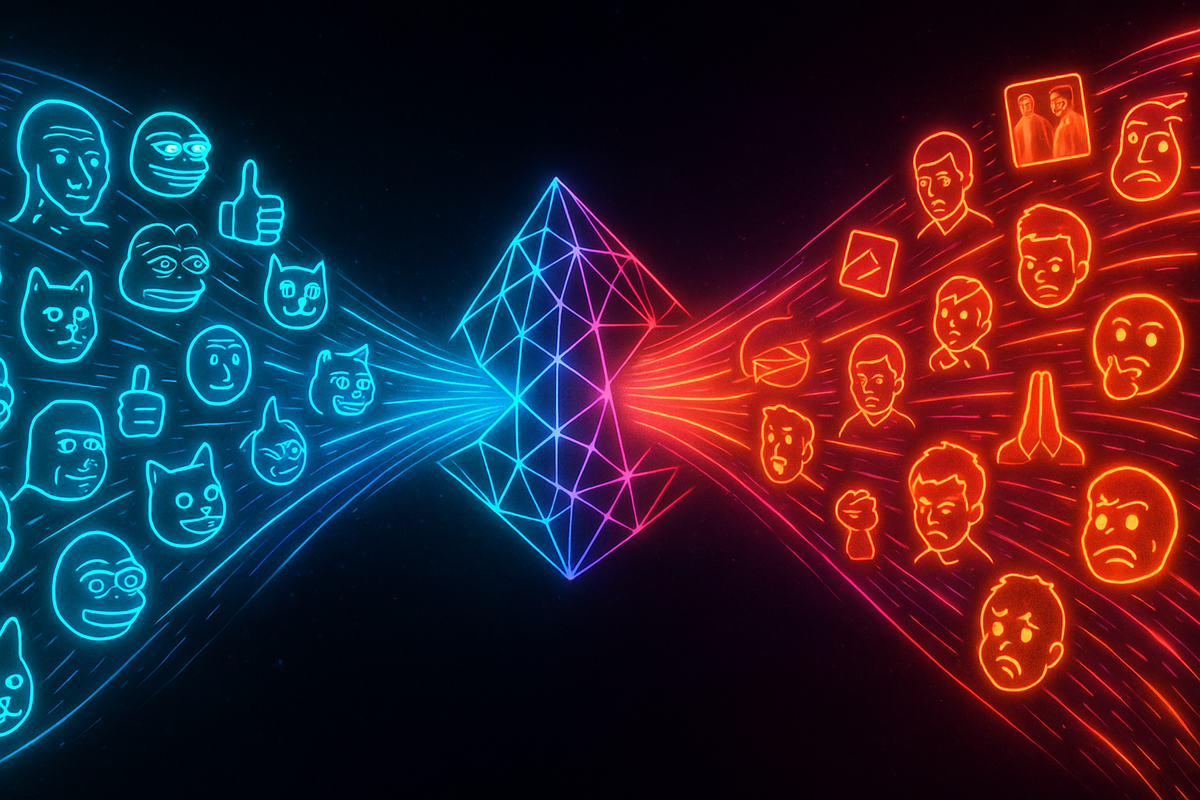
The meme stream never stops. Some digital mythologies build coherence; others exploit the same circuitry for engagement. Discernment means knowing which is which before you've already been captured.
Discernment in the Meme Stream: What Digital Mythologies Serve You
Series: Digital Folklore | Part: 9 of 10
You've internalized thousands of them. Templates for interpreting reality. Frames for understanding yourself. Narratives about how the world works, who has power, what matters, what's broken, what's possible. They arrived as memes, spread through your feed, lodged in your brain without you noticing. Some serve you. Some don't. Most, you've never examined.
This isn't paranoia about manipulation—though manipulation exists. It's recognition of a structural reality: you're swimming in mythology. The question isn't whether you participate. You already do. The question is whether you participate consciously or unconsciously. Whether you develop discernment about which digital mythologies shape your perception, behavior, and sense of meaning.
Because not all myths are created equal. Some encode genuine wisdom. Some exploit cognitive vulnerabilities for profit. Some build coherence. Some fragment it. And the algorithmic meme stream doesn't distinguish. It optimizes for engagement, not for truth or human flourishing.
Learning to tell the difference is essential literacy for the 2020s.
The Problem: Memetic Overload
Start with the scale. You're exposed to more symbolic content in a week than a medieval person encountered in a lifetime. Every scroll delivers compressed narratives about how reality works. Every viral post encodes assumptions about human nature, social dynamics, political possibility.
Traditional mythology was slow. A culture's myths accumulated over generations, transmitted through ritual, embedded in community practice. There was time for testing, for seeing what patterns actually served collective coherence. Bad myths—ones that led to poor decisions or social fragmentation—got edited out through lived experience.
Digital mythology is fast. A narrative can achieve global saturation before anyone has tested whether it corresponds to reality or serves human needs. Engagement metrics select for stickiness, not accuracy. Algorithmic amplification rewards emotional intensity, not wisdom.
The result: your symbolic environment is polluted. Not with lies, exactly—though those exist—but with untested, unvetted, engagement-optimized narratives that install themselves in your cognitive infrastructure and shape how you perceive everything.
And here's the insidious part: you don't experience this as "consuming content." You experience it as "learning how the world works." Your brain doesn't tag incoming memes with epistemic status markers. It doesn't say "this is a provisional hypothesis from a random internet stranger optimized for viral spread." It processes patterns, extracts regularities, updates your world model. Memes become priors.
The question isn't whether you're influenced. The question is whether you notice.
Coherence vs. Engagement Optimization
Let's clarify the distinction. In AToM terms, coherence means integrable trajectories under constraint. A system is coherent when its parts work together, when actions don't undermine each other, when prediction and action align over time. Meaning, in this framework, is M = C/T—coherence sustained across temporal depth.
Coherence-supporting myths help you:
- Navigate reality more effectively
- Coordinate with others
- Build sustainable practices
- Reduce internal fragmentation
- Maintain stability while adapting to change
Engagement-optimized myths make you:
- Click, share, comment
- Experience strong emotional arousal
- Return to the platform
- Stay scrolling
- Generate advertising revenue
Sometimes these overlap. Often they don't.
An engagement-optimized meme might make you angry (high arousal), self-righteous (identity reinforcement), eager to share (signal group membership)—and leave you more fragmented, less capable of nuanced thinking, worse at coordinating with people outside your bubble.
A coherence-supporting meme might make you recognize a pattern you'd felt but couldn't name, giving you better tools for navigating complexity—but generate minimal engagement because it doesn't trigger outrage or tribal signaling.
The platforms don't optimize for coherence. They can't. Coherence is a property of integrated systems unfolding over time. Engagement is a property of momentary attention capture. These are different selection pressures, often actively opposed.
Which means: if you want coherence, you have to select for it yourself.
The Discernment Framework
Here's a practical approach. When you encounter a meme—a narrative, template, frame, or mythology—that's spreading through your attention:
1. Notice It's There
Most memes install themselves pre-consciously. You scroll, process, internalize, move on. The first practice is simply catching the installation process.
When a meme lands—especially one that triggers strong emotion or immediate agreement—pause. Note that you just encountered a compressed narrative making claims about how reality works. You don't have to do anything else yet. Just notice.
This sounds trivial. It's not. Most people never interrupt the stream long enough to recognize they're consuming mythology, not just "content."
2. Ask: What Is This Claiming?
Unpack the implicit assertions. Memes work through compression—they say a lot with little. Make the hidden claims explicit.
"OK Boomer" encodes: generational conflict is fundamental, older generations don't understand contemporary conditions, dismissal is an appropriate response to perceived ignorance, age-based categorization is explanatorily useful.
"Sigma male grindset" encodes: success comes from radical individualism, social bonds are optional, conventional morality is for the weak, status hierarchies are natural and desirable, emotional stoicism is strength.
"This is fine" encodes: cognitive dissonance is universal, maintaining normalcy during crisis is absurd yet relatable, ironic detachment is a valid coping strategy.
Not all of these claims are false. But they're claims. And accepting them uncritically changes how you interpret your life.
3. Check Against Lived Experience
This is the test traditional mythology underwent automatically: does this pattern correspond to reality? Does acting on it produce good outcomes?
If you internalize "all [group] are [trait]," does that make your interactions with that group more accurate and productive? Or does it install a filter that creates confirmation bias and prevents you from seeing nuance?
If you adopt a narrative about how success works, and you act on it, do you get the results promised? Or do you get different results that the meme didn't prepare you for?
If a myth about relationships feels true, does it help you build better relationships? Or does it create self-fulfilling prophecies that reinforce the mythology while making your actual relating worse?
Your lived experience is data. Use it.
4. Evaluate Coherence Impact
This is the deeper test. Does this mythology increase or decrease your capacity for:
Internal integration — Are your beliefs, values, and actions more aligned, or more fragmented? Does the meme resolve internal contradictions or create new ones?
Effective action — Are you better able to navigate your environment, or more confused? Does the frame provide useful predictions, or does it lead you to expect things that don't happen?
Relational coordination — Does this mythology help you connect with others, or does it drive wedges? Does it create empathy and understanding, or in-group/out-group polarization?
Temporal stability — Can you sustain this frame long-term, or does it create unsustainable patterns? Does it point toward growth and adaptation, or toward rigid stuckness or burnout?
A coherence-supporting myth makes your system more integrated. An engagement-optimized myth often fragments you—makes you angrier, more reactive, less capable of complex thought, worse at seeing other perspectives.
5. Trace the Incentive Structure
Who benefits from you believing this? Not in a paranoid conspiracy sense, but structurally: what systems get reinforced if this meme spreads?
Memes that make you distrust institutions benefit from institutional distrust. Memes that make you feel inadequate unless you buy something benefit sellers. Memes that make you outraged at the other tribe benefit platforms (engagement) and tribal leaders (status, donations, votes).
This doesn't mean the meme is false. It means you should be aware of the selection pressure. If a mythology is spreading because it serves someone's interests rather than because it corresponds to reality, that's important context.
6. Consider the Alternative
What mythology does this one compete with? What frame is it displacing?
"You're being oppressed by [system]" competes with "you have agency within constraints." Both might be partially true. But they lead to different orientations, different actions, different outcomes.
"Authenticity means expressing every impulse" competes with "authenticity means integration of multiple values." Both feel true in different contexts. But they imply different practices.
Recognizing that memes are competing narratives—that adopting one means not adopting others—helps you make conscious choices rather than passively accepting whatever spreads most virally.
Practical Application: Case Studies
Let's test this framework on actual memes:
Case 1: "Hustle Culture" Mythology
Claims: Success requires constant work, rest is weakness, optimization is virtue, productivity defines worth, anyone can make it if they work hard enough.
Lived experience test: Does this frame predict outcomes accurately? For some people, yes—intense focus yields results. For many, it produces burnout, chronic stress, and diminishing returns. The mythology oversells agency (ignoring structural constraints) and undersells recovery needs.
Coherence impact: Often creates fragmentation—devalues rest and relationships, leads to unsustainable patterns, generates shame when reality doesn't match the narrative.
Incentive structure: Benefits platforms selling courses, productivity tools, supplements. Benefits employers wanting maximum extraction. Benefits status games in certain subcultures.
Verdict: Partially useful (focused effort matters), but coherence-damaging at the extremes it's usually presented. Treat as provisional, context-dependent advice, not universal truth.
Case 2: "All Perspectives Are Valid"
Claims: Truth is subjective, lived experience is the ultimate authority, no one can judge anyone else's reality, disagreement is violence.
Lived experience test: Does this help you navigate complexity? Sometimes—it prevents dismissing perspectives too quickly. But it also prevents you from distinguishing accurate from inaccurate models, helpful from harmful practices, or recognizing when someone's "truth" is demonstrably wrong about shared reality.
Coherence impact: Can reduce conflict (respecting difference), but can also prevent coordination (no shared reality to navigate together), enable manipulation (no basis for calling out harmful behavior), and fragment understanding.
Incentive structure: Benefits platforms (reduces moderation burden), benefits anyone wanting to avoid accountability, undermines collective sense-making.
Verdict: Useful as a reminder to respect different experiences. Damaging if taken as absolute—prevents distinguishing better from worse models of shared reality.
Case 3: "Touch Grass" / "Log Off"
Claims: Digital engagement is unhealthy, real life is offline, embodied experience is more authentic, social media makes you sick.
Lived experience test: Partially true—excessive screen time does correlate with various problems. But oversimplified—digital connection can be meaningful, some people's communities are primarily online, "touching grass" doesn't automatically solve systemic issues.
Coherence impact: Can support coherence (reducing compulsive scrolling, reconnecting with embodied experience) or fragment it (creating shame about digital engagement, ignoring the reality that digital spaces are part of contemporary life).
Incentive structure: Counter-cultural—doesn't obviously benefit platforms or institutions. Might benefit wellness industry. Mostly seems to encode genuine recognition of a problem.
Verdict: Useful as corrective to excessive digital immersion. Limited as comprehensive framework—life includes both digital and physical domains.
The Meta-Skill: Holding Mythology Lightly
Here's the deeper practice: treat all frames as provisional.
Traditional cultures often knew their myths were myths. They served a function—coordination, meaning-making, wisdom transmission—but weren't confused with literal factual claims. The myth was true in the sense that it worked, not in the sense that it described objective reality.
Modern mythologies—memes, narratives, frames—often present as fact. They don't say "this is one useful way to think about things." They say "this is how things are." And because they arrive through your feed mixed with news, information, and actual data, your brain treats them as equivalent.
The meta-skill is recognizing: this is a map, not the territory. It might be a useful map. It might help you navigate. But it's not reality itself.
This doesn't mean everything is relative. Some maps correspond to territory better than others. But it means:
- You can use multiple frames without being trapped by any single one
- You can recognize which frame is useful in which context
- You can update when experience contradicts the mythology
- You can resist the urge to defend your mythology as identity
When a meme installs itself, you can think: "Interesting. That's one way to frame this situation. Let me test whether it's useful." Rather than: "This is how reality is, and anyone who disagrees is wrong/stupid/evil."
Why This Matters: Memetic Sovereignty
We're living through a moment of mythological fragmentation. There's no shared cultural mythology that everyone agrees on. Instead, there are thousands of competing narratives, each optimized for virality within particular algorithmic niches and demographic bubbles.
This creates both crisis and opportunity.
The crisis: without shared mythology, coordination becomes difficult. People literally see different realities. Conversations across bubbles feel like talking to aliens. Collective action requires shared understanding, and shared understanding requires shared symbolic vocabulary.
The opportunity: conscious participation in mythology-selection becomes possible. You're not born into a single narrative tradition that defines your entire symbolic universe. You encounter thousands. Which means you can evaluate, select, and synthesize.
But only if you develop discernment.
Memetic sovereignty means:
- Recognizing when mythology is being installed
- Evaluating whether it serves your coherence
- Choosing which frames to internalize and which to discard
- Updating when experience contradicts belief
- Participating in myth-making consciously rather than unconsciously
This isn't about becoming immune to influence—you can't. You're a social, symbolic creature. You need mythology. But you can become conscious about which mythologies you host, propagate, and act upon.
The Practice
Here's what this looks like day-to-day:
When scrolling: Catch yourself internalizing narratives. Notice when something feels true not because it corresponds to your experience but because it's presented confidently and spreads virally.
When sharing: Ask why you're amplifying this particular mythology. Are you spreading it because it's useful and accurate, or because it makes you feel part of a tribe, or because it's emotionally satisfying?
When believing: Hold your frames lightly. Test them against experience. Update when they fail. Recognize you might be wrong.
When encountering disagreement: Consider that different people have internalized different mythologies, not that they're stupid or evil. Understanding their frame doesn't mean adopting it, but it makes coordination possible.
This is difficult work. It's easier to let the stream carry you, to absorb whatever spreads, to adopt the mythology of your bubble. But the cost is fragmentation—internal incoherence, relational breakdown, collective confusion.
Digital folklore is the meaning-making infrastructure of the contemporary world. You're participating whether you want to or not. The only question is whether you participate with discernment.
In the final article, we'll synthesize everything—how digital mythology connects to broader meaning-making, what the future of myth looks like when it's algorithmically mediated, and how to build coherent mythology in a fragmented landscape.
This is Part 9 of the Digital Folklore series, exploring memes, fandoms, and world-building as contemporary mythology.
Previous: Mythopoeia: The Conscious Construction of Mythology
Next: Synthesis: Digital Meaning Infrastructure and the Future of Myth
Further Reading
- Boyer, P. (2001). Religion Explained: The Evolutionary Origins of Religious Thought. Basic Books.
- Haidt, J., & Rose-Stockwell, T. (2019). "The Dark Psychology of Social Networks." The Atlantic.
- Nguyen, C. T. (2020). "Echo Chambers and Epistemic Bubbles." Episteme, 17(2), 141-161.
- Williams, J. (2018). Stand Out of Our Light: Freedom and Resistance in the Attention Economy. Cambridge University Press.
Comments ()