Synthesis: Discrete Math as the Foundation of Computer Science
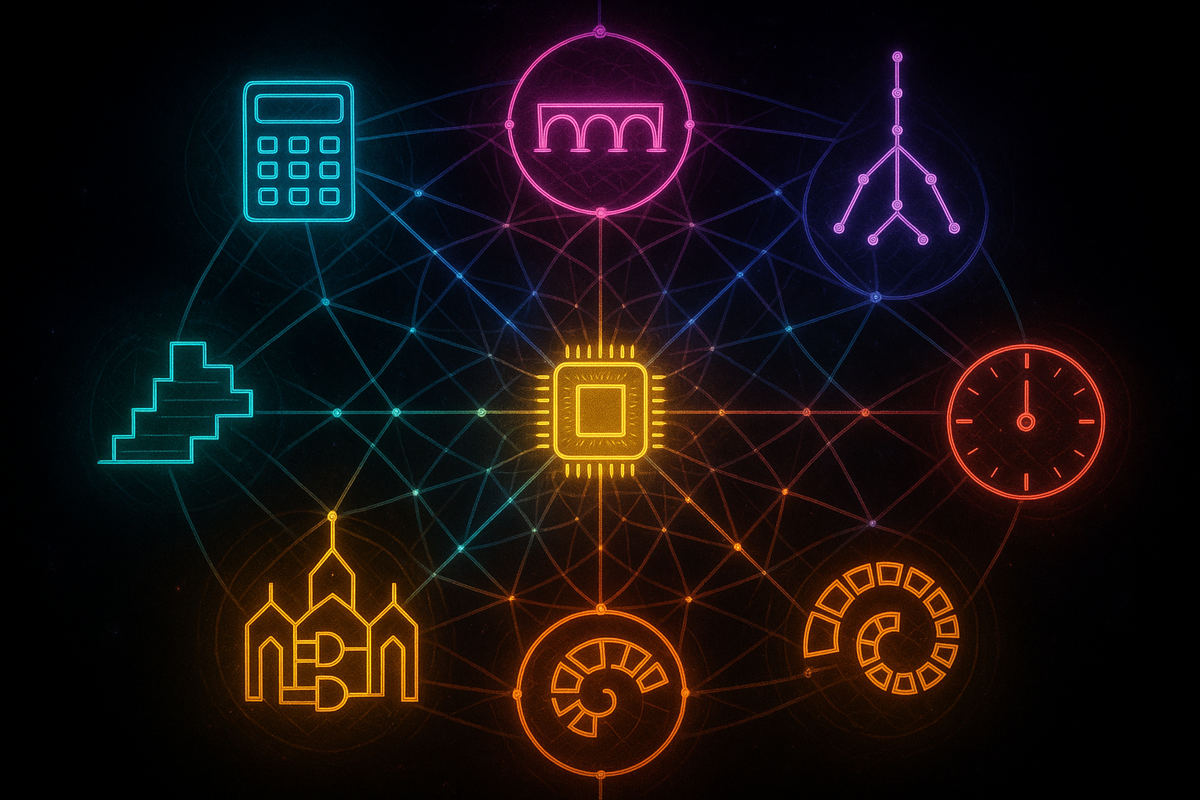
Discrete math is the hidden foundation of computing. Graphs model networks, logic powers circuits, and combinatorics controls complexity—understanding these ideas means understanding how computers actually think.
Every algorithm you've ever used is built on discrete mathematics.
The search bar that finds your email in milliseconds: graph theory (inverted index as a bipartite graph) and Big O analysis (O(log n) lookup).
The encryption securing your bank transaction: modular arithmetic (RSA), number theory (prime factorization), and Boolean algebra (bit operations).
The social network showing you friend recommendations: graph algorithms (friends-of-friends, community detection, centrality measures).
The code that autocorrects your typos: trees (trie data structures), combinatorics (edit distance), and recurrence relations (dynamic programming).
The neural network recognizing your face: graph theory (network architecture), Big O (training complexity), Boolean functions (activation thresholds).
Discrete mathematics isn't a collection of random topics. It's the unified foundation of computational thinking—the mathematics of structure, counting, connectivity, and algorithmic possibility.
The Core Insight
Computers are discrete machines.
They don't handle continuous values—they quantize everything into bits. Memory is discrete addresses. Instructions are discrete steps. Data structures are discrete objects. Algorithms are discrete processes.
This discreteness isn't a limitation. It's what makes computation possible. You can't compute with smooth, continuous functions—there's too much information. But discrete structures are finite, enumerable, manipulable.
Discrete mathematics is the native language of machines that think.
The Pillars
Let's review what we've covered and how it all connects.
1. Combinatorics: Counting Possibility Spaces
Core idea: How many ways can things be arranged, selected, or combined?
- Permutations: Order matters (racing podiums, passwords, playlists)
- Combinations: Order doesn't (committees, lottery tickets, subsets)
- Binomial theorem: Pascal's triangle encodes combination counts
- Applications: Probability, algorithm analysis, cryptography
Why it matters: Counting defines possibility spaces. Combinatorics tells you the size of the search space—whether brute force is feasible or impossible.
Pebble: "There are 52! ways to shuffle a deck—more than atoms in the universe. Every shuffle produces a unique sequence never before seen."
2. Graph Theory: The Mathematics of Relationships
Core idea: Model connections between objects.
- Nodes and edges encode relationships
- Paths, cycles, connectivity: Can you get from A to B?
- Shortest paths: GPS routing (Dijkstra, A*)
- Network flows: Maximize throughput, minimize cost
- Centrality: Who's important? (PageRank, betweenness)
- Community detection: Find clusters in networks
Applications: Social networks, internet routing, recommendation systems, logistics, biology (neural networks, protein interactions).
Pebble: "Euler solved the Königsberg bridge problem by abstracting to nodes and edges. Three centuries later, Google Maps uses the same mathematics."
3. Trees: Hierarchical Structure
Core idea: Connected graphs with no cycles—exactly one path between any two nodes.
- Binary search trees: O(log n) search
- Heaps: Priority queues for efficient min/max extraction
- Tries: Fast string lookup (autocomplete)
- Decision trees: Machine learning classifiers
- Spanning trees: Minimal connected structure
Applications: File systems, databases, compilers (parse trees), AI (game trees), network design.
Pebble: "Trees eliminate ambiguity—one path between any two nodes. That's why hierarchies work."
4. Recurrence Relations: Feedback Loops
Core idea: Sequences defined recursively—each term depends on previous terms.
- Fibonacci: F(n) = F(n-1) + F(n-2) → closed form via golden ratio
- Master Theorem: Solves divide-and-conquer recurrences (merge sort, binary search)
- Tower of Hanoi: H(n) = 2H(n-1) + 1 → H(n) = 2^n - 1
- Generating functions: Transform recurrences into algebraic equations
Applications: Algorithm runtime analysis, population models, financial projections, physics (discrete dynamics).
Pebble: "Simple rules generate complex behavior. Fibonacci—two numbers, one addition—produces the golden ratio."
5. Big O Notation: How Things Scale
Core idea: Describes growth rate of algorithms as input size → ∞.
- O(1): Constant (perfect scalability)
- O(log n): Logarithmic (binary search, balanced trees)
- O(n): Linear (iterate once)
- O(n log n): Linearithmic (efficient sorting)
- O(n²): Quadratic (nested loops, naive comparisons)
- O(2^n): Exponential (brute-force subset search—intractable)
- O(n!): Factorial (TSP brute force—impossible)
Applications: Predicting performance, comparing algorithms, identifying bottlenecks, understanding computational limits.
Pebble: "Some problems are provably impossible to solve efficiently. Big O reveals the boundaries of feasibility."
6. Boolean Algebra: The Two-Number System
Core idea: Mathematics with only 0 and 1, AND/OR/NOT operations.
- Logic gates: AND, OR, NOT, NAND (universal)
- Truth tables: Completely specify Boolean functions
- De Morgan's laws: Simplify circuits
- SAT problem: NP-complete—solving it solves all NP problems
Applications: Digital circuits, CPUs, database queries, access control, formal verification.
Pebble: "Boolean algebra has two numbers and built every computer ever made."
7. Modular Arithmetic: When Numbers Wrap Around
Core idea: Arithmetic where numbers cycle after reaching a modulus.
- Clock arithmetic: 11 + 3 ≡ 2 (mod 12)
- Modular inverses: Enable division mod m
- Fermat's Little Theorem: a^(p-1) ≡ 1 (mod p) for prime p
- RSA encryption: Security via modular exponentiation and factoring hardness
Applications: Cryptography, hash functions, check digits, pseudorandom generators, cyclic structures.
Pebble: "RSA encryption secures the internet. The math? Modular arithmetic and the hardness of factoring."
How It All Connects
Discrete math isn't seven isolated topics. It's a web of interconnected ideas.
Combinatorics → Graph Theory:
- C(n, 2) = number of edges in a complete graph
- Permutations count Hamiltonian paths
- Catalan numbers count binary trees
Graph Theory → Trees:
- Trees are acyclic connected graphs
- Spanning trees minimize edges while maintaining connectivity
- Tree traversals (DFS, BFS) are graph algorithms restricted to trees
Recurrence Relations → Big O:
- T(n) = 2T(n/2) + O(n) describes merge sort's structure
- Master Theorem maps recurrences to Big O bounds
- Algorithm analysis reduces to solving recurrences
Boolean Algebra → Modular Arithmetic:
- Boolean algebra is modular arithmetic mod 2
- Bitwise operations (AND, OR, XOR) use Boolean logic on bits
- Hash functions combine both
Combinatorics → Boolean Algebra:
- Truth tables have 2^n rows for n variables (combinatorial)
- SAT solvers explore combinations of variable assignments
Big O → All of Discrete Math:
- Big O describes the complexity of combinatorial algorithms (counting permutations: O(n!))
- Graph algorithms have Big O bounds (Dijkstra: O(E log V))
- Tree operations scale logarithmically (O(log n) for balanced trees)
Everything feeds into everything else. Discrete math is a unified framework for understanding computation.
The Deep Patterns
Pattern 1: Exponential Blowup
Possibility spaces explode.
- Permutations: n! grows super-exponentially
- Subsets: 2^n subsets of an n-element set
- Graph edges: C(n, 2) possible edges in a complete graph
- Boolean functions: 2^(2^n) possible n-variable Boolean functions
This explosion makes brute-force intractable. It's why we need:
- Heuristics and approximations
- Clever algorithms (dynamic programming, greedy methods)
- Accepting hardness (NP-complete problems)
Pebble: "Some problems can't be solved by trying everything. The space is too vast."
Pattern 2: Logarithms Save the Day
Halving problems repeatedly yields logarithmic complexity.
- Binary search: O(log n)
- Balanced trees: O(log n) insert/search
- Divide-and-conquer: Often O(n log n)
- Modular exponentiation: O(log n) via repeated squaring
Logarithms turn exponential spaces into manageable ones.
Pebble: "log₂(1,000,000) = 20. Even massive inputs require few operations."
Pattern 3: Structure Determines Feasibility
Not all problems are created equal.
- Trees: Easier than general graphs (no cycles, unique paths)
- Planar graphs: Easier than arbitrary graphs (4-color theorem)
- Sorted arrays: Easier to search than unsorted (binary search vs. linear)
- Modular arithmetic: Makes some number theory problems tractable
Imposing structure (constraints, ordering, hierarchy) often enables efficient algorithms.
Pebble: "Constraints aren't limitations—they're leverage."
Pattern 4: Discretization Enables Computation
Continuous → discrete makes problems computable.
- Differential equations → difference equations: Continuous dynamics discretized
- Real numbers → integers/rationals: Exact computation vs. floating-point approximation
- Continuous functions → Boolean functions: Logic gates, digital circuits
- Smooth curves → graphs: Network modeling
Discretization is how we make the analog world digital.
The Practical Impact
Discrete math isn't theoretical. It's the operating system of the digital age.
Google: PageRank (graph centrality), search indices (trees, hash tables), MapReduce (graph partitioning).
Facebook: Social graph (graph theory), friend recommendations (community detection, graph algorithms), news feed ranking (graph centrality).
Cryptography: RSA (modular arithmetic, primes), Diffie-Hellman (discrete logarithm), elliptic curves (modular arithmetic on curves).
Machine Learning: Neural networks (graphs), decision trees (trees), feature selection (combinatorial optimization), training complexity (Big O, recurrence relations).
Databases: B-trees (balanced trees for indexing), hash tables (modular arithmetic), query optimization (graph algorithms).
Compilers: Parsing (trees, recurrence relations), optimization (graph coloring for register allocation), code generation (Boolean algebra for bit operations).
Operating Systems: Scheduling (graph algorithms, modular arithmetic for round-robin), memory management (trees, hash tables), process synchronization (Boolean algebra, graph theory for deadlock detection).
Every piece of software, every algorithm, every data structure traces back to discrete math.
What You've Learned
You now understand:
- How to count without counting (combinatorics, binomial theorem)
- How networks work (graph theory, shortest paths, centrality)
- How hierarchies are structured (trees, traversals, spanning trees)
- How sequences evolve (recurrence relations, generating functions)
- How algorithms scale (Big O, complexity classes, P vs. NP)
- How computers think (Boolean algebra, logic gates, circuits)
- How numbers wrap (modular arithmetic, cryptography, hashing)
More importantly, you see the connections:
- Counting defines search spaces
- Graphs model relationships
- Trees optimize hierarchies
- Recurrences describe feedback
- Big O predicts scaling
- Boolean algebra enables digital logic
- Modular arithmetic secures communication
Discrete math is the skeleton beneath the skin of computation.
The Unsolved Problems
Discrete math has deep open questions.
P vs. NP: Can every problem whose solution is easy to verify also be solved quickly? Most believe no, but it's unproven. If yes, cryptography breaks. If no, some problems are inherently hard.
Graph isomorphism: Determine if two graphs are the same up to relabeling. Neither proven P nor NP-complete. A 2015 quasi-polynomial algorithm stirred debate.
Twin prime conjecture: Are there infinitely many primes p where p+2 is also prime? Number theory (related to modular arithmetic) has many unsolved problems.
Optimal matrix multiplication: Is O(n²) possible, or is there a fundamental lower bound above n²? Current best: O(n^2.371).
Perfect algorithms: For many problems, we don't know if the best-known algorithm is optimal. Are there faster sorting, graph coloring, or TSP algorithms waiting to be discovered?
Discrete math is an active frontier—questions remain, breakthroughs await.
Why Discrete Math Is the Language of the Future
The 21st century runs on algorithms.
- AI and machine learning: Neural networks (graphs), decision trees, algorithm optimization
- Cryptography and security: Post-quantum crypto (lattice-based, hash-based—all discrete math)
- Blockchain: Hash functions, Merkle trees, Byzantine fault tolerance (graph theory)
- Quantum computing: Still uses discrete math (quantum gates, error correction codes)
- Bioinformatics: DNA as strings (combinatorics, graph theory), protein folding (discrete optimization)
- Social networks: Graph analysis at scale
- Autonomous systems: Pathfinding, decision trees, optimization
Every emerging technology depends on discrete mathematics.
If you understand discrete math, you understand the foundation beneath:
- How search engines work
- Why some problems are hard
- What makes encryption secure
- How networks connect
- Why algorithms scale (or don't)
You're not just learning math—you're learning the operating principles of the digital world.
Where to Go Next
This series introduced the core concepts. To go deeper:
Textbooks:
- Concrete Mathematics (Graham, Knuth, Patashnik) — Combinatorics, recurrences, generating functions
- Introduction to Algorithms (Cormen et al.) — Algorithm analysis, graph algorithms, data structures
- Discrete Mathematics and Its Applications (Rosen) — Comprehensive survey
Specialized Topics:
- Networks (Newman) — Graph theory applications
- Number Theory (Burton) — Modular arithmetic, cryptography
- Introduction to the Theory of Computation (Sipser) — Complexity theory, P vs. NP
Practice:
- Solve problems on Leetcode, Codeforces, Project Euler
- Implement data structures from scratch (trees, graphs, hash tables)
- Read algorithm papers and trace through proofs
Discrete math isn't just theory. It's the lens through which to see—and build—the computational future.
The Final Pebble
Discrete mathematics is what happens when you take infinity off the table.
No infinitesimals. No continuous limits. Just countable, finite, distinct objects and the relationships between them.
And from this impossibly constrained system—where numbers are separate, graphs are finite, functions are discrete—we built the entire digital world.
Every algorithm is a recipe in discrete math. Every data structure is a discrete mathematical object. Every computation is a sequence of discrete steps.
The mathematics of the finite isn't a restriction. It's the foundation of everything computable.
And once you see it—once you recognize combinatorics in password security, graph theory in social networks, trees in file systems, Big O in performance bottlenecks, Boolean algebra in circuits, modular arithmetic in cryptography—you can't unsee it.
The discrete structures are everywhere.
And they determine what's possible.
Further Reading
- Graham, Ronald L., Donald E. Knuth, and Oren Patashnik. Concrete Mathematics: A Foundation for Computer Science. Addison-Wesley, 2nd edition, 1994.
- Cormen, Thomas H., et al. Introduction to Algorithms. MIT Press, 4th edition, 2022.
- Rosen, Kenneth H. Discrete Mathematics and Its Applications. McGraw-Hill, 8th edition, 2018.
- Knuth, Donald E. The Art of Computer Programming (series). Addison-Wesley.
- Sipser, Michael. Introduction to the Theory of Computation. Cengage Learning, 3rd edition, 2012.
This concludes the Discrete Mathematics series. You now have the foundational mathematics for understanding algorithms, data structures, complexity, and computational thinking. Every line of code you write, every algorithm you analyze, every system you design will rest on these discrete structures. Use them well.
Part 12 of the Discrete Mathematics series.
Comments ()