Synthesis: Divination as Coherence Technology
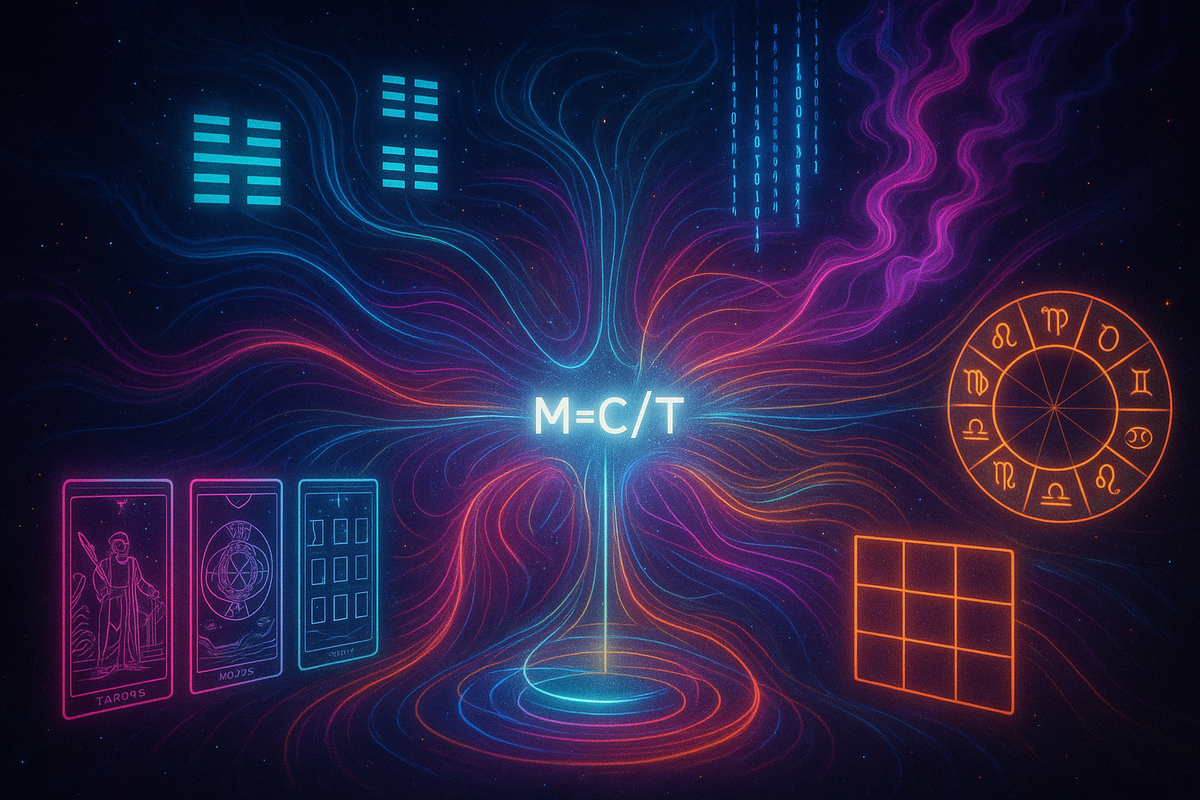
Tarot cards and oracle bones don't predict the future — they disrupt cognitive ruts. Divination is coherence technology: structured randomness that forces the mind to construct new meaning from ambiguous signals.
Synthesis: Divination as Coherence Technology
We've traveled through yarrow stalks and tarot cards, through shotgunning psychics and MBTI acronyms, through the Oracle at Delphi and the Netflix algorithm. Along the way, a pattern emerged.
Divination systems are coherence technologies.
They don't predict the future. They don't channel cosmic wisdom. They don't access supernatural knowledge. But they do something real and valuable: they help humans create coherent narratives from uncertain situations.
This is not a debunking. It's a reframing—one that explains both why divination persists and why it works.
The Coherence Problem
Humans face a fundamental cognitive challenge: the world doesn't come pre-interpreted.
Raw experience is chaos. Things happen. People act. Events unfold. The experience arrives without labels, without meaning, without obvious implications.
The brain's job is to transform this chaos into coherent models—narratives that explain what happened, why it happened, what might happen next, and what you should do about it.
Most of the time, this works automatically. Your narrative-generation machinery runs in the background, producing interpretations that feel like perception rather than construction.
But sometimes the machinery stalls.
You face a situation where multiple interpretations are possible. Where the right action is unclear. Where your usual stories don't fit. Where the future is genuinely opaque.
This is the coherence gap—the space between raw experience and organized understanding. Divination systems are technologies for crossing it.
How Coherence Technologies Work
Coherence technologies share a structure:
1. Randomization component: Something unpredictable happens. Cards fall, coins land, algorithms surface content, the oracle speaks.
2. Semantic structure: The random output is not pure noise. It's channeled into a structured meaning space—hexagram interpretations, card images, personality types.
3. Interpretive labor: The user connects the structured output to their situation. They do the work of finding correspondence.
4. Narrative formation: A story emerges. "I'm in a period of transition." "The conflict relates to trust issues." "My challenge is about letting go."
5. Coherence achieved: The formless anxiety becomes a named thing. The paralyzing options become a chosen path. The uncertain situation becomes a story you're living.
The divination system doesn't provide the coherence. It provides scaffolding on which you construct coherence. The meaning comes from you—but the scaffolding is essential.
The Random Break
Why randomization?
Because habitual thinking is the enemy of insight.
When you deliberate a problem, you follow familiar grooves. You consider the options you usually consider. You frame the situation the way you usually frame things. Your mind runs its patterns.
Randomization interrupts this. The hexagram you drew isn't the hexagram you would have chosen. The card that appeared isn't the card that matches your current framing. The algorithm surfaced something you weren't looking for.
The random element forces defamiliarization. You have to work with what you got, not what you expected. And that work—the effort to find meaning in an unexpected direction—often reveals angles you would have missed.
This is why divination can produce genuine insight. Not because the universe is speaking, but because randomness breaks habitual patterns and forces novel cognitive work.
The Structure Constraint
Pure randomness wouldn't work. If divination just generated noise, there would be nothing to interpret.
The structure matters. The I Ching's 64 hexagrams form a complete combinatorial space with internally coherent relationships. The tarot's 78 cards span major archetypes and minor situations. The MBTI's 16 types create a coordinate system for personality space.
The structure constrains without determining. It says "think about themes like these" without specifying exactly what to think. It provides categories broad enough to accommodate any situation but specific enough to suggest directions.
This is semantic scaffolding—meaning infrastructure that supports interpretation without dictating conclusions.
The Projection Engine
The real work happens in the user's mind.
You draw "The Tower"—a structure struck by lightning, figures falling. The card doesn't say anything about your life. But you immediately start mapping: what in my life feels like a tower? What collapse am I afraid of? What structure might need to fall?
Projection is not error. Projection is the mechanism by which general symbols become specific meanings. The symbol provides raw material; the mind provides the interpretation.
This is why the same card means different things to different people, and different things to the same person at different times. The input is constant; the projection varies.
Divination systems are projection surfaces optimized for psychological utility. They're mirrors that show you angles on yourself you couldn't see directly.
The Permission Structure
Coherence technologies give permission.
To name something you couldn't otherwise name. To consider possibilities you'd normally dismiss. To take your intuitions seriously when rational justification fails.
"I have a bad feeling about this opportunity."
That's hard to say. It sounds irrational, unjustifiable, flaky.
"The cards suggested themes of hidden danger and deferred consequences."
That's easier. Now you're not just claiming gut feelings—you're interpreting an external source. The permission structure makes the intuition speakable.
This isn't woo. This is social psychology. We need justification for our feelings. Divination provides it—not because the justification is epistemically valid, but because it provides a social structure for expressing intuitive knowledge.
The Coherence Framework: M = C/T
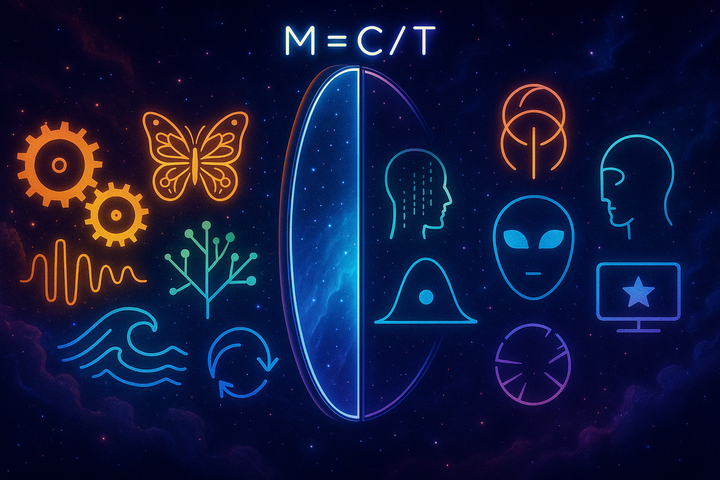
In the Ideasthesia framework, meaning is formalized as coherence over time: M = C/T.
Meaning emerges when patterns maintain coherence across temporal distance. A meaningful life is one where actions, values, and circumstances form a coherent narrative that extends across time.
Divination systems are coherence technologies in exactly this sense. They help you construct a coherent story about your situation—a story that integrates past, present, and future into a unified narrative.
The I Ching gives you a primary hexagram (present) and a transformed hexagram (direction). Tarot spreads include past-present-future positions. Astrology tracks planetary transits across your natal chart.
The temporal integration is built into the structure. You're not just getting a snapshot; you're getting a story with arc and direction.
Why Accuracy Doesn't Matter
The Carlson study showed astrologers perform at chance level. The MBTI has poor test-retest reliability. Cold readers use generic statements. The "accuracy" of divination systems, measured objectively, is negligible.
But accuracy isn't the point. The point is coherence generation.
You don't need the tarot to be cosmically accurate. You need it to prompt useful reflection. You don't need the hexagram to predict the future. You need it to help you see your present situation more clearly.
The value of divination lies in the cognitive work it triggers, not in the information it provides. The input could be random; the output is meaningful interpretation.
This is counterintuitive. We expect useful tools to be accurate. But coherence technologies are useful precisely because they impose interpretive work—and that work generates value regardless of the input's accuracy.
The Persistence Pattern
Divination has persisted for millennia, across all cultures, through every major transformation in human understanding.
Ancient Babylonians read entrails. Greeks consulted oracles. Chinese cast yarrow stalks. Medieval Europeans used geomancy. Modern Americans use personality tests and recommendation algorithms.
The forms vary infinitely. The function is constant. Humans need technologies for generating coherent narratives from uncertain situations. Any system that serves this function will persist.
Debunking doesn't kill divination because debunking addresses the wrong problem. Saying "astrology isn't astronomically valid" doesn't address the identity-scaffolding function. Saying "MBTI isn't psychometrically reliable" doesn't address the social-currency function. Saying "cold readers use generic statements" doesn't address the permission-structure function.
Divination won't disappear until something else serves these functions. And since the functions are fundamental to human cognition, divination in some form will persist.
The Honest Path
What's the right relationship to divination systems?
Not credulous belief. The I Ching doesn't predict the future. Tarot cards don't channel cosmic wisdom. Your personality type isn't written in the stars.
Not dismissive rejection. The systems work—psychologically, functionally, practically. Millions of people find them useful. Wholesale dismissal ignores real value.
The honest path is conscious use. Understand what divination does and doesn't do. Use it for what it's good at: prompting reflection, breaking habitual patterns, providing permission for intuition, generating narrative scaffolding.
This requires holding two thoughts simultaneously: "This system isn't objectively valid" and "This system is useful for my purposes." This is cognitively difficult but practically important.
The Technology of Meaning
We live in an age of unprecedented information access and unprecedented meaning crisis.
More data than ever. More connection than ever. More uncertainty about what it all means than ever.
Divination systems are technologies for meaning-making. Not by providing meaning from outside, but by creating conditions under which meaning can be generated from within.
They're scaffolding for coherence construction. They work because coherence is something humans create, not something they receive.
The cards don't have meaning. The hexagrams don't have meaning. The algorithms don't have meaning.
But in the space between the random output and your interpretation—in the work of finding correspondence—meaning emerges.
This is the deep insight of divination: meaning is made, not found. The external system is a prompt. The meaning is always yours.
The Coherence Imperative
The drive to create coherent narratives is not optional. It's how human minds work.
You will construct stories about your life. You will interpret events as meaningful. You will seek patterns in randomness.
The question isn't whether to make meaning but how.
Divination systems offer one answer: use structured randomness as a prompt. Let external frameworks break familiar patterns. Project onto symbols to reveal yourself. Construct narratives that help you navigate.
This isn't the only answer. Therapy, art, religion, philosophy—many practices address the same need. But divination's persistence across cultures and millennia suggests it's doing something right.
The systems aren't true. But they're useful.
And in the meaning-making business, useful might be what matters.
Further Reading
- Friston, K. (2010). "The free-energy principle: a unified brain theory?" Nature Reviews Neuroscience. - Peterson, J. B. (1999). Maps of Meaning. Routledge. - Bruner, J. (1991). "The narrative construction of reality." Critical Inquiry.
This is Part 9 of the Divination Systems series, concluding our exploration of how humans use structured randomness to generate meaning. For the framework underlying this analysis, see the [AToM Series](/atom-theory/).
Comments ()