The Science of Divination
Divination sounds like superstition, but it's doing something cognitively real. From cracking oracle bones to shuffling tarot cards, the practice of structured randomness has a surprisingly coherent function.
The Science of Divination
Humans have been asking the future for answers since before we had writing to record the questions.
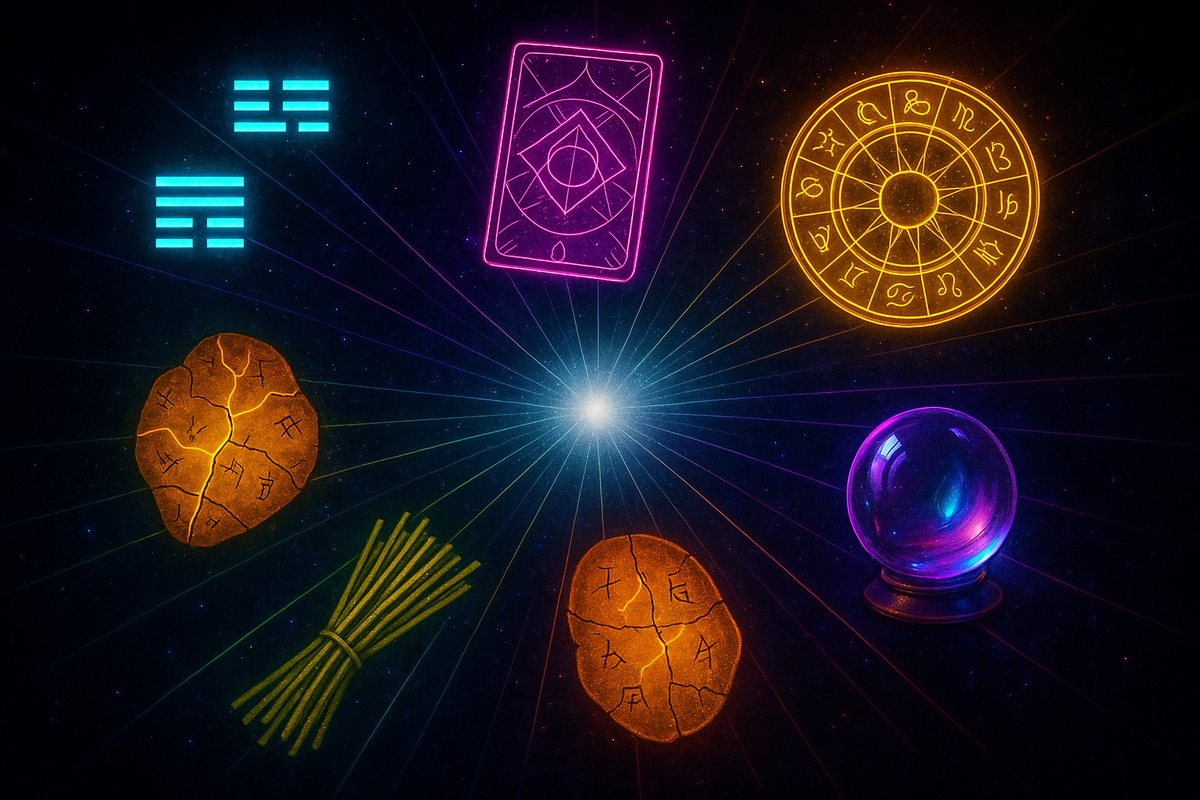
Bones cracked over fire. Entrails inspected for omens. Yarrow stalks cast according to ancient algorithms. Cards shuffled and laid in spreads. Stars mapped onto personality and fate. In every culture, in every era, people have consulted randomness for guidance—and believed it spoke back.
This is usually dismissed as superstition. But that dismissal misses something important.
Divination doesn't work the way practitioners think it works. The I Ching doesn't actually predict the future. Tarot cards don't channel cosmic wisdom. Your horoscope isn't astronomically meaningful. But divination does work—psychologically, functionally, and sometimes even rationally. And understanding why tells us something profound about human cognition.
What This Series Explores
This series approaches divination not as a believer or a debunker, but as a cognitive scientist asking: Why does this exist? What need does it serve? Why won't it die?
The answers are more interesting than "people are irrational."
Article 1: [Why Divination Works (Psychologically)](/divination-psychology/) — The mechanisms: projection, narrative scaffolding, decision fatigue relief
Article 2: [The I Ching: 3,000 Years of Structured Randomness](/i-ching-structured-randomness/) — The oldest and most mathematically elegant system
Article 3: [Tarot: How 78 Cards Became a Mirror](/tarot-psychology-mirror/) — From playing cards to archetypal projection device
Article 4: [Astrology: The Persistence of an Unfalsifiable System](/astrology-persistence-psychology/) — Why evidence doesn't kill belief
Article 5: [Oracles and Randomization: From Delphi to Decision Theory](/oracles-randomization-decision/) — The rational case for consulting chance
Article 6: [Cold Reading: How Psychics Simulate Insight](/cold-reading-techniques/) — The techniques behind the illusion
Article 7: [Why Smart People Believe](/smart-people-divination-belief/) — Intelligence doesn't protect against motivated cognition
Article 8: [Secular Divination: MBTI and Algorithms](/secular-divination-mbti-algorithms/) — Modern systems serving ancient functions
Article 9: [Synthesis: Divination as Coherence Technology](/divination-coherence-technology/) — Structured randomness as meaning-making tool
The Core Insight
Divination systems are coherence technologies. They take the chaos of uncertainty and give it narrative structure. They provide scaffolding for decisions that feel impossible to make rationally. They let us externalize our intuitions and then "discover" them as if they came from outside.
This isn't a bug. It's a feature—one that evolution has been selecting for across thousands of cultures and thousands of years.
The question isn't whether divination is "real." The question is: What is it actually doing? And why do we keep doing it?
Begin with [Why Divination Works (Psychologically)](/divination-psychology/).

Comments ()