DNA Data Storage: Biology as Hard Drive
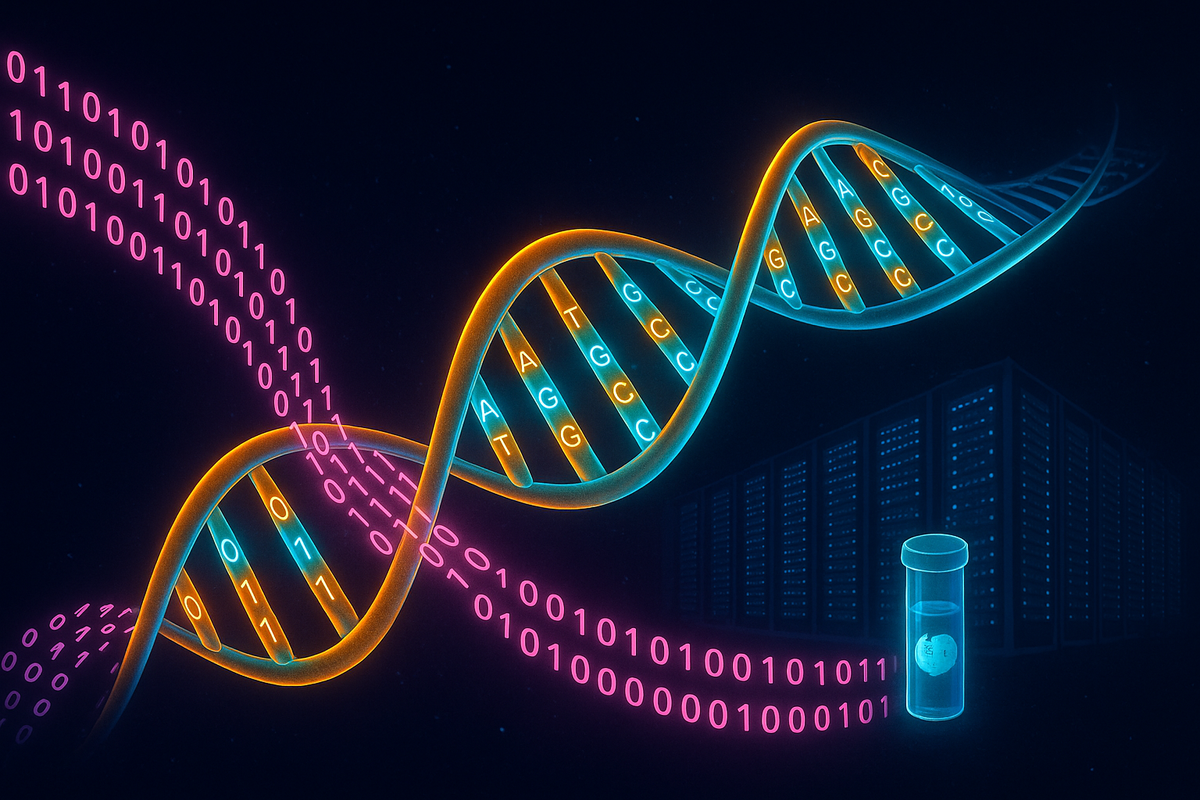
DNA is the densest information storage medium that exists. One gram holds 215 petabytes. Researchers at Harvard have already written — and read back — a full book encoded in synthetic DNA strands.
DNA Data Storage: Biology as Hard Drive
In 2012, George Church's lab at Harvard encoded a 53,000-word book into DNA. Not a metaphor. They took the digital file—including images and JavaScript code—and converted it to DNA sequences. They synthesized those sequences, stored them in a tube, and later sequenced them back to recover the original file, error-free. The book was Church's own Regenesis. The stunt was the proof of concept. DNA is an information storage medium. It's been storing the information of life for four billion years. What Church demonstrated was that it could store human information too—any digital data you want. The numbers are staggering. A single gram of DNA can theoretically store 215 petabytes of data. That's about 215 million gigabytes. All the movies ever made could fit in a space smaller than a sugar cube. All the data humans have ever produced could fit in a room. And DNA lasts. Properly stored, it remains readable for thousands of years. We've sequenced DNA from 700,000-year-old horse bones. Try that with a magnetic hard drive. DNA is the densest, most durable data storage medium known. And we're learning to use it.
How It Works
The basic principle is encoding: convert digital information (0s and 1s) into DNA sequences (As, Ts, Gs, Cs). One simple encoding: A = 00, T = 01, G = 10, C = 11. Every pair of bits becomes one nucleotide. Your digital file becomes a DNA sequence. In practice, encodings are more sophisticated. They avoid problematic sequences (very long repeats, high GC content, secondary structures) that are hard to synthesize or sequence. They add redundancy—error-correcting codes—so that if some bases are misread, the data can still be recovered. Once you have the sequence, you synthesize it. DNA synthesis has become routine. You send your sequence to a company like Twist Bioscience, and they mail you a tube with your DNA in it. To read the data back, you sequence the DNA. Modern sequencing is fast and cheap—and getting faster and cheaper every year. You reconstruct the digital file from the sequences. Write: bits → nucleotides → synthesis Read: sequencing → nucleotides → bits
The Milestones
Let's trace the history. 2012: Church's lab encodes Regenesis—52,000 words, images, and code—in DNA. About 700 kilobytes total. 2013: The European Bioinformatics Institute stores all 154 Shakespeare sonnets, an MP3, a JPEG, and a PDF in DNA. They demonstrate recovery with no errors. 2016: Microsoft and the University of Washington store 200 megabytes in DNA—including video and the Universal Declaration of Human Rights in over 100 languages. They demonstrate random access—reading specific files without sequencing everything. 2019: Catalog Technologies encodes the entire Wikipedia—16 gigabytes—in DNA. The information fits in a tube the size of a pencil eraser. 2021: Researchers demonstrate reading and writing DNA storage fully automated, without human intervention. Ongoing: Companies including Microsoft, Twist Bioscience, and DNA Script are working on making DNA storage commercially viable. Each milestone pushed the boundaries—more data, cheaper, faster, more practical. We're still in the early stages, but the trajectory is clear.
The Technical Challenges
DNA storage isn't ready to replace your hard drive. Several challenges remain: Synthesis cost. Writing DNA is expensive. Current costs are cents to dollars per base pair. Storing a gigabyte costs thousands of dollars. That has to drop by orders of magnitude for DNA to compete with tape. Synthesis speed. Current synthesis is slow—hours to days for meaningful amounts. For archival storage (write once, read rarely), this might be acceptable. For anything more interactive, it's not. Sequencing cost. Reading DNA has become cheap, but reading selectively—random access rather than sequential read—is harder. You can't easily read byte 4,523 without reading everything around it. Error rates. Both synthesis and sequencing introduce errors. Error-correcting codes help, but they add overhead. Robust encoding schemes trade density for reliability. Decay. DNA does degrade, especially if not stored properly. Cold, dry, dark conditions are needed for long-term preservation. Encapsulation in glass or silica helps. These challenges are engineering problems, not fundamental barriers. Synthesis costs have dropped dramatically over the past decade and will continue to drop. Sequencing costs have fallen even faster. The question isn't whether DNA storage is possible. It's when it becomes economical.
Random Access
One key advance: reading specific files without sequencing everything. In early demonstrations, the entire DNA pool was sequenced to recover data. That's like reading every book in a library to find one page. Researchers developed schemes for random access: PCR-based selection: Include unique "address" sequences in each data block. To retrieve a specific block, use primers that recognize that address. PCR amplifies just the targeted sequences. Sequence only those. Nanopore targeting: Some newer approaches use selective nanopore sequencing, reading only the molecules of interest. Spatial organization: Store different data files in different physical locations within a chip or well plate. Read only the location you need. Random access transforms DNA from a sequential archive to something more flexible. You can write data once and retrieve specific files on demand—like a biological file system.
The Business Case
Who would use DNA storage? Cold archives. Data that needs to be preserved for decades or centuries but rarely accessed. Legal records, medical data, cultural heritage, scientific datasets. Tape currently handles this, but DNA could do it better—denser, longer-lasting. Disaster recovery. DNA is chemically inert. It survives conditions that destroy electronic media. A small DNA capsule could preserve crucial data through disasters that wipe out data centers. High-security applications. DNA is easy to hide, hard to access without the right tools. For certain security applications, the obscurity might be valuable. Space. Launching mass to space is expensive—thousands of dollars per kilogram. DNA's extreme density makes it attractive for long-duration space missions where data needs to survive for years. The first markets will be niche—situations where density, durability, or longevity justify the cost premium. As costs drop, the addressable market expands. Microsoft has been particularly aggressive, announcing partnerships and research programs aimed at commercial DNA storage. They see it as the future of archival data.
The Information Perspective
Let's think about what's happening here. DNA has always been an information storage system. The genome encodes the information needed to build an organism. Evolution wrote that information over billions of years. Biology reads it continuously. What's new is using DNA to store our information—arbitrary digital data, not biological instructions. The molecule that carries the code of life now carries movies, books, and databases. This isn't as strange as it sounds. Information is information. The physics of storage doesn't care what the information means. DNA is a stable polymer that can encode arbitrary sequences. That's all you need. But there's something poetically satisfying about using life's own storage medium for human knowledge. The library of life and the library of humanity, encoded in the same molecules.
Longevity
DNA's durability is almost surreal. In 2013, researchers sequenced the genome of a 700,000-year-old horse from permafrost-preserved bone. The DNA had survived almost a million years. More routinely, we sequence DNA from thousands-year-old samples: Egyptian mummies, Neolithic humans, extinct megafauna. The information persists. What human technology can match that? The oldest readable books are perhaps 2,000 years old—and only because they were copied and recopied, not because the original medium survived. The oldest digital storage media are already unreadable after decades. DNA storage, properly implemented, could be the longest-lasting human records ever created. Data written today could be readable in 10,000 years—by whatever beings or machines exist then. We could write for posterity in a way no previous generation could.
Synthetic Biology Integration
DNA storage connects to the broader synthetic biology ecosystem. DNA synthesis advances are driven partly by demand for gene synthesis (making DNA for biological experiments) and partly by DNA storage ambitions. The markets reinforce each other. Sequencing technology continues improving, driven by genomics, medical diagnostics, and research. DNA storage benefits from all of it. DNA computing is a related field—using DNA molecules to perform computations. Storage and computation could eventually merge: DNA that both stores data and processes it. Biological cryptography: DNA could encode information in ways that require biological processes to decode—combining storage with security through biology. The synthetic biology toolkit gets stronger; DNA storage becomes more practical. The fields co-evolve.
The Philosophical Note
There's something profound about writing human culture into DNA. For four billion years, DNA has carried the information of life—the instructions for building organisms, evolving populations, creating the biosphere. Now it carries Shakespeare sonnets and Wikipedia. This is an expansion. The molecules that encoded bacteria and mammals now encode Bach and Einstein. The information substrate of biology becomes the information substrate of civilization. And DNA is universal. Any life form that can read DNA—future humans, future AIs, future aliens—could read what we write. We're using a format that's been validated by four billion years of evolution. DNA is not just a storage medium. It's a medium that connects us to life's deepest history—and potentially to its far future.
Further Reading
- Church, G. M., Gao, Y., & Kosuri, S. (2012). "Next-Generation Digital Information Storage in DNA." Science.
- Grass, R. N., et al. (2015). "Robust Chemical Preservation of Digital Information on DNA in Silica with Error-Correcting Codes." Angewandte Chemie.
- Organick, L., et al. (2018). "Random access in large-scale DNA data storage." Nature Biotechnology.
- Ceze, L., Nivala, J., & Strauss, K. (2019). "Molecular digital data storage using DNA." Nature Reviews Genetics.
This is Part 5 of the Synthetic Biology series. Next: "Genetic Circuits: Cells as Computers."
Comments ()