Dual Inheritance: How Genes and Culture Evolve Together
Most animals evolve one way: genetically. Humans run two inheritance systems simultaneously — genes and culture — and they co-evolve. Lactase persistence shows just how fast cultural change can reshape human biology.
Dual Inheritance: How Genes and Culture Evolve Together
Series: Gene-Culture Coevolution | Part: 2 of 9
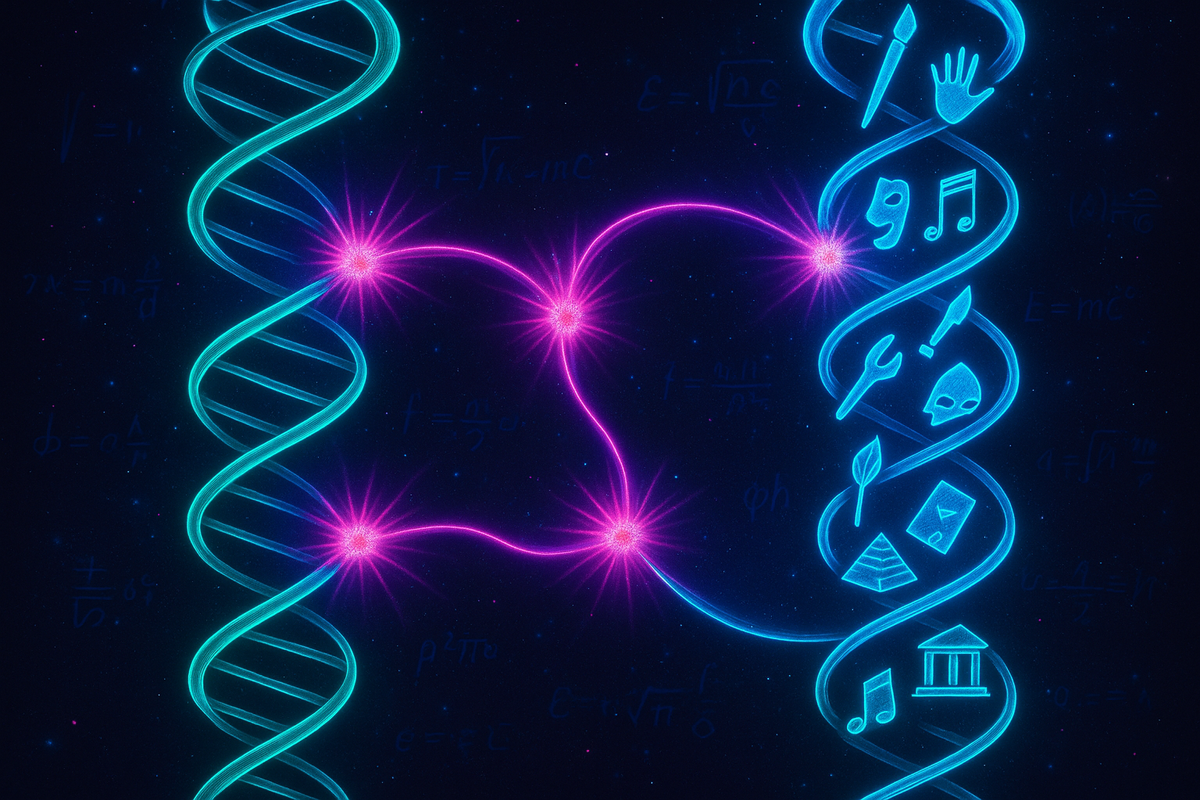
If you want to understand why humans are the way we are, you need to track two evolutionary processes simultaneously—one written in DNA, one written in behavior, artifacts, and social structures. This is dual inheritance theory, and it's the formal framework that makes sense of how genes and culture evolve together.
The core insight is deceptively simple: humans inherit information through two channels. But the implications are profound. Because these channels operate on different timescales, follow different rules, and interact in complex ways, dual inheritance creates evolutionary dynamics that look nothing like standard Darwinian selection.
The Two Channels
Genetic inheritance is the familiar story. You inherit half your genes from each biological parent. These genes were copied (mostly) faithfully from their parents, and so on back through deep time. Variation enters through mutation and recombination. Selection filters variants based on reproductive success. The process is vertical (parent to offspring), slow (generational), and conservative (mutations are usually harmful).
Cultural inheritance works differently. You inherit cultural information from parents, yes—but also from peers, teachers, media, institutions, and the broader environment. Cultural variants can spread horizontally (between unrelated individuals), rapidly (within a single generation), and selectively (you can choose which cultural practices to adopt). The process is promiscuous, fast, and highly responsive to environmental change.
The technical term for this is dual inheritance because you're inheriting from two systems at once. Robert Boyd and Peter Richerson formalized this framework in the 1980s, showing how cultural transmission creates evolutionary dynamics that require their own mathematical models, distinct from population genetics.
Why Cultural Evolution Isn't Just Fast Genetic Evolution
It's tempting to think of cultural evolution as just genetic evolution with the speed turned up. But that misses what makes culture genuinely different.
Culture can be Lamarckian. In genetic evolution, acquired traits don't pass to offspring. But in cultural evolution, they do. If you learn to make better stone tools, you can teach that skill directly. The improvement passes on immediately. Cultural evolution allows for the inheritance of learned adaptations—something genetic evolution cannot do.
Culture enables cumulative evolution. Most animal social learning involves copying what's currently being done. But humans build on previous generations' innovations. We start where our teachers left off and add our own improvements. This ratchet effect is why technology and knowledge accumulate over time instead of resetting with each generation.
Culture creates frequency-dependent selection. The fitness of a cultural trait often depends on how common it is. Speaking a rare language is disadvantageous; speaking the dominant language confers benefits. Wearing an unusual style might mark you as deviant or as a trendsetter, depending on context. These frequency dynamics create evolutionary patterns—like conformist bias and prestige bias—that have no genetic analog.
Culture can spread maladaptive traits. Genetic selection ruthlessly eliminates alleles that reduce reproductive success. But cultural practices can spread even when they're harmful. Smoking, extreme body modifications, celibate priesthoods—these reduce biological fitness yet persist because cultural transmission doesn't require genetic reproduction. Culture can carry practices that genes never would.
The Feedback Loops
The real magic happens when genetic and cultural evolution interact. This is where coevolution comes in—each system creating selection pressures on the other.
Culture Drives Genetic Evolution
When a cultural practice becomes widespread and persistent, it creates a new selection environment for genes.
Lactose tolerance is the textbook example. The cultural practice of dairy herding created an environment where digesting milk as an adult conferred nutritional advantages. This selected for genetic variants that maintain lactase production into adulthood. No dairy culture, no selection pressure. The gene spread because of the culture.
Fire use and cooking created selection for smaller teeth, weaker jaws, and shorter digestive tracts. Cultural externalization of food processing relaxed constraints on gut size, freeing up metabolic resources for brain expansion.
Language likely drove selection for neural architecture supporting syntax, phonological processing, and theory of mind. As proto-linguistic communication became culturally entrenched, genetic variants that improved linguistic capacity would have been strongly favored.
In each case, culture altered the fitness landscape, and genes evolved in response. The cultural environment becomes part of the selective environment.
Genes Enable Cultural Evolution
The reverse also holds. Genetic changes can open up new possibilities for cultural transmission.
Theory of mind—the ability to model others' mental states—is partly genetic. But it's also the foundation for most cultural learning. You can't learn by imitation if you can't infer intention. You can't teach if you can't model what the learner doesn't know. Enhanced theory of mind capacity, genetically evolved, enabled vastly richer cultural transmission.
Extended childhood is another gene-enabled cultural accelerator. Humans have the longest juvenile period of any primate. This creates an extended window for cultural learning before reproductive maturity. The genetic change (slower development) enabled more complex cultural acquisition.
Neural plasticity is the biological substrate for cultural flexibility. Brains that remain plastic longer can absorb more cultural information and adapt to diverse cultural environments. Greater genetically-based plasticity enables greater cultural diversity.
The Coevolutionary Spiral
When culture drives genetic change, and genetic change enables richer culture, you get a positive feedback loop. Better cultural transmission creates selection for biology that supports it. Better biology enables more sophisticated culture. This spirals upward, creating a coevolutionary ratchet that may explain the rapid brain expansion in human evolution.
This is Peter Richerson and Robert Boyd's argument for why human brains got so big so fast: cultural evolution created selection for better cultural learners, which enabled more complex culture, which intensified selection for even better learning capacity. The two systems locked into mutual acceleration.
Modeling Dual Inheritance
Boyd and Richerson developed mathematical models to formalize dual inheritance dynamics. The key insight is that you need to track both genetic and cultural variants simultaneously, accounting for how each affects the transmission of the other.
A simple model might track:
- Genetic alleles (A vs. a)
- Cultural variants (B vs. b)
- How cultural variant affects genetic fitness
- How genetic variant affects cultural transmission
The math quickly gets complex, but the framework reveals patterns impossible to see with genetic-only models.
One key finding: cultural group selection can maintain cooperation at much larger scales than genetic group selection. Because culture transmits rapidly and can include strong conformist biases, cultural groups can maintain behavioral uniformity even when genetic groups cannot. This may explain why humans cooperate with strangers in ways no other primate does.
Another finding: runaway cultural evolution can occur when a cultural trait increases its own transmission success without increasing genetic fitness. Fashion, prestige symbols, and some forms of religious extremism may be examples. The cultural variant spreads because it's good at spreading, not because it's good for genes.
What Dual Inheritance Explains That Other Theories Don't
Human universals: We all have the biological capacity for dual inheritance—language acquisition, imitative learning, norm psychology. These are species-universal because they're genetically specified.
Human diversity: The content of culture varies wildly because cultural evolution is fast and context-dependent. We're running the same evolutionary software with radically different cultural inputs.
Rapid behavioral change: Humans can transform their behavior in a generation without genetic change. Cultural evolution allows for adaptive tracking of environmental variation on timescales where genetic evolution is helpless.
Maladaptive persistence: Some cultural practices harm genetic fitness yet endure for generations. Standard evolution can't explain this. Dual inheritance can: cultural transmission has its own evolutionary logic, sometimes orthogonal to genetic fitness.
The human trajectory: The acceleration of human cognitive and cultural complexity over the past 100,000 years is too fast to be purely genetic. But it makes sense as a coevolutionary spiral where culture and genes amplified each other.
The Geometry of Dual Inheritance
In AToM terms, dual inheritance is a system where coherence maintenance operates across two coupled substrates—biological and cultural.
Genetic coherence is maintained through Darwinian selection: variants that preserve viable form persist. Cultural coherence is maintained through social learning: practices that function well enough to be transmitted persist. The coupling between these substrates creates emergent dynamics where each system shapes the other's landscape of possibility.
This is why humans are constructors at two levels. We construct our biological form through genetic inheritance. And we construct our cultural form through learned inheritance. The interaction between these construction processes creates a species capable of rewriting its own evolutionary trajectory.
We're not just evolved. We're coevolved—products of two inheritance systems so deeply entangled that neither can be understood without the other.
This is Part 2 of the Gene-Culture Coevolution series, exploring how genes and culture evolve together to make humans uniquely human.
Previous: The Missing Half of Evolution: Why Culture Changes Everything
Next: Why Humans Are Cultural Apes: The Cognitive Equipment for Culture
Further Reading
- Boyd, R., & Richerson, P. J. (1985). Culture and the Evolutionary Process. University of Chicago Press.
- Richerson, P. J., & Boyd, R. (2005). Not by Genes Alone: How Culture Transformed Human Evolution. University of Chicago Press.
- Henrich, J., & McElreath, R. (2003). "The Evolution of Cultural Evolution." Evolutionary Anthropology, 12(3), 123-135.
- Laland, K. N., & Brown, G. R. (2011). Sense and Nonsense: Evolutionary Perspectives on Human Behaviour (2nd ed.). Oxford University Press.
Comments ()