Dune and Attractor Basins: Paul Had to Do Jihad
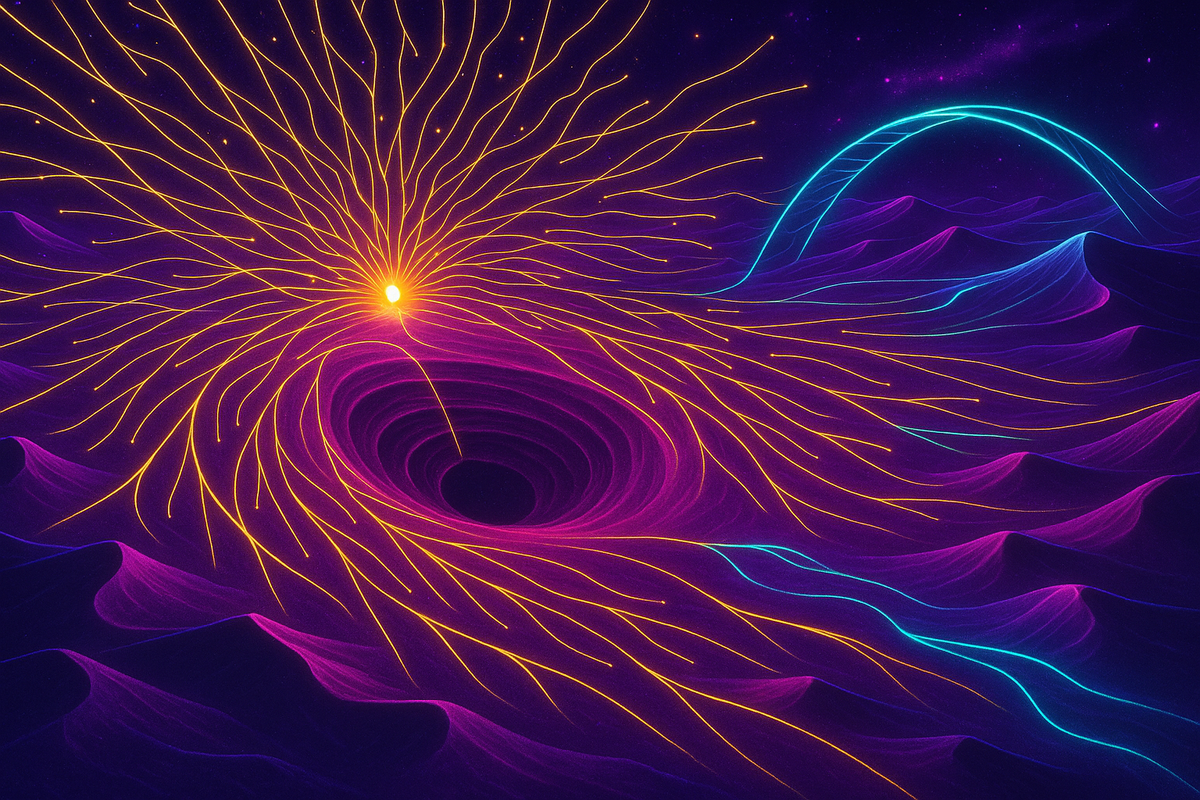
Paul Atreides has perfect foresight and no good options. Herbert built Dune around a dynamical systems concept: attractor basins — regions of possibility space that funnel all nearby trajectories toward the same outcome, no matter what any individual chooses.
Dune and Attractor Basins: Paul Had to Do Jihad
In 1965, Frank Herbert published Dune—a novel that remains one of the most sophisticated treatments of prescience, determinism, and agency in science fiction.
The hero, Paul Atreides, gains the ability to see the future. Not one future—many. He sees branching possibilities, probability distributions, paths that converge and diverge.
And then something terrible happens.
Paul sees that almost all paths lead to the same destination: a galactic jihad in his name that will kill billions. The few paths that avoid this outcome require his death. The more power he gains, the more certain the jihad becomes.
Paul can see the future. Paul cannot escape the future.
Herbert understood something that wouldn't be formalized in physics for another decade: attractor basins. Some outcomes are so stable that once you enter their region of state space, you're drawn inexorably toward them. You can see the attractor. You cannot escape its pull.
The Complexity Theory of Prescience
Paul's prescient visions aren't magic. Herbert treats them as a form of computation—running simulations on available information to calculate probable futures.
This is important. Paul doesn't see fate as a mystical decree. He sees probability as mathematical reality.
And what he sees is terrifying: the dynamics of the system he's embedded in have an attractor.
Here's how attractors work: In complex systems, certain states are stable. The system tends to evolve toward them and, once near them, tends to stay near them. These are attractor basins.
Think of a ball on a landscape. The valleys are attractors. If you place the ball on a slope, it will roll toward the nearest valley. It might bounce around on the way, but it's going to end up in a valley.
Paul sees that "galactic jihad" is a deep valley. The political, economic, religious, and ecological dynamics of his universe slope toward it. Almost everywhere he starts, almost every choice he makes, leads to that basin.
Why Paul Had No Choice
Let's trace Paul's trap.
He cannot not be prescient. The Bene Gesserit breeding program, the spice of Arrakis, his training—these converge to make him the Kwisatz Haderach. The setup precedes him by centuries.
He cannot not become a leader. His father's death, his family's allies, the Fremen prophecies—these make leadership inevitable. He cannot disappear. He cannot be ordinary.
He cannot prevent the Fremen from deifying him. The Missionaria Protectiva has seeded the religion for generations. Paul is the prophesied figure whether he claims the role or not.
He cannot prevent the jihad. Once he's a messianic figure leading a militarized religious movement, the dynamics are set. Even if he tried to stop it, his followers would continue it in his name. The movement has its own momentum.
Paul can see all this. Paul sees the paths that avoid the jihad—and they all require him to die before gaining power, or to never reach Arrakis, or to be someone other than who he is.
The trap is structural. It's not that Paul makes bad choices. It's that the system has an attractor, and Paul is already in its basin.
The Tragedy of Prescience
Here's Herbert's insight: seeing the future doesn't mean escaping the future.
Naive sci-fi treats prescience as power. If you can see what's coming, you can change it. Dodge the bullet. Take a different path.
But Herbert understood that knowing the future might trap you in it.
First, because the paths that avoid the bad outcome might require things you're not willing to do. Paul could prevent the jihad by dying. But Paul doesn't want to die. So he chooses paths that preserve his life—paths that lead to jihad.
Second, because your knowledge changes the system, but not always in the direction you want. Paul's attempts to mitigate the jihad might make it worse. The harder he tries to escape the attractor, the more energy he adds to the system—energy that can be captured by the attractor.
Third, because the attractor isn't one outcome but a basin of outcomes. The jihad might kill 60 billion or 80 billion. Paul can affect the numbers. But he can't escape the category.
Herbert Knew the Math
Frank Herbert wrote Dune before chaos theory and complexity theory were named. But he was reading cybernetics, systems theory, and ecology—the precursors.
His desert ecology is remarkably sophisticated. The sandworm-spice-sandtrout cycle is a genuine ecosystem with feedback loops. The terraforming plan involves century-scale dynamics.
His political analysis is systems-based. He understands how charismatic leadership, resource dependency, and religious fervor create dynamics that outlast individuals.
The prescience in Dune is a literary device for making the reader see what Herbert already saw: that large-scale systems have their own dynamics, and individuals—even powerful, knowledgeable individuals—are often trapped within them.
Paul is the reader's avatar for learning this terrible lesson.
Messiah and Children: The Lesson Continues
The sequels (Dune Messiah, Children of Dune) extend the lesson.
In Messiah, Paul's jihad has killed 61 billion people. He's achieved everything—and lost everything. He has prescient visions of his children, his enemies, his doom. He can see the paths, and the paths are all bad.
Paul's solution? He walks into the desert, blind, to die. He removes himself from the system. He gives up.
In Children of Dune, Paul's son Leto II takes the lesson further. He sees an even deeper attractor: human extinction. To escape it, he must become something inhuman—a sandworm-human hybrid who will live for millennia, enforcing a tyranny so stifling that humanity will eventually scatter across the galaxy, becoming immune to any single catastrophe.
Leto II sees the attractor. Leto II spends 3,500 years engineering an escape from its basin.
Herbert's point is brutal: if you're already in the basin, escaping requires sacrifices that most people won't make. Paul couldn't. Leto could—but at the cost of his humanity.
The Golden Path as Basin Escape
Leto II's "Golden Path" is a complexity-theory concept in narrative form.
The attractor basin for human civilization is stagnation and eventual extinction. Leto sees this. Every empire centralizes until it becomes brittle. Every species stabilizes until it loses adaptability.
Leto's solution: enforce artificial pressure that scatters humanity across countless worlds, making the species robust through diversification. His millennia of tyranny is a basin-escape strategy—deliberately making conditions so bad that humanity explodes outward when he finally dies.
This is sophisticated systems thinking. Leto isn't preventing a bad outcome. He's engineering a state-space escape—moving humanity from a basin that ends in extinction to a configuration that lacks that attractor.
Herbert understood that some problems can't be solved by choosing correctly. They require restructuring the system so the bad attractor disappears.
What Dune Says About Choice
Here's the uncomfortable thesis Dune proposes:
Individual agency is real but bounded. Paul makes choices. His choices matter. But his choices operate within a system that has its own dynamics. The system constrains the effects of his choices.
Knowing the future doesn't give you power over it. Paul sees more than anyone. He understands the system better than anyone. And he still cannot escape.
Some outcomes are attractors. They're not fated—a different system wouldn't have them. But given this system, with these dynamics, they're effectively inevitable.
Escaping an attractor requires changing the system, not choosing differently within it. Paul couldn't escape by making better choices. Leto escaped by becoming something capable of engineering a different system.
This is a darker view of agency than most fiction offers. It's also more realistic. Many of our greatest challenges—climate change, systemic inequality, technological risk—are attractor problems. The dynamics slope toward bad outcomes. Individual choices help at the margins. Systemic change is what actually matters.
The Herbert Insight
Frank Herbert wrote Dune as a warning about charismatic leaders and messianic thinking.
But the deeper warning is about the trap of systems—the way dynamics can create outcomes that no one wants but no one can prevent.
Paul isn't evil. Paul isn't stupid. Paul isn't even really wrong. He's a good person with perfect information making reasonable choices, and he still ends up leading a jihad that kills billions.
The system is the villain. The attractor is the trap. And the only escape is to see the system as the system, not as a series of individual choices.
This is what Dune teaches: read the system, not just the choices. See the basin, not just the path. Understand that some outcomes are structural, not moral.
Paul had to do jihad. Not because he was destined to. Not because he chose to. Because the system had an attractor, and he was already inside it.
Further Reading
- Herbert, F. (1965). Dune. Chilton Books. - Herbert, F. (1969). Dune Messiah. Putnam. - O'Reilly, T. (1981). Frank Herbert. Frederick Ungar Publishing.
This is Part 3 of the Science Fiction Mirror series. Next: "[The Matrix and Wormholes: Neo Had More Choices](/matrix-wormholes-choice/)."
Comments ()