Embedded Cognition: Mind in Context
Your brain doesn't solve problems in isolation — it recruits the environment. Embedded cognition argues that the world's structure is part of the cognitive system, not just a backdrop to it.
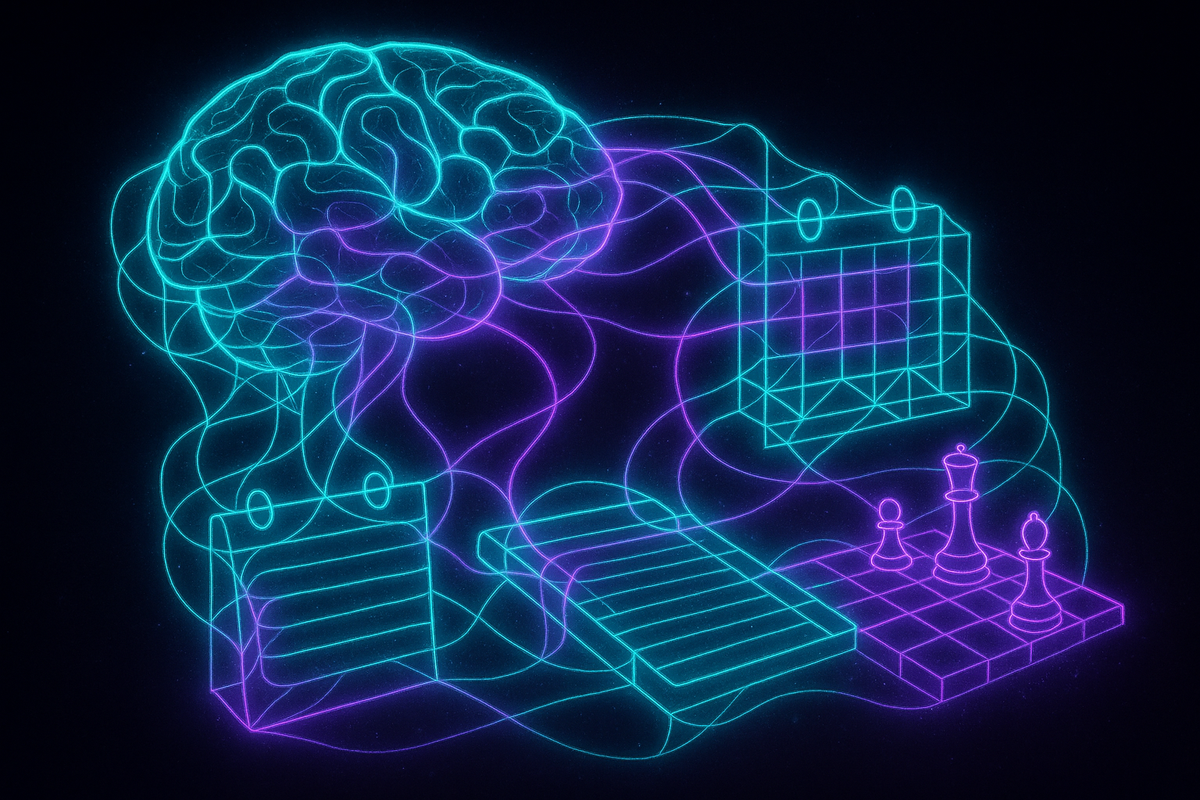
Embedded Cognition: Mind in Context
Series: 4E Cognition | Part: 3 of 9
A chess grandmaster glances at a board mid-game and sees not pieces but possibilities—threats, tactics, strategic imbalances. A novice sees the same physical configuration but perceives something entirely different: isolated pieces in arbitrary positions.
What changed? Not the board. Not the eyes. The embedding.
The grandmaster has thousands of hours coupling with chessboard structure—learning legal moves, tactical patterns, positional principles. This coupling makes certain information environmentally available without internal computation. The board itself does part of the cognitive work.
This is embedded cognition: the recognition that minds don't exist in isolation but are structured by—and structure themselves around—environmental regularities. Cognition isn't computation happening inside skulls that happens to use external inputs. Cognition is a process distributed across brain and world, with environmental structure reducing, shaping, and enabling what would otherwise be impossibly expensive internal processing.
The environment isn't a problem to be solved. It's part of the solution.
Epistemic Actions: Changing the World to Think Better
Watch someone playing Tetris at high speed. They don't just mentally rotate pieces—they physically rotate them using the game controls, then visually perceive the result. Rotating the piece in the world is faster and more reliable than mentally rotating an internal representation.
David Kirsh and Paul Maglio called these epistemic actions—actions performed not to advance toward a goal directly but to change the world in ways that make thinking easier. You're not rotating the piece to place it (pragmatic action). You're rotating it to see if it fits (epistemic action).
Epistemic actions are everywhere once you notice them:
- Spreading documents across a desk to see relationships
- Talking out loud to organize thoughts
- Drawing diagrams to understand structure
- Rearranging scrabble tiles to find words
These aren't crutches for limited minds. They're efficient uses of environmental structure to reduce internal computational load. The mind extends its working space into the world.
The 20 Questions Study
Kirsh showed people playing Twenty Questions exhibit two strategies. Some ask questions purely for information ("Is it animal?"). Others ask questions that also restructure the problem space ("Is it bigger than a breadbox?" chunks the space into regions).
The second strategy is faster and more successful—not because those players have better memory or logic, but because they use questions as tools to scaffold their own thinking. They embed their reasoning in a structure they're actively constructing.
This is embedded cognition in action: using the environment (here, the question sequence) to maintain state and structure that would be expensive to maintain internally.
Stigmergy: When the Environment Remembers for You
Termites build complex mounds with ventilation systems, fungal gardens, and royal chambers. They do this without architects, blueprints, or central coordination. How?
Stigmergy: coordination through environmental traces. A termite deposits mud. The next termite, encountering elevated mud, deposits more there. The environment accumulates modifications that guide future action. The "plan" for the mound exists nowhere internally—it emerges from local interactions mediated by environmental structure.
Human cognition works similarly more often than we admit.
You don't remember every appointment—your calendar does. You don't track every task—your to-do list does. You don't maintain awareness of which emails need replies—your inbox does. These aren't failures of biological memory. They're efficient uses of reliable external structure.
The environment becomes a memory prosthesis, but calling it "prosthesis" implies something's broken. Nothing's broken. This is how embedded cognition works: distributing cognitive load across whatever substrate reliably maintains the necessary structure.
Situated Learning: Why Apprenticeship Works
Jean Lave and Etienne Wenger's research on situated learning showed that expertise develops not through abstract instruction but through participation in communities of practice. You learn to be a tailor by tailoring alongside master tailors, embedded in an environment rich with tools, materials, social norms, and ongoing projects.
The learning isn't about transferring abstract knowledge from expert to novice. It's about the novice becoming embedded in the same environmental structure that supports expert performance. The tools, the workspace layout, the workflow patterns, the social expectations—these aren't neutral context. They're part of the cognitive system that constitutes tailoring expertise.
This explains why knowledge often doesn't transfer across contexts. A student who can solve physics problems in class struggles with the same physics in real-world situations—not because they "don't really understand" but because the cognitive system that solved classroom problems was embedded in classroom structure (equations on boards, worked examples, professor hints). Outside that embedding, the system functions differently.
The Cognitive Niche
Kim Sterelny's concept of cognitive niche construction extends this: humans don't just adapt to environments—we actively structure environments to support our cognitive needs. We create libraries, filing systems, notation schemes, social institutions. These aren't for cognition happening elsewhere. They're components of the distributed cognitive systems we build.
Written language is the paradigmatic example. It doesn't capture thoughts you already had—it enables thoughts you couldn't otherwise think. Mathematical notation doesn't record calculations—it makes calculations tractable that would be impossible without external symbol manipulation.
We construct niches that extend our cognitive capacity, then embed ourselves in those niches.
Distributed Cognition: Thinking Across Persons and Artifacts
Ed Hutchins's study of Navy ship navigation showed that successful navigation emerges from a system including sailors, instruments, charts, protocols, and communication patterns. No individual knows everything. The "cognition" that maintains safe passage is distributed across the whole crew-plus-tools ensemble.
A sailor takes a bearing. Another records it on a chart. A third computes position from multiple bearings. The protocol coordinates these activities. The instruments extend perceptual range. The chart maintains spatial relationships too complex for working memory.
Where is the "navigation cognition"? Not in any individual brain. It's a property of the distributed cognitive system spanning persons and artifacts in tight functional coupling.
This seems exotic until you realize all complex cognition works this way. A surgical team distributing awareness of patient state across monitors, instruments, team roles. A software team distributing code knowledge across documentation, version control, and social memory. A writer distributing thought across notes, outlines, drafts, and feedback.
We've organized our world to make distributed cognition the norm, not the exception.
Environmental Scaffolding: Structure That Enables Performance
A key insight from embedded cognition: the right environment makes hard things easy. Not easier—easy. The difficulty is in the fit between cognitive system and environment, not in the task itself.
Cognitive Offloading
You could memorize every appointment, but why? Calendars are more reliable. You could mentally track every chess position you're analyzing, but why? Moving pieces on a board is faster and less error-prone.
Cognitive offloading isn't laziness—it's adaptive. Use external structure when it's more reliable, faster, or less effortful than internal processing. This frees internal resources for tasks that require them.
People with ADHD often excel at cognitive offloading—they have to build external structure to maintain coherence. The strategies they develop (color-coding, spatial organization, visual reminders) aren't compensations for deficit. They're sophisticated uses of embedded cognition that neurotypical people could benefit from.
The Scrabble Study
Expert scrabble players don't just have better memory for words. They've learned to see words in letter arrangements. The tiles themselves suggest possibilities through their perceptual organization. This is environmental scaffolding: the physical arrangement of tiles does cognitive work that would otherwise require expensive internal search.
Designers leverage this constantly. Good interface design doesn't just present information—it structures information spatially and temporally to minimize cognitive load. Bad design makes users maintain structure internally that should be in the environment.
The Dark Side: Environmental Manipulation
If cognition is embedded, then controlling environments controls cognition. This isn't paranoia—it's mechanism.
Attention engineering in social media exploits embedded cognition. Infinite scroll removes natural stopping points. Red notification badges trigger completion urgency. Recommendation algorithms structure information access. These environmental features shape cognitive patterns—what you attend to, how long you engage, what you remember.
You're not "weak-willed" for getting sucked into feeds. Your cognition is embedded in environments designed by teams of engineers optimizing for engagement. The environment is structuring your cognitive behavior, and doing it effectively.
Similarly, casino design embeds players in environments that eliminate time cues, create immersive sensory environments, and remove friction from monetary transactions. The gambling happens in a person, but the cognitive system maintaining gambling behavior spans person and environment.
Recognizing embedded cognition means recognizing how deeply environment shapes thought and behavior—for good and ill.
The Geometry of Environmental Coherence
In AToM terms, embeddedness means environmental structure reduces the complexity of coherence maintenance. When relevant information is reliably available in the world, you don't need expensive internal models. When action scaffolds align with affordances, behavior flows smoothly. When social norms provide predictable patterns, coordination becomes effortless.
Coherence is maintained through brain-body-world coupling. The world isn't outside the system—it's part of the manifold on which coherence exists.
This is why environmental mismatch creates suffering. ADHD isn't a deficit in a brain—it's a mismatch between a cognitive style and environments designed for different processing. Put that same "disordered" brain in the right environment (high novelty, immediate feedback, externalized structure), and the disorder dissolves.
Autism isn't broken social cognition—it's cognitive processing embedded in environments with different structure than neurotypical processing expects. Change the embedding (reduce sensory unpredictability, clarify social expectations, remove ambiguity), and autistic people function smoothly.
The problem isn't the brain. The problem is the embedding.
Implications: Design for Embeddedness
If cognition is embedded, then designing better lives means designing better embeddings.
Personal: Structure your environment to support the cognition you want. Visual reminders for attention. Spatial organization for memory. Reduced friction for desired behaviors. Increased friction for undesired ones.
Social: Build institutions that provide reliable scaffolding. Clear procedures reduce coordination costs. Consistent norms enable effortless interaction. Thoughtful architecture shapes behavior without coercion.
Therapeutic: Many "disorders" are embedding mismatches. Environmental redesign isn't avoiding the "real" problem—it's addressing the actual mechanism. You maintain coherence through coupling, and the environment is half of every coupling.
Further Reading
- Hutchins, E. (1995). Cognition in the Wild. MIT Press.
- Kirsh, D., & Maglio, P. (1994). "On Distinguishing Epistemic from Pragmatic Action." Cognitive Science, 18(4), 513-549.
- Lave, J., & Wenger, E. (1991). Situated Learning: Legitimate Peripheral Participation. Cambridge University Press.
- Sterelny, K. (2003). Thought in a Hostile World: The Evolution of Human Cognition. Blackwell.
- Clark, A. (2008). Supersizing the Mind: Embodiment, Action, and Cognitive Extension. Oxford University Press.
This is Part 3 of the 4E Cognition series, exploring how cognitive science moved beyond the brain.
Previous: Embodied Cognition: Why Bodies Shape Minds
Next: Enacted Cognition: Bringing Forth a World
Comments ()