Embodied Cognition: Why Bodies Shape Minds
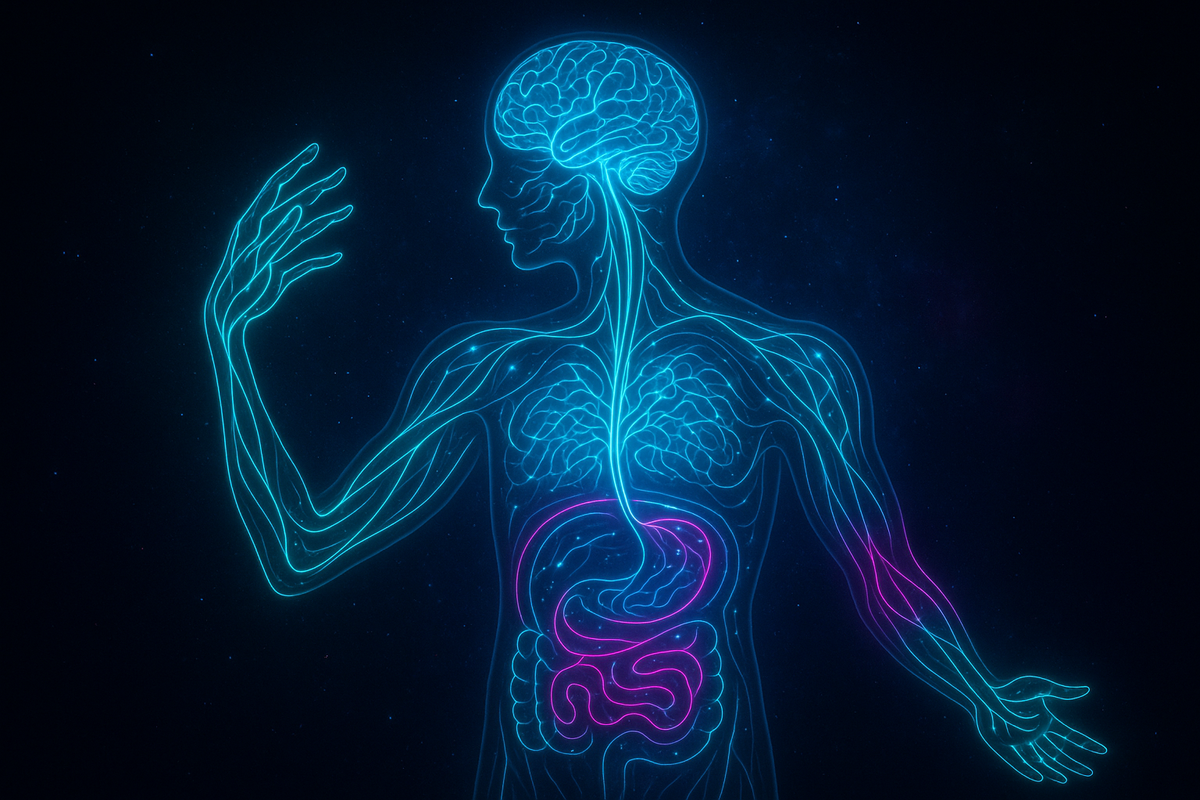
Cognition isn't something that happens inside the skull and then steers the body. Embodied cognition argues the body is constitutive of thought — shaping concepts, memory, and reasoning from the ground up.
Embodied Cognition: Why Bodies Shape Minds
Series: 4E Cognition | Part: 2 of 9
There's a moment in learning to drive stick shift when the clutch stops being a mechanical problem and becomes part of your body. You stop thinking about the pedal and start thinking through it. The boundary between you and machine blurs. Your foot knows things your verbal mind doesn't.
This isn't poetic license. It's embodied cognition: the recognition that thinking happens through bodies, not just in brains using bodies as input devices.
The classical view treated bodies as peripherals—sensory input ports and motor output channels for a central processing unit located in the skull. But the more carefully we look, the more it becomes clear that bodies aren't for cognition. Bodies are cognition—or at least, they're inseparable parts of cognitive systems that can't be cleanly divided into "processor" and "environment."
Your body isn't a meat puppet controlled by your brain. Your brain is one organ in a whole-body system that thinks together. And the particular kind of body you have—its morphology, its sensory resolution, its autonomic patterns—shapes what and how you can think.
This matters for everything from therapy to AI to understanding why meditation works. If cognition is embodied, then you can't fix minds by targeting brains alone. You have to work with the whole system.
The Body Keeps the Score (And Does the Math)
Consider how you count. If you learned mathematics in a Western context, you probably visualize numbers on a line extending left to right. This feels natural, inevitable—the way numbers are.
But the YUPNO people of Papua New Guinea don't use a mental number line. They gesture numbers spatially along the landscape—uphill and downhill, matching the topography they navigate daily. For them, "counting" is inseparable from moving through terrain. The body's experience of space structures numerical cognition.
Or consider Rafael Núñez's work on mathematical abstraction. Even advanced mathematics—limits, infinity, continuity—relies on conceptual metaphors grounded in bodily experience. We understand abstract concepts by mapping them onto spatial relations (more is up, less is down), containment (sets as containers), and motion along paths.
There's no escape from embodiment, even in the most abstract thinking. You don't transcend the body to think—you think through the body's possibilities.
Gesture: Thinking Made Visible
Watch someone explain a complex idea. Their hands move—not as decoration, but as part of the thinking itself. Susan Goldin-Meadow's research shows that gesture precedes verbal insight. Children solving math problems often gesture correct solutions before they can articulate them verbally.
This isn't the brain using hands to communicate thoughts it's already formed. It's the brain-body system thinking in gesture and space, with verbalization coming later as a translation.
Even when gestures don't communicate anything to observers—when people gesture while on the phone, or in the dark—they still improve performance on spatial and abstract reasoning tasks. The gestures are for the thinker, not the audience. They're part of the cognitive process itself.
The Gut-Brain Axis: When Your Stomach Thinks
Your gut contains roughly 500 million neurons—more than in the spinal cord. This enteric nervous system regulates digestion, yes, but it also sends more signals to the brain than it receives from it.
The gut produces 90% of the body's serotonin. It hosts trillions of microbes that influence neurotransmitter production, inflammation, and immune response—all of which affect mood, decision-making, and cognition. Gut microbiome composition correlates with anxiety, depression, and even autism.
This is embodiment at the biochemical scale. You can't understand cognition by studying neurons alone when gut bacteria are producing molecules that modulate neural signaling.
Antonio Damasio's somatic marker hypothesis makes this explicit: decisions aren't made through pure reason. The body generates affective signals—gut feelings, literally—that mark options as attractive or aversive before conscious deliberation. People with damage to brain regions processing bodily signals don't become more rational—they become paralyzed by indecision.
The body isn't noise the brain filters out. The body is signal the brain depends on.
Proprioception: The Sense You Didn't Know You Had
You know where your hand is right now without looking. This isn't vision or touch—it's proprioception, the sense of body position and movement. Proprioceptive feedback creates the felt sense of embodiment, the "here-ness" of being in a body.
When proprioception fails—as in rare neurological conditions—people lose the ability to coordinate movement even though muscles and motor neurons work fine. Ian Waterman, who lost proprioception after a viral infection, had to visually monitor his body to perform any action. Without proprioceptive feedback, his brain couldn't generate coherent motor commands.
This reveals something crucial: motor control isn't the brain sending instructions to a passive body. It's the brain and body continuously coupled through sensory feedback loops. Movement emerges from this coupling—you can't separate "planning" from "executing" because they happen together through proprioceptive loops.
For embodied cognition, this means the body isn't downstream of thought. The body is the medium through which thought-action emerges as an inseparable unity.
Why Bodies Constrain (and Enable) Minds
The morphology of your body determines what you can perceive and how you can act. This isn't limitation—it's specification. A body is a particular way of coupling with the world, and cognition is shaped by that coupling.
Sensory Resolution
Your fingertips have far denser mechanoreceptors than your back. This isn't arbitrary—it reflects how you interact with objects. Your visual fovea has higher resolution than peripheral vision because you move your eyes to center relevant information.
Different sensory resolutions create different perceptual worlds. A tick perceives three things: warmth, butyric acid (mammal sweat), and angles (for dropping from branches onto hosts). That's its entire phenomenology, determined by its receptor complement.
Humans have richer perceptual worlds not because of "better" brains but because of richer sensorimotor coupling. More sensors, finer control, more degrees of freedom in action—all body features that enable different cognitive capacities.
Morphological Computation
Engineers have discovered that robot bodies can compute solutions to control problems. A passive walking robot exploits gravity and limb dynamics to walk downhill without any control system. The body's physical structure does the computation.
This is morphological computation: using body mechanics to solve problems that would otherwise require expensive neural processing. Octopuses distribute control across arms that have local nervous systems. Each arm can respond to local conditions without waiting for central commands.
For cognition, this means intelligence isn't just neural. The particular structure of bodies enables certain computations while making others impossible. Cognition emerges from brain-body-world coupling, and the body's contribution is computational, not just mechanical.
The Predictive Body: Interoception and Coherence
The brain doesn't just receive signals from the body—it predicts them. Interoception is the perception of internal bodily states: heart rate, breathing, hunger, arousal. And according to predictive processing accounts (particularly Karl Friston's active inference), the brain is constantly generating predictions about what interoceptive signals should be, given current goals and contexts.
When predictions match incoming signals, you feel embodied coherence—the sense of being smoothly integrated with your body. When predictions mismatch—as in anxiety, dissociation, or trauma—you experience disembodiment, the felt sense that your body is alien or threatening.
This makes embodiment itself a kind of inference. You don't simply "have" a body. You construct a coherent model of yourself-as-embodied through continuous prediction and error correction.
Trauma as Embodied Prediction Error
Bessel van der Kolk's The Body Keeps the Score documents how trauma lodges in the body. PTSD isn't just disturbed memory—it's chronic interoceptive prediction error. The body generates threat signals (elevated heart rate, shallow breathing, muscle tension) that don't match safe contexts, and the brain can't update its predictions.
This is why talk therapy alone often fails for trauma. You can verbally understand that you're safe, but if your body keeps signaling danger, the predictive model doesn't update. Effective trauma therapy—EMDR, somatic experiencing, yoga—works directly with bodily states to help the system learn new predictions.
Embodiment means healing requires bodies, not just beliefs.
The Geometry of Embodied Coherence
In AToM terms, embodiment means coherence is maintained through brain-body coupling. The relevant manifold for predicting and acting isn't just neural—it includes autonomic state, proprioceptive feedback, interoceptive signals, and morphological affordances.
You can't separate "mental" coherence from "physical" coherence. When your breathing is smooth and diaphragmatic, your autonomic state shifts parasympathetic, which modulates neural activity, which changes what predictions feel plausible. The coherence is distributed across the whole system.
This is why breathwork affects cognition. Changing breathing patterns directly modulates autonomic tone, which shifts the prediction landscape. You're not "relaxing the mind" through breathing—you're restructuring the coupled brain-body system that maintains coherent predictions.
Similarly, posture affects cognition. Slumped posture shifts interoceptive signals toward low energy and defeat, which biases predictions toward negative outcomes. Expansive posture (the "power pose") does the opposite, not through psychological placebo but through actual changes in hormonal and autonomic state.
Bodies don't just express mental states—they constitute them.
Implications: From Therapy to AI
Embodied Therapy
If cognition is embodied, then therapeutic change requires working with bodies. This isn't alternative medicine—it's mechanistic necessity. You can't durably change prediction-action loops without engaging the body that generates much of the relevant signal.
This explains why practices work:
- Yoga: Directly modulates autonomic tone and interoceptive precision
- Martial arts: Train tight sensorimotor coupling and embodied confidence
- Dance: Develops proprioceptive richness and rhythmic entrainment
- EMDR: Uses bilateral stimulation to help reprocess embodied trauma memories
These aren't vague interventions. They're precise tools for restructuring embodied prediction.
Embodied AI
Current AI systems are mostly disembodied—language models processing text, vision systems analyzing images. They achieve impressive performance but lack robustness because they don't have bodies constraining and enabling their learning.
Rodney Brooks demonstrated this with behavior-based robotics: simple embodied systems can achieve complex adaptive behavior that eludes sophisticated disembodied planners. The body provides constraints that simplify the learning problem.
The next frontier in AI isn't larger models—it's embodied agents learning through sensorimotor interaction. Not because embodiment is philosophically necessary but because it's computationally efficient. Bodies solve problems brains would otherwise struggle with.
Further Reading
- Damasio, A. (1994). Descartes' Error: Emotion, Reason, and the Human Brain. Putnam.
- Gallagher, S. (2005). How the Body Shapes the Mind. Oxford University Press.
- Núñez, R., & Lakoff, G. (2000). Where Mathematics Comes From: How the Embodied Mind Brings Mathematics into Being. Basic Books.
- Van der Kolk, B. (2014). The Body Keeps the Score: Brain, Mind, and Body in the Healing of Trauma. Viking.
- Goldin-Meadow, S. (2003). Hearing Gesture: How Our Hands Help Us Think. Harvard University Press.
This is Part 2 of the 4E Cognition series, exploring how cognitive science moved beyond the brain.
Previous: Mind Beyond the Brain: The 4E Revolution in Cognitive Science
Next: Embedded Cognition: Mind in Context
Comments ()