Embodied Religious Cognition: Why Bodies Matter for Mystical States
Religion isn't just belief — it's a bodily practice. Kneeling, prostration, breath control, chanting: cognitive science of religion shows these aren't mere symbols but active modulators of the states practitioners seek.
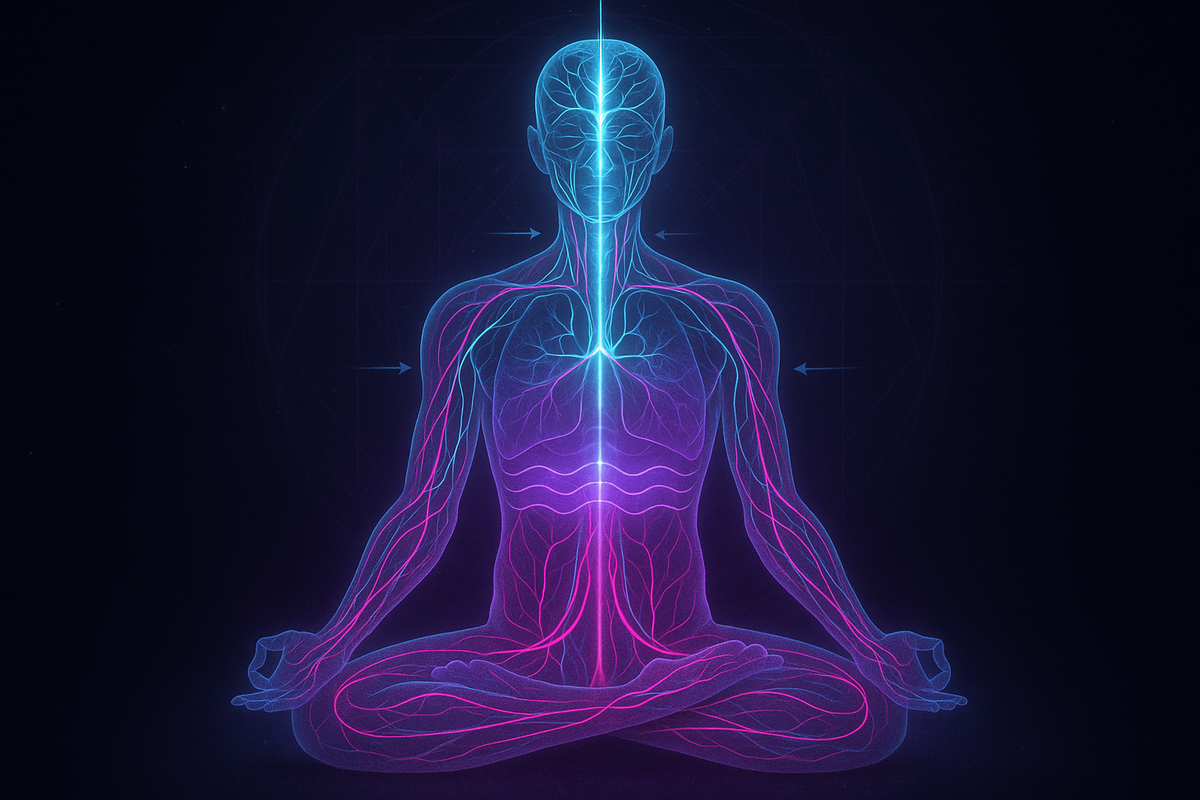
Embodied Religious Cognition: Why Bodies Matter for Mystical States
Series: Comparative Mysticism | Part: 9 of 10
When you think of mystical experience, you probably think of consciousness. Maybe the brain. Definitely something happening in the mind. The body is just the container—the meat suit that sits while the real action unfolds in awareness.
Every contemplative tradition disagrees with this.
Not through abstract philosophy but through concrete practice: how you hold your body determines what states you can access. The specific angle of your spine. The pattern of your breath. The position of your hands. The direction of your gaze. These aren't incidental to the experience—they're the technology.
This isn't mysticism. It's anatomy meeting neuroscience meeting phenomenology. Your body isn't where your mind lives. Your body is how your mind happens.
And when mystics across traditions describe similar states—ego dissolution, boundary collapse, unitive experience—they're reporting what becomes possible when specific embodied configurations create particular neurological conditions. Different paths. Same geometry. All requiring bodies doing specific things.
The Posture Problem
Start with something simple: Why does every meditation tradition care so much about posture?
Not metaphorically. Mechanically. The Zen teacher who adjusts your spine with a stick. The yoga instructor micro-correcting your alignment. The Sufi sheikh demonstrating the exact angle of prostration. They're not being fastidious. They're engineering.
Your posture directly affects your neurological state.
The research is unambiguous. Upright posture increases arousal and alertness (Peper & Lin, 2012). Forward head position restricts breathing and increases anxiety markers (Peper et al., 2014). Slumped posture correlates with negative mood and reduced cognitive function (Wilson & Peper, 2004). The mechanism is bidirectional: your mental state shapes your posture and your posture shapes your mental state.
This isn't correlation. It's a control system. Your body provides proprioceptive feedback that your brain uses to infer your current situation. When you sit erect with relaxed shoulders and an open chest, you're sending a clear signal: alert but not threatened, engaged but not stressed. Your brain adjusts its prediction model accordingly, shifting arousal levels, attention allocation, and affective tone.
Every contemplative tradition discovered this through extended practice. The "seven-point posture" of Tibetan Buddhism isn't aesthetic. The "mountain pose" of yogic practice isn't symbolic. The precisely defined sitting positions of Zen aren't about discipline. They're attractor states—body configurations that create neurological conditions conducive to specific meditation states.
When you sit properly, you're literally building the hardware for altered consciousness.
But posture is just the foundation. The real technology involves more sophisticated body control.
Breathing as State Control
The relationship between breath and nervous system activation is the most precisely controllable variable you have access to without pharmaceutical intervention.
Slow exhale-dominant breathing activates parasympathetic tone—the "rest and digest" system that downregulates arousal. Heart rate decreases. Blood pressure drops. Cortisol reduces. The default mode network quiets (Wielgosz et al., 2016). You're biochemically shifting toward states associated with relaxation and introspection.
Fast inhale-dominant breathing does the opposite. Sympathetic activation. Arousal increase. The system preparing for action. Practiced deliberately, this produces states that range from energized clarity to full-on altered consciousness—which is why holotropic breathwork and similar techniques can induce psychedelic-like experiences without drugs (Rindfleisch, 2005).
Breath retention creates temporary hypoxia and CO2 buildup, directly affecting brain chemistry and neural activity. Yogis who master kumbhaka (breath suspension) report access to states that require minutes or hours of meditation for others. They're using controlled hypoxia as a state-access accelerator.
But here's what makes this embodied cognition rather than mere physiology: You can't separate the breathing technique from the phenomenological result. The breath pattern isn't causing a brain state that produces an experience. The breath pattern is part of the experience. When Thich Nhat Hanh instructs "breathing in, I calm body and mind; breathing out, I smile," he's not describing a method to achieve calm—he's describing how calm is enacted through breathing.
The distinction matters. You can't have the mystical state without the body doing what creates it. It's not that the breathing gets you to the experience. The breathing is constitutive of the experience.
This applies to every embodied technique traditions use.
The Technology Stack of Body Practice
Different traditions emphasize different body technologies, but the stack is remarkably consistent:
Postural foundation: Stable, alert, sustainable body configuration that signals safety to the nervous system while maintaining engagement.
Breath regulation: Precise control of respiratory rhythm to modulate arousal, attention, and neurochemistry.
Gaze control: Where and how you direct visual attention affects cognitive mode. Soft focus defocuses executive control. Fixed-point gazing (trataka) increases concentration. Eyes-closed reduces external input. Eyes-half-open balances internal and external awareness.
Gesture (mudra): Hand positions that create proprioceptive patterns. Whether these "channel energy" or create embodied metaphors or simply provide attentional anchors—they're used across traditions because they function.
Movement: From Sufi whirling to Tibetan prostrations to walking meditation to qigong, traditions use motion to access states. Not as relaxation but as technique. Specific speeds. Specific patterns. Specific coordination requirements that occupy the motor system in ways that alter global brain state.
Sound production: Chanting, toning, mantra repetition. The physical production of sound creates vibration throughout the body, provides rhythmic structure, occupies the linguistic system, and generates auditory feedback that entrains neural oscillations (Berkovich-Ohana et al., 2015).
Temperature and pain: Cold water immersion. Heat endurance. Controlled discomfort. Many contemplative paths use physical stressors to access altered states—not through masochism but because acute stress creates neurological conditions that, if navigated skillfully, open unusual state space. The Tibetan tummo practitioners generating body heat through meditation aren't performing miracles—they're using autonomic control techniques that modern research confirms are learnable (Kozhevnikov et al., 2013).
Each element is a state-space navigation tool. Combined, they constitute a complete technology for accessing specific regions of consciousness that don't become available through thought alone.
Why Traditions Converge on Similar Bodies
Here's the striking pattern: Contemplative traditions that developed in complete isolation from each other prescribe remarkably similar body practices.
Yogic asana. Buddhist meditation posture. Christian contemplative sitting. Islamic prayer positions. Daoist standing meditation. All emphasize:
- Upright spine
- Relaxed shoulders
- Open chest
- Breath attention
- Minimal unnecessary tension
- Sustainable position for extended duration
This isn't cultural diffusion. It's convergent evolution. Different traditions independently discovered that these body configurations reliably produce the neurological conditions for accessing mystical states.
The reason: human nervous systems are human nervous systems. We all have the same basic architecture. The same vagus nerve that parasympathetic breathing activates. The same postural feedback loops. The same respiratory-cardiac coupling. The same brain structures that produce self-models and can be induced to dismantle them.
When Bengali yogis and Spanish mystics and Chinese monks describe similar states and use similar body technologies to access them, they're reporting successful engineering of the same underlying system.
The diversity comes in what they do with those states, how they interpret them, and what practices they build around them. But the basic embodied techniques converge because the biology converges.
The Mistake Modern Practice Makes
When contemplative practices migrate to secular Western contexts, something predictable happens: the body technology gets stripped out.
Mindfulness becomes an app. Meditation becomes "watching your thoughts." Contemplative practice becomes introspection while sitting however is comfortable. The body is acknowledged as "where you feel things" but not as the mechanism that generates states.
This produces a particular failure mode: People learn to think about meditation rather than do the states. They understand the concepts. They appreciate the philosophy. They sit regularly. But they never access the geometry the practices are designed to navigate because they're not building the embodied configurations that make those states possible.
This isn't all practices. Yoga retained its body technology (even if the philosophy got simplified). Intensive retreat environments enforce postural discipline. Some teachers emphasize embodied technique. But in popular secularized contemplative practice, the body often becomes optional.
The result: People sit for years without encountering the states the traditions describe. Not because the states are rare or require special talent. Because they're not doing the thing that produces the states. They're doing a mentalized simulation of the practice.
You can't think your way to ego dissolution. You have to build the neurological conditions that produce ego dissolution. And that requires bodies doing specific things in specific ways for sufficient duration.
The Hard Thing About Embodied Realization
Here's what makes embodied religious cognition difficult: You can't shortcut it with understanding.
In cognitive practices, insight can create sudden shifts. You grasp a concept and your entire worldview reorganizes around it. One good explanation and years of confusion resolve.
Embodied practices don't work that way. You can completely understand the Vipassana instructions. Perfectly grasp the theory. Have zero confusion about what to do. And still require ten thousand hours of body practice before the states reliably arise.
Because you're not learning a concept. You're developing capacity. Like learning to play an instrument, the knowing is in the doing. The understanding doesn't substitute for the training.
This creates a specific challenge for Western practitioners acculturated to value intellectual mastery. We want to get it. To understand our way to attainment. And contemplative philosophy is rich enough to provide endless material for intellectual engagement.
But the mystics insist: Sit. Breathe. Hold the posture. Do the practice. Ten thousand hours.
Not because they're anti-intellectual. Because the states they're pointing to emerge from body configurations repeated until they become accessible. The body learns to hold states it couldn't initially maintain. The nervous system adapts to patterns it couldn't initially sustain. The whole system reorganizes around new attractors.
This is why lineages emphasize physical proximity and extended practice with teachers. Not for mystical transmission but for technical training. The teacher sees what your body is doing, corrects the micro-adjustments, demonstrates the quality of engagement you're aiming for. You're learning embodied skill, which requires embodied teaching.
What This Means for Mystical Convergence
Return to the original question: Why do mystics across traditions describe similar states?
The full answer now: Because they're using similar body technologies to navigate similar neurological geometry.
The Buddhist attaining anatta (non-self), the Christian mystic experiencing unio mystica, the Sufi undergoing fana (annihilation in the beloved), the Hindu realizing moksha—they're reporting variations on ego dissolution that occur when the default mode network's self-modeling function attenuates through specific practices.
Those practices are embodied. They involve breath, posture, gaze, gesture, and sustained attentional configurations that downregulate the neural patterns that generate the sense of a bounded self.
The experiences differ in emotional coloring, conceptual interpretation, and relational framing (dissolving into what—emptiness? God? universal consciousness?). But the underlying phenomenology—the geometry of the state—maps consistently because it's the same nervous system architecture being navigated.
And critically: the states don't happen by accident. They happen because traditions developed sophisticated embodied technologies for reliably producing them. Technologies that required bodies doing specific things.
Consciousness doesn't float free of biology. Mystical states aren't purely mental events. Your body isn't incidental to spiritual experience.
Your body is where and how spirit happens.
This is Part 9 of the Comparative Mysticism series, exploring convergent geometry across contemplative traditions. Next: "Synthesis: Convergent Geometry and the Shape of Liberation."
Further Reading
- Peper, E., & Lin, I. M. (2012). "Increase or decrease depression: How body postures influence your energy level." Biofeedback.
- Wielgosz, J., et al. (2016). "Mindfulness meditation and psychopathology." Annual Review of Clinical Psychology.
- Kozhevnikov, M., et al. (2013). "Neurocognitive and somatic components of temperature increases during g-Tummo meditation." PLOS ONE.
- Berkovich-Ohana, A., et al. (2015). "Data for default network reduced functional connectivity in meditators." Data in Brief.
- Varela, F., Thompson, E., & Rosch, E. (1991). The Embodied Mind: Cognitive Science and Human Experience. MIT Press.
Comments ()