The Energy of Civilization
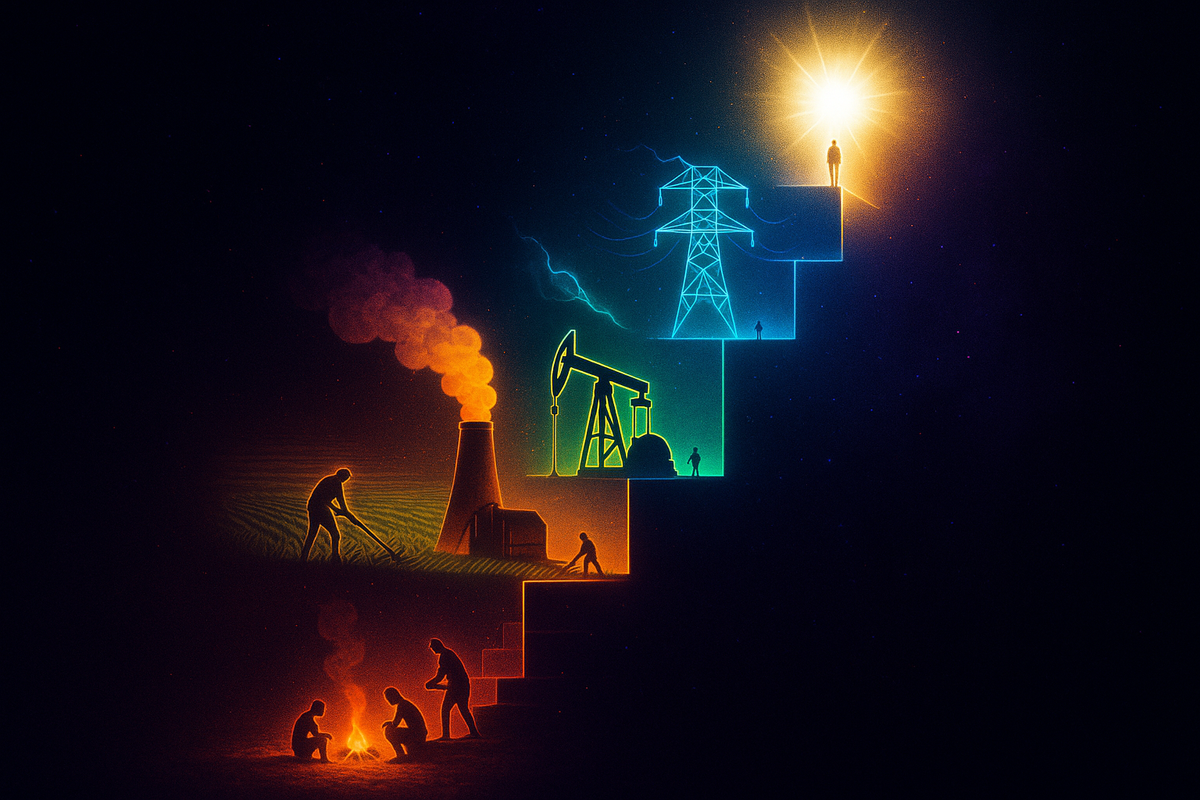
The history of civilization is a history of energy capture: fire, crops, coal, electricity, and now computation. Each transition didn't just add power — it restructured what was possible for society, cognition, and politics.
The Energy of Civilization
Every leap in human capacity has been an energy leap.
Fire. Agriculture. Coal. Oil. Electricity. Nuclear. Each transition expanded what humanity could do—not through cleverness alone, but through access to more power. The story of civilization is, in large part, the story of energy.
This series traces that history from the cooking fires that grew our brains to the fusion reactors that might power our future. It's the companion to our [Intelligence of Energy](/intelligence-of-energy/) series, which explores the physics of computation. Here we ask the historical question: How did humanity get here, and where might energy take us next?
The Pattern
The pattern is consistent across millennia:
More energy → more capability → more complexity → more energy demand.
Fire freed calories for brain growth. Agriculture freed labor for specialization. Fossil fuels freed muscle power for machines. Each energy transition enabled new forms of social organization, new technologies, new ways of living.
But each transition also created new dependencies. We don't just use energy; we become shaped by it. The oil economy isn't just powered by petroleum—it's organized around petroleum. The grid isn't just infrastructure—it's the nervous system of industrial civilization.
What This Series Covers
We begin with the caloric brain: how the metabolic demands of human cognition shaped our evolution and why cooking was the first energy technology.
Then fire and cooking: Richard Wrangham's hypothesis that external digestion—processing food outside the body—was the key innovation that made us human.
Muscle power explores the biological ceiling: what humans and animals could accomplish before machines, and why that ceiling constrained civilization for millennia.
Coal and steam covers the breakthrough: how fossil fuels broke the muscle barrier and launched the industrial revolution.
Tesla vs. Edison tells the story of electrification and the war of currents that shaped our modern grid.
Oil and the 20th century examines how hydrocarbons became the blood of modern civilization and reshaped geopolitics.
Moore's Law looks at the energy dimension of computing: the efficiency revolution that made information technology possible, and its recent death.
The Kardashev scale offers a framework for thinking about civilization in terms of energy consumption.
Back to the future surveys the next energy transition: fusion, advanced fission, and solar at scale.
The synthesis ties it together: intelligence scales with energy, from cooking fire to training run.
The Through-Line
Energy isn't just a resource. It's a constraint that shapes what's possible. Understanding the history of energy is understanding why the world is the way it is—and what it might become.
This is the hub page for the Energy of Civilization series. Start with [The Caloric Brain: Why Thinking Costs Food](/caloric-brain-thinking/).
Comments ()