Back to the Future: Fusion Fission and Solar
Every civilization transition has been an energy transition. Fusion, fission, and solar power aren't just technologies — they're the next rungs on a ladder humanity has been climbing for millennia.
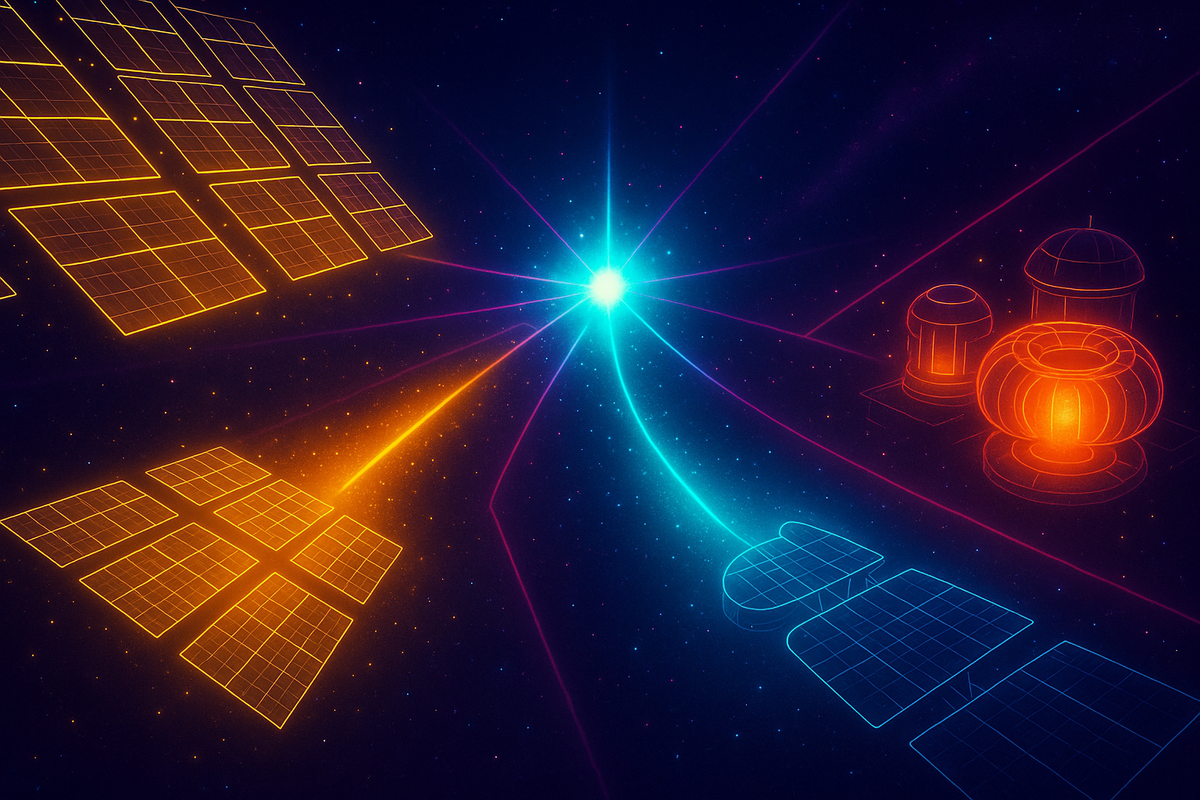
Back to the Future: Fusion, Fission, and Solar
Every energy transition in history has been a transition to higher energy density. Wood to coal. Coal to oil. Oil to uranium. The pattern is clear: civilizations climb the energy ladder by accessing more concentrated power sources.
The next rung is fusion. The one after that might be something we haven't imagined yet. But between here and there, we have to navigate a transition that's already underway—from fossil fuels to something cleaner, more abundant, and less likely to cook the planet.
This article maps the territory: what the next energy transitions look like, what physics enables and constrains them, and what it would take to complete the climb to Type I civilization.
The Fission Bridge
Nuclear fission—splitting heavy atoms—has been powering civilization since 1954. The physics is well understood. A kilogram of uranium-235 contains about 80 terajoules of energy, equivalent to about 2,000 tons of coal. Atom for atom, fission beats chemistry by a factor of roughly a million.
Yet fission supplies only about 10% of global electricity. Why?
The constraints are mostly not technical:
1. Capital costs: Nuclear plants are expensive to build—often $10+ billion for a modern reactor. Much of this cost is regulatory compliance, specialized materials, and the extreme precision required for safety.
2. Construction time: A nuclear plant takes 10-15 years from conception to operation. Political and economic conditions change; projects get cancelled mid-stream.
3. Waste management: Spent fuel remains radioactive for thousands of years. No country has built a permanent repository. The waste exists in temporary storage, waiting for solutions.
4. Proliferation risk: The same enrichment technology that produces reactor fuel can produce weapons material. Nuclear expansion raises security concerns.
5. Public perception: Chernobyl, Three Mile Island, Fukushima—each accident, though rare, cements opposition. Fear of radiation outweighs statistical evidence of safety.
These are real barriers, but they're not laws of physics. They're social, economic, and political facts that could change with different incentives.
Advanced fission designs address many concerns:
- Small modular reactors (SMRs) can be factory-built and shipped, reducing construction time and cost - Molten salt reactors operate at atmospheric pressure, eliminating the explosion risk of pressurized water reactors - Breeder reactors produce more fuel than they consume, turning nuclear waste into resources - Thorium cycles work with a fuel that can't be weaponized and is more abundant than uranium
None of these is science fiction. All have been demonstrated at some scale. The question is whether they'll be deployed before climate change makes fission moot or essential.
The AI-energy nexus is accelerating interest. Big tech companies—Microsoft, Google, Amazon—are signing deals for nuclear power to run their data centers. They need reliable, carbon-free baseload power and have concluded solar and wind alone can't provide it. This corporate demand might finally unlock the capital and political support for fission expansion.
The Solar Revolution
While fission has stalled, solar has exploded.
The cost of photovoltaic solar has dropped by 99% since 1976. A watt of solar capacity that cost $76 in 1977 costs about $0.20 today. This isn't a gentle decline; it's a collapse that rivals Moore's Law in computing.
Solar is now the cheapest source of electricity in most of the world. In sunny regions, new solar produces power at 2-3 cents per kilowatt-hour—cheaper than coal, natural gas, or nuclear.
The physics explains why: solar cells convert photons directly to electrons with no moving parts, no fuel, no combustion. The technology is more like electronics than traditional power generation. It benefits from the same learning curves, manufacturing scale, and material science advances that revolutionized semiconductors.
Solar has limitations:
1. Intermittency: The sun doesn't shine at night or through clouds. Solar generates power when it wants to, not when you need it.
2. Energy density: Solar power is diffuse. Covering enough land to power civilization requires vast areas—thousands of square miles.
3. Storage: Without cheap storage, solar's value diminishes. You need batteries, pumped hydro, or some other way to shift energy from day to night.
4. Embedded energy: Manufacturing solar panels requires energy, much of it currently from fossil fuels. The lifecycle emissions are low but not zero.
Each limitation has solutions in progress:
Storage is following solar's cost curve. Lithium-ion battery costs have dropped 90% since 2010. Grid-scale storage projects are multiplying. Alternative chemistries (iron-air, sodium-ion, flow batteries) promise even cheaper long-duration storage.
Intermittency diminishes with geographic diversity. The wind is always blowing somewhere. Link enough solar and wind across enough area, and the aggregate becomes surprisingly stable.
Land use is real but manageable. Powering America with solar would require about 0.6% of the land area—roughly the space already devoted to roads.
Solar's trajectory suggests it will dominate electricity by mid-century. The question is whether that's fast enough for climate, and whether electricity can replace the fossil fuels that power transportation, industry, and heating.
The Fusion Dream
Fusion—smashing light atoms together—is the energy of the sun. It powers the stars. It's the most abundant energy source in the universe.
A kilogram of fusion fuel contains roughly 10 times more energy than a kilogram of fission fuel, and about 10 million times more than a kilogram of coal. The fuel is deuterium (from seawater) and lithium (abundant in the Earth's crust). There's enough for billions of years.
The challenge is that fusion requires temperatures of 100 million degrees. At those temperatures, matter becomes plasma—a soup of nuclei and electrons. Containing plasma without it touching any walls requires either extreme magnetic fields or extreme compression.
Magnetic confinement (the tokamak approach) uses powerful magnets to suspend plasma in a donut-shaped chamber. The ITER project, under construction in France, aims to demonstrate net energy gain—more fusion power out than heating power in—by the early 2030s.
Inertial confinement uses lasers to compress fuel pellets until fusion ignites. In December 2022, the National Ignition Facility achieved "ignition"—more energy out than laser energy in, though not accounting for the huge energy needed to power the lasers.
Both approaches face the same fundamental challenge: Q > 10. To be economically useful, a fusion reactor needs to produce about ten times more energy than it consumes. ITER aims for Q=10. A commercial plant would need Q=30 or higher.
We've been "30 years away from fusion" for 60 years. But something has changed: private investment. Companies like Commonwealth Fusion, TAE Technologies, and Helion are pursuing compact fusion with commercial timelines of the 2030s. They're using high-temperature superconductors and AI-optimized designs that weren't available to earlier efforts.
Will they succeed? The physics is proven—the sun runs on fusion. The engineering is hard but possibly solvable. If commercial fusion arrives in the 2030s or 2040s, it changes everything. If it takes until 2080, it's too late for the climate transition.
Fusion represents true abundance. Not "enough energy to meet current needs" but "enough energy to transform civilization." A fusion-powered world has no energy scarcity. The constraint isn't fuel but the engineering capacity to build reactors.
The Transition Math
Let's do some numbers.
Current global primary energy consumption: ~580 exajoules per year, or about 18 terawatts continuous.
To reach Type I (~10^17 watts): we need roughly 60x current consumption.
To decarbonize by 2050: we need to replace most of that 18 terawatts with non-carbon sources while the economy continues growing.
Current non-carbon electricity capacity (nuclear + renewables): roughly 4 terawatts equivalent.
Required rate of clean energy addition: about 1 terawatt per year for the next 25 years. We're currently adding about 0.5 terawatts per year.
These numbers suggest the transition is possible but not assured. We need to roughly double the deployment rate of clean energy. That's not physics—it's manufacturing, financing, and political will.
The distribution matters too. It's not enough to add clean energy; we have to retire dirty energy. A solar panel in a new location is good. A solar panel replacing a coal plant is better. Much of the existing fossil fuel infrastructure has decades of life left. Retiring it early requires either regulations that mandate closure or economics that make operation unprofitable.
Three Scenarios
Scenario 1: Muddle Through (Most Likely) Solar and wind continue expanding. Batteries get cheaper. Electric vehicles displace gas cars. Natural gas replaces coal. Emissions peak and decline, but slowly. Temperature rise: 2-2.5°C by 2100. Civilization adapts but doesn't transform.
Energy mix 2050: 40% renewables, 30% gas, 15% nuclear, 15% coal/oil Kardashev level: ~0.75
Scenario 2: Clean Energy Acceleration Policy shifts and technology breakthroughs accelerate the transition. SMRs and advanced fission find markets. Fusion arrives commercially by 2040. Electrification spreads faster than expected. Emissions drop sharply after 2030.
Energy mix 2050: 60% renewables, 20% nuclear, 15% gas, 5% fusion pilots Kardashev level: ~0.78
Scenario 3: Energy Leap Fusion works and scales faster than anyone expects. Solar becomes essentially free. Energy abundance enables previously impossible projects: atmospheric carbon capture, desalination at scale, cheap intercontinental transport.
Energy mix 2060: 50% renewables, 30% fusion, 15% nuclear, 5% legacy fuels Kardashev level: ~0.82
None of these scenarios reaches Type I by 2100. The physics allows it; the engineering timelines don't. But the differences between scenarios matter enormously for what kind of civilization we become.
The Stakes
Energy transitions aren't just technical achievements. They reshape civilizations.
Coal and steam created industrial capitalism, urban proletariats, and global empires. Oil created suburbs, petrochemical economies, and Middle Eastern geopolitics. Nuclear could have created something different but was stunted by fear and mismanagement.
The clean energy transition—whatever form it takes—will reshape politics, economics, and daily life as thoroughly as the fossil fuel era did. The countries that lead in clean energy will have economic and strategic advantages. The regions that remain dependent on fossil exports will face decline.
More fundamentally: the energy transition is a test of whether civilization can manage long-term challenges. We know what needs to happen. The physics is understood. The technologies exist or are achievable. What's uncertain is whether the social, political, and economic systems can coordinate fast enough.
This is the through-line of the energy of civilization series: every leap in human capacity has been an energy leap. Fire enabled cooking. Agriculture enabled cities. Fossil fuels enabled industry. The next leap—to abundant clean energy—would enable things we can barely imagine.
Whether we complete that leap, or stumble on the way, will define the next century.
Further Reading
- Smil, V. (2022). How the World Really Works: A Scientist's Guide to Our Past, Present, and Future. Viking. - Rhodes, R. (1986). The Making of the Atomic Bomb. Simon & Schuster. - Gates, B. (2021). How to Avoid a Climate Disaster. Knopf.
This is Part 9 of the Energy of Civilization series. Next: "[Synthesis: Intelligence Scales With Energy](/energy-intelligence-scales/)."

Comments ()