Entrainment: How Oscillating Systems Learn to Move Together
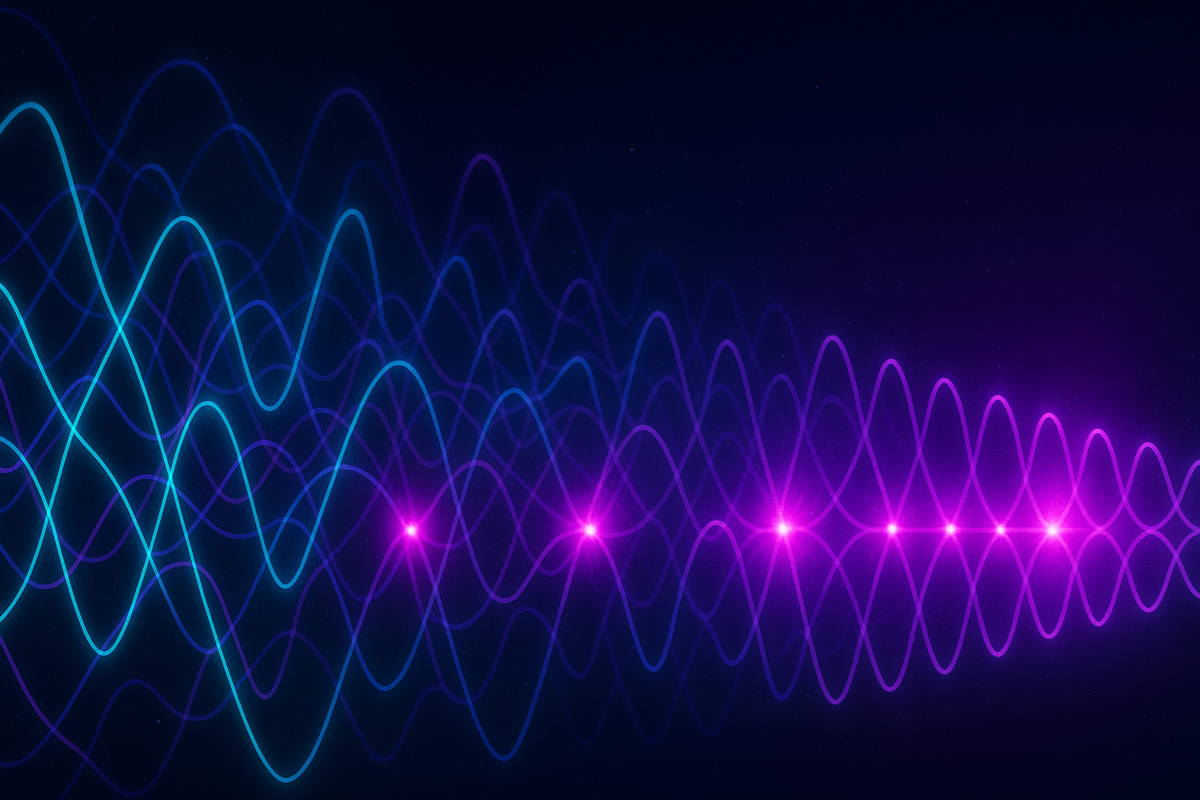
In 1665, Christiaan Huygens noticed two pendulum clocks on the same wall began ticking in unison. That observation—entrainment—describes a phenomenon that runs from pendulums to neurons to social rhythm.
Entrainment: How Oscillating Systems Learn to Move Together
Series: Ritual Entrainment | Part: 2 of 11
Place two metronomes on a rigid surface, set them ticking at slightly different rates, and watch what happens. At first, they're out of sync—one ticks, then the other, the interval between clicks irregular and wandering. But slowly, mysteriously, they converge. The interval stabilizes. The ticks align. Within minutes, they're clicking in perfect unison, locked together as if controlled by a single mechanism.
No intelligence required. No communication. No intention. Just physics.
This is entrainment—the spontaneous synchronization of coupled oscillators. And it's everywhere. Fireflies flashing in unison across Southeast Asian riverbanks. Neurons firing in rhythmic volleys across cortical columns. Menstrual cycles synchronizing in shared living quarters. Audiences clapping together without anyone calling for coordination. Your heartbeat coupling to the person you're embracing.
Entrainment is the mechanism beneath ritual efficacy. Understanding how it works—why oscillating systems spontaneously synchronize, what determines coupling strength, how phase relationships stabilize—reveals why humans have built ritual technologies in every culture for tens of thousands of years.
Because when you understand entrainment, you understand how separate nervous systems can become temporarily one.
The Mathematics of Spontaneous Synchronization
In 1665, Christiaan Huygens was bedridden and bored. To pass time, he watched the pendulum clocks on the wall of his room. He noticed something remarkable: two clocks mounted on the same beam would synchronize their pendulums, swinging in perfect opposition. When he deliberately threw them out of sync, they would reconverge within half an hour.
Huygens called it "an odd sympathy" and correctly identified the mechanism: tiny vibrations transmitted through the shared beam were coupling the pendulums. Each clock's swing created minute oscillations in the beam. Those oscillations perturbed the other clock's pendulum. Over time, these mutual perturbations drove the system toward a stable synchronized state.
This is the essence of entrainment. When two or more oscillating systems are coupled—connected by any mechanism that allows one's rhythm to influence the other—they tend to synchronize. Not because they're trying to, but because synchronized states are often stable attractors in the coupled system's dynamics.
The mathematics was formalized in the 1960s by Art Winfree and Yoshiki Kuramoto. The Kuramoto model describes populations of coupled oscillators with slightly different natural frequencies. Even with weak coupling and frequency differences, the system spontaneously transitions to synchronized states when coupling strength exceeds a critical threshold.
The key insight: synchronization emerges from the interactions, not the individual oscillators. No central coordinator needed. No blueprint. Just coupled dynamics and time.
This is why ritual works without anyone understanding it. The mechanism is in the physics.
What Makes Systems Entrain
Not all oscillators couple easily. Several factors determine how readily systems synchronize:
Frequency proximity. Oscillators with similar natural frequencies entrain more easily than those with large frequency differences. Your heart rate (roughly 1 Hz) can couple to breathing (roughly 0.25 Hz) because they're within coupling range. But neural gamma oscillations (30-100 Hz) won't directly entrain with circadian rhythms (10^-5 Hz)—the frequency gap is too large.
Coupling strength. Stronger connections enable synchronization despite larger frequency mismatches. Two metronomes on a heavy table won't synchronize—the coupling through the table is too weak. Put them on a light board that can freely rock, and they lock rapidly. Similarly, weak social coupling (occasional interaction) produces weak entrainment, while strong coupling (sustained coordinated activity) produces robust synchronization.
Coupling mechanism. Different oscillators couple through different channels. Pendulums couple through mechanical vibration. Fireflies through light. Neurons through chemical synapses and electrical gap junctions. Humans couple through sound, vision, touch, pheromones, and electromagnetic fields from heartbeats.
Number of oscillators. Individual coupling might be weak, but populations amplify. A single firefly's flash weakly influences your circadian rhythm. A forest of thousands flashing in synchrony creates strong entrainment. This is why rituals work better with larger groups—more oscillators, stronger collective field.
Network structure. All-to-all coupling (everyone interacts with everyone) produces fastest synchronization. Sparse networks with specific topologies can support synchronization, but require stronger individual coupling or more time. This is why rituals often arrange people in circles or facing a central point—maximizing mutual coupling.
Biological Oscillators and Coupling Mechanisms
Humans are walking orchestras of coupled oscillators operating across timescales from milliseconds to months:
Neural oscillations (1-100 Hz): Rhythmic patterns of brain activity from delta waves in deep sleep to gamma oscillations in active perception. Neurons couple through synaptic transmission and gap junctions, creating synchronized firing patterns that coordinate computation across brain regions.
Cardiac rhythms (0.5-2 Hz): The heart's electrical pacemaker cells create rhythmic contractions. Heart rate variability reflects respiratory coupling and autonomic state. Hearts can couple between individuals through acoustic vibrations, electromagnetic fields, and the pressure waves they create in shared spaces.
Respiratory cycles (0.1-0.5 Hz): Breathing creates rhythmic changes in blood chemistry, pressure, and neural activity. Respiratory patterns couple to speech, movement, and cardiac function. People in conversation unconsciously coordinate breathing patterns.
Hormonal pulses (minutes to months): Cortisol shows daily rhythms. Insulin pulses every few hours. Sex hormones follow monthly or seasonal cycles. Pheromones and shared environmental cues can couple hormonal rhythms across individuals.
Circadian clocks (24 hours): Nearly every cell contains molecular oscillators synchronized to day-night cycles. Light is the primary entrainment signal, but social cues (meal times, activity patterns) also couple circadian systems.
Gait and motor patterns (0.5-2 Hz): Walking, running, dancing—all involve rhythmic motor output. When people walk side by side, their gaits synchronize. When they dance together, their movements lock.
Each of these systems can entrain within an individual—your breathing couples to your heartbeat, both modulated by neural oscillations, all entrained to circadian rhythms. But crucially, they can also entrain between individuals when coupling mechanisms are present.
The Physics of Ritual: How Humans Couple
Ritual practices are technologies for coupling human oscillators. They work by creating shared rhythmic signals that multiple nervous systems can lock onto.
Auditory coupling through rhythm. Drumming at 2 Hz creates a strong periodic signal that everyone in earshot receives simultaneously. Neural motor areas entrain to the beat, creating synchronized preparatory activity. Actual movement further reinforces the entrainment. This is why every culture has percussion.
Vocal coupling through chanting. Sustained vocalization coordinates breathing—you can't chant without entraining respiration to the phrase structure. When groups chant together, they create both auditory entrainment (hearing synchronized sound) and proprioceptive entrainment (feeling your own breath match the pattern). Gregorian chant, Buddhist mantras, Islamic dhikr, protest chants—same mechanism.
Visual coupling through coordinated movement. Mirror neurons fire both when you move and when you observe movement. Watching synchronized dancers creates motor resonance in observers' brains. Participating creates even stronger coupling. This is why military drills, line dances, and liturgical gestures are universal ritual elements.
Tactile coupling through touch. Holding hands in a circle creates direct physical coupling. Rhythmic touch (massage, rocking, drumming on bodies) can entrain heart rate and breathing. Many rituals include elements of physical contact or close proximity that enable electromagnetic and acoustic coupling.
Chemical coupling through shared consumption. Eating and drinking together aligns metabolic states and can synchronize hormonal responses. Psychoactive substances (alcohol, caffeine, entheogens) create shared neurochemical states. The Eucharist, ayahuasca ceremonies, coffee breaks—all leverage chemical entrainment.
Electromagnetic coupling through cardiac coherence. The heart generates electromagnetic fields detectable several feet away. When people are in close proximity with synchronized hearts, these fields can couple. Heart-rate variability in synchronized groups shows coherent patterns measurable between individuals.
Effective rituals stack multiple coupling mechanisms. A church service combines singing (vocal/respiratory entrainment), standing/sitting in unison (motor entrainment), liturgical responses (vocal pattern matching), and often shared communion (chemical entrainment). Raves combine steady beats (auditory/motor), synchronized dancing (visual/motor), close proximity (electromagnetic/tactile), and sometimes substances (chemical).
The more coupling channels engaged, the stronger and faster the entrainment.
Phase Relationships and Stable Patterns
Entrainment doesn't just mean synchronization—it means locking into specific phase relationships that can be stable or unstable.
In-phase synchronization: Both oscillators reach peaks simultaneously. This is what happens when you clap with a crowd—everyone's hand motion peaks at the same moment, creating a unified sound pulse. In-phase locking is often stable because it maximizes mutual reinforcement.
Anti-phase synchronization: Oscillators alternate, one peaking while the other troughs. Huygens' clocks synchronized anti-phase. Breathing can entrain anti-phase to walking (exhale on left step, inhale on right). Anti-phase can be stable because it minimizes competition for shared resources.
Complex phase patterns: In larger populations, more elaborate patterns emerge. Chorusing frogs might synchronize in cascading waves. Neural populations show traveling waves where synchrony progresses across space. Some firefly species create synchronized flashing that sweeps across trees in organized patterns.
What phase relationship emerges depends on coupling properties and network structure. But crucially, some phase relationship typically emerges. Pure disorder—completely unsynchronized oscillation—is often unstable when coupling is present.
This is why rituals that bring people together almost always produce some degree of synchronization, even if participants don't intend it. The coupled dynamics favor coordinated over independent oscillation.
The Transition to Collective Coherence
When do scattered individual oscillators become a synchronized collective? The Kuramoto model reveals that synchronization often appears as a phase transition—a sudden shift from disorder to order when coupling strength crosses a threshold.
Below the critical coupling strength, oscillators remain desynchronized despite interactions. Individual frequencies dominate, and perturbations from neighbors aren't strong enough to pull oscillators into alignment. The system stays in a disordered state.
At the critical coupling, something remarkable happens: a subpopulation spontaneously synchronizes, forming a coherent cluster. As coupling increases further, more oscillators join the synchronized population until eventually the entire system locks.
This isn't gradual. It's a bifurcation—a qualitative state change. Below threshold: disorder. Above threshold: order. Near threshold: small changes in coupling produce dramatic changes in system behavior.
This maps directly to ritual experience. Small gatherings with weak interaction stay desynchronized—everyone doing their own thing. Increase coupling (louder music, closer proximity, more coordinated movement), and suddenly the crowd becomes something. You feel it phenomenologically as the moment the ritual "catches"—when separate individuals become a synchronized collective.
Durkheim's "collective effervescence" might be the phenomenology of crossing the synchronization threshold. The feeling of something larger arising isn't imagination—it's accurate perception of a phase transition in the coupled system.
Why Synchronization Feels Good
Evolutionary psychology offers obvious explanations for why synchronization is rewarding. Coordinated action was crucial for hunting, warfare, construction, and child-rearing. Groups that synchronized well outcompeted groups that didn't. Selection favored neural architectures that reward coordination.
But there's a deeper mechanistic reason: synchronization reduces prediction error.
In active inference terms, your brain constantly predicts sensory input and updates predictions based on errors. When you're in a synchronized group, your predictions about others' behavior become highly accurate. You know what they'll do next because you're doing it together. Prediction error drops, uncertainty decreases, and your brain interprets this as evidence that things are going well.
Moreover, synchronized states require less computational work to maintain. When everyone is doing the same thing, you don't need complex models of different agents with different goals. The collective simplifies to a shared pattern. Cognitive load decreases, freeing resources for other processing or simply creating a sense of ease.
The phenomenology—the good feeling of synchronization—reflects this computational efficiency and predictive success. It's not arbitrary reward; it's your brain recognizing, "This is working. This is coherent. This is valuable."
This is why even trivial synchronization feels satisfying. Clapping together at a concert, stepping in rhythm while walking with someone, harmonizing a note with singers—these tiny moments of entrainment feel disproportionately meaningful because they signal successful coordination, reduced uncertainty, and collective coherence.
When Entrainment Fails: Desynchronization and Coherence Collapse
Not all oscillators can entrain. Some systems resist synchronization, and understanding why reveals the limits and dangers of entrainment.
Frequency mismatch. If natural frequencies differ too much, coupling can't overcome the difference. In social terms: trying to synchronize people with radically different baselines—different energy levels, neurodivergent processing speeds, trauma-altered physiology—can fail despite strong coupling attempts. Forced synchronization in these cases creates stress, not coherence.
Weak coupling with noise. When coupling is barely above threshold and the environment is noisy (competing signals, distractions, instability), synchronization can't stabilize. The system flickers between ordered and disordered states. This is why rituals need controlled environments—reduce noise to allow weak coupling to achieve entrainment.
Competing attractors. Sometimes oscillators lock into subgroups that synchronize internally but remain desynchronized from each other. In crowds, this creates factions. In music, it creates clashing rhythms. The overall system fails to cohere because multiple stable patterns compete.
Pathological synchronization. Sometimes synchronization itself is the problem. Epileptic seizures are hypersynchronized neural activity—too much entrainment, losing the functional desynchronization that healthy brains require. Parkinsonian tremor emerges from pathological synchronization of motor circuits.
In social systems, excessive entrainment can produce groupthink, loss of individual judgment, and mob behavior. The system becomes so tightly coupled that diversity and flexibility disappear, leaving only rigid collective patterns.
Healthy entrainment requires balance: enough coupling to achieve coordination, but enough independence to maintain functional diversity. Wisdom traditions understood this—rituals have structure and space for individual variation.
Entrainment Across Scales
One of entrainment's most profound properties: it scales. Small synchronized clusters can couple to form larger synchronized systems, creating nested hierarchies of rhythmic coordination.
Individual neurons entrain to form cortical oscillations. Cortical regions entrain to form whole-brain rhythms. Brains entrain to form synchronized dyads. Dyads entrain to form group coherence. Groups entrain to form crowd phenomena.
At each scale, the same mathematics applies. Kuramoto dynamics describe both neural populations and human crowds. Phase transitions appear at molecular, cellular, organismal, and social levels.
This is how ritual creates meaning that spans scales. A chant coordinates breathing within individuals (coupling respiratory oscillators to vocalization). Synchronized chanting coordinates individuals to the group (coupling multiple respiratory systems). The group rhythm can couple to larger temporal structures (seasonal rituals, generational transmission).
In AToM terms, entrainment is the mechanism by which coherence propagates across boundaries and scales. M = C/T applies not just within a system but to the coupled supersystem that entrainment creates.
When a ritual works, you feel connected not just to the people in the room, but to everyone who has ever performed this ritual, across time. That's not mysticism—it's recognizing that you're now part of the same oscillatory pattern that has coupled nervous systems for generations. The tradition is the temporal extension of the entrainment pattern.
Practical Implications: Engineering Entrainment
Understanding entrainment mechanics allows conscious design rather than relying on traditional forms whose mechanisms we don't understand.
To maximize entrainment:
- Use clear, strong rhythmic signals (steady beats, repeated patterns)
- Minimize frequency mismatch (choose tempos near natural human rhythms: 0.5-2 Hz for motor, 2-4 Hz for speech)
- Increase coupling (louder sound, closer proximity, more coordinated movement)
- Reduce noise (controlled environments, focused attention)
- Engage multiple coupling channels (combine auditory, visual, motor, tactile)
- Provide time for synchronization to stabilize (don't rush)
To maintain healthy entrainment:
- Build in variation (prevent pathological rigidity)
- Create exit pathways (allow desynchronization when needed)
- Match intensity to context (strong for rare ceremonies, moderate for regular practice)
- Respect individual differences (some people entrain more easily than others)
- Embed in larger structures (rituals need containers and integration with non-ritual life)
To recognize entrainment when it's happening:
- Decreased effort in coordination (it becomes automatic)
- Increased predictability (you know what comes next)
- Subjective sense of connection or unity
- Loss of self-consciousness (individual boundaries soften)
- Timelessness (the synchronized state feels outside normal temporal flow)
These aren't mystical markers—they're the phenomenology of successful oscillator coupling.
The Bridge to Ritual
Entrainment is the physics underneath ritual's phenomenology. Understanding it demystifies sacred experiences without diminishing them. The transcendent feeling of collective worship, the unity of a thousand people moving to the same beat, the ineffable connection in synchronized ceremony—these aren't illusions. They're accurate perceptions of real physical phenomena.
Your nervous system is coupled to others. Your oscillators have phase-locked. Your individual dynamics have become part of a larger coherent pattern. You are literally more than yourself in that moment.
The sacred is real. It's just neuroscience and physics and coupled dynamics. Which, if anything, makes it more remarkable, not less.
In the next article, we'll examine how Émile Durkheim—working a century before neuroscience could validate his insights—correctly identified collective effervescence as the origin of the sacred. His sociological theory was missing the mechanistic details, but his core intuition was right: the divine is what synchronized collectives generate through entrainment.
This is Part 2 of the Ritual Entrainment series, exploring how rhythmic practices synchronize nervous systems and generate collective meaning.
Previous: Why Rituals Work: The Neuroscience of Collective Synchronization
Next: Durkheim Was Right: Collective Effervescence and the Birth of the Sacred
Further Reading
- Strogatz, S. H. (2003). Sync: The Emerging Science of Spontaneous Order. Hyperion.
- Kuramoto, Y. (1984). Chemical Oscillations, Waves, and Turbulence. Springer-Verlag.
- Winfree, A. T. (2001). The Geometry of Biological Time. Springer.
- Pikovsky, A., Rosenblum, M., & Kurths, J. (2001). Synchronization: A Universal Concept in Nonlinear Sciences. Cambridge University Press.
- Clayton, M., Sager, R., & Will, U. (2005). "In time with the music: The concept of entrainment and its significance for ethnomusicology." European Meetings in Ethnomusicology, 11, 3-142.
- Nessler, J. A., & Gilliland, S. J. (2009). "Interpersonal synchronization during side by side treadmill walking is influenced by leg length differential and altered sensory feedback." Human Movement Science, 28(6), 772-785.
Comments ()