Epiphany and Insight: When Solutions Appear
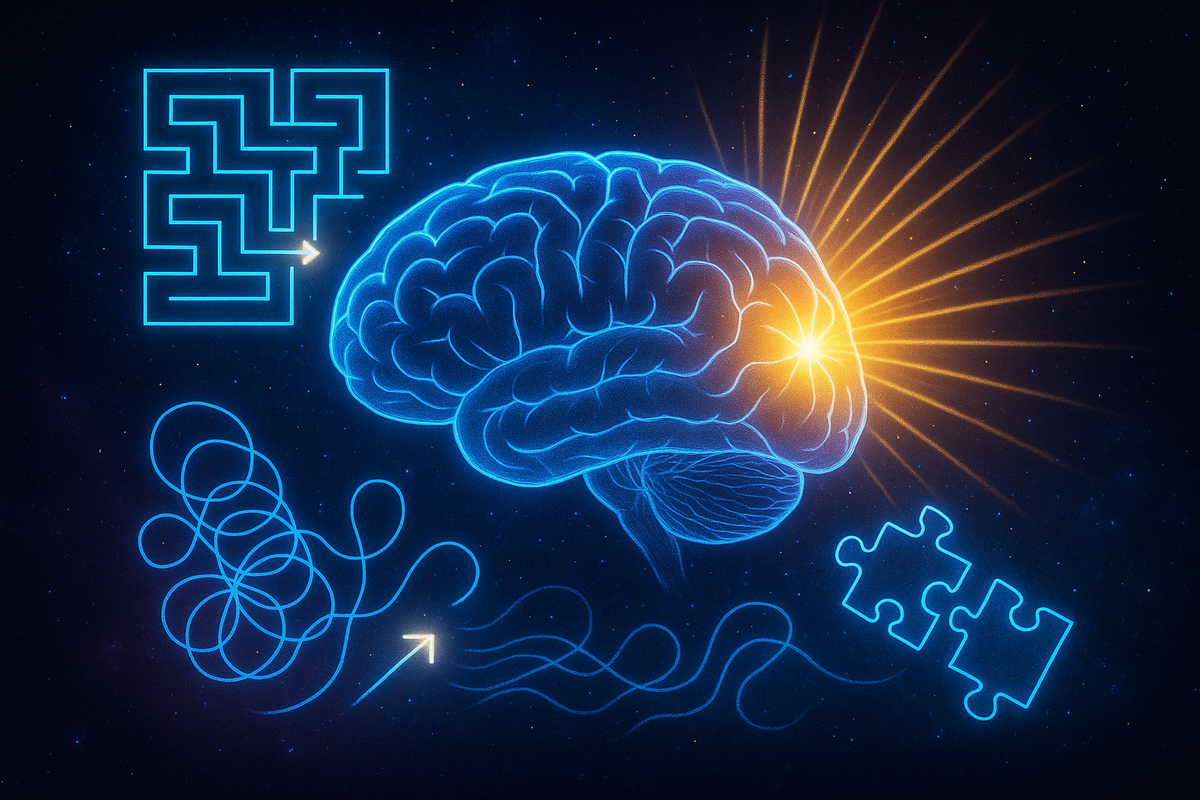
You stop thinking about the problem. Then, in the shower or on a walk, the answer arrives fully formed. Neuroscience is finally mapping what happens in the brain during those moments of sudden insight.
Epiphany and Insight: When Solutions Appear
Series: Anomalous Cognition | Part: 5 of 9 Primary Tag: FRONTIER SCIENCE Keywords: epiphany, insight, aha moment, neuroscience, creativity, incubation
Archimedes in his bath. Newton under the apple tree. Kekulé dreaming of snakes biting their tails.
The history of discovery is punctuated by sudden insights—moments when solutions appear complete, seemingly from nowhere. Not gradual progress, but instantaneous revelation.
Is this supernatural? A gift from the muses? The brain tapping into some cosmic knowledge base?
Or is it something the brain does—a specific neural process that sometimes delivers answers in a dramatic flash?
Neuroscience is mapping the aha moment. What we're finding is strange but not mystical.
The Phenomenology of Insight
Insight experiences share characteristic features:
Suddenness: The solution appears all at once, not incrementally. One moment you're stuck; the next, you understand.
Certainty: Insight comes with strong conviction that the answer is correct—even before you've verified it.
Positive affect: The aha moment feels good. There's a rush of pleasure, sometimes described as exhilarating.
Surprise: The answer seems to come from outside conscious deliberation. You weren't thinking your way there step by step.
Restructuring: Insight often involves seeing the problem differently—a shift in perspective that makes the solution obvious in retrospect.
This pattern appears across domains: mathematical proofs, scientific discoveries, artistic breakthroughs, everyday problem-solving, and even jokes (the punchline is a sudden reframe).
The Neural Signature
Neuroscientists can now identify when an insight is about to happen.
Mark Jung-Beeman and colleagues at Northwestern studied insight using brain imaging and EEG. Their method: present verbal problems that can be solved either by systematic search or by sudden insight. Ask subjects to report which method they used.
The findings:
Right anterior superior temporal gyrus (aSTG): This region shows increased activity just before insight solutions—but not before analytic solutions. The right aSTG integrates distantly related information, making unexpected connections.
Gamma burst: About 300 milliseconds before an insight solution reaches consciousness, there's a burst of high-frequency gamma waves over the right temporal lobe. This gamma burst is the neural signature of the aha moment.
Alpha burst: Just before the gamma burst, there's increased alpha activity over visual cortex. Alpha waves are associated with turning attention inward, reducing external distractions. The brain seems to "close its eyes" right before insight.
Reduced prefrontal activity: The conscious, effortful, analytical processing in prefrontal cortex often decreases during insight. The breakthrough happens when deliberate thinking relaxes.
Insight isn't random. It has a neural signature we can detect—sometimes even before the person consciously experiences the aha moment.
Incubation and Preparation
The famous insights didn't come from nothing. Archimedes had been thinking hard about displacement before his bath. Newton had been working on gravity for years. Kekulé had been obsessing over benzene's structure.
Preparation: Insight requires prior work. You need to load the problem into your mind, attempt solutions, understand the constraints. The prepared mind recognizes opportunities the unprepared mind misses.
Incubation: After preparation, stepping away helps. The unconscious continues working while conscious attention is elsewhere. Sleep, walks, showers, mundane tasks—these create space for incubation.
Illumination: The insight breaks through. It feels sudden, but it's the result of unconscious processing that began much earlier.
Verification: The insight must be checked. The certainty that accompanies insight isn't always warranted. Insights can be wrong.
This is the classic four-stage model of creativity (from Graham Wallas, 1926). Modern research confirms its broad outlines: preparation loads the problem, incubation allows unconscious processing, and insight emerges when the unconscious solution reaches consciousness.
Unconscious Processing
Here's what's strange: the brain solves problems you're not consciously working on.
Evidence for unconscious problem-solving:
Sleep helps: Studies show that sleeping between problem attempts increases solution rates—even controlling for the time elapsed. Something happens during sleep that facilitates insight.
Distraction helps: Brief distraction during incubation leads to more insights than sustained effort. The unconscious works better when consciousness is occupied elsewhere.
Hint processing: People can be primed with hints they don't consciously notice, and these hints increase insight. The unconscious picks up information below conscious awareness.
Insight without awareness: Sometimes people solve problems without knowing they've solved them. They might reject the answer consciously while their physiological responses indicate recognition.
The unconscious processing isn't mystical. It's what neural networks do: explore solution spaces, make connections, test possibilities—all without requiring conscious attention. The conscious mind is the executive, but the unconscious staff does much of the work.
Why Does Insight Feel Special?
If insight is just the result of unconscious processing breaking through to consciousness, why does it feel so remarkable?
Compression: Hours, days, or years of background processing are compressed into a single moment of conscious realization. The work isn't sudden, but the awareness of it is.
Lack of effort: We associate thinking with effort. Insight arrives without effort—the solution is just there. This makes it feel like a gift, not an achievement.
Restructuring: Many insights involve seeing the problem differently. This perceptual shift is qualitatively distinct from adding more information or trying harder.
Certainty: Insight comes with conviction. We don't usually feel certain about conclusions we've worked toward step by step. The certainty is salient.
Pleasure: The gamma burst correlates with positive affect. There's a reward signal. The brain reinforces insight experiences.
The special feeling is real. But it comes from how the brain delivers the solution, not from the solution's supernatural origin.
Can We Cultivate Insight?
If insight has a neural signature and follows predictable patterns, can we increase it?
Strategies that help:
- Work hard on problems, then step away (incubation) - Get enough sleep (sleep consolidates and integrates information) - Vary your environment and activities (diverse inputs enable distant connections) - Relax your focus (defocused attention allows broader associations) - Be open to surprise (the answer might not look like what you expected) - Keep a notebook (insights are often forgotten if not recorded immediately)
What doesn't seem to help:
- Trying harder when stuck (more effort can prevent insight) - Time pressure (stress narrows attention, reducing insight likelihood) - Focusing narrowly on the problem (you might need peripheral information)
The irony: insight often requires not trying. The harder you consciously strain toward a solution, the less likely the unconscious is to deliver one. Relaxation, play, and distraction create the conditions for aha moments.
The Limits of Insight
Insight is real and valuable, but it has limits:
Insight can be wrong. The certainty that accompanies insight doesn't guarantee accuracy. Verify before celebrating.
Preparation is required. You won't have insights about domains you haven't studied. Expertise enables insight; insight doesn't replace expertise.
Not everything yields to insight. Some problems require systematic, effortful analysis. Insight isn't a universal problem-solving method.
Insight is unreliable. You can't guarantee an insight will come. You can improve the odds, but you can't force the aha moment.
Insight is one mode of cognition, not the only one. Creative work involves both insight and analysis, both flashes and grind.
The Wonder Remains
Explaining insight's neural basis doesn't eliminate its wonder.
It's remarkable that brains can solve problems below conscious awareness and deliver solutions in moments of vivid clarity. It's remarkable that sleep and relaxation aid cognition more than strain. It's remarkable that we can think without knowing we're thinking, and know without knowing how we know.
The neuroscience makes insight more interesting, not less. The aha moment is the brain revealing capabilities we don't fully understand and can't fully control.
The muses may be neural, but they're no less inspiring for that.
Further Reading
- Jung-Beeman, M. et al. (2004). "Neural activity when people solve verbal problems with insight." PLOS Biology. - Kounios, J. & Beeman, M. (2009). "The Aha! Moment: The Cognitive Neuroscience of Insight." Current Directions in Psychological Science. - Wallas, G. (1926). The Art of Thought. Jonathan Cape. - Dijksterhuis, A. & Nordgren, L.F. (2006). "A Theory of Unconscious Thought." Perspectives on Psychological Science.
This is Part 5 of the Anomalous Cognition series. Next: "Nostradamus and Pattern-Matching: Why We See Prophecy."

Comments ()