Epitranscriptomics: RNA's Own Epigenetic Layer
Epigenetics gets the attention, but epitranscriptomics may be equally important. RNA modifications add a dynamic, reversible layer of regulation between gene expression and protein output — one that responds to stress, development, and disease.
Epitranscriptomics: RNA's Own Epigenetic Layer
In 1974, scientists discovered something curious about DNA. The nucleotide bases—the A, T, G, C that encode genetic information—weren't always plain. Sometimes they had chemical groups attached. Methyl groups, mostly, stuck onto cytosine bases. This methylation didn't change the genetic sequence, but it changed how genes were expressed. This was the birth of epigenetics: information beyond genetics. Modifications on top of the code that regulate how the code gets read. A whole layer of cellular control that the genetic sequence alone couldn't explain. For decades, epigenetics meant DNA methylation and histone modifications. The regulatory layer was on DNA and the proteins packaging it. RNA was still just the messenger—unmodified, transient, disposable. Then we discovered that RNA is modified too. Heavily modified. More than 170 different chemical modifications can occur on RNA bases. And these modifications aren't random decorations. They're regulatory signals, part of a vast control system we're only beginning to map. This is epitranscriptomics: the epigenetics of RNA. And it's rewriting our understanding of gene expression.
Writers, Erasers, Readers
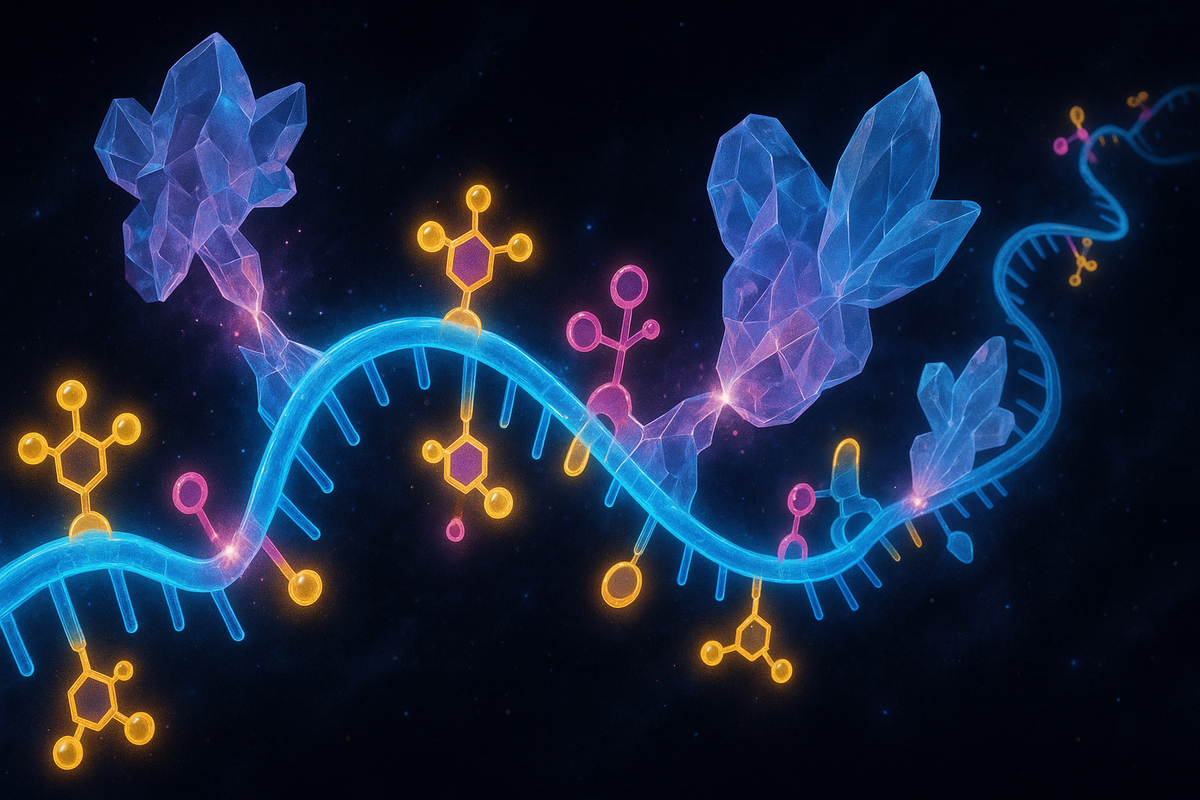
Epigenetics taught us to think about modifications in terms of three classes of proteins: writers that add the marks, erasers that remove them, and readers that recognize and respond to them. The same framework applies to epitranscriptomics. Writers for m6A include a complex called METTL3-METTL14. These enzymes add methyl groups to specific adenosines—not randomly, but in defined sequence contexts. The cell knows where it wants methylation and puts it there. Erasers include FTO and ALKBH5. These are demethylases—they remove the methyl groups. This makes the modification dynamic. It's not set once and forgotten; it can be added or removed depending on cellular conditions. Readers are proteins that recognize m6A and do something about it. The YTHDF family of proteins, for example, binds to methylated adenosines and can promote mRNA degradation, enhance translation, or affect where in the cell the mRNA localizes. This is a complete regulatory system. The cell writes methylation marks, reads them with specialized proteins, and erases them when conditions change. It's not static decoration—it's active control. RNA modifications are reversible. The cell is editing its transcripts in real-time.
What m6A Does
So what's the modification actually doing? Why mark certain RNAs in certain places? Stability. m6A often promotes RNA degradation. The YTHDF2 reader protein, for example, binds methylated mRNAs and targets them for destruction. This is a way to tune transcript half-lives—how long an mRNA persists before being recycled. Translation. m6A can enhance or reduce how efficiently an mRNA gets translated into protein. In some contexts, methylation promotes translation; in others, it inhibits it. The effect depends on which reader proteins are present and where the modification occurs. Splicing. Alternative splicing—the process by which one gene can produce multiple different mRNAs—is influenced by m6A. Methylation near splice sites can affect which exons get included or excluded. Localization. Where an mRNA goes in the cell matters. Neurons, for example, transport specific mRNAs to synapses where local translation occurs. m6A is involved in determining which transcripts get transported where. Timing. Gene expression isn't just about which genes are on—it's about when. m6A modifications are dynamic, changing with circadian rhythms, developmental stages, and cellular stress. This provides temporal control that the genetic sequence alone can't encode. In short: m6A is everywhere, and it affects nearly every aspect of mRNA metabolism. It's not one function—it's a general regulatory currency.
Beyond m6A
m6A is the best-studied RNA modification, but it's far from the only one. Pseudouridine (Ψ) is the most abundant modification in RNA overall—especially in ribosomal RNA and transfer RNA, where it's been known for decades. But it also occurs on mRNAs, where it can affect translation and stability. This is the modification that Katalin Karikó exploited to make mRNA vaccines work. 5-methylcytosine (m5C) is the RNA equivalent of DNA methylation. It occurs on mRNAs and other transcripts, influencing stability and translation. N1-methyladenosine (m1A) is found primarily in the 5' untranslated region of mRNAs, where it can affect translation initiation. Adenosine-to-inosine (A-to-I) editing is particularly interesting. Enzymes called ADARs convert adenosine to inosine in double-stranded RNA regions. This changes the coding sequence—inosine is read as guanosine during translation. A-to-I editing is extensive in the brain and affects proteins involved in neurotransmission. There are more than 170 known RNA modifications. Most are poorly understood. We're in early days—we know these marks exist, we're starting to learn where they occur, but we're still largely ignorant of their full functional implications. The RNA code isn't just A, U, G, C. It's A, m6A, m1A, U, Ψ, G, C, m5C, I, and a hundred other variants.
The Machinery Is Ancient
One of the striking findings from epitranscriptomics research: the modification machinery is highly conserved across evolution. The m6A writer complex exists in yeast, worms, flies, mice, and humans. The reader proteins have ancient origins. This suggests that RNA modification isn't a recent evolutionary innovation—it's fundamental to how eukaryotic cells work, conserved for hundreds of millions of years. Why would evolution maintain such a complex system? Probably because it provides regulatory flexibility that sequence alone can't match. Consider the problem cells face: they have a fixed genome, but they need to respond dynamically to changing conditions. Stress, nutrients, temperature, developmental signals—all require adjusting gene expression rapidly. Transcribing new genes takes time. But modifying existing RNAs can be nearly instantaneous. The epitranscriptome allows cells to reprogram their gene expression post-transcriptionally. The message has already been sent; now you're editing how it's received. RNA modifications are the post-it notes of molecular biology—annotations that change how the main text gets interpreted.
Disease Connections
When you discover a new regulatory layer, the next question is: what happens when it goes wrong? Cancer. Multiple cancers show altered m6A patterns—either changes in modification levels or mutations in writer/reader/eraser proteins. Acute myeloid leukemia, glioblastoma, liver cancer, and others have been linked to epitranscriptomic dysregulation. The FTO eraser protein is overexpressed in certain leukemias and promotes cancer cell survival. Neurological disease. The brain is particularly rich in RNA modifications, and disruptions have been linked to neurodegeneration, intellectual disability, and psychiatric conditions. The m6A reader YTHDF1, for example, is important for learning and memory. Mice lacking it have cognitive deficits. Metabolic disease. FTO—the m6A eraser—was originally identified as a gene associated with obesity risk. The connection between fat-mass-related phenotypes and RNA demethylation is still being untangled, but it suggests metabolic regulation has an epitranscriptomic component. Immune function. m6A modification affects how immune cells develop and respond to pathogens. T cell activation, macrophage function, and antiviral responses all involve epitranscriptomic changes. The pattern is consistent: wherever we look, RNA modifications turn up as regulatory switches. When those switches malfunction, disease follows.
Technical Challenges
Mapping the epitranscriptome is hard. Much harder than sequencing the genome or transcriptome. Detection is indirect. Most modifications don't change how RNA is sequenced using standard methods. To find m6A, you need modification-specific antibodies or chemical treatments that create detectable signatures. Each method has biases and limitations. Stoichiometry is partial. Unlike mutations, which are all-or-nothing, modifications are often fractional. Maybe 30% of a given mRNA carries m6A at position X. Measuring these fractions precisely is technically challenging. Dynamic range is enormous. Some modifications are abundant (m6A on common transcripts); others are rare (novel modifications on tissue-specific RNAs). Capturing both requires different approaches. The field is young. Standards are still being established. Different labs using different methods can get different results. Reproducibility is improving but not yet where it needs to be. The good news: technology is advancing rapidly. New sequencing methods, including direct RNA sequencing with nanopores, can detect some modifications without antibodies. The resolution and throughput are improving year by year. We're moving from "RNA modifications exist" to "here is exactly where every modification sits on every transcript in every cell type." That map will transform our understanding of gene regulation.
The Regulation of Regulation
Here's where it gets philosophically interesting. We used to think genetic information flowed linearly: DNA to RNA to protein. Then we discovered epigenetics—modifications on DNA that regulate how genes are expressed. Now we have epitranscriptomics—modifications on RNA that regulate how transcripts are processed. Each layer regulates the layer below it. But here's the thing: the proteins that write, read, and erase RNA modifications are themselves encoded by genes, transcribed into mRNAs, and subject to... epitranscriptomic regulation. The regulatory system regulates itself. It's recursive. Modifications affect the abundance of modification enzymes, which affects modification patterns, which affects enzyme abundance. Feedback loops all the way down. This is what complex systems look like. There's no master controller. There's a network of interacting processes, each affecting the others, producing emergent behavior that can't be predicted from any single component. The cell isn't executing a program. The cell is the program and the programmer simultaneously.
Therapeutic Implications
If RNA modifications are regulatory switches, can we flip them therapeutically? The mRNA vaccines already exploit this principle. By incorporating modified nucleosides like pseudouridine, the vaccines reduce immunogenicity and increase translation. That's crude epitranscriptomic engineering—modifying RNA before it enters the cell. The next frontier is manipulating endogenous modifications—the marks the cell puts on its own RNAs. Small molecule inhibitors targeting modification enzymes are in development. If m6A promotes a cancer, inhibiting the m6A writer might starve the tumor. If insufficient modification contributes to disease, enhancing writer activity might help. RNA therapeutics could be designed with specific modification patterns that optimize stability, translation, or cellular localization. Understanding which modifications do what would enable rational design. Diagnostics could use epitranscriptomic signatures as biomarkers. Cancer cells often have distinct modification patterns; detecting these in circulating RNA could enable early diagnosis. We're very early in this space. Most interventions are still in preclinical stages. But the logic is clear: if modifications regulate gene expression, targeting modifications is a new axis of therapeutic intervention. We're not just reading the RNA code. We're learning to edit the annotations.
The New Central Dogma
The Central Dogma was: DNA makes RNA makes protein. The updated version might be: DNA, modified by epigenetics, makes RNA, modified by epitranscriptomics, makes protein, modified by post-translational chemistry, resulting in phenotype. Every layer of information flow has its own regulatory overlay. The simple linear story became a multidimensional regulatory network. And at each layer, the modifications are dynamic—added, removed, and interpreted differently depending on cellular context. This is messier than the textbook version. It's also more accurate. Biology is not a simple machine executing a fixed program. It's a complex adaptive system with layers of control that we're only beginning to understand. The epitranscriptome is one of those layers. Probably not the last one we'll discover.
Further Reading
- Roundtree, I. A., Evans, M. E., Pan, T., & He, C. (2017). "Dynamic RNA Modifications in Gene Expression Regulation." Cell.
- Zaccara, S., Ries, R. J., & Jaffrey, S. R. (2019). "Reading, writing and erasing mRNA methylation." Nature Reviews Molecular Cell Biology.
- Frye, M., Harada, B. T., Behm, M., & He, C. (2018). "RNA modifications modulate gene expression during development." Science.
- Shi, H., Wei, J., & He, C. (2019). "Where, When, and How: Context-Dependent Functions of RNA Methylation Writers, Readers, and Erasers." Molecular Cell.
This is Part 3 of the RNA Renaissance series. Next: "RNA Interference: Silencing Genes on Demand."


Comments ()