Euler's Identity: When e π i 1 and 0 Meet
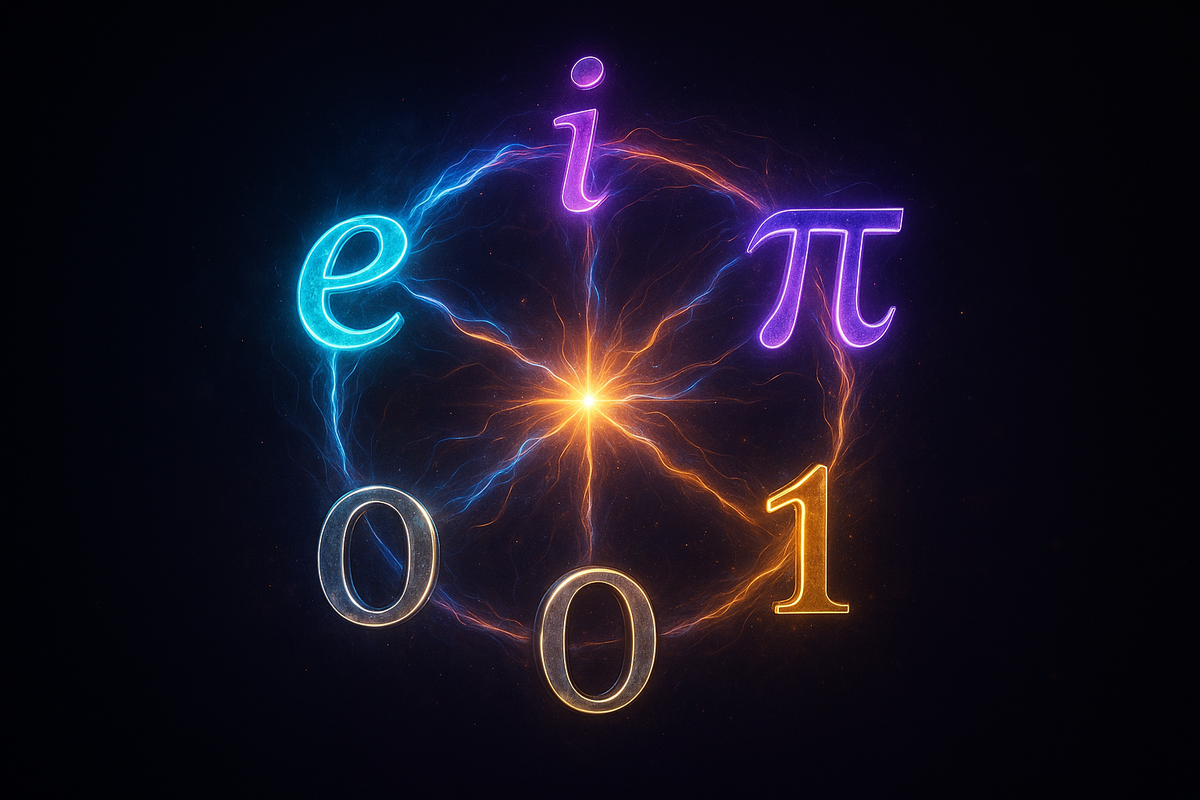
e^(iπ) + 1 = 0
Five fundamental constants. One equation. Zero coincidence.
This is Euler's identity, often called the most beautiful equation in mathematics. Mathematicians don't use the word "beautiful" casually. When they do, they mean something specific: unexpected connections, inevitable truths, deep simplicity.
This equation has all three.
The Five Constants
Each number in Euler's identity comes from a completely different corner of mathematics:
e ≈ 2.71828 — The base of natural logarithms. The number where d/dx(eˣ) = eˣ. It emerges from compound interest, probability, and calculus.
i — The imaginary unit, defined by i² = -1. Born from algebra's need to solve every polynomial.
π ≈ 3.14159 — The ratio of circumference to diameter. Pure geometry.
1 — The multiplicative identity. The simplest building block of arithmetic.
0 — The additive identity. Nothingness made mathematical.
Five constants from five different origins. And they satisfy one equation.
Derivation from Euler's Formula
Start with Euler's formula:
e^(iθ) = cos θ + i sin θ
Set θ = π:
e^(iπ) = cos π + i sin π = -1 + i(0) = -1
Rearrange:
e^(iπ) + 1 = 0
The derivation takes one line. The significance takes longer.
What It Says Geometrically
Remember what e^(iθ) means: rotation by angle θ in the complex plane.
e^(iπ) means: rotate by π radians (180 degrees).
Start at 1 on the real axis. Rotate 180 degrees. You land at -1.
That's it. e^(iπ) = -1 says "half a turn around the unit circle ends up at negative one."
Adding 1 brings you back to 0.
The identity is a complete rotation through opposition back to nothing.
Why Mathematicians Love It
The identity combines:
Analysis (e, the exponential) Algebra (i, complex numbers) Geometry (π, circles) Arithmetic (0 and 1, the identities)
These fields developed independently over centuries. Different motivations, different methods, different communities.
And yet they collapse into one equation.
This isn't coincidence. Mathematics is more unified than its textbook divisions suggest. Euler's identity is a signpost: keep digging and you'll find everything connects.
Adding the Operations
The equation e^(iπ) + 1 = 0 also uses the fundamental operations:
- Exponentiation: e^(iπ)
- Multiplication: the implicit iπ
- Addition: + 1
- Equality: = 0
Five constants, four operations, one true statement.
Some call it a "mathematical poem" — maximum meaning in minimum symbols.
Rearrangements
The identity can be written several ways:
e^(iπ) + 1 = 0 — The "poetic" form, ending with nothing.
e^(iπ) = -1 — The "computational" form, useful for calculations.
e^(iπ) + e^(0) = 0 — Highlighting symmetry (since e^0 = 1).
e^(iπ) = e^(iπ) — Trivially true but less interesting.
The first form, ending in 0, has aesthetic appeal: emergence from nothing, return to nothing.
What About e^(2πi)?
e^(2πi) = cos(2π) + i sin(2π) = 1 + 0 = 1
A full rotation (2π radians = 360 degrees) brings you back to 1.
This gives another identity:
e^(2πi) = 1
Or: e^(2πi) - 1 = 0
Less famous, equally true. The version with π hits the midpoint; the version with 2π completes the circle.
Physical Significance
In physics, e^(iωt) describes oscillation. The identity e^(iπ) = -1 represents half an oscillation cycle — the point of maximum opposition.
In AC circuits: Half a cycle means the voltage has flipped sign.
In quantum mechanics: A phase shift of π means the wave function has inverted. Two such shifts return to the original state.
In music: π phase shift means a sound wave is at its opposite point — compression becomes rarefaction.
The identity isn't abstract. It describes what happens at the midpoint of every oscillation.
The Aesthetic Dimension
Mathematicians have voted on "most beautiful equation" multiple times. Euler's identity consistently wins.
Physicist Richard Feynman called Euler's formula (the general version) "our jewel." Benjamin Peirce reportedly said of the identity: "It is absolutely paradoxical; we cannot understand it, and we don't know what it means, but we have proved it, and therefore we know it must be the truth."
The appeal is not just that it's true. It's that it seems like it shouldn't work — and then it does.
A Proof Without Euler's Formula
Here's another approach, using the definition e = lim[n→∞](1 + 1/n)^n.
Consider e^x = lim[n→∞](1 + x/n)^n.
For x = iπ:
e^(iπ) = lim[n→∞](1 + iπ/n)^n
Each factor (1 + iπ/n) is a complex number slightly rotated from 1. As n → ∞, you're taking infinitely many infinitesimal rotations, totaling π radians.
The result: e^(iπ) points at -1.
This gives a "limiting rotation" intuition independent of Taylor series.
Generalizations
Euler's identity is a special case of more general truths:
Euler's formula: e^(iθ) = cos θ + i sin θ (for any θ)
Complex exponential: e^(a+bi) = e^a(cos b + i sin b)
Fundamental theorem of algebra: Complex numbers make every polynomial solvable.
The identity at θ = π is memorable precisely because the values are so simple: the cosine is -1, the sine is 0, and you get integer results.
Skepticism
Some mathematicians find the "most beautiful equation" hype overblown.
Gian-Carlo Rota argued that the identity is "not deep" — it follows immediately from definitions. The real depth, he said, is in Euler's formula and the general theory of complex analysis.
Fair enough. The identity is a corollary, not a foundational theorem.
But beauty and depth aren't the same. A corollary can be beautiful if it crystallizes a vast theory into one memorable line.
Summary
e^(iπ) + 1 = 0
- Combines five fundamental constants: e, i, π, 1, 0
- Follows from Euler's formula with θ = π
- Means: half a rotation in the complex plane lands at -1
- Symbolizes the unity of analysis, algebra, and geometry
- Is not coincidence but consequence
The identity is a window into mathematical structure. Five symbols from different worlds, one equation, zero accident.
Further Reading
- Nahin, P. Dr. Euler's Fabulous Formula. History and applications.
- Maor, E. e: The Story of a Number. The exponential constant.
- Livio, M. Is God a Mathematician? Philosophy of mathematical beauty.
This is Part 6 of the Complex Numbers series. Next: "Roots of Unity" — complex numbers that equal 1 when raised to a power.
Part 6 of the Complex Numbers series.
Previous: Euler's Formula: The Most Beautiful Equation in Mathematics Next: Roots of Unity: Complex Numbers That Equal One When Powered
Comments ()