Exponential Growth: When Doubling Never Stops
Humans are bad at exponential thinking by design. The math that drives pandemics, investments, and nuclear chain reactions is the same math our intuition consistently gets wrong.
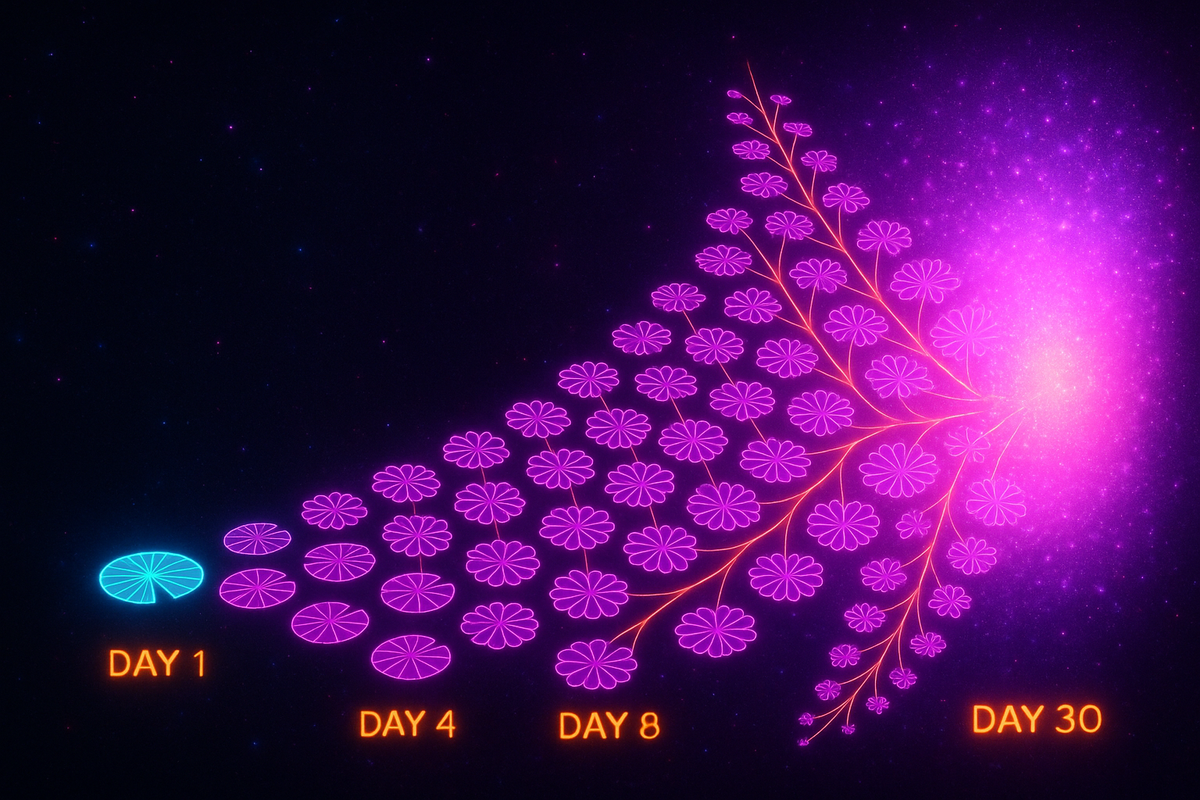
Exponential growth looks slow until it isn't.
Here's a classic puzzle: A lily pad doubles in size every day. On day 30, it covers the entire pond. On what day did it cover half the pond?
Day 29.
That's exponential growth. You spend 29 days getting to halfway, then one more day doubles everything. The explosive final phase blindsides you.
This is why exponential growth is dangerous, powerful, and fundamentally difficult for human intuition.
The Defining Property
A quantity grows exponentially when its rate of increase is proportional to its current size.
The bigger it is, the faster it grows. Growth feeds on itself.
Mathematically: df/dt = kf where k > 0.
Solution: f(t) = f₀ · e^(kt)
Or in discrete form: f(n) = f₀ · bⁿ, where b > 1.
The key: each unit of time multiplies by a constant factor. Not adds—multiplies.
Doubling Time
Every exponential growth process has a doubling time—the time it takes to double.
If f(t) = f₀ · 2^(t/T), then T is the doubling time.
After T units: f₀ → 2f₀ After 2T units: f₀ → 4f₀ After 10T units: f₀ → 1024f₀
For continuous growth at rate k, the doubling time is:
T = ln(2)/k ≈ 0.693/k
Or use the Rule of 70: T ≈ 70/(k%), where k is the percentage growth rate.
- 7% annual growth → doubles in 10 years
- 10% growth → doubles in 7 years
- 1% growth → doubles in 70 years
The Chess Board Story
Legend: The inventor of chess asked for payment in rice. One grain on the first square, two on the second, four on the third, doubling each square.
- Square 1: 1 grain
- Square 10: 512 grains
- Square 20: about 500,000 grains
- Square 64: 9,223,372,036,854,775,808 grains
That's about 18 quintillion grains—more rice than has ever existed.
The total for all 64 squares: 2⁶⁴ - 1 grains, weighing about 460 billion metric tons.
The king couldn't pay. The request seemed modest (just rice, starting with a single grain), but exponential growth makes modest beginnings into impossible demands.
Population Growth
Thomas Malthus worried about this in 1798: populations grow geometrically (exponentially), but food supply grows arithmetically (linearly).
Exponential wins eventually. If population doubles every 25 years:
- Year 0: 1 billion
- Year 25: 2 billion
- Year 50: 4 billion
- Year 75: 8 billion
- Year 100: 16 billion
Linear food growth can't keep up. Something must give—either growth slows or collapse occurs.
In practice, populations hit resource limits and growth becomes logistic (S-shaped) rather than purely exponential. But the early phase is genuinely exponential, and that phase determines much of history.
Viral Spread
Epidemics start exponentially. If each infected person infects 2 others:
- Week 1: 1 case
- Week 2: 2 cases
- Week 3: 4 cases
- Week 4: 8 cases
- Week 10: 1,024 cases
- Week 20: 1,048,576 cases
The "R" number (basic reproduction number) is the base of the exponential. R > 1 means growth. R < 1 means decay.
COVID-19 early data showed R ≈ 2-3. In unmitigated spread, case counts double every few days. This is why early intervention matters: catching exponential growth early (at 100 cases) is vastly easier than later (at 100,000 cases).
Moore's Law
Gordon Moore observed in 1965 that the number of transistors on integrated circuits doubles approximately every two years.
This exponential trend held for decades:
- 1971: 2,300 transistors
- 1980: 30,000 transistors
- 1990: 1,000,000 transistors
- 2000: 40,000,000 transistors
- 2010: 2,000,000,000 transistors
- 2020: 50,000,000,000 transistors
Each doubling halves the cost per transistor. This is why your smartphone has more computing power than Apollo-era NASA.
Moore's Law is slowing as we approach physical limits, but its decades of exponential growth created the digital world.
Why Intuition Fails
Human intuition evolved for linear processes. We're good at:
- Adding quantities
- Predicting constant rates of change
- Extrapolating straight lines
We're bad at:
- Multiplicative accumulation
- Predicting accelerating change
- Feeling the difference between 10 doublings and 20 doublings
The lily pad problem catches everyone. Half the pond feels like halfway through the process. It's actually 97% of the way through.
The Mathematics
Discrete exponential growth: f(n) = f₀ · bⁿ
Example: Starting with 100, growing 5% per period: f(n) = 100 · (1.05)ⁿ
After 50 periods: 100 · (1.05)⁵⁰ ≈ 1,147
Continuous exponential growth: f(t) = f₀ · e^(kt)
Example: Starting with 100, continuous growth rate 5% per time unit: f(t) = 100 · e^(0.05t)
After 50 time units: 100 · e^(2.5) ≈ 1,218
Continuous growth is slightly faster than discrete growth at the same rate because interest compounds continuously rather than periodically.
When Does Exponential Growth End?
Real exponential growth always stops. Resources deplete. Competitors emerge. Physical limits apply.
The question isn't whether it stops, but when and how.
Logistic growth: The realistic model. Growth slows as the system approaches carrying capacity K:
df/dt = kf(1 - f/K)
Early on, f << K, and growth is approximately exponential. As f approaches K, growth slows and levels off.
The S-curve (logistic curve) is exponential early, then flattens. Most real growth follows this pattern.
Compound Growth Rate
To find the average rate from data:
If quantity goes from A to B in time T:
Rate b = (B/A)^(1/T)
Example: A stock goes from $100 to $400 in 10 years. b = (400/100)^(1/10) = 4^0.1 ≈ 1.149
That's about 14.9% annual growth.
Orders of Magnitude
Exponential growth is measured in doublings or orders of magnitude (powers of 10).
- 10 doublings: 2¹⁰ ≈ 1,000 (three orders of magnitude)
- 20 doublings: 2²⁰ ≈ 1,000,000 (six orders of magnitude)
- 30 doublings: 2³⁰ ≈ 1,000,000,000 (nine orders of magnitude)
Each additional 10 doublings multiplies by another 1,000. This is why exponential processes rapidly exceed comprehension.
The Key Lesson
Exponential growth is counterintuitive because early growth is unimpressive. By the time it looks serious, it's already enormous.
The time to act on exponential trends is when they look like nothing much. By the time they look like something, you're in the steep part of the curve.
This applies to:
- Personal savings (start early)
- Epidemics (intervene early)
- Technology adoption (get in early)
- Environmental degradation (act early)
Exponential growth rewards early action and punishes delay—because each doubling time lost doubles the problem.
Part 2 of the Exponential Functions series.
Previous: What Is an Exponential Function? When the Variable Is the Power Next: Exponential Decay: Half-Lives and Cooling
Comments ()