Extended Cognition: When Mind Leaks Into the World
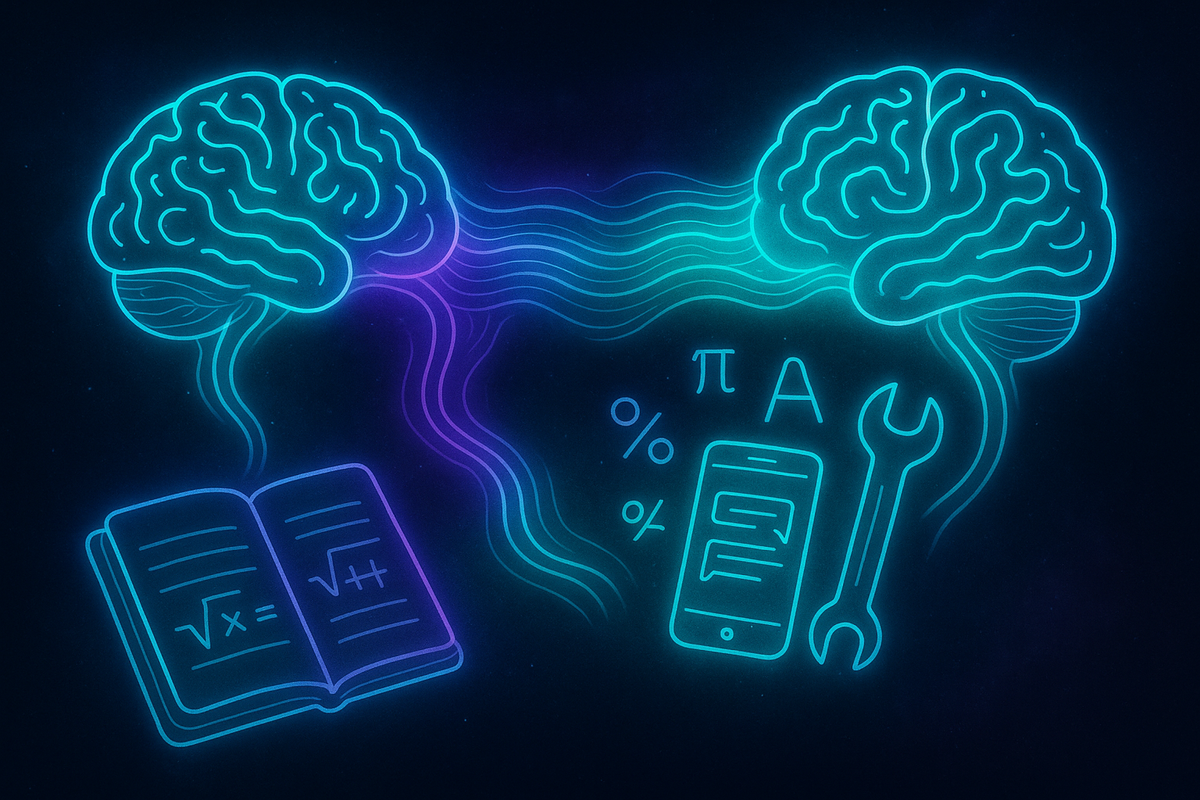
Your phone isn't helping your memory — it IS your memory. Extended cognition argues the mind doesn't stop at the skull, and that claim is harder to dismiss than it sounds.
Extended Cognition: When Mind Leaks Into the World
Series: 4E Cognition | Part: 5 of 9
Otto has Alzheimer's. His biological memory is failing. But Otto functions remarkably well because he carries a notebook everywhere, writing down appointments, addresses, and information he needs. When Otto looks up a phone number in his notebook and calls someone, is he remembering the number?
Andy Clark and David Chalmers say yes. Absolutely yes.
This is the extended mind thesis: cognitive processes aren't confined to brains. When external resources play the same functional role as internal processes, they are cognitive processes. Otto's notebook isn't helping his memory—it is part of his memory system.
This sounds radical. It is. But it's also the logical conclusion of taking embodied, embedded, and enacted cognition seriously. If cognition is about maintaining functional loops, not preserving anatomical boundaries, then where those loops extend determines where mind extends.
And minds extend far beyond skulls.
The Argument: Parity and Coupling
Clark and Chalmers's 1998 paper laid out the logic cleanly. Consider two people:
Inga hears about an exhibition at MoMA. She retrieves the museum's address from biological memory and travels there.
Otto hears about the same exhibition. He consults his notebook, retrieves the address, and travels there.
What's the difference? Inga's memory is neural. Otto's is partly notational. But functionally, they're equivalent. Both retrieve stored information. Both use it to guide action. Both trust the source. Both access it reliably.
The parity principle says: if an external process plays the same role as an internal one—if removing it would impair cognitive function the same way removing the internal process would—then it's part of the cognitive system.
Otto's notebook passes the test. Losing it would impair his cognition the same way amnesia would. Therefore, the notebook is part of his memory.
The Coupling Criterion
But not every external resource counts as cognition. Using Google occasionally doesn't make Google part of your mind. The key is coupling: how reliably, automatically, and functionally integrated the resource is.
Clark refines the criterion:
- The resource must be reliably available
- It must be automatically invoked (not effortfully deployed)
- The information must be trusted (not constantly verified)
- The coupling must be dense and reciprocal
Otto's notebook meets all criteria. It's always with him. He automatically consults it. He trusts its contents. The coupling is tight.
Your smartphone might meet the criteria too. If you check it constantly, trust its information, rely on it for memory and navigation, and would be severely impaired without it—then it's not metaphor to say it's part of your extended mind.
It literally is.
Scaffolding: Tools That Become Transparent
Richard Menary distinguishes between cognitive extension (tools that are part of cognition) and cognitive scaffolding (tools that support cognition without being part of it). The difference is integration depth.
A calculator scaffolds arithmetic—it helps, but you know you're using a tool. Mathematical notation extends arithmetic—once you're fluent, you think through symbols without awareness of using them. The notation becomes transparent.
Transparent Technology
When tools become transparent, they're cognitively integrated. You stop thinking about them and start thinking through them:
- A blind person using a cane doesn't feel the cane—they feel the ground through the cane. The cane becomes perceptually transparent.
- An expert typist doesn't think about keys—they think through the keyboard directly to words. The keyboard is motorically transparent.
- A mathematician using algebra doesn't manipulate symbols then solve problems—solving problems is manipulating symbols. Notation is cognitively transparent.
Transparency indicates extension. When you stop experiencing the tool as separate, it's become part of your cognitive system.
Language as Cognitive Technology
One of Clark's boldest claims: language isn't just for communication. It's cognitive scaffolding that extends human thinking into domains impossible for non-linguistic cognition.
Consider recursion. Non-human animals struggle with recursive structures (patterns within patterns within patterns). Humans handle them easily—but primarily through language. Recursion in thought piggybacks on recursion in syntax.
Or consider abstraction. Abstract concepts like "justice" or "momentum" are hard to think without words to stabilize them. Language provides persistent, manipulable symbols that extend working memory and enable combinatorial thought.
Peter Carruthers goes further: language enables metacognition—thinking about thinking. You monitor your thoughts by "hearing" them in inner speech, which makes implicit processes available for reflection and control.
This means linguistic humans don't just think more than non-linguistic animals. They think differently, in a qualitatively extended cognitive space opened by linguistic scaffolding.
Writing as Radical Extension
If spoken language extends cognition, writing extends it further. Writing offloads memory externally, enables complex argument tracking, and allows ideas to accumulate across generations.
Mathematics is barely thinkable without written notation. Science requires shared written records. Philosophy depends on sustained written argument. None of these are possible with biological memory alone.
Writing doesn't record thoughts you already had. It enables thoughts you couldn't otherwise think. That's cognitive extension.
Social Extension: Other Minds as Cognitive Resources
Groups of people can constitute cognitive systems more capable than any individual. This isn't teamwork metaphor—it's literal cognitive extension across multiple brains.
Transactive Memory
Daniel Wegner's research on transactive memory in couples shows that partners store different information and know who knows what. If you ask me something I don't know but my partner does, I don't say "I don't know"—I say "ask them." I'm using their memory as part of my extended system.
Long-term couples develop cognitive division of labor: one remembers directions, the other remembers appointments. The system is the couple, not the individuals. Separate them, and both become cognitively impaired in their domain.
Work teams function similarly. Distributed expertise means no individual has complete knowledge, but the team-as-system does. The cognition solving the problem is distributed across multiple brains plus shared artifacts (documents, code, models).
Collaborative Problem-Solving
Watch two people solving a puzzle together. Ideas ping-pong between them. One person's half-formed thought triggers the other's completion. Neither could solve it alone at the same speed.
The cognitive system solving the puzzle includes both brains, the puzzle itself, and the communicative coupling between people. The boundaries of "the mind solving this" don't respect skin.
The Internet as Extended Mind?
Does the internet extend cognition? It depends on coupling.
If you Google facts occasionally, it's scaffolding—helpful but external. If you have instant, reliable access that you automatically invoke for all memory needs, it starts looking like extension.
Millennials who "can't remember" life before smartphones haven't lost memory capacity—they've offloaded it. Their memory system includes devices. Losing the phone feels like losing part of yourself because functionally, you did.
The Dark Side: Mandatory Extension
If cognition extends into technology, then controlling technology controls cognition. This isn't hypothetical—it's current reality.
Social media platforms shape attention, memory, and belief through algorithmic curation. These aren't neutral tools—they're cognitive prosthetics with agenda. When your extended mind includes Facebook's algorithm, your thoughts are partly engineered by Facebook.
Search engines shape what you know by determining what you find. Recommendation systems shape what you believe by filtering information access. These extensions aren't democratizing cognition—they're channeling it.
Recognizing extended mind means recognizing cognitive vulnerability. If your mind extends into tools, whoever controls the tools shapes your cognition.
Objections and Replies
"Where Does It End?"
If mind extends into notebooks and phones, does it extend into libraries? The internet? The universe?
Clark's reply: extension is determined by coupling strength. Tightly, reliably coupled resources are part of the cognitive system. Loosely coupled ones aren't. The boundary is real but context-dependent and fluid.
A library you visit weekly isn't extended mind. A reference book you consult constantly might be. It's not about location—it's about functional integration.
"Cognition Requires Consciousness"
Some object that notebooks aren't conscious, so they can't be cognitive.
But neurons aren't conscious either—consciousness is a system-level property. Individual neurons process signals; consciousness emerges from their interaction. Similarly, individual components of extended cognitive systems needn't be conscious for the system to support conscious thought.
"This Trivializes Cognition"
If everything counts as cognition, the concept loses meaning.
But the extended mind thesis doesn't say everything counts. It says functionally integrated resources count. The criterion is clear: parity and coupling. This expands the boundaries of cognition without dissolving them.
The Geometry of Extended Coherence
In AToM terms, cognitive extension means the coherence boundary can literally transcend biological limits. The system maintaining prediction-action loops can include tools, technologies, and social structures when coupling is tight enough.
Coherence is maintained through prediction error minimization. When tools become reliably incorporated into prediction loops—when you predict their behavior as automatically as you predict your arm's movement—they're inside the coherence boundary.
This is why losing a phone feels worse than losing an object of similar monetary value. The phone was part of the system maintaining your coherent navigation of daily life. Losing it destabilizes the whole predictive architecture.
Extended mind isn't metaphysical speculation. It's how coherence-maintaining systems actually work: they extend across whatever substrate provides reliable coupling.
Implications: Designing Extended Minds
If cognition extends, then designing better cognition means designing better extensions.
Personal: Curate your extended mind deliberately. Which tools do you couple with? Which information flows do you trust? Your extended cognitive system is partly your responsibility to architect.
Educational: Stop teaching as if minds are isolated brains. Teach students to skillfully use extensions—how to think with notation, how to leverage tools, how to participate in distributed cognition.
Therapeutic: Cognitive impairment can be addressed through better extension, not just biological intervention. If dementia disrupts biological memory, robust external memory systems can maintain function.
Ethical: Technologies that extend cognition have cognitive responsibility. Designing addictive interfaces isn't just unethical—it's cognitive manipulation. Extended mind means extended moral consideration.
Further Reading
- Clark, A., & Chalmers, D. (1998). "The Extended Mind." Analysis, 58(1), 7-19.
- Clark, A. (2008). Supersizing the Mind: Embodiment, Action, and Cognitive Extension. Oxford University Press.
- Menary, R. (2007). Cognitive Integration: Mind and Cognition Unbounded. Palgrave Macmillan.
- Wegner, D. M. (1987). "Transactive Memory: A Contemporary Analysis of the Group Mind." In B. Mullen & G. R. Goethals (Eds.), Theories of Group Behavior. Springer.
- Hutchins, E. (1995). Cognition in the Wild. MIT Press.
This is Part 5 of the 4E Cognition series, exploring how cognitive science moved beyond the brain.
Previous: Enacted Cognition: Bringing Forth a World
Next: The Boundaries of Mind: Where Does Cognition Stop?
Comments ()