Synthesis: What Our Fiction Says About Our Science
When physicists dream up wormholes and writers put them in novels, who's leading whom? The boundary between scientific possibility and fictional speculation has always been blurrier than textbooks admit.
Synthesis: What Our Fiction Says About Our Science
We've traveled from clockwork universes to quantum branches, from Dune's attractor basins to Black Mirror's feedback traps. The journey reveals a single through-line: science fiction is the imagination processing what science means.
Not the technical details—the metaphysical implications. What does the universe allow? What does it constrain? What kinds of choices are real? What kinds of futures are possible?
The answers change as science changes. And the answers appear in fiction before they appear in philosophy—because narrative is how humans actually work through abstract implications.
The Paradigm Summary
Let's map what we've covered:
Clockwork/Determinism: The universe runs on predictable laws. Sufficient knowledge enables complete prediction. Agency is experienced but ultimately illusory—you feel like you choose, but your choice was determined by prior causes.
Narrative signature: Inevitable destinies, mysteries with solutions, plots that click shut like mechanisms.
Chaos: The universe runs on deterministic laws but is practically unpredictable. Tiny changes yield huge differences. The butterfly flaps.
Narrative signature: Contingent turning points, sliding doors, outcomes that hinge on moments.
Complexity/Attractors: The universe contains emergent dynamics. Systems evolve toward stable states (attractors) that constrain possibilities. You might not be determined, but you might be captured.
Narrative signature: Systemic traps, inescapable dynamics, protagonists who see the trap but can't exit.
Quantum/Multiverse: Every possibility is realized. The universe branches at each choice. All paths are taken—just in different timelines.
Narrative signature: Branching stories, variant characters, stakes diluted by infinite optionality.
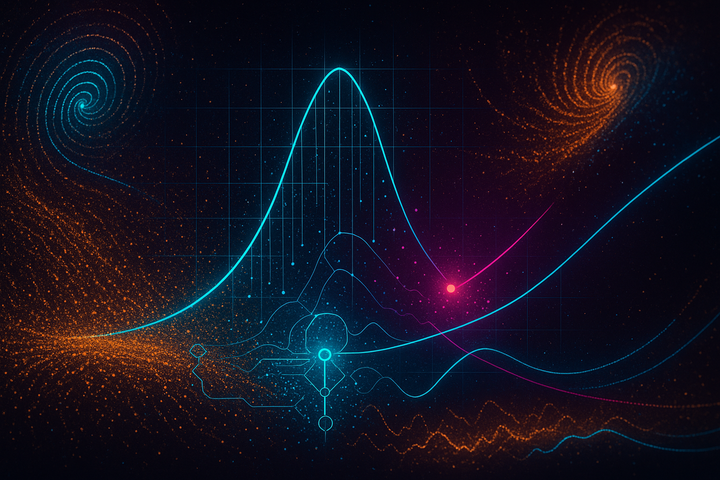
Statistical/Large-N: Individuals are unpredictable, but aggregates follow laws. Statistical knowledge enables prediction and control of masses, even if individual fates remain uncertain.
Narrative signature: Prophecy through math, history as calculated trajectory, outliers who break the pattern.
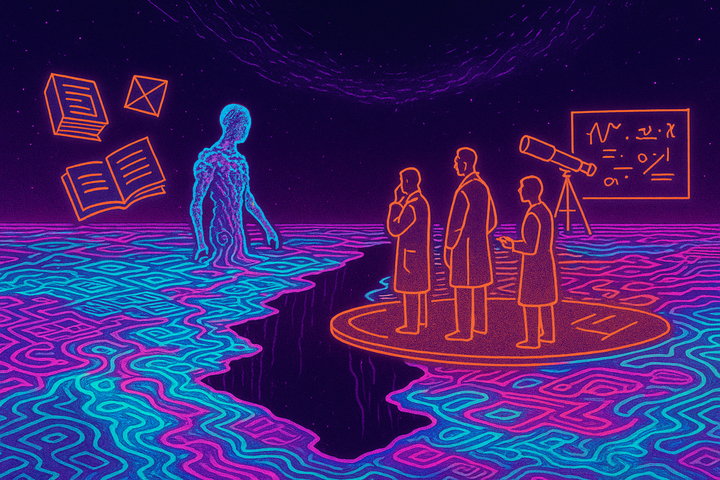
Unknowability: Some things exceed human comprehension. Epistemic limits are real. The universe might contain intelligence we cannot recognize as intelligence.
Narrative signature: Failed understanding, permanent mystery, the alien that remains alien.
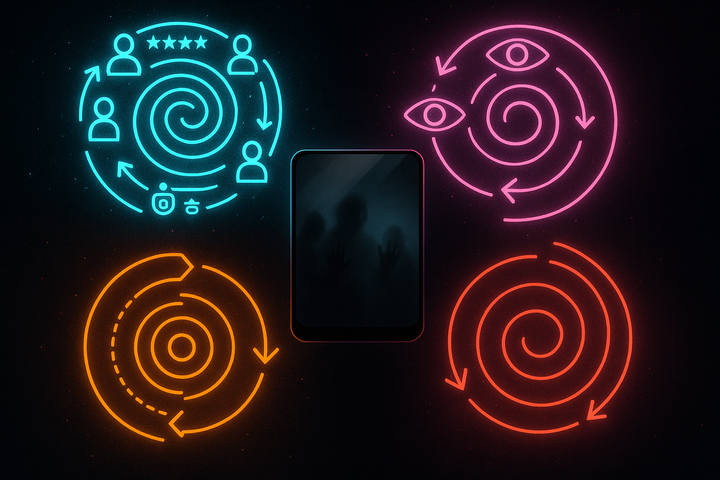
Systems/Feedback: Technology and society form feedback loops. Behavior shapes environment; environment shapes behavior. The trap tightens through dynamics, not villains.
Narrative signature: Inescapable loops, soft traps, horror without a monster.
The Mirror Function
Why does this matter?
Because the paradigm you hold shapes what you think is possible—and therefore what you attempt.
If you believe in clockwork determinism, you might work toward understanding the mechanism, accepting that outcomes are fixed once conditions are set.
If you believe in chaos, you might focus on critical moments, seeking the leverage points where small actions create large effects.
If you believe in attractors, you might focus on system design—engineering dynamics so the attractors are where you want them.
If you believe in multiverse, you might focus on exploration—trying everything because somewhere it works.
If you believe in statistical determinism, you might focus on aggregates—managing populations rather than individuals.
If you believe in unknowability, you might cultivate humility—accepting that some problems won't be solved.
If you believe in feedback systems, you might focus on loop dynamics—identifying and interrupting the processes that trap.
Each paradigm suggests different strategies. The fiction reveals the paradigm; the paradigm shapes the strategy.
What Our Current Fiction Says
What paradigm dominates contemporary science fiction?
Multiverse has been ascendant. The MCU, Everything Everywhere All at Once, countless video games—the cultural imagination has been exploring maximum optionality.
But there's a counter-movement. Climate fiction grapples with attractor dynamics: we're in a basin that slopes toward catastrophe, and individual choices don't seem to shift the trajectory. Systems fiction (Black Mirror, Severance, White Lotus) depicts feedback traps. Complexity fiction (Three-Body Problem) shows emergent dynamics that exceed prediction.
The contemporary imagination is split. One stream says: everything is possible, every branch exists, choose your adventure. Another stream says: you're in a system, the system has dynamics, the dynamics constrain.
This split might reflect a genuine ambivalence. We have unprecedented individual optionality (career paths, lifestyle choices, identity expressions) while simultaneously facing systemic constraints that individuals can't escape (climate, inequality, platform capture).
The Agency Question
Underlying all these paradigms is a question: how much does individual choice matter?
Clockwork says: not at all, ultimately. Your choices are effects, not causes.
Chaos says: enormously, sometimes. The right action at the right moment can cascade.
Attractors say: less than you think. The dynamics dominate; you can surf them but not escape them.
Multiverse says: both completely and not at all. Your choice matters here, but another you made the other choice there.
Statistical says: not individually, but collectively. You're a data point; the distribution is what matters.
Unknowable says: we can't know. The question might not even be well-formed.
Systems says: your choices are shaped by the loop you're in. Change the loop, and your choices change.
Science fiction works through these answers in narrative form. Every sci-fi story implicitly takes a position on agency. Reading the story reveals the position.
The Coherence Connection
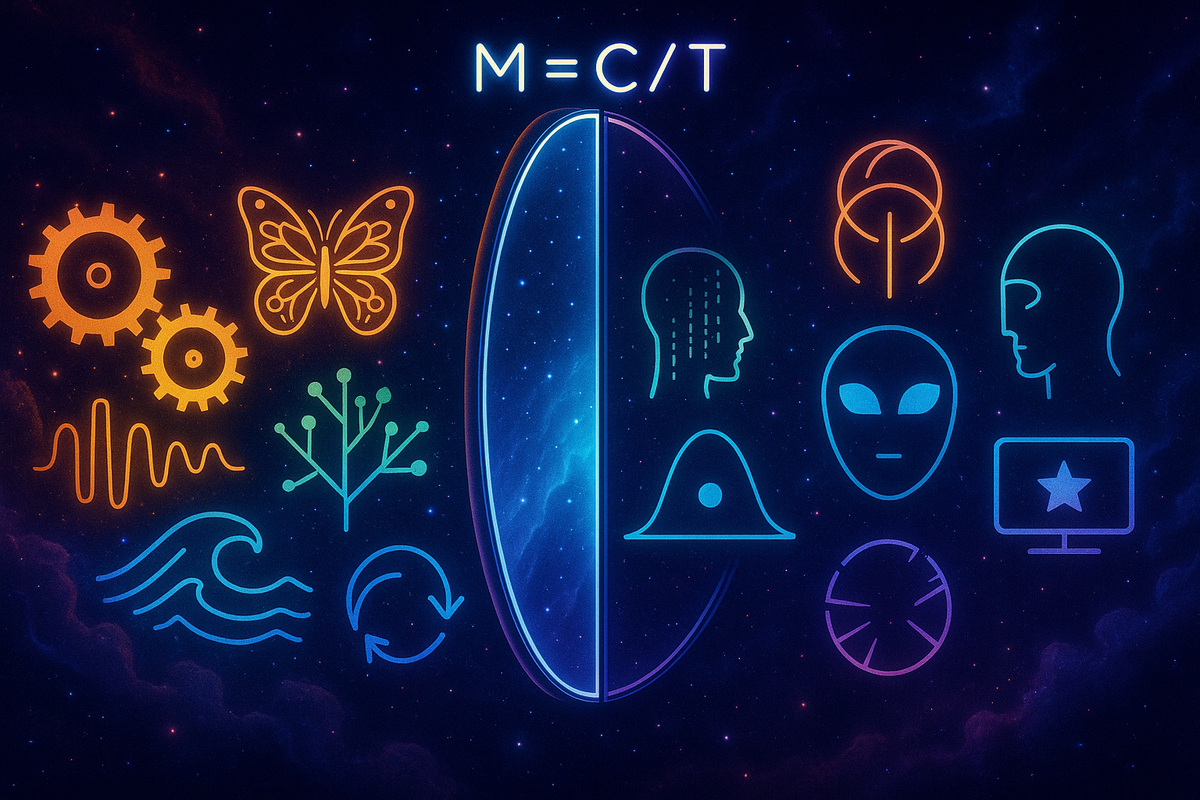
In the Ideasthesia framework, meaning relates to coherence: M = C/T, meaning equals coherence over time.
Each paradigm offers a different relationship to coherence:
- Clockwork universes have maximum coherence—everything fits, everything is determined, the whole is comprehensible. - Chaotic universes have local coherence that degrades—nearby predictions hold, distant predictions fail. - Attractor dynamics create coherence at the basin level—you might not know the path, but you know the destination. - Multiverse has coherence within branches but incoherence across them—each timeline is sensible; the ensemble is noise. - Statistical systems have aggregate coherence but individual incoherence—the distribution is predictable; the instance is not. - Unknowable systems block coherence-formation—you can't integrate what you can't comprehend. - Feedback systems create perverse coherence—the loop holds together, trapping you in its consistency.
The paradigm determines what kind of meaning is available. In a clockwork universe, meaning is discovering the mechanism. In a chaotic universe, meaning is navigating contingency. In an attractor universe, meaning is finding the escape or accepting the basin.
Fiction explores these meaning-structures. Reading science fiction is reading thought experiments about what meaning is available under different physical assumptions.
The Evolution
The paradigms haven't just coexisted—they've evolved.
Early modern science fiction reflected early modern science: mechanical, predictable, solvable. Verne's submarines, Wells' time machines—technology as tool, universe as understandable.
20th century science fiction absorbed thermodynamics, relativity, quantum mechanics. The universe became stranger—entropy increases, time dilates, particles superpose. But it remained comprehensible.
Late 20th century absorbed chaos and complexity. The universe became less predictable even when deterministic. Control became harder. Emergence became a theme.
21st century absorbs systems thinking, network effects, feedback dynamics. The universe becomes a process that traps, not just constrains. Technology becomes environment, not tool.
Each shift reflects a shift in the scientific imagination. And each shift changes what stories are possible, what outcomes are imaginable, what struggles are meaningful.
Reading the Mirror
Here's the practice this series proposes:
When you read science fiction, ask: what paradigm is operating?
Is the universe clockwork, chaos, attractor, multiverse, statistical, unknowable, feedback? What does the fiction assume about causation, agency, prediction, escape?
When you watch the paradigm, ask: what does it say about now?
Why is this paradigm resonating? What cultural mood does it reflect? What problems does it reveal? What strategies does it suggest?
When you see the mood, ask: is it accurate?
Does the paradigm match reality? Are we actually in an attractor basin, or does it just feel that way? Is the multiverse a physical truth, or a cultural fantasy of escaped commitment?
The fiction doesn't just reflect the science. It reflects what the science feels like—the emotional and existential implications of living in a universe that works a certain way.
Reading the fiction paradigmatically reveals both what we believe about reality and what we feel about what we believe.
Conclusion: The Mirror Is Real
Science fiction doesn't predict the future. Technology prediction is mostly wrong, and that's fine—prediction isn't the point.
Science fiction shows us what we believe about the structure of possibility. It processes the implications of scientific paradigms before philosophy catches up. It reveals the cultural imagination in the act of working through what science means for human life.
The mirror is real. Show me what stories a culture tells about possibility, and I'll show you what that culture believes about agency, fate, and the nature of choice.
Read the fiction. See the paradigm. Understand the mirror.
And ask yourself: which paradigm are you living in? And is it the right one?
Further Reading
- Suvin, D. (1979). Metamorphoses of Science Fiction. Yale University Press. - Jameson, F. (2005). Archaeologies of the Future. Verso. - Hayles, N. K. (2012). How We Think: Digital Media and Contemporary Technogenesis. University of Chicago Press.
This is Part 9 of the Science Fiction Mirror series, concluding our exploration of how the scientific imagination shapes narrative possibility. For more on meaning and coherence, see the [AToM Series](/atom-theory/).
Comments ()