The Four Laws of Thermodynamics: The Universe's Operating System
You can't win. You can't break even. You can't quit the game. The four laws of thermodynamics don't just describe energy — they set the hard limits on everything that can ever happen.
The Four Laws of Thermodynamics: The Universe's Operating System
In 1850, Rudolf Clausius realized something that would haunt physics forever: heat flows from hot to cold, never the reverse. It sounds obvious. It's not. It's the reason the universe has a direction.
That insight became the Second Law of Thermodynamics. But it was just the beginning. Over the next century, physicists would discover that four laws—not three, four—govern everything from stellar fusion to your morning coffee cooling. These aren't just rules about heat. They're constraints on reality itself.
Here's what makes thermodynamics different from other physics: you can't cheat it. Quantum mechanics has loopholes (tunneling, superposition). Relativity has edge cases (wormholes, frame-dragging). Thermodynamics? Zero exceptions in 170 years. Every perpetual motion machine ever built has failed. Every free energy scam has collapsed. The laws hold.
The universe runs on thermodynamics the way your computer runs on an operating system. Everything else—chemistry, biology, computation, consciousness—executes on top of it.
The Four Laws (Plus One)
Here's the strange part: we call them the Zeroth, First, Second, and Third Laws. Not First through Fourth. The Zeroth Law was discovered last but proved so fundamental it needed to come first. Physics naming conventions are a mess.
The Zeroth Law: Thermal Equilibrium Is Transitive
If system A is in thermal equilibrium with system B, and system B is in thermal equilibrium with system C, then A is in thermal equilibrium with C.
This sounds trivial. It's not. It's what makes temperature meaningful. It's why you can build a thermometer, put it against something, and trust that the reading applies to the thing you're measuring. Without the Zeroth Law, temperature would be a local property with no guarantee of transitivity. Measurement would be chaos.
The pebble: Temperature only works as a concept because the universe is transitive about thermal equilibrium. If it weren't, every thermometer would be lying.
The First Law: Energy Is Conserved
Energy cannot be created or destroyed, only transformed from one form to another.
The universe's accounting is perfect. Every joule is tracked. When you burn gasoline, the chemical energy becomes kinetic energy, heat, sound—but the total never changes. When a star fuses hydrogen into helium, mass converts to energy via E=mc², but the books still balance.
This law kills perpetual motion machines of the first kind—devices that produce work from nothing. They don't exist. They can't exist. Every one ever claimed has been fraud or error.
The pebble: The universe doesn't do free lunches. Every output requires an input. The energy you spend reading this sentence came from ATP hydrolysis in your neurons, which came from glucose oxidation, which came from food, which came from photosynthesis, which came from sunlight, which came from nuclear fusion in the sun. The chain never breaks.
The Second Law: Entropy Always Increases
In an isolated system, entropy never decreases. It either increases or stays the same.
This is the law that explains time. The First Law says energy is conserved—but it doesn't say which way processes go. A video of a ball dropping looks normal. Play it backward, and the ball rising still conserves energy. But a video of an egg unscrambling itself? Impossible. That's the Second Law.
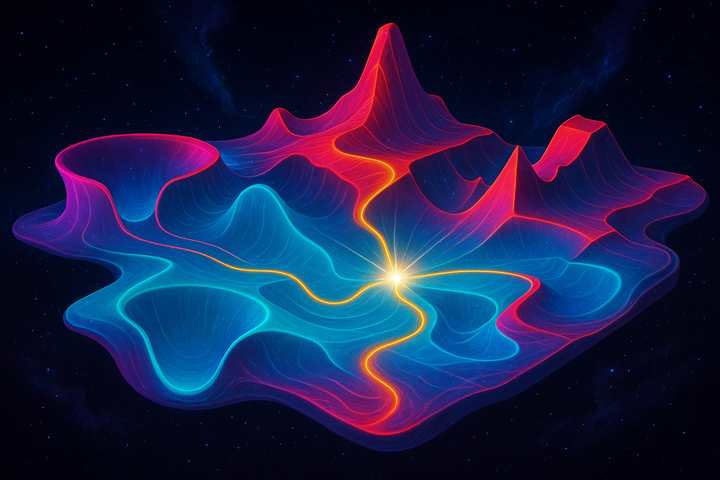
Entropy is often described as "disorder," but that's misleading. It's better understood as the number of microscopic arrangements consistent with a macroscopic state. A scrambled egg has more possible arrangements than an intact one. Systems evolve toward more probable configurations. That's all the Second Law says. But "more probable" becomes "certain" when you're dealing with 10²³ particles.
The pebble: The Second Law is why you can't unscramble an egg, why ice melts in warm water, why your room gets messy, why you age, why the universe will eventually go dark. It's not that disorder is favored—it's that there are more ways to be disordered than ordered, and probability always wins at scale.
The Third Law: You Can't Reach Absolute Zero
As temperature approaches absolute zero, the entropy of a perfect crystal approaches zero. And you can't actually get there.
Absolute zero (0 Kelvin, -273.15°C) is the floor. At this temperature, particles would have minimum possible energy. But the Third Law says you can't reach it—you can only approach it asymptotically. Each step closer requires exponentially more effort.
Scientists have gotten within billionths of a degree. They've never hit zero. They never will.
The pebble: The universe has a basement, and the door is locked. You can get infinitely close to the floor, but you'll never touch it. Absolute zero is physics' asymptote.
Why Four Laws Instead of One?
Here's a secret: the four laws are really facets of one constraint. The First Law is about quantity (energy is conserved). The Second Law is about quality (energy degrades). The Third Law is about limits (there's a floor). The Zeroth Law is about measurement (we can compare temperatures).
They all emerge from statistical mechanics—the behavior of enormous numbers of particles following simple rules. When 10²³ molecules bounce around, conservation and probability together produce all four laws as emergent properties.
Ludwig Boltzmann saw this in the 1870s. He showed that entropy is proportional to the logarithm of the number of microstates: S = k ln W. That equation is carved on his tombstone. It unified thermodynamics with statistics and explained why the Second Law isn't a fundamental law but an overwhelming probability.
The Laws in Action
Why Your Coffee Cools
Your hot coffee is surrounded by cooler air. The Second Law says entropy must increase. Heat flowing from hot coffee to cool air increases total entropy (more ways to distribute that thermal energy). Heat flowing the other way would decrease entropy. So heat flows out. Always. Your coffee cools. The room warms imperceptibly. Entropy increases. The universe wins.
Why Life Requires Energy
Living things are highly ordered—low entropy structures in a high entropy universe. The Second Law says entropy must increase. So how do we exist?
By exporting entropy. Every time you breathe, eat, and excrete, you're taking in low-entropy matter (food) and expelling high-entropy matter (heat, CO2, waste). You stay ordered by disordering your environment faster than you order yourself. You're not violating the Second Law. You're obeying it by being an entropy pump.
The pebble: Life is a controlled entropy debt. You stay ordered by making the universe more disordered. When you stop being able to do that, you die.
Why Perpetual Motion Is Impossible
A perpetual motion machine of the first kind violates the First Law—it produces energy from nothing. Impossible.
A perpetual motion machine of the second kind violates the Second Law—it converts heat entirely into work without any waste. Also impossible. There's always friction, always dissipation, always entropy increase.
The laws don't care how clever your design is. They've seen every trick. They always win.
The Arrow of Time
Here's the deepest mystery: the laws of physics are time-symmetric. Run Newton's equations backward, they still work. Run quantum mechanics backward, it still works. But macroscopic reality has a direction. Eggs break but don't unbreak. Stars burn out but don't unburn.
The Second Law creates the arrow of time. Not because it forbids entropy decrease, but because entropy decrease is vanishingly improbable at macroscopic scales. The probability of an egg spontaneously unscrambling is not zero—it's just so small that it would take longer than the age of the universe to happen once.
Time flows in the direction of increasing entropy. That's not poetry. That's physics.
Why This Matters
Thermodynamics isn't about steam engines anymore. It's about:
Information: Landauer's principle says erasing one bit of information requires dissipating at least kT ln 2 joules of energy. Information is physical. Computation generates heat. This is why your laptop has a fan.
Biology: Every cell is a thermodynamic engine, converting chemical energy into work while exporting entropy. Metabolism is applied thermodynamics.
Cosmology: The universe began in a low-entropy state (the Big Bang) and is evolving toward maximum entropy (heat death). Everything that happens between—stars, planets, life, you—is entropy increasing along the way.
Economics: Ecological economists argue that economic activity is fundamentally entropy production. You can't recycle everything. Resources degrade. The laws apply to markets too.
The Series Ahead
This series explores each law in depth:
- The Zeroth Law: Why temperature makes sense - The First Law: Conservation of energy - The Second Law: Entropy and the arrow of time - The Third Law: Absolute zero and the unreachable floor - Entropy: The quantity that enforces the Second Law - Maxwell's Demon: Information and thermodynamics - Synthesis: Why the four laws are one
The laws of thermodynamics are the universe's operating system. Everything else runs on top. Let's see how it works.
Further Reading
- Atkins, P. (2010). The Laws of Thermodynamics: A Very Short Introduction. Oxford University Press. - Carroll, S. (2010). From Eternity to Here: The Quest for the Ultimate Theory of Time. Dutton. - Feynman, R. (1963). The Feynman Lectures on Physics, Vol. 1, Chapters 44-46.
This is Part 1 of the Laws of Thermodynamics series. Next: "[The Zeroth Law: Why Temperature Makes Sense](/zeroth-law-thermodynamics/)"
Comments ()