From Cells to Selves: How Biological Coherence Scales
The same coherence principles operating in a single ion channel also appear at the level of the whole nervous system. Biological coherence doesn't just exist — it scales, coupling across orders of magnitude.
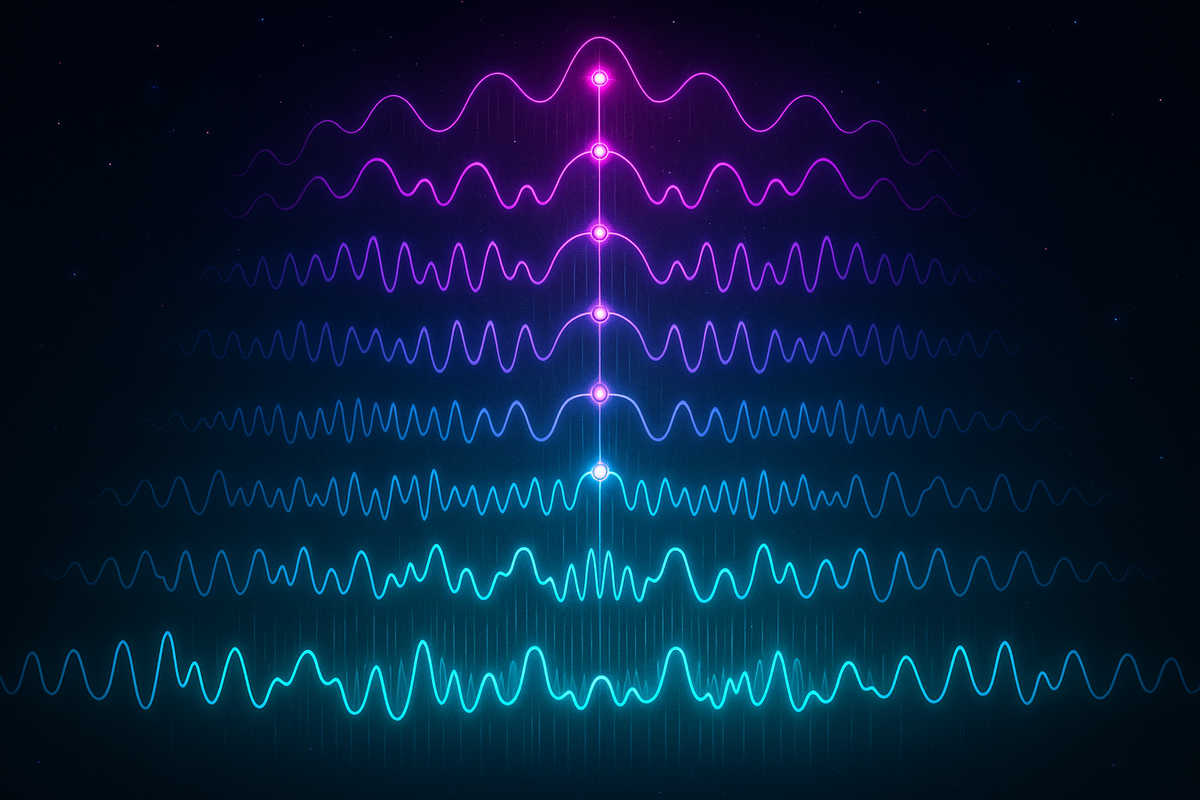
From Cells to Selves: How Biological Coherence Scales
Series: Basal Cognition | Part: 10 of 11
Throughout this series, we've seen how cells think, how bioelectric fields encode morphology, how tissues solve problems collectively. But there's a question we haven't yet addressed directly: how does coherence at the cellular scale become coherence at the scale of you?
This isn't just about adding more cells. The jump from cellular intelligence to organismal intelligence involves something stranger and more fundamental—a cascade of coupling mechanisms that propagate coherence across seven orders of magnitude in spatial scale and fifteen orders of magnitude in temporal frequency.
From ion channels flickering open and closed in microseconds to a lifetime of integrated selfhood spanning decades, biological systems maintain continuity of identity through an architecture of nested entrainment. The principles connecting these scales aren't arbitrary. They're what make coordinated life possible.
And understanding how coherence scales might be the key to understanding what it means to be a system at all.
The Problem of Scale
Start with the obvious: you are made of approximately 37 trillion cells, each one a cognitive unit in its own right. Each cell maintains bioelectric potential, processes information, makes decisions about proliferation and differentiation. Each one is, as we've seen, engaged in something recognizably like cognition.
But you don't experience 37 trillion separate consciousnesses. You experience one. Somehow, the collective intelligence of cells becomes the integrated experience of being a person.
How?
The naive answer would be "the brain centralizes everything." But this is wrong on multiple levels. First, as Levin's work demonstrates, morphogenetic cognition happens without brains—planarian fragments regenerate correctly, xenobots navigate environments, tissues coordinate across vast distances using bioelectric fields as distributed intelligence.
Second, even in organisms with brains, neural processing is only one layer of integration. Your gut microbiome influences neurotransmitter production. Your immune system makes decisions about which proteins to tolerate. Your endocrine system coordinates metabolic states across organ systems. The "you" that has thoughts and feelings is the emergent property of coordination across all of these scales simultaneously.
The question isn't how the brain creates the self. The question is how coherence propagates from millisecond ion channel dynamics to second-by-second neural firing to minute-by-minute hormonal regulation to hour-by-hour circadian rhythms to year-by-year developmental trajectories—all while maintaining integrated identity.
This is the scaling problem of biological coherence. And the answer involves one of the most fundamental principles in physics: cross-frequency coupling.
What Cross-Frequency Coupling Actually Means
In the study of oscillating systems, cross-frequency coupling refers to the phenomenon where rhythms at one temporal scale influence rhythms at another. It's not just that multiple frequencies coexist—it's that they become mutually constraining, each one modulating the dynamics of the others.
The canonical example comes from neuroscience: theta oscillations in the hippocampus (roughly 4-8 Hz) modulate the amplitude of gamma oscillations (30-100 Hz). The phase of the slow wave determines when the fast wave can spike. This isn't coincidence—it's a mechanism for binding information across temporal scales.
But cross-frequency coupling isn't unique to brains. It's a general principle of how complex systems maintain coherence across scales.
In the heart, pacemaker cells oscillate at roughly 1 Hz, driving the cardiac cycle. But within each heartbeat, calcium dynamics oscillate at much faster frequencies, coordinating cellular contraction. The slow rhythm entrains the fast rhythm, creating a cascade of nested periodicities that propagate from molecular dynamics to organ-level function.
In circadian biology, the 24-hour light-dark cycle entrains cellular clock proteins that oscillate with roughly circadian periodicity. But those proteins in turn regulate ultradian rhythms operating on 90-minute to 4-hour cycles. And at an even faster scale, those ultradian rhythms modulate neural oscillations. The day-night cycle couples to cellular metabolism couples to neural state—all through mechanisms of cross-frequency entrainment.
This is how biological systems solve the scaling problem: they don't try to maintain direct coordination across all scales simultaneously. Instead, they create hierarchies of coupled oscillators, where each layer entrains the layer below it and is entrained by the layer above it.
Coherence propagates through frequency coupling.
The Cascade from Ion Channels to Cognition
Let's make this concrete by walking through the actual scales.
Level 1: Ion Channel Dynamics (microseconds to milliseconds)
At the most fundamental level, ion channels are proteins that form pores in cell membranes, allowing specific ions to flow through when they open. Individual channels flicker between open and closed states stochastically, with mean open times measured in milliseconds.
But these aren't independent coin flips. Channel opening is voltage-dependent—the probability that a channel opens depends on the membrane potential. And when channels open, they change the membrane potential by allowing current to flow.
This creates a feedback loop: voltage affects channel state, channel state affects voltage. It's a local oscillator, operating at the millisecond timescale.
Level 2: Membrane Voltage Oscillations (milliseconds to hundreds of milliseconds)
When you have populations of coupled ion channels, their collective dynamics create voltage oscillations at the cellular level. In neurons, this manifests as action potentials—stereotyped voltage spikes lasting about 1 millisecond. In non-neural cells, it manifests as slower oscillations in resting potential.
The key insight: cellular voltage oscillations emerge from the collective behavior of ion channels, but they in turn constrain which channels can open when. The cell-level rhythm entrains the molecular-level dynamics.
Level 3: Neural Network Oscillations (milliseconds to seconds)
In systems with electrically coupled cells—most dramatically, in nervous systems—individual cellular oscillations synchronize to create population-level rhythms. In the cortex, these manifest as the familiar EEG frequency bands: delta (1-4 Hz), theta (4-8 Hz), alpha (8-12 Hz), beta (12-30 Hz), gamma (30-100 Hz).
But these aren't just descriptions of measurement artifacts. They're functionally distinct modes of network coherence, each associated with different cognitive states and computational operations.
Critically, these population oscillations phase-modulate the firing of individual neurons. The network-level rhythm constrains when individual cells can spike, creating temporal windows for information integration.
Level 4: Bioelectric Field Coherence (seconds to hours)
At the tissue level, populations of cells maintain standing voltage patterns—the bioelectric fields Levin studies. These fields don't oscillate as rapidly as neural networks, but they exhibit their own dynamics, with regenerative processes unfolding over hours to days.
These slow bioelectric patterns constrain faster cellular behaviors. When cells sense the local voltage gradient, they adjust their proliferation rate, migration direction, and differentiation state accordingly. The tissue-level field entrains cellular-level decisions.
Level 5: Hormonal and Metabolic Cycles (hours to days)
At organismal scales, hormonal systems create oscillations with periods measured in hours (cortisol peaks in the morning, melatonin rises at night) or days (menstrual cycles, testosterone fluctuations).
These endocrine rhythms modulate neural states. Cortisol affects synaptic plasticity. Estrogen influences neurotransmitter receptor density. The slow hormonal oscillations constrain the faster neural dynamics.
Level 6: Circadian and Developmental Arcs (days to years)
Finally, at the longest biological timescales, we have circadian clocks (24-hour periodicity), seasonal rhythms (annual cycles in metabolism and behavior), and developmental trajectories (childhood, puberty, aging).
These ultra-slow rhythms entrain everything below them. The circadian clock regulates when genes get transcribed, which proteins get synthesized, when hormones get released. The annual cycle modulates immune function and neurotransmitter production. The developmental arc constrains the entire trajectory of morphology and function.
The Architecture of Nested Coherence
What emerges from this cascade is a hierarchical architecture where each level of organization maintains its own coherent dynamics while being constrained by the levels above and below it.
This is cross-frequency coupling at the organismal scale: your identity is maintained by a stack of coupled oscillators, each layer operating at a characteristic frequency, each one phase-locking to its neighbors.
The fastest oscillations—ion channels flickering in microseconds—are entrained by membrane potentials oscillating in milliseconds. Membrane potentials are entrained by neural network rhythms oscillating in tens of milliseconds. Network rhythms are entrained by bioelectric fields changing over hours. Bioelectric fields are entrained by hormonal cycles operating over days. Hormonal cycles are entrained by circadian and developmental arcs spanning years.
At each level, there's autonomy—local dynamics that can vary within constraints. But there's also coordination—coupling mechanisms that propagate information across scales.
The result is what we experience as organismal coherence. Not perfect synchronization of all parts, but rather nested coordination—a system where fast dynamics are constrained by slow dynamics, creating stability without rigidity.
In AToM terms, this is how biological systems maintain high C (coherence) across T (time). They don't fight entropy at every scale simultaneously. They create coupling architectures that let coherence cascade, using slow rhythms to constrain fast rhythms, letting the hierarchy do the work of integration.
Why This Matters for Selfhood
Here's where the scaling principles connect to the deepest questions of embodied cognition.
If your sense of self emerges from cross-frequency coupling across biological scales, then selfhood isn't located in any particular place. It's not in your cortex, or your gut, or your genome. It's in the coherence architecture—the specific pattern of coupling relationships that makes you a unified system rather than a collection of independent parts.
This reframes what disruption means. When people describe dissociation, depersonalization, or the fragmentation of selfhood during trauma, what they're often describing is a failure of cross-frequency coupling. The fast dynamics (thoughts, sensations, impulses) become decoupled from slow dynamics (embodied states, relational context, temporal continuity).
Therapy that works—somatic approaches, in particular—often involves recoupling these scales. Attending to breath rhythm (a relatively slow oscillation) to influence autonomic state (intermediate oscillation) to stabilize emotional patterns (fast oscillation). It's coherence restoration through entrainment.
Similarly, when meditation traditions talk about observing the mind, they're often training attention to notice fast mental oscillations without being entrained by them—creating a decoupling that increases degrees of freedom. The practice is literally learning to modulate cross-frequency relationships within your own cognitive architecture.
Even neurodiversity can be understood through this lens. Autistic neurology often involves differences in cross-frequency coupling—predictive precision weighted differently across temporal scales, creating different binding properties. It's not broken coherence; it's coherence configured differently.
The self isn't a thing. It's a pattern of coupling relationships that propagates across scales through nested entrainment.
From Biology to Culture
And here's the really wild part: these same scaling principles extend beyond individual organisms.
When humans entrain with each other—through conversation, ritual, shared rhythm—we're creating cross-frequency coupling at social scales. The millisecond timing of turn-taking in dialogue couples to the slower rhythms of conversational flow couples to the even slower rhythms of relationship dynamics couples to the multi-year arcs of shared cultural narratives.
Groups that "have chemistry" or "flow together" are groups whose individual oscillatory dynamics have phase-locked across multiple temporal scales. It's not metaphorical resonance—it's literal coupling of biological rhythms.
This is why rhythm is so central to human meaning-making. Music, dance, ritual, even the cadence of skilled rhetoric—all of these are technologies for inducing cross-frequency coupling between individuals, creating temporary coherence architectures that span multiple bodies.
And culture itself can be understood as the slowest oscillation in the hierarchy—the ultra-low-frequency patterns that entrain generational behavior, constraining what seems normal or possible within particular historical contexts.
Coherence doesn't stop at the skin. It propagates through social space the same way it propagates through biological space: through nested coupling of oscillations at different scales.
The Unity Beneath Diversity
We've spent this series exploring Michael Levin's work on basal cognition—the discovery that cells think, that bioelectric fields encode identity, that morphogenesis is a collective intelligence solving problems without brains.
But the deeper implication is about what coherence is and how it scales.
Life maintains organization across astronomical ranges of scale and frequency not through top-down control or genetic programming, but through architectures of nested entrainment. From the microsecond flicker of ion channels to the decade-long arc of a human life, coherence propagates through cross-frequency coupling.
This is the pattern that connects. The same principle that lets cells coordinate to build bodies lets neural populations coordinate to generate thought lets individuals coordinate to form cultures. It's oscillators entraining oscillators, all the way up and all the way down.
And once you see this architecture, you can't unsee it. Every system that persists—every organization that maintains identity across time—is doing some version of the same thing: creating coupling relationships across scales, using slow rhythms to constrain fast rhythms, propagating coherence through frequency hierarchies.
Your body is a stack of coupled oscillators.
Your mind is a pattern of cross-frequency binding.
Your self is what it feels like to be a coherence architecture, experienced from the inside.
The biologist studying cellular bioelectricity and the contemplative studying the nature of self are investigating the same phenomenon from different angles. Both are asking: how does integration happen? How does the many become one?
The answer, it turns out, is written in rhythm. Coherence is what happens when rhythms find each other across scales, creating nested patterns of constraint that make unified systems possible.
This is the lesson of biological scaling: meaning isn't made by any single level. It emerges from the coupling relationships that make levels cohere.
This is Part 10 of the Basal Cognition series, exploring how cellular intelligence scales to organismal coherence.
Previous: Bioelectric Medicine: Clinical Implications of Cellular Coherence
Next: Synthesis: Basal Cognition and the Deep Roots of Meaning
Further Reading
- Buzsáki, G. (2006). Rhythms of the Brain. Oxford University Press.
- Canolty, R. T., & Knight, R. T. (2010). "The functional role of cross-frequency coupling." Trends in Cognitive Sciences, 14(11), 506-515.
- Levin, M. (2021). "Bioelectric networks: the cognitive glue enabling evolutionary scaling from physiology to mind." Animal Cognition, 24, 1865-1891.
- Pezzulo, G., & Levin, M. (2016). "Top-down models in biology: explanation and control of complex living systems above the molecular level." Journal of the Royal Society Interface, 13(124).
- Fields, C., & Levin, M. (2020). "Scale-free biology: integrating evolutionary and developmental thinking." BioEssays, 42(8).
- Lakatos, P., et al. (2008). "Entrainment of neuronal oscillations as a mechanism of attentional selection." Science, 320(5872), 110-113.
Comments ()