The Fundamental Theorem of Arithmetic: Unique Factorization
The Fundamental Theorem of Arithmetic guarantees that every integer above 1 has a unique prime factorization. It sounds obvious until you try to prove it — and then you realize how much of number theory rests on this single fact.
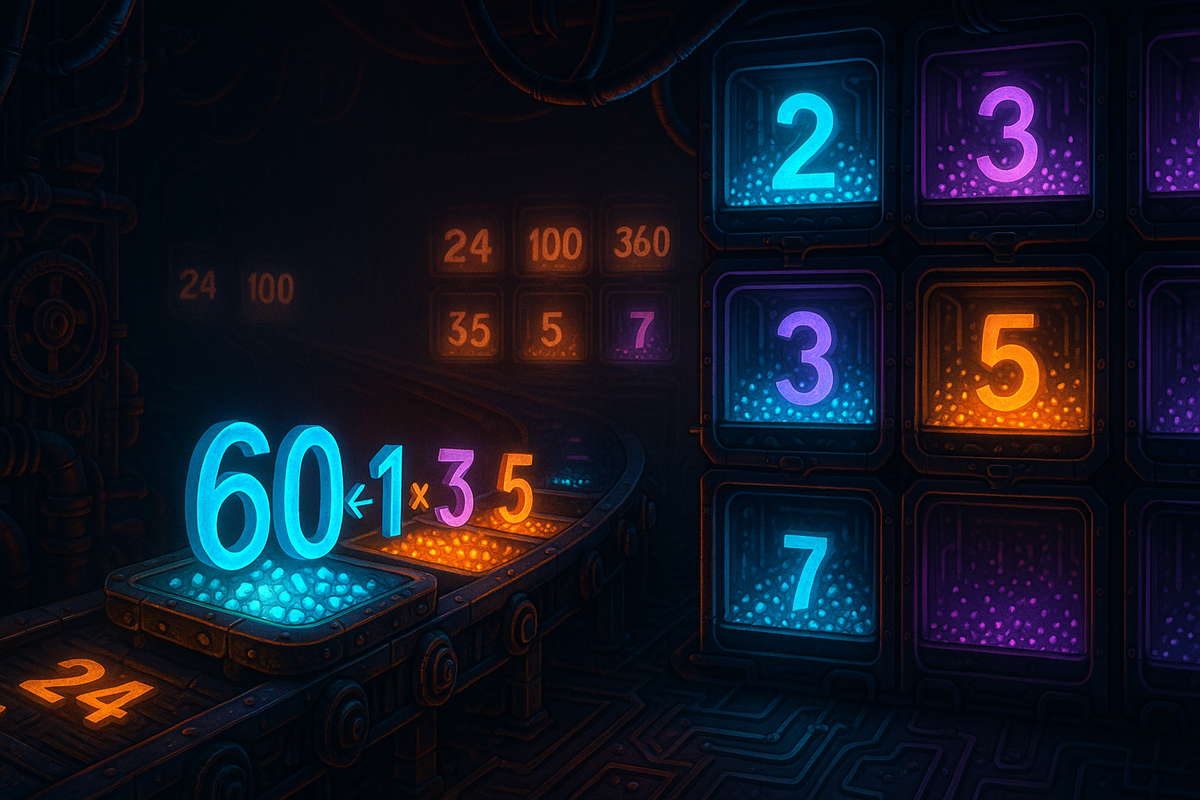
Every integer greater than 1 has exactly one prime factorization.
Not "at least one." Exactly one. 12 = 2² × 3. That's it. You can't find different primes that also multiply to 12. You can reorder (3 × 2² = 12), but the primes and their powers are fixed.
Every number has a unique prime fingerprint.
That's the unlock. The Fundamental Theorem of Arithmetic says multiplication has a definite structure: primes combine to form composites, and there's only one way to decompose a composite back into primes. This is why we can meaningfully ask "what are the prime factors of n?" — there's a unique answer.
The Theorem
Existence: Every integer n > 1 is either prime or a product of primes.
Uniqueness: This prime factorization is unique, up to the order of the factors.
Together: every integer > 1 can be written as
n = p₁^a₁ × p₂^a₂ × ... × pₖ^aₖ
where the pᵢ are distinct primes and the aᵢ are positive integers. This representation is unique.
Examples
12 = 2² × 3 60 = 2² × 3 × 5 100 = 2² × 5² 1001 = 7 × 11 × 13 2310 = 2 × 3 × 5 × 7 × 11
Each factorization is the only one.
Why Existence?
Every composite can be broken down into smaller factors.
Take n. If n is prime, we're done. If not, n = a × b where 1 < a, b < n.
Now factor a and b. Repeat.
Since the factors keep getting smaller and stay positive integers, this process must terminate. The terminal factors are primes (they can't be broken down further).
So n is a product of primes. ∎
Why Uniqueness?
This is the hard part. Uniqueness requires a key lemma:
Euclid's Lemma: If a prime p divides ab, then p divides a or p divides b.
This is what makes primes special. Composites don't have this property: 6 | (4 × 9) = 36, but 6 ∤ 4 and 6 ∤ 9.
With Euclid's Lemma, suppose n has two factorizations:
n = p₁ × p₂ × ... × pᵣ = q₁ × q₂ × ... × qₛ
p₁ divides the left side, so p₁ divides the right side.
By Euclid's Lemma (applied repeatedly), p₁ divides some qⱼ.
But qⱼ is prime, so p₁ = qⱼ.
Cancel p₁ from both sides. Repeat.
All primes match up. The factorizations are the same. ∎
Prime Factorization Notation
We often write n = p₁^e₁ × p₂^e₂ × ... × pₖ^eₖ with p₁ < p₂ < ... < pₖ.
360 = 2³ × 3² × 5
This canonical form lists primes in increasing order. It's the standard representation.
GCD and LCM from Factorizations
Given factorizations, GCD and LCM are easy:
a = 2³ × 3² × 5 b = 2 × 3³ × 7
GCD: Take the minimum power of each common prime. gcd(a, b) = 2¹ × 3² = 18
LCM: Take the maximum power of each prime that appears. lcm(a, b) = 2³ × 3³ × 5 × 7 = 7560
This gives the beautiful relation: gcd(a,b) × lcm(a,b) = a × b.
Counting Divisors
If n = p₁^e₁ × p₂^e₂ × ... × pₖ^eₖ, how many divisors does n have?
Any divisor has the form p₁^f₁ × p₂^f₂ × ... × pₖ^fₖ where 0 ≤ fᵢ ≤ eᵢ.
For each pᵢ, there are (eᵢ + 1) choices for fᵢ.
Number of divisors = (e₁ + 1)(e₂ + 1)...(eₖ + 1)
Example: 360 = 2³ × 3² × 5¹ Divisors: (3+1)(2+1)(1+1) = 4 × 3 × 2 = 24
Why "Fundamental"?
The theorem is fundamental because:
- It establishes primes as building blocks
- It makes factorization well-defined
- It enables algorithms (GCD, LCM, divisor counting)
- It underlies modular arithmetic, cryptography, and more
Without uniqueness, number theory would collapse. Questions like "is n divisible by p?" wouldn't have clean answers.
Factorization Is Hard
Finding the factorization of a large number is computationally difficult.
For n with hundreds of digits, no known algorithm factors n in polynomial time.
This difficulty is the foundation of RSA cryptography. The security of your encrypted messages depends on the hardness of factoring.
(Note: proving the factorization exists is easy. Computing it for large n is hard.)
Where Uniqueness Fails
In some number systems, unique factorization fails!
In ℤ[√-5] = {a + b√-5 : a, b ∈ ℤ}:
6 = 2 × 3 = (1 + √-5)(1 - √-5)
Two different factorizations into "irreducible" elements. Unique factorization fails.
This failure led to the development of ideals in algebraic number theory — a profound generalization.
The Core Insight
The Fundamental Theorem says: integers have unique prime DNA.
Every integer > 1 breaks down into primes in exactly one way. This structure — unique factorization — is what makes the integers special.
Primes are the alphabet. Factorization is spelling. Each number has a unique spelling. That's the theorem, and that's why it's fundamental.
Part 3 of the Number Theory series.
Previous: Prime Numbers: The Atoms of Arithmetic Next: Divisibility Rules: Patterns in the Digits
Comments ()