Gene Drives: Engineering Evolution Itself
Gene drives are CRISPR with a propagation engine: instead of editing one organism, they spread a genetic change through an entire wild population. The implications for disease control—and for ecology—are staggering.
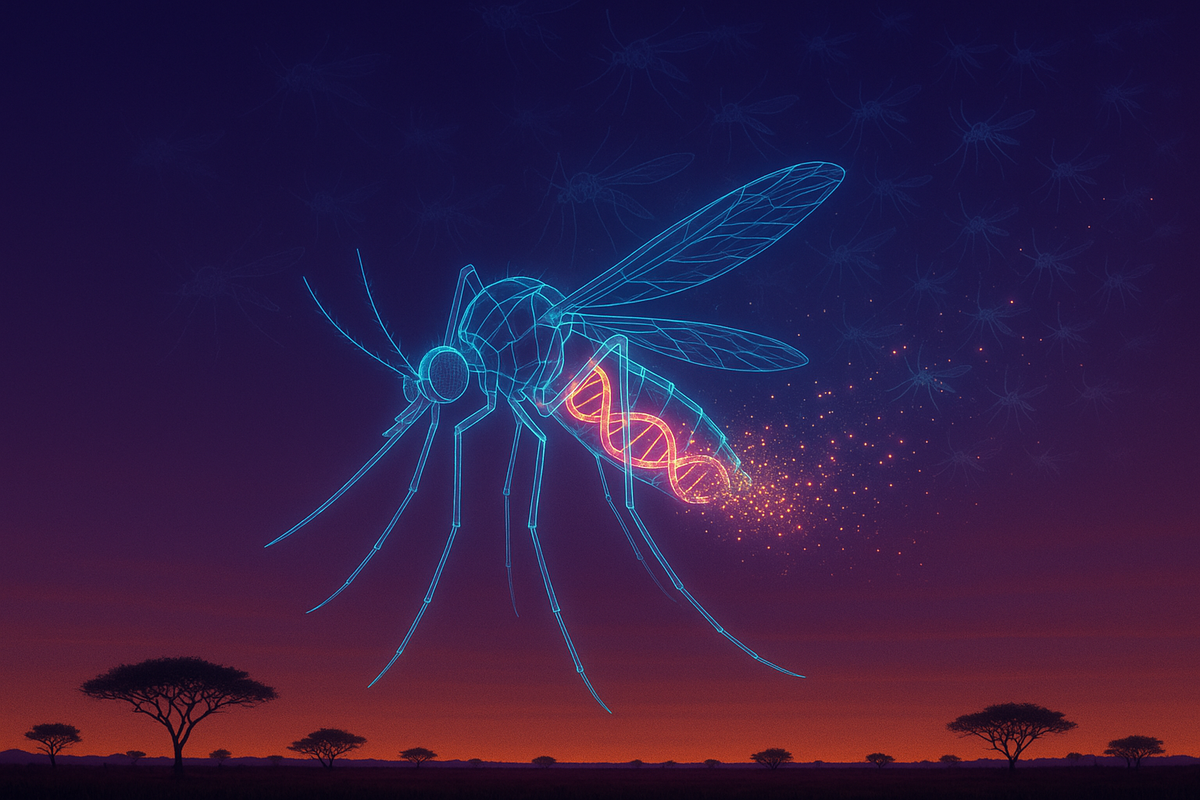
Gene Drives: Engineering Evolution Itself
Mosquitoes kill more humans than any other animal on Earth. Not sharks. Not snakes. Not other humans. Mosquitoes. Specifically, the Anopheles mosquitoes that carry malaria parasites and the Aedes mosquitoes that spread dengue, Zika, and yellow fever. Every year, malaria alone kills over 600,000 people—mostly children under five in sub-Saharan Africa. A child dies of malaria roughly every minute. We've tried everything. Bed nets. Insecticides. Antimalarial drugs. Draining swamps. Genetic modification of mosquitoes to make them sterile. Billions of dollars, decades of effort. Malaria is still here. The mosquitoes keep adapting. The parasites keep evolving resistance. We're running out of conventional options. But what if we didn't have to fight evolution? What if we could hijack it? A gene drive is a genetic system that breaks the normal rules of inheritance. Usually, a gene has a 50% chance of being passed to offspring. Gene drives change those odds to nearly 100%. A gene drive spreads through a population like a chain reaction—parent to child to grandchild—until every member of the species carries it. We could engineer mosquitoes to be incapable of carrying malaria. Release a few thousand. Wait a few generations. No more disease. Or we could engineer them to be sterile, and the species would collapse entirely. No more mosquitoes. No more malaria. Problem solved. Except: what happens when you delete a species from an ecosystem? What happens when you release a self-propagating genetic system that can never be recalled? Gene drives are the most powerful—and most terrifying—application of CRISPR yet. And we're already testing them.
The Malaria Moonshot (Target Malaria)
The most advanced gene drive project in the world is called Target Malaria, and it's going after the deadliest animal on the planet. The target: Anopheles gambiae, the mosquito species responsible for most malaria transmission in Africa. The goal: make them unable to spread the disease—or make them go extinct. Target Malaria is testing several approaches: Approach 1: Break female fertility. Engineer a gene drive that disrupts a gene called doublesex, which determines whether a mosquito develops as male or female. Males with the drive are normal. Females with two copies of the drive are sterile—they can't bite, can't reproduce, can't transmit malaria. The population crashes. In laboratory cages, this works devastatingly well. When researchers released gene-drive mosquitoes into contained populations, the populations collapsed within 8-12 generations. Total extinction. In a cage. Approach 2: Make mosquitoes malaria-proof. Instead of killing the mosquitoes, engineer them to be incompatible hosts for the Plasmodium parasite that causes malaria. The mosquitoes survive, the ecosystem stays intact, but they can't transmit the disease anymore. This is gentler but harder. You need to find genetic modifications that block the parasite without harming the mosquito. And the parasite might evolve resistance, starting the arms race all over again. Target Malaria has been running field trials in Burkina Faso since 2019—though so far only with sterile, non-gene-drive mosquitoes. The gene drive itself hasn't been released into the wild yet. That decision is still years away, pending more research, community consultation, and regulatory approval. But the technology works. The question isn't whether we can do this. It's whether we should.
The Ecological Roulette Wheel
Here's where it gets complicated. Mosquitoes aren't just disease vectors. They're also food. Mosquito larvae feed fish, frogs, and dragonfly nymphs. Adult mosquitoes feed birds, bats, and spiders. Some mosquito species pollinate plants. The ecological web is tangled, and we don't fully understand it. What happens if you delete Anopheles gambiae from African ecosystems? The honest answer: nobody knows. Some ecologists argue the impact would be minimal. There are over 3,500 mosquito species, and only a few dozen transmit human diseases. Anopheles gambiae occupies a niche that other species could fill. The fish that eat mosquito larvae also eat other things. The bats that eat mosquitoes have diverse diets. Life is resilient. Others argue we're playing Russian roulette with ecosystems we don't understand. Removing a species—any species—can trigger cascades. Maybe another mosquito species expands to fill the gap, and that species carries a different disease. Maybe a predator population crashes, and its prey explodes. Ecology is nonlinear. Small changes can have outsized effects. And gene drives, once released, are essentially irreversible. You can't recall them. You can't say "oops" and undo the change. The edited genes spread on their own, generation after generation, until they saturate the population. What if we're wrong? What if there's an ecological function we didn't anticipate? What if the gene drive mutates and does something unexpected? The standard safety argument is: we can engineer "reversal drives" that could spread a corrective edit through the population, undoing the original change. In theory, yes. In practice, you're trying to chase a self-propagating genetic system with another self-propagating genetic system. It's gene drives all the way down.
Invasive Species and Island Nightmares
Malaria isn't the only target. Gene drives could solve some of the most intractable conservation problems on Earth. New Zealand's predator problem: Before humans arrived, New Zealand had no land mammals except bats. The birds evolved without predators and lost the ability to fly—kiwis, kakapos, takahes. Then humans brought rats, stoats, and possums. The native birds are being slaughtered. Dozens of species have gone extinct. Dozens more are critically endangered. New Zealand has committed to eliminating all invasive predators by 2050. Current methods—trapping, poisoning, hunting—aren't working fast enough. A gene drive could spread female infertility through rat populations, collapsing them within years instead of decades. Hawaii's mosquito invasion: Native Hawaiian birds are being devastated by avian malaria, carried by invasive mosquitoes that arrived with European ships. Species like the honeycreeper are retreating up mountains to escape the mosquitoes, running out of habitat. A gene drive could eliminate the invasive mosquitoes and save the birds. Australia's cane toad disaster: Cane toads were introduced in 1935 to control beetles in sugarcane fields. They failed at that and became one of the worst invasive species on the continent—toxic to native predators, breeding explosively, spreading relentlessly. A gene drive could engineer vulnerability into the population, letting native predators kill them safely. The conservation case is compelling. Invasive species cause billions of dollars in damage and drive native species extinct. Current control methods are expensive, labor-intensive, and often inadequate. Gene drives offer a solution that scales—release a few thousand modified individuals and let biology do the work. But every release is a one-way door. And ecosystems don't respect national borders.
The Biosecurity Nightmare
Gene drives aren't just ecological tools. They're potential weapons. Imagine a hostile actor engineers a gene drive targeting a crop pollinator. Or a livestock pest. Or a species that anchors a critical ecosystem. The technology to build gene drives is increasingly accessible—CRISPR kits are cheap, the science is published, the methods are teachable. The U.S. Defense Advanced Research Projects Agency (DARPA) has funded gene drive research explicitly because of biosecurity concerns. They want to understand the technology before someone else uses it against American interests. The "Safe Genes" program is developing tools to detect, prevent, and reverse gene drives in the wild. International governance is... a mess. Gene drives don't fit neatly into existing frameworks. The Cartagena Protocol on Biosafety covers genetically modified organisms, but it was written before gene drives existed. The Convention on Biological Diversity has discussed gene drives repeatedly without reaching consensus. Some countries want a moratorium. Others want to proceed with research. Nobody agrees on what "safe" would even look like. And here's the really uncomfortable part: gene drives offer asymmetric power. A small group—or even a single well-funded lab—could release a gene drive affecting global ecosystems. The decision doesn't require international consensus. It just requires someone willing to do it. We're in a race between governance and capability. So far, capability is winning.
The Case For Proceeding (Carefully)
Despite everything, there's a strong argument for continuing gene drive research—and eventually, deployment. The status quo is also a choice. Every year we delay, 600,000 more people die of malaria. Mostly kids. If we have a tool that could stop that and we refuse to use it because of hypothetical ecological risks, we're making a moral calculation: certain human deaths are acceptable to avoid uncertain environmental harm. Maybe that calculation is right. But we should be honest that we're making it. Ecosystems are already destabilized. Climate change, habitat destruction, invasive species, pollution—we've been altering ecosystems for centuries. The pristine baseline that gene drives might disrupt doesn't exist anymore. If gene drives can remove invasive species and restore native ecosystems, they might be restorative rather than destructive. The research is happening regardless. Gene drives are too powerful and too accessible to be contained by bans. If responsible scientists in democratic countries don't develop the technology, others will—with less oversight, less transparency, and less concern for ecological safety. Better to have the expertise in institutions that can be held accountable. The responsible path isn't to stop research. It's to develop robust containment systems, build international governance frameworks, invest in ecological modeling, engage affected communities, and proceed incrementally—testing in cages before islands, islands before continents. Kevin Esvelt, who helped invent the technology, has become one of its most cautious advocates. He argues for "daisy drives"—gene drive systems designed to burn out after a limited number of generations, allowing localized deployment without global spread. Self-limiting systems that give us an off switch. The technology is here. The question is how—not whether—we use it.
The Edge of the Uncontrollable
Gene drives represent something genuinely new in human history: the ability to alter wild populations without their cooperation. Every previous genetic technology required ongoing effort—you had to keep breeding modified crops, keep raising modified livestock. Gene drives are self-sustaining. They propagate on their own. That's the promise and the terror. We could eliminate malaria. We could restore island ecosystems. We could save species from extinction. The potential benefits are enormous and real. But we could also make irreversible mistakes at planetary scale. We could trigger ecological cascades we didn't predict. We could unleash genetic systems that mutate beyond our control. The potential harms are also enormous—and, unlike the benefits, they might not be fixable. The CRISPR revolution started with the power to edit individual genes. Gene drives extend that power to entire species, entire ecosystems, the entire biosphere. We've been given the ability to rewrite the rules of evolution itself. The question isn't whether we're capable. It's whether we're wise enough.
Further Reading
- Esvelt, K.M. et al. (2014). "Emerging Technology: Concerning RNA-guided gene drives for the alteration of wild populations." eLife.
- Hammond, A. et al. (2016). "A CRISPR-Cas9 gene drive system targeting female reproduction in the malaria mosquito vector Anopheles gambiae." Nature Biotechnology.
- National Academies of Sciences (2016). Gene Drives on the Horizon: Advancing Science, Navigating Uncertainty, and Aligning Research with Public Values.
- Target Malaria. "Our Work." https://targetmalaria.org/
This is Part 4 of the CRISPR Revolution series. Previous: "The CRISPR Babies Scandal." Next: "Sickle Cell Cured"—Victoria Gray was the first American treated with CRISPR. She hasn't had a sickle cell crisis in four years. This is what curing genetic disease looks like.



Comments ()