Synthesis: Geometry as the Mathematics of Space
Geometry began as a practical tool for measuring land. It ended up revealing that space itself has a shape—and that shape determines how the universe behaves.
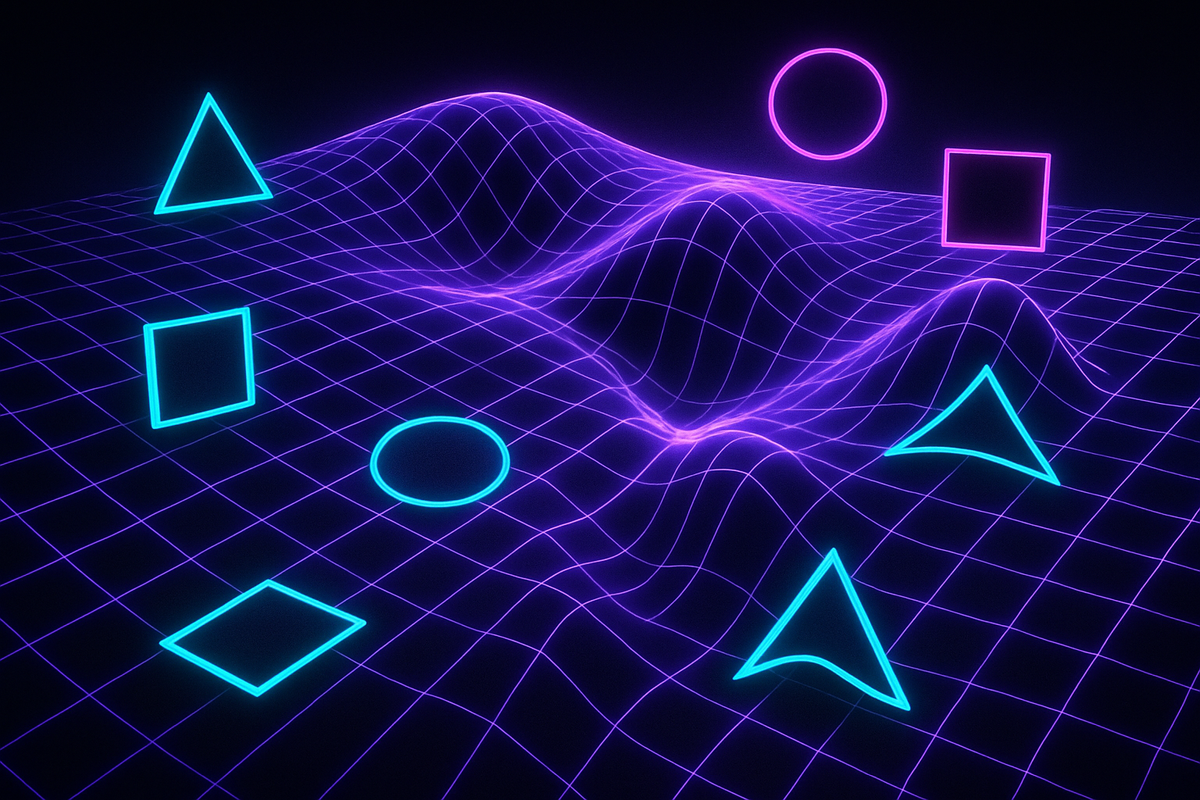
Space has rules. Geometry is those rules written down.
You can't tie a knot in two dimensions. You can't turn your right hand into your left hand without flipping it through a mirror. Parallel lines in flat space never meet, but on a sphere they always do. These aren't random facts — they're properties of space itself.
Here's what this series has been building toward: geometry is the mathematics of what's possible in space. Not what's true about shapes — what's true about the space those shapes live in.
Change the space, change the geometry. Flat space gives you Euclid. Curved space gives you Einstein. The shapes are consequences. The space is fundamental.
What We've Built
This series started with the most basic objects:
Points, lines, and planes — not physical things, but concepts. Location without size. Direction without width. Flatness without thickness.
Angles — the measure of rotation, not intersection. How far you turn between directions.
Triangles — the simplest rigid structure. The only polygon whose side lengths lock in its shape.
The Pythagorean theorem — not just a triangle fact, but the definition of distance in flat space.
Circles — the shape of constant distance. A rule made visible.
Area, perimeter, volume, surface area — independent measurements that scale by different powers.
Coordinate geometry — the bridge between pictures and equations, between visual intuition and calculation.
Each piece connects to the others. Circles relate to Pythagoras (the circle equation is x² + y² = r²). Triangles relate to angles (they sum to 180° in flat space). Coordinates translate everything into algebra.
The Invariance Lens
We opened with the idea that geometry studies what doesn't change under transformation.
Rotate a triangle — the angles stay the same. Scale it — the ratios stay the same. Translate it — the distances stay the same.
Different geometries allow different transformations:
- Euclidean geometry allows rigid motions (translation, rotation, reflection). Distances and angles are preserved.
- Similarity geometry also allows scaling. Ratios and angles preserved, but not distances.
- Affine geometry allows shearing. Parallel lines preserved, but not angles.
- Projective geometry allows projection. Cross-ratios preserved, but not parallelism.
- Topology allows continuous deformation. Connectedness preserved, but not much else.
Each geometry is defined by its invariants — what survives its allowed transformations.
Flat Space Is Special
Most of what you learned in school geometry assumes flat (Euclidean) space:
- Parallel lines never meet
- Triangles sum to 180°
- The Pythagorean theorem holds
- Circles have circumference 2πr
But these are properties of flat space, not universal laws.
On a sphere (positive curvature):
- "Parallel" lines eventually meet (think longitude lines meeting at poles)
- Triangles sum to more than 180°
- The Pythagorean theorem fails
- Circles have circumference less than 2πr
In hyperbolic space (negative curvature):
- Parallel lines diverge forever
- Triangles sum to less than 180°
- The Pythagorean theorem fails the other way
- Circles have circumference more than 2πr
Euclidean geometry is the special case where curvature is exactly zero.
Why This Matters for Physics
Einstein's general relativity is geometry taken seriously.
Gravity isn't a force pulling objects together. Gravity is curved spacetime — objects follow the straightest possible path through curved geometry.
The Sun doesn't pull the Earth. The Sun's mass curves the spacetime around it, and the Earth follows that curvature in what looks like an orbit.
Light bends around stars not because something pushes it, but because "straight" near a star isn't what "straight" means far away. The geometry is different.
When you learn that a² + b² = c², you're learning how distance works in flat space. General relativity tells us that space isn't flat where there's mass. The mathematics you learned is still true — it's just not the whole story.
The Dimension Ladder
We've worked in 2D and 3D, but geometry extends to any dimension:
- 1D: Points on a line. One coordinate.
- 2D: Points on a plane. Two coordinates.
- 3D: Points in space. Three coordinates.
- 4D: Spacetime (in physics) or abstract higher dimensions. Four coordinates.
- nD: As many coordinates as you need.
The patterns generalize:
- Distance: √(x₁² + x₂² + ... + xₙ²)
- Volume of hypercube: sⁿ
- Surface area grows as n−1 power, volume as n power
Higher dimensions aren't physical necessarily, but they're mathematically coherent. Machine learning uses geometry in spaces with thousands of dimensions — each feature is a coordinate.
Why Proof Matters
Geometry was humanity's first axiomatic system — the first time we said "these are our assumptions, and everything else must follow logically."
Euclid's five axioms were the starting point. From them, every theorem in his Elements could be derived without appealing to intuition or observation.
This matters because:
- Assumptions are explicit. You know exactly what you're taking for granted.
- Conclusions are certain. If the axioms are true, the theorems must be.
- Alternative systems are possible. Deny an axiom, get a different geometry.
The discovery of non-Euclidean geometry (by denying the parallel postulate) was a breakthrough precisely because it showed axioms are choices, not laws.
Geometry Beyond Shapes
Modern geometry extends far past triangles and circles:
Differential geometry: Geometry on curved surfaces and manifolds. The language of general relativity.
Algebraic geometry: Geometric objects defined by polynomial equations. Deep connections to number theory.
Topology: What's preserved under continuous deformation. The famous "coffee cup equals donut" because both have one hole.
Discrete geometry: Geometry of graphs, tilings, polyhedra, packing problems.
Each branch asks the same question: what's true about the space, and what survives which transformations?
The Visual Mode of Thought
Geometry trains a mode of thinking: spatial reasoning.
Can you visualize how an object looks from another angle? What happens when you cut it? How shapes fit together?
This isn't just academic. Engineers, architects, surgeons, physicists, graphic designers, roboticists — anyone dealing with physical or simulated space uses geometric intuition constantly.
When you learn geometry, you're not memorizing formulas. You're building the ability to think spatially — to see relationships in space before you calculate them.
What Geometry Teaches
Geometry teaches you that space has structure.
Not just "there's room for things to be placed" — but specific rules governing distance, direction, dimension, and curvature.
Distance isn't arbitrary. In flat space, it follows Pythagoras. In curved space, it doesn't. Either way, there's a formula.
Shape isn't arbitrary. Triangles are rigid. Circles are equidistant from center. These follow from definitions, not observations.
Space itself can be characterized. By what's invariant under transformation. By curvature. By dimension.
When you learn geometry, you learn to see the invisible architecture — the rules that make space behave the way it does.
The Core Insight
Geometry is the study of space itself.
Not shapes in space — space. The shapes are examples, illustrations, special cases. The real subject is the structure of the spatial medium.
What's possible in this space? What's true about distance, angle, parallelism, curvature? What stays the same when you transform things?
From Euclid's axioms to Einstein's curved spacetime, the question is the same: what kind of space is this, and what are its rules?
You're not learning facts about triangles. You're learning to see space for what it is — a mathematical structure with properties as definite and explorable as the numbers.
Part 10 of the Geometry series.
Comments ()