The Gibbs Free Energy Formula: ΔG = ΔH - TΔS
Every spontaneous process is a negotiation between enthalpy and entropy. Gibbs free energy — ΔG = ΔH − TΔS — is the single number that tells you who wins, and whether a reaction proceeds without outside help.
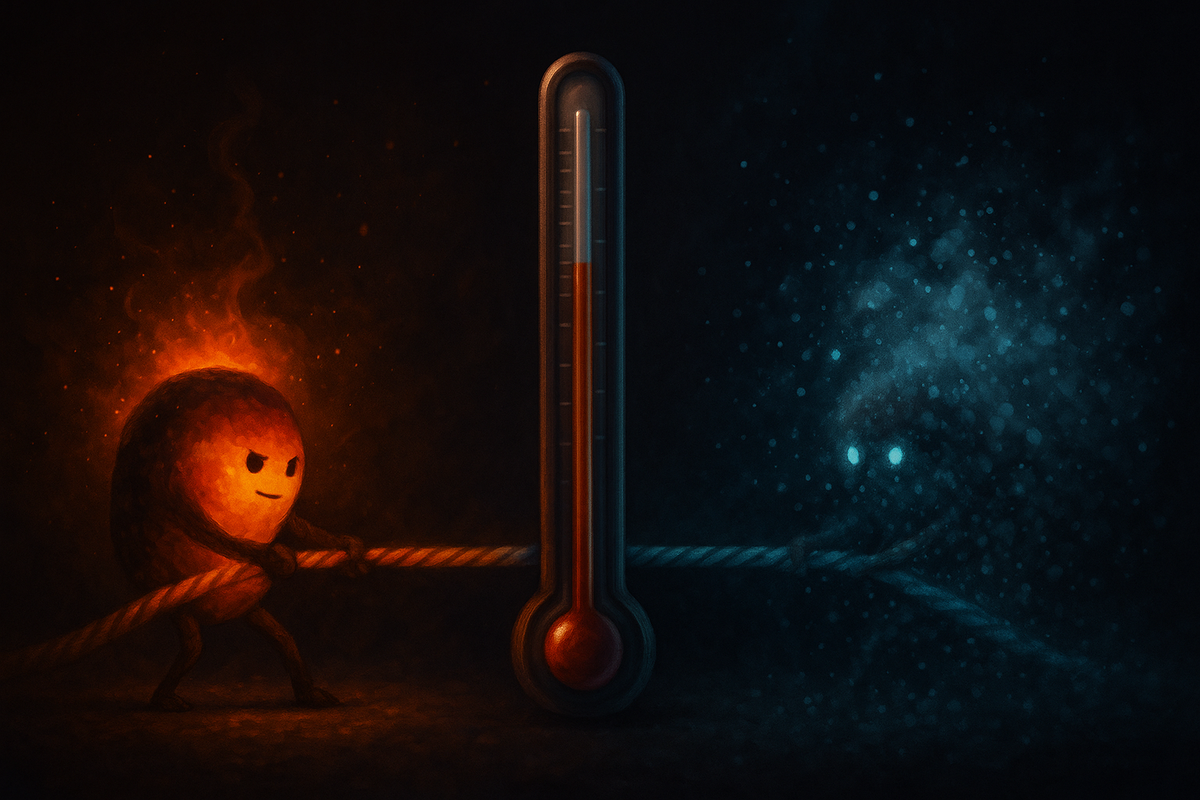
The Gibbs Free Energy Formula: ΔG = ΔH - TΔS
Three letters, one equation, the universe's decision rule.
ΔG = ΔH - TΔS
Every chemist knows this formula. Most memorize it for exams and forget the meaning. But this equation encodes the competition between energy and entropy, with temperature as referee. Understanding it—really understanding it—means understanding why anything happens at all.
Decoding the Equation
ΔG: Change in Gibbs free energy. The verdict. Negative means spontaneous, positive means non-spontaneous, zero means equilibrium.
ΔH: Change in enthalpy. The energy term. Negative for exothermic reactions (release heat), positive for endothermic (absorb heat).
T: Absolute temperature in Kelvin. The weight on the entropy term. Higher temperature amplifies entropy's importance.
ΔS: Change in entropy. The disorder term. Positive when disorder increases, negative when it decreases.
The minus sign is crucial: it makes entropy increase favorable. When ΔS is positive, -TΔS is negative, pulling ΔG down.
The Two Drives
Nature has two preferences:
1. Minimize energy (enthalpy) Systems "want" to be at low energy. Balls roll downhill. Electrons fill low orbitals first. Exothermic reactions release energy to the surroundings.
2. Maximize entropy Systems "want" to spread out, explore possibilities. Gases expand to fill containers. Solutes dissolve. Heat distributes evenly.
These drives often conflict. Crystallization lowers energy but also lowers entropy. Dissolving increases entropy but sometimes absorbs energy. Which wins?
The pebble: ΔG = ΔH - TΔS is the formula for resolving conflicting thermodynamic drives. Temperature sets the exchange rate between energy and entropy.
Units and Magnitudes
ΔH is measured in kJ/mol or kcal/mol (energy per mole of reaction)
ΔS is measured in J/(mol·K) or cal/(mol·K) (energy per mole per degree)
T is in Kelvin
TΔS must have the same units as ΔH. This means entropy has units of energy/temperature, which checks out: J/(mol·K) × K = J/mol.
Typical magnitudes: - Bond energies: 150-500 kJ/mol - ΔH for reactions: -200 to +200 kJ/mol - ΔS for reactions: -200 to +200 J/(mol·K) - TΔS at 300 K: -60 to +60 kJ/mol
The enthalpy term is often larger, but at high temperatures, entropy can dominate.
Temperature as Referee
The T in -TΔS is what makes Gibbs free energy so powerful.
At low temperature (T small): - The -TΔS term is small - ΔH dominates - Reactions favor low energy over high entropy - Exothermic reactions win
At high temperature (T large): - The -TΔS term is large - ΔS dominates - Reactions favor high entropy over low energy - Entropy-increasing reactions win
The temperature where ΔG changes sign—where enthalpy and entropy contributions balance—is:
T_transition = ΔH/ΔS
Below this temperature, one direction is spontaneous. Above it, the other direction is spontaneous.
Example: Ice and Water
For H₂O(s) → H₂O(l) at 1 atm:
- ΔH = +6.01 kJ/mol (endothermic—absorbs heat) - ΔS = +22.0 J/(mol·K) (entropy increases—liquid more disordered)
Both terms favor melting at different temperatures: - ΔH > 0 opposes melting (makes ΔG positive) - ΔS > 0 favors melting (makes -TΔS negative)
The transition temperature: T = ΔH/ΔS = 6010 J/mol ÷ 22.0 J/(mol·K) = 273 K = 0°C
Below 0°C: ΔH term wins, ΔG > 0, freezing favored Above 0°C: -TΔS term wins, ΔG < 0, melting favored At 0°C: ΔG = 0, equilibrium, ice and water coexist
The pebble: The melting point of ice isn't arbitrary—it's the temperature where enthalpy and entropy exactly balance. Change either ΔH or ΔS, and the melting point shifts.
Visualizing the Formula
Plot ΔG vs temperature:
ΔG = ΔH - TΔS is a straight line with: - Y-intercept: ΔH (the value at T = 0) - Slope: -ΔS
If ΔS > 0: negative slope, line goes down with temperature If ΔS < 0: positive slope, line goes up with temperature
The line crosses ΔG = 0 at T = ΔH/ΔS (if both have the same sign).
Case 1: ΔH < 0, ΔS > 0 Line starts below zero, slopes down. Always negative. Spontaneous at all temperatures.
Case 2: ΔH > 0, ΔS < 0 Line starts above zero, slopes up. Always positive. Never spontaneous.
Case 3: ΔH < 0, ΔS < 0 Line starts below zero, slopes up. Crosses zero eventually. Spontaneous at low T.
Case 4: ΔH > 0, ΔS > 0 Line starts above zero, slopes down. Crosses zero eventually. Spontaneous at high T.
The Minus Sign Matters
Why -TΔS and not +TΔS?
Because entropy increase is favorable for spontaneity. The universe "wants" entropy to increase. Making the entropy term negative when ΔS is positive aligns with this: positive ΔS pushes ΔG down (favorable).
If the formula were ΔG = ΔH + TΔS, high entropy would make ΔG more positive (unfavorable). That's backward from reality.
The minus sign encodes the Second Law: entropy increase is thermodynamically favored.
Standard vs Non-Standard Conditions
The basic formula gives ΔG° at standard conditions (25°C, 1 atm, 1 M).
For non-standard conditions:
ΔG = ΔG° + RT ln Q
Where: - R = 8.314 J/(mol·K) (gas constant) - Q = reaction quotient (ratio of concentrations/pressures)
At equilibrium, Q = K and ΔG = 0, so:
ΔG° = -RT ln K
This connects the standard free energy change to the equilibrium constant.
Sign Conventions and Spontaneity
A crucial clarification: spontaneous doesn't mean fast.
ΔG tells you thermodynamic favorability—whether the products are lower in free energy than reactants. It says nothing about kinetics—how quickly the reaction proceeds.
Diamond → graphite has ΔG < 0. Diamonds are thermodynamically unstable. But the rate is so slow that diamonds last "forever" at room temperature.
Spontaneous means "would happen given infinite time and no kinetic barriers." Real chemistry cares about both thermodynamics (ΔG) and kinetics (activation energy).
The pebble: Thermodynamics tells you where you're going. Kinetics tells you when you'll get there. ΔG < 0 is permission, not a deadline.
Enthalpy: The Heat Content
ΔH is the heat absorbed or released at constant pressure.
- Negative ΔH: Reaction releases heat (exothermic) - Positive ΔH: Reaction absorbs heat (endothermic)
Enthalpy includes: - Bond breaking (costs energy) - Bond forming (releases energy) - Changes in intermolecular forces
Net ΔH = energy to break reactant bonds - energy released forming product bonds.
Strong products have negative ΔH. They're in deeper energy wells.
Entropy: The Disorder Term
ΔS measures how the number of accessible microstates changes.
Positive ΔS (entropy increase): - Gas produced from solid/liquid - Dissolution - Mixing - Temperature increase - Breaking large molecules into small ones
Negative ΔS (entropy decrease): - Condensation or freezing - Crystallization - Polymerization - Complexation
Rule of thumb: if the products have more ways to arrange themselves, ΔS > 0.
Why This Formula Works
The Gibbs free energy formula isn't arbitrary. It follows from the Second Law.
For a process at constant T and P, the entropy change of the universe is:
ΔS_universe = ΔS_system - ΔH_system/T
The Second Law requires ΔS_universe ≥ 0. Multiply by -T:
-TΔS_universe = ΔH_system - TΔS_system ≤ 0
Define ΔG = ΔH - TΔS. Then ΔG ≤ 0 for spontaneous processes.
The pebble: ΔG < 0 is mathematically equivalent to "the universe's entropy increases." The formula encodes the Second Law for constant T and P.
Practical Applications
Predicting reaction direction: Calculate ΔG from ΔH and ΔS. If negative, proceed.
Finding equilibrium constants: ΔG° = -RT ln K relates thermodynamics to equilibrium.
Determining temperature sensitivity: Compare ΔH and TΔS to see which dominates.
Understanding phase transitions: Find T where ΔG = 0 for phase boundaries.
Designing coupled reactions: Combine reactions so total ΔG < 0.
The Formula's Power
ΔG = ΔH - TΔS is chemistry's most important equation because it:
1. Predicts what happens (sign of ΔG) 2. Quantifies how hard it pushes (magnitude of ΔG) 3. Shows temperature dependence (the T factor) 4. Connects to equilibrium (via K) 5. Unifies energy and entropy (the two drives)
Three terms, one equation, all of chemistry.
Further Reading
- Atkins, P. & de Paula, J. (2014). Physical Chemistry. Oxford University Press. - McQuarrie, D. A. & Simon, J. D. (1997). Physical Chemistry: A Molecular Approach. University Science Books.
This is Part 2 of the Gibbs Free Energy series. Next: "[What Is Delta G?](/delta-g-explained/)"


Comments ()