Synthesis: Free Energy as the Logic of Becoming
Every spontaneous process in the universe — from a chemical reaction to the formation of a cell — can be described as free energy finding its minimum. That's not chemistry. That's the logic of becoming.
Synthesis: Free Energy as the Master Variable
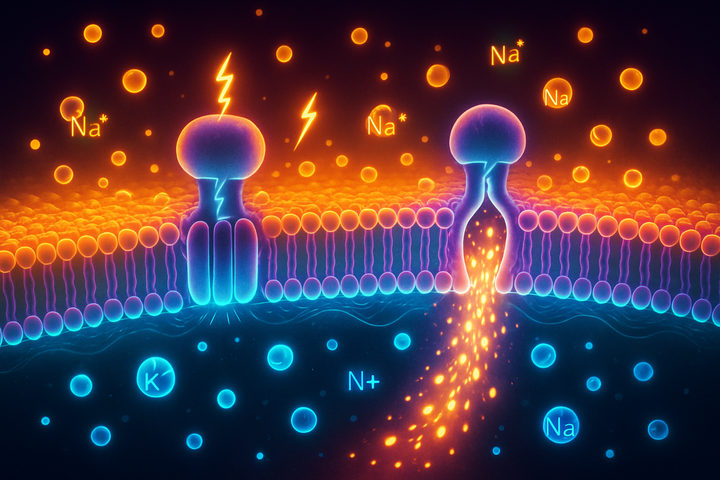
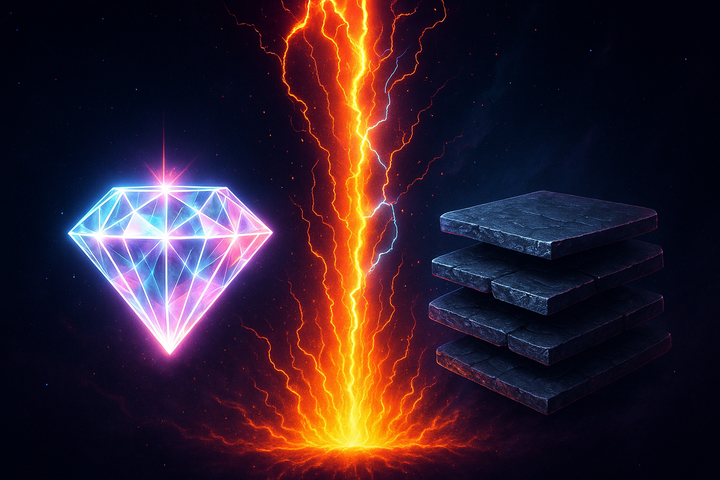
We've traveled through Gibbs free energy from formula to function—from ΔG = ΔH - TΔS to protein folding, membrane potentials, and the persistence of diamonds.
Now we step back. What does it all mean?
Free energy is not merely a thermodynamic quantity. It's the master variable of physical reality. Every spontaneous process—every chemical reaction, every phase transition, every living cell—is a system minimizing free energy. This isn't a rule of thumb. It's the deepest principle of change.
Understanding free energy as the master variable reveals why the universe evolves, why life exists, and why time has a direction.
The Central Principle
At constant temperature and pressure, systems evolve to minimize Gibbs free energy.
ΔG < 0: Process occurs spontaneously ΔG > 0: Process doesn't occur spontaneously ΔG = 0: Equilibrium
This single principle encompasses: - Chemical reactions (which ones go, how far) - Phase transitions (which state is stable) - Biological processes (metabolism, signaling, growth) - Electrochemistry (batteries, corrosion, neurons) - Materials science (stability, metastability, synthesis)
No exceptions. If something happens spontaneously at constant T and P, it decreased free energy.
The pebble: Free energy is nature's answer to "what happens next?" Whatever minimizes G happens. Everything else doesn't.
Entropy vs Free Energy
The Second Law says entropy increases. Why use free energy instead?
For isolated systems, entropy is the master variable. But real systems aren't isolated—they exchange heat with their environment at temperature T.
Free energy accounts for this exchange. It's the system's entropy change plus the entropy created by heat transfer to the environment:
ΔG = ΔH - TΔS ΔG/T = -ΔS_system + ΔH/T -ΔG/T = ΔS_system + ΔS_surroundings = ΔS_total
Minimizing G is equivalent to maximizing total entropy. Free energy converts the entropy maximization principle into a form usable for real (non-isolated) systems.
The pebble: Free energy isn't replacing entropy—it's carrying entropy's message in a more practical package.
The Four Faces of Free Energy
G = H - TS = U + PV - TS
Free energy balances four contributions:
1. U (internal energy): Bonds, interactions, configurations 2. PV (pressure-volume work): Expansion against surroundings 3. -TS (entropy): Disorder, multiplicity of states
At low T, enthalpy dominates. Systems minimize energy—crystals form, bonds strengthen. At high T, entropy dominates. Systems maximize disorder—crystals melt, bonds break.
Temperature is the dial. Free energy is the reading. The balance point determines reality.
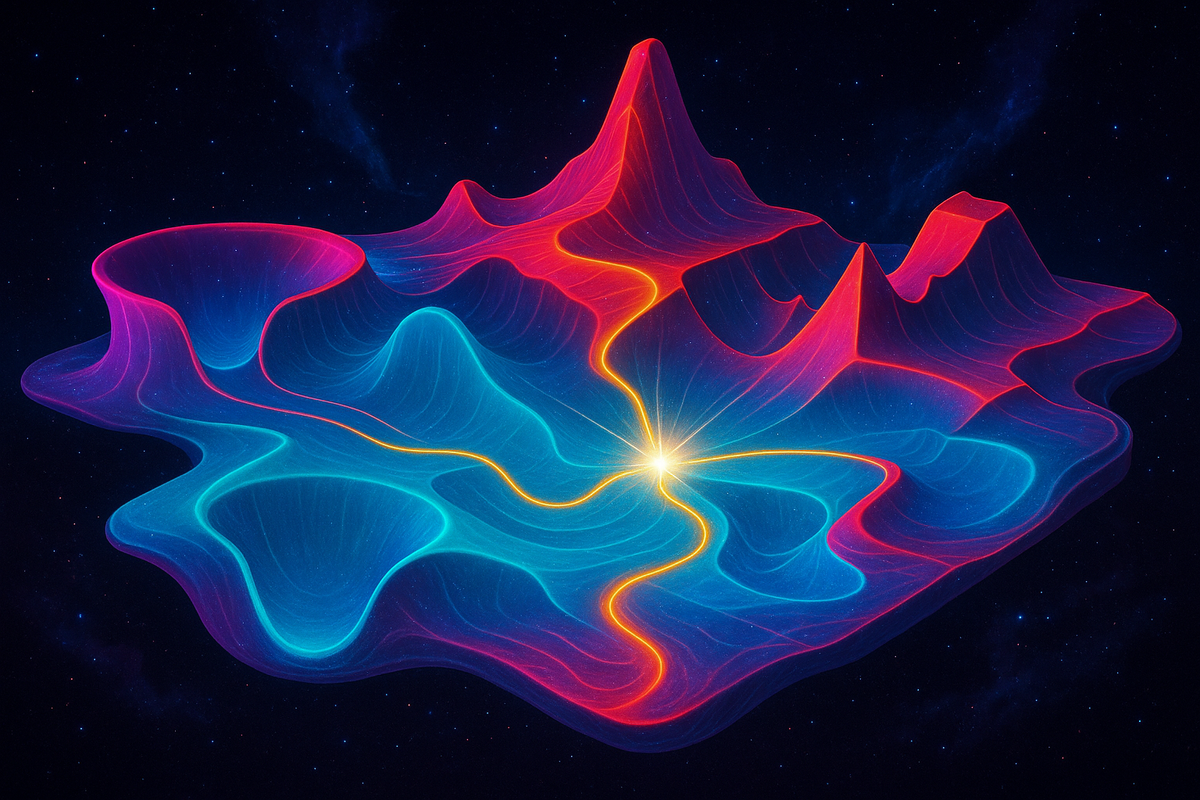
Free Energy Landscapes
Every system has a free energy landscape—a surface in configuration space where height is G.
Equilibrium: The global minimum. The lowest point. What the system would reach given infinite time.
Metastable states: Local minima. Lower than surroundings but not lowest overall. Diamonds, glasses, life.
Transition states: Saddle points. High free energy barriers between states. Kinetics lives here.
Dynamics: Systems roll downhill on this landscape, following the steepest descent (with thermal fluctuations causing detours).
This geometric picture unifies: - Chemical reaction coordinates - Protein folding funnels - Phase diagrams - Evolutionary landscapes
The landscape metaphor is so powerful because it's exact—free energy really does define a surface, and systems really do minimize it.
Far from Equilibrium: Life
Living systems operate far from equilibrium. G_living >> G_dead.
Life maintains this distance by: 1. Importing low-entropy energy (food, light) 2. Exporting high-entropy waste (heat, CO₂) 3. Continuously dissipating free energy to maintain structure
An organism is a free energy dissipation machine. Not a free energy minimizer—that would be death—but a free energy processor that maintains a non-equilibrium steady state.
The pebble: You are a waterfall. Free energy flows through you, from food to waste, maintaining your structure in the cascade. Stop the flow, and you collapse to equilibrium. That's death.
Free Energy and Information
Landauer's principle connects free energy to information:
Erasing one bit requires at least kT ln 2 of free energy dissipation.
This means: - Information processing has thermodynamic costs - Cells pay to maintain information (DNA, protein structures, ion gradients) - Computation is physical—bits require energy
The free energy cost of information explains: - Why enzymes that proofread consume more ATP - Why memory requires metabolism - Why Maxwell's demon can't violate thermodynamics
Information and free energy are two views of the same reality.
Free Energy Principle in Neuroscience
Karl Friston's "free energy principle" proposes that biological systems minimize a quantity called variational free energy—related to surprise (in the information-theoretic sense).
The idea: brains minimize the difference between their internal models and sensory input. Perception, action, learning—all serve to minimize this free energy.
Is this the same as Gibbs free energy? Not directly. Variational free energy is an information-theoretic quantity. But the name isn't accidental—both describe systems minimizing a weighted sum of energy and entropy terms.
The connection runs deep: thermodynamic free energy constrains what's physically possible; variational free energy describes how prediction-machines operate within those constraints.
Free Energy and Evolution
Evolution is free energy optimization at the population level.
Organisms that better capture and utilize free energy outcompete others. Natural selection is a free energy search algorithm: - Mutations explore configuration space - Selection rewards lower free energy expenditure per reproduction - Adaptation converges toward efficient free energy processing
Life evolves toward better ways of maintaining far-from-equilibrium states. Each adaptation is a thermodynamic innovation.
The pebble: Evolution is thermodynamics playing the long game. Organisms are hypotheses about how to process free energy; natural selection tests them.
Free Energy and the Arrow of Time
Why does time flow one way? Why do we remember the past but not the future?
The thermodynamic answer: entropy increases, creating an arrow of time. Free energy decreases, giving that arrow direction.
The psychological arrow of time (memory) aligns with the thermodynamic arrow because forming memories requires free energy. Recording information is an entropy-increasing process. We remember the past because remembering happens down the free energy gradient.
The free energy principle connects the thermodynamic arrow to the psychological arrow. Time flows toward equilibrium; experience flows with it.
The Universal Currency
Different fields use different languages: - Chemistry: ΔG determines reaction spontaneity - Physics: Entropy maximization drives equilibration - Biology: ATP/ADP ratios determine cellular capability - Economics: Free energy ≈ available work ≈ capital
These are the same thing in different notation. Free energy is the universal currency of possibility—what can be done, what will happen, what's stable and what's not.
Practical Takeaways
From this series:
For chemistry: ΔG predicts reactions. ΔG° from tables; ΔG from actual conditions. Equilibrium at ΔG = 0.
For biology: Life is non-equilibrium. ATP maintains the distance. Ion gradients store energy. Proteins fold to free energy minima.
For materials: Metastability is useful. Kinetic barriers protect thermodynamically unstable structures. Phase diagrams are free energy maps.
For engineering: Maximize efficiency by minimizing free energy waste. The Gibbs-Helmholtz equation guides temperature optimization.
For understanding: Everything that happens decreases free energy (at constant T, P). Everything that persists is at or near a free energy minimum (or kinetically trapped).
The Final Synthesis
Gibbs free energy is not just a formula. It's a worldview.
At the most abstract level: Reality is a free energy landscape. Systems roll downhill. What exists is what's stable (low G) or trapped (local minimum). What happens is what decreases G.
At the human level: You are a complex, far-from-equilibrium structure maintained by free energy flux. Your existence is paid for in ATP, measured in electrochemical gradients, and sustained by eating order and excreting disorder.
At the cosmic level: The universe began with low entropy (high free energy availability). It evolves toward equilibrium. Life is a temporary eddy in that flow—complexity emerging from the gradient, not despite thermodynamics but because of it.
Series Pebbles: The Best Lines
The Big Sentences: - "Spontaneity isn't about speed. It's about direction. The -ΔG reaction happens; the +ΔG reaction doesn't. How fast is a different question." - "Nature has two drives: minimize energy, maximize entropy. Gibbs free energy is the compromise." - "You don't run on ATP. You run on the distance between your ATP concentration and equilibrium. That distance is what it means to be alive." - "A protein's fold is a theorem, proved by thermodynamics." - "Every diamond is a thermodynamic debt, accruing for billions of years, never called due." - "Your thoughts are ion gradients discharging. Consciousness is the sound of free energy cascading through neural networks."
Wait, WHAT? Moments: - Graphite is more stable than diamond (your ring should be pencil lead) - Proteins are marginally stable—a few hydrogen bonds of stability separate folded from denatured - You turn over your body weight in ATP every day - Erasing a bit has a thermodynamic cost, paid in heat
Thread Hooks: - "Every chemical reaction is asking the same question: Does this decrease free energy? The answer determines what happens in the universe." - "Your existence violates equilibrium. Here's the thermodynamic bill, and how you pay it every second." - "Diamonds aren't forever—they're just kinetically patient. Here's why they should be graphite."
Further Reading
- Atkins, P. (2010). The Laws of Thermodynamics: A Very Short Introduction. Oxford University Press. - Dill, K. A. & Bromberg, S. (2011). Molecular Driving Forces. Garland Science. - Schrödinger, E. (1944). What Is Life? Cambridge University Press.
This concludes the Gibbs Free Energy series. Free energy is the master variable—the thermodynamic quantity that decides what happens, what persists, and what you are. Now you can read it too.

Comments ()