Glial Cells: The Other Half of Your Brain
For decades, glia were dismissed as neural glue. We now know astrocytes modulate synaptic strength, microglia sculpt circuits, and oligodendrocytes set the speed of thought. The other half of your brain has been ignored.
Glial Cells: The Other Half of Your Brain
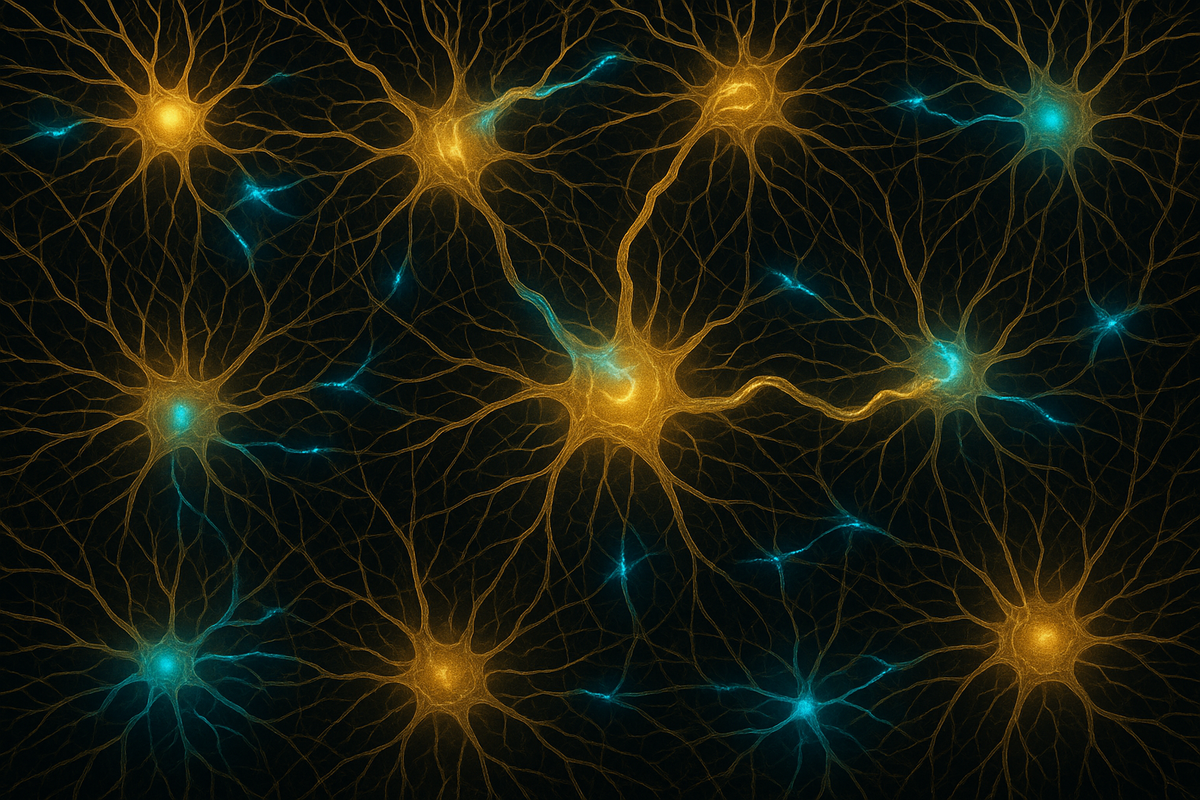
For most of the history of neuroscience, glial cells were the forgotten majority. Your brain contains roughly 86 billion neurons. It also contains roughly the same number of glial cells—maybe more. That's half your brain, by cell count, that isn't neurons. And for over a century, we assumed they didn't matter much. The name "glia" comes from the Greek for "glue." When early anatomists saw these cells filling the spaces between neurons, they figured their job was structural—holding the brain together, providing scaffolding, maybe supplying nutrients. The neurons did the computing. The glia were just... there. We were spectacularly wrong. Astrocytes don't just support neurons—they actively modulate synaptic transmission. Microglia aren't just janitors—they shape neural circuits by pruning connections. Oligodendrocytes don't just insulate axons—they control the timing of neural signals. The "support cells" are part of the computation. And understanding them is rewriting what we know about how brains work.
Astrocytes: The Star-Shaped Computers
For decades, astrocytes seemed boring. They didn't fire action potentials—the electrical spikes that neurons use to communicate. Without spikes, how could they be doing anything interesting? Then researchers discovered that astrocytes communicate differently. Calcium waves. Astrocytes signal through changes in intracellular calcium concentration. When one astrocyte is stimulated, calcium floods into it. This triggers calcium release in neighboring astrocytes, creating a wave that spreads through the network. It's slower than neuronal signaling (seconds rather than milliseconds) but it's real communication. Gliotransmitters. Astrocytes release signaling molecules—glutamate, ATP, D-serine—that affect neuronal activity. They don't fire action potentials, but they modulate neurons that do. This is called "gliotransmission," and it was controversial when first proposed. It's now established. Tripartite synapses. The classical synapse has two parts: the presynaptic neuron releasing neurotransmitter and the postsynaptic neuron receiving it. The new model adds a third participant: the astrocyte process that wraps the synapse and influences both sides. The "tripartite synapse" is now the standard model. What are astrocytes actually computing? That's the frontier. One hypothesis: astrocytes integrate information across thousands of synapses and set the overall activity level of their territory. They're not processing specific information—they're modulating the gain of local circuits. When astrocytes are active, the neurons in their territory become more or less responsive. Another hypothesis: astrocytes create functional boundaries. Each astrocyte has a territory, and that territory might define a computational unit—a module that processes information somewhat independently of neighboring modules. Another: astrocytes are involved in memory consolidation. During sleep, astrocytes show increased calcium activity and may be involved in moving memories from short-term to long-term storage. None of this was in the textbooks thirty years ago. Astrocytes went from glue to active participants in brain computation.
Microglia: The Brain's Immune System
Microglia are the resident immune cells of the brain. Unlike other brain cells, which come from the neural lineage, microglia migrate into the brain during development and come from the same lineage as blood macrophages. Their classic job: clean up. When neurons die, microglia engulf the debris. When pathogens invade, microglia mount an immune response. When injury occurs, microglia rush to the site. But microglia do something else—something that surprised everyone. Synaptic pruning. During brain development, neurons form far more synapses than they'll keep. The brain is overconnected at first, and then connections are eliminated—"pruned"—based on activity. Use it or lose it. Microglia are the pruners. They literally eat synapses. Processes of microglia infiltrate synaptic spaces, engulf the synaptic structures, and digest them. This isn't pathology—it's normal development. The immune cells shape the neural circuits by deciding which connections survive. Beth Stevens at Boston Children's Hospital pioneered this work, showing that microglia use immune signaling molecules (like complement proteins) to tag synapses for elimination. The same molecules that tag pathogens for destruction are repurposed to tag unwanted synapses. When this goes wrong, things go very wrong. Excessive microglial pruning has been implicated in schizophrenia. Genetic variants that increase complement activity—making pruning more aggressive—are among the strongest genetic risk factors for schizophrenia. The hypothesis: schizophrenia involves too much synaptic pruning during adolescence, removing connections that should have been kept. Insufficient microglial pruning may contribute to autism. Some evidence suggests that autistic brains have more synapses than neurotypical brains, possibly because pruning was incomplete. The circuitry stays overconnected. The immune cells that clean up debris also sculpt the circuits that make us who we are.
The Pruning Hypothesis of Mental Illness
Let's sit with this for a moment, because it's a paradigm shift. For decades, psychiatric disorders were conceptualized in terms of neurotransmitter imbalances. Depression = not enough serotonin. Schizophrenia = too much dopamine. The treatments followed: SSRIs boost serotonin, antipsychotics block dopamine. The neurotransmitter hypothesis isn't wrong, but it's incomplete. The drugs work (somewhat) but nobody believes depression is simply "low serotonin" anymore. The new hypothesis: psychiatric disorders are disorders of circuit development and maintenance, and glial cells—especially microglia—are central players. Schizophrenia typically emerges in late adolescence. That's when the prefrontal cortex undergoes major synaptic pruning. If microglia are overactive, they prune too much—removing connections needed for normal cognition and reality-testing. Depression involves inflammation. Inflammatory markers are elevated in depressed patients. Microglia, when chronically activated, release inflammatory cytokines that alter neurotransmission and may cause the symptoms we call depression. Some evidence suggests that anti-inflammatory treatments can have antidepressant effects. Alzheimer's disease involves microglia at multiple stages. Microglia clear amyloid plaques (helpful) but also release inflammatory molecules that damage neurons (harmful). The balance between protective and destructive microglia function may determine disease progression. If this hypothesis is right, the future of psychiatry isn't just about neurotransmitters. It's about glial function.
Oligodendrocytes: Timing Is Everything
Oligodendrocytes make myelin—the fatty insulation that wraps axons and gives white matter its color. Myelin speeds up signal transmission. A myelinated axon can conduct signals up to 100 times faster than an unmyelinated one. This matters because the brain is a timing machine. Neurons in different regions need to synchronize their activity, and synchronization requires signals to arrive at the right time. But here's the twist: myelin isn't fixed. Oligodendrocytes can add or remove myelin throughout life, adjusting conduction speed based on experience. When you learn a new skill—playing piano, speaking a language, juggling—the white matter tracts involved show increased myelination. The circuits you practice get faster. This "myelin plasticity" is slower than synaptic plasticity but may be just as important for learning. Recent work suggests that myelin changes can explain aspects of cognitive development that synaptic plasticity can't. Adolescents have most of the synapses they'll ever have, but myelination continues into the mid-20s. The slow maturation of prefrontal white matter may explain why impulse control and long-term planning develop slowly through adolescence. The timing of neural signals matters for computation. Oligodendrocytes control the timing. Therefore, oligodendrocytes participate in computation.
Einstein's Brain (And What Glia Might Have to Do With It)
When Albert Einstein died in 1955, his brain was removed and preserved (somewhat controversially, without his family's clear consent). Over the decades, it's been studied repeatedly for clues about what made him a genius. Most studies found nothing remarkable about his neurons. The brain was normal-sized, maybe even slightly smaller than average. But one study, published in 1985, found something odd: Einstein's brain had an unusually high ratio of glial cells to neurons in certain regions—particularly in areas involved in mathematical and spatial reasoning. The interpretation is speculative. Maybe Einstein had more astrocytes supporting his neurons. Maybe those extra glia enhanced his cognitive abilities. Or maybe the finding is a statistical fluke from studying one brain without good controls. What's not speculation: the fact that researchers even thought to count glia shows how the field has changed. The "glue" is now considered potentially important for intelligence.
The Future of Glial Research
Glia research is booming, but it's decades behind neuron research. Tools are catching up. Optogenetics has been adapted for astrocytes—you can now stimulate or silence astrocytes specifically and see what happens to neural activity. Calcium imaging can track astrocyte communication alongside neuronal activity. Single-cell RNA sequencing reveals that "astrocytes" are actually many distinct subtypes with different functions. Hypotheses are being tested. Does astrocyte signaling contribute to memory formation? Does microglial pruning gone wrong really cause schizophrenia? Does myelin plasticity explain skill learning? These were untestable speculation twenty years ago. They're active research programs now. Therapies are emerging. If microglia contribute to Alzheimer's, maybe drugs that modulate microglial activity could slow disease progression. If astrocytes contribute to epilepsy, maybe targeting astrocyte signaling could control seizures. If oligodendrocyte dysfunction causes multiple sclerosis, maybe promoting remyelination could reverse damage. We're at the beginning of glia neuroscience, not the end.
Half Your Brain, Half the Story
Here's the philosophical point underneath the science. For a century, we built our models of brain function on neurons alone. The "neural network" in machine learning is inspired by neurons. The "connectome" maps neuronal connections. The "neural correlates of consciousness" look for correlates in neurons. But if glia are part of the computation—if astrocytes modulate synaptic strength, if microglia sculpt circuits, if oligodendrocytes control signal timing—then we've been building models of half a brain. The computational principles might be different from what we expect. Neurons compute fast; glia compute slow. Neurons are digital-ish (spike or no spike); glia are analog (graded calcium concentrations). Neurons process specific information; glia modulate overall circuit dynamics. Maybe consciousness, memory, or cognition depend on interactions between neuronal and glial networks—two computational systems with different properties, working together. We don't know yet. But we've stopped ignoring half the brain. The "support cells" are part of the story. And the story is more complex than we imagined.
Further Reading
- Fields, R.D. (2009). The Other Brain: The Scientific and Medical Breakthroughs That Will Heal Our Brains and Revolutionize Our Health. Simon & Schuster.
- Haydon, P.G. & Bhattacharya, A. (2006). "Astrocytes and the modulation of sleep." Current Opinion in Neurobiology.
- Stevens, B. et al. (2007). "The classical complement cascade mediates CNS synapse elimination." Cell.
- Fields, R.D. (2008). "White matter in learning, cognition and psychiatric disorders." Trends in Neurosciences.
This is Part 4 of the New Neuroscience series. Previous: "Optogenetics: Controlling Neurons with Light." Next: "Neuroinflammation: When Your Brain's Immune System Attacks"—what happens when the brain's immune system becomes part of the problem.


Comments ()