Göbekli Tepe: Religion Before Agriculture?
The standard story: surplus food enabled complex society, then religion. Göbekli Tepe flips it — a monumental ritual site built by nomadic hunter-gatherers, suggesting belief may have driven agriculture, not followed it.
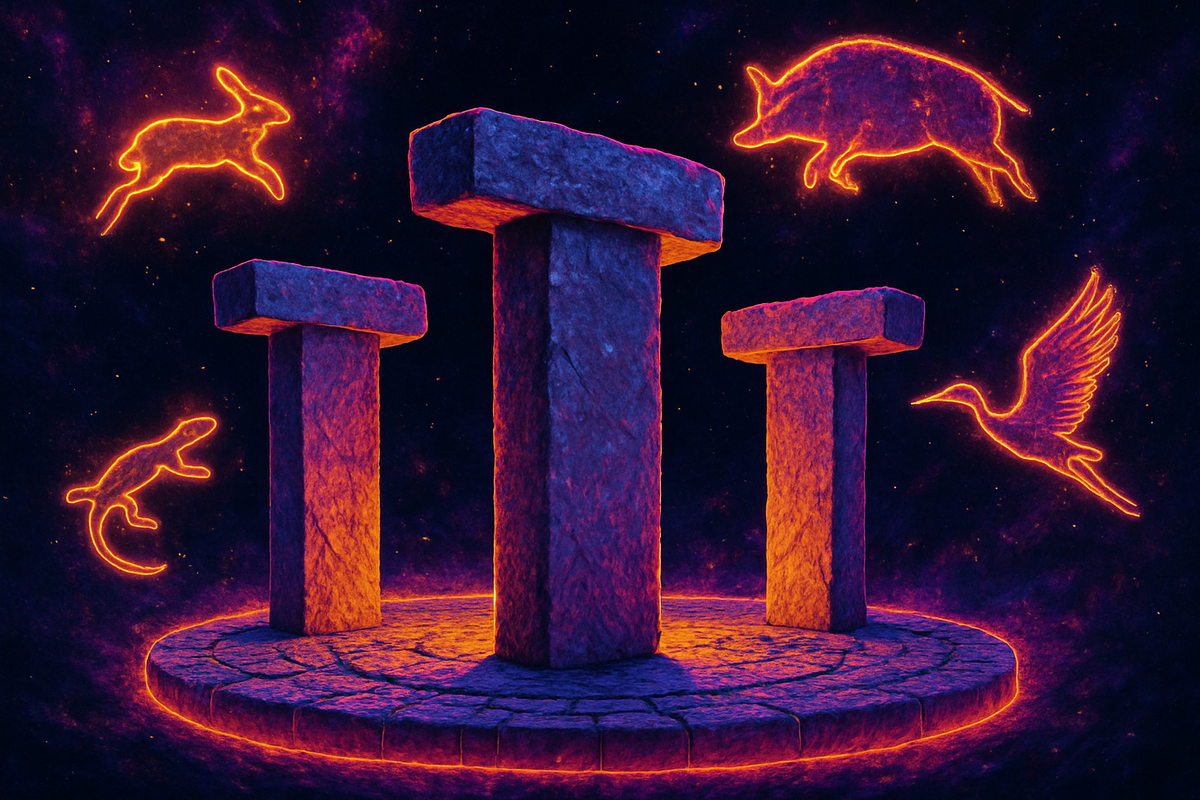
Göbekli Tepe: The Temple Before the Farm
In 1994, a German archaeologist named Klaus Schmidt arrived at a site in southeastern Turkey that local farmers had known about for decades. They called it "Potbelly Hill"—Göbekli Tepe in Turkish. It was covered with worked flint and limestone fragments. Previous archaeologists had dismissed it as a medieval cemetery.
Schmidt thought otherwise. He started digging.
What he found upended everything we thought we knew about the origins of civilization. Massive stone pillars, carved with elaborate animal reliefs—lions, bulls, foxes, vultures, snakes. Some pillars weigh 50 tons. The oldest layers date to around 9500 BCE—before agriculture, before permanent settlement, before anything else like it.
Hunter-gatherers built this. Then they buried it and walked away.
What Göbekli Tepe Is
The site consists of multiple circular enclosures, each containing large T-shaped limestone pillars. The pillars are up to 5.5 meters tall. They're carved with images of animals—wild animals, dangerous animals. Some pillars have arms and hands carved into them, suggesting they represent human or humanoid figures.
The imagery is striking. Predators dominate—lions, leopards, boars, wild bulls. Snakes are everywhere. Vultures appear repeatedly, possibly representing death rituals. But there are also strange, almost whimsical figures—a fox, a crane, a spider. And notably, few herbivores. This wasn't about animals people hunted for food. It was about animals that mattered symbolically.
The oldest structures date to roughly 9500 BCE—the Pre-Pottery Neolithic A period. This predates the oldest known permanent villages. It predates agriculture by at least a millennium. It predates pottery by millennia more.
For context: Stonehenge was built around 3000 BCE. The Egyptian pyramids around 2500 BCE. Göbekli Tepe is older than both of those combined. When people were building Stonehenge, Göbekli Tepe had already been buried and forgotten for five thousand years.
The construction required coordination at an unprecedented scale. Quarrying, transporting, and erecting 50-ton limestone pillars takes hundreds of workers. Someone had to organize them. Someone had to feed them while they worked. Someone had to maintain a shared vision across years of construction.
All of this happened before we thought complex society was possible.
The site wasn't inhabited. There are no houses. No storage structures. No garbage middens from long-term occupation. People came from elsewhere, built these structures, conducted whatever rituals they conducted, and left. It was a gathering place—a pilgrimage site, perhaps, or a ritual center.
Around 8000 BCE, the site was deliberately buried. Hundreds of cubic meters of debris were intentionally deposited to cover the structures. Then it was abandoned for 10,000 years until Schmidt started digging.
Why It Matters
Göbekli Tepe inverts the standard narrative about the origins of civilization.
The standard story: Agriculture came first. Surplus came second. Surplus enabled specialization—priests, craftspeople, warriors. Specialization required coordination. Coordination produced hierarchy. Hierarchy built monuments.
The sequence is: farm → surplus → specialists → temples.
Göbekli Tepe suggests a different sequence: temples → gathering → agriculture.
If hunter-gatherers could build monumental architecture, the "surplus" explanation for civilization doesn't work. You don't need agriculture to coordinate labor. You don't need stored grain to feed workers. Something else was driving the assembly of large groups for shared projects.
What was driving it? The most obvious answer: religion.
The Religion Hypothesis
Schmidt, before his death in 2014, argued that Göbekli Tepe was built for religious purposes. The imagery—wild animals, death symbols, T-shaped pillars that might represent ancestors or spirits—suggests ritual significance.
His provocative claim: religion came before agriculture. The desire to gather for rituals created the need for food surplus, which drove the adoption of farming. Not: farming enabled temples. Rather: temples required farming.
This is still debated. But several lines of evidence support it:
The earliest domesticated plants appear near Göbekli Tepe. The Karacadağ mountains, where the wild ancestors of domesticated wheat grow, are within 30 kilometers of the site. The earliest evidence of plant cultivation comes from this region. It's possible that the need to feed pilgrims gathering at the site accelerated agricultural experiments.
The sequence in other regions. In the Levant, monumental sites appear before full agricultural dependence. The transition to farming was gradual—centuries of experimentation, adoption, and abandonment. Ritual gathering places might have driven the process.
Comparative evidence. Other non-agricultural peoples have built monuments. Poverty Point in Louisiana. The mound complexes of the Pacific Northwest. Assembly for ritual purposes doesn't require agriculture—but it might encourage it.
The timing is suggestive. Agriculture appears in the archaeological record almost immediately after Göbekli Tepe begins. The site's construction spans the precise period when humans transitioned from foraging to farming. This might be coincidence. It might also be causation.
The stronger version of Schmidt's claim: not just that religion preceded agriculture, but that religion caused agriculture. The need to provision ritual gatherings created the incentive to intensify food production. Agriculture was a response to religious demand.
If correct, this has profound implications. It means the foundational transition in human history—the shift from hunting and gathering to farming—wasn't driven by population pressure or climate change or accidental discovery. It was driven by meaning. People didn't start farming because they had to. They started because their gods demanded feasts.
The Organizational Problem
How do you build Göbekli Tepe without a state?
Modern construction projects of this scale involve blueprints, supply chains, management hierarchies, wage labor. None of that existed in 9500 BCE. Yet the construction happened.
Several possibilities:
Seasonal assembly. Hunter-gatherer groups might have gathered seasonally—as many documented groups do—for rituals, trade, and social bonding. During assembly, the labor for construction was available. Between assemblies, groups dispersed.
Feasting. The site shows evidence of large-scale feasting—animal bones from many individuals, food preparation areas. Feasting is a well-documented mechanism for mobilizing labor in non-state societies. You throw a feast; people come; while they're there, they work on your project.
Competitive display. Different groups might have competed to build more impressive structures. The site has multiple enclosures built over time, each with its own character. This could reflect competition between groups—or the successive contributions of the same community.
Charismatic leadership. Someone had to organize this. The presence of a particularly compelling leader—a priest, a shaman, a visionary—might have been essential. But that leadership needn't have been permanent or hereditary. It could have been situational authority, dissolved when the project ended.
Whatever the mechanism, Göbekli Tepe demonstrates that complex coordination is possible without permanent hierarchy. You don't need a state to build monuments. You need motivation—and religion, apparently, provides it.
This challenges the assumption that large-scale coordination requires coercion. The workers at Göbekli Tepe weren't slaves. They weren't conscripted labor. They came voluntarily, probably at considerable cost to their regular subsistence activities. They came because the project meant something to them—something worth the effort.
The same pattern appears in other early monumental sites. The labor was motivated, not forced. The coordination emerged from shared belief, not bureaucratic command. Authority existed, but it was authority freely granted to those who could articulate and execute the vision.
The Burial Mystery
Around 8000 BCE, the site was deliberately buried. Hundreds of cubic meters of fill—broken stone, flint, bones, and debris—were intentionally deposited to cover the structures.
Why?
Decommissioning. Perhaps the rituals conducted there required periodic closure. When a structure's sacred life was complete, it was properly buried and a new one built. The multiple enclosures might represent successive ritual cycles.
Secrecy. Perhaps the site was intentionally hidden—from enemies, from the uninitiated, from future generations. Sacred knowledge might have been deliberately buried with the structures.
Cultural change. Perhaps the beliefs that motivated the site's construction faded. A new religion, a new worldview, might have made the old structures obsolete—or dangerous. Burial would be a way of neutralizing their power.
Practical transition. Perhaps as populations became more sedentary and agriculture took hold, the pattern of seasonal gathering that Göbekli Tepe represented became obsolete. Permanent villages replaced temporary pilgrimage sites. The old way was buried along with the old structures.
We don't know. The burial itself is as mysterious as the construction.
What's clear is that the burial was intentional, careful, and complete. This wasn't abandonment—leaving a site to be covered by natural processes. This was active decommissioning. The people who buried Göbekli Tepe cared enough to do it properly. Whatever the site meant to them, it still meant something when they covered it up.
What It Tells Us About Institutions
Göbekli Tepe offers several lessons about institutional origins:
Motivation matters more than surplus. The standard economic explanation—that surplus enables complexity—is backward. What enables complexity is motivation. If people want to coordinate badly enough, they'll find ways to provision the coordination. Göbekli Tepe suggests that religious motivation can drive institutional innovation before material conditions seem to permit it.
This has implications beyond ancient history. Modern institutions also run on motivation. People will organize incredible efforts for causes they believe in—often without material incentives. The assumption that economic incentives are primary might be as wrong for contemporary institutions as it was for Neolithic ones.
Scale is possible without permanence. The site represents massive coordinated effort, but it wasn't a permanent settlement. The people who built it didn't live there. They assembled, built, worshipped, and dispersed. Temporary assembly can achieve what we usually attribute to permanent institutions.
This should be obvious to anyone who's attended a music festival or organized a large event. Temporary coordination can be remarkably sophisticated. What's remarkable about Göbekli Tepe is the scale—and the fact that it happened 11,500 years ago.
Early doesn't mean simple. The sophistication of the carvings, the precision of the construction, the apparent astronomical alignments—all suggest complex knowledge, transmitted across generations, maintained by hunter-gatherer societies. We've systematically underestimated what non-agricultural peoples could achieve.
The condescension toward "primitive" peoples is built into our vocabulary. "Hunter-gatherer" sounds like a description of material poverty. But the people who built Göbekli Tepe had rich symbolic lives, complex social organization, and technical skills we would struggle to replicate today. They knew things we don't know.
Religion may be primary. If the religion hypothesis is correct, religious institutions might be the foundation on which all other institutions rest. The capacity to gather large groups for shared rituals might be the prerequisite for everything else—states, markets, classes.
This aligns with other evidence about the role of shared belief in human coordination. Yuval Noah Harari's argument in Sapiens—that the ability to believe in shared fictions enables human cooperation at scale—finds archaeological support at Göbekli Tepe. Before we had grain stores, before we had armies, before we had bureaucracies, we had shared stories that brought people together.
Reversibility was possible. The site was built, used, and then deliberately buried. The people who buried it walked away—presumably back to lives that looked more like their ancestors' than like the sedentary agricultural societies that would eventually dominate. This wasn't a one-way escalator. People tried complexity, and then they chose to step back from it. That choice was available to them in ways it might not be available to us.
The Takeaway
Göbekli Tepe is the oldest known monumental architecture. It predates agriculture by at least a millennium. It was built by hunter-gatherers, for purposes we don't fully understand, and then deliberately buried.
The site suggests that religion may have preceded and caused agriculture, not the other way around. The desire to gather for rituals created the need for reliable food supplies, which drove agricultural intensification.
More broadly, Göbekli Tepe demonstrates that the standard sequence—agriculture → surplus → hierarchy → monuments—is wrong. Complex coordination is possible before agriculture. Motivation matters more than material conditions. Early humans were more institutionally creative than we thought.
The first temples came before the first farms. That should change how we think about everything that followed.
Further Reading
- Schmidt, K. (2010). "Göbekli Tepe—the Stone Age Sanctuaries: New Results of Ongoing Excavations." Documenta Praehistorica. - Dietrich, O., et al. (2019). "Cereal Processing at Early Neolithic Göbekli Tepe." PLOS ONE. - Curry, A. (2008). "Göbekli Tepe: The World's First Temple?" Smithsonian Magazine.
This is Part 6 of the Anthropology of Institutions series. Next: "[State Formation](/state-formation-primary-states/)"


Comments ()