Gravitational Wave Technosignatures: A New Search Channel
LIGO listens for merging black holes — but what if it could detect alien megastructures too? Gravitational wave technosignatures open a strange new channel in the search for extraterrestrial intelligence.
Gravitational Wave Technosignatures: A New Search Channel
Series: Technosignatures | Part: 6 of 9
For a century, we've searched for aliens by listening for radio signals. For decades, we've scanned stellar light for megastructures and atmospheric biosignatures. Now we're opening an entirely new channel: the gravitational wave spectrum. And it turns out that if advanced civilizations exist, they might be doing things that literally bend spacetime in detectable ways.
This isn't science fiction. LIGO has proven we can measure gravitational waves—ripples in the fabric of spacetime itself. The question emerging at the intersection of gravitational wave astronomy and SETI is: what kinds of advanced engineering might produce gravitational wave signatures we could detect? And more provocatively: might some already be hiding in our data?
What Gravitational Waves Actually Are
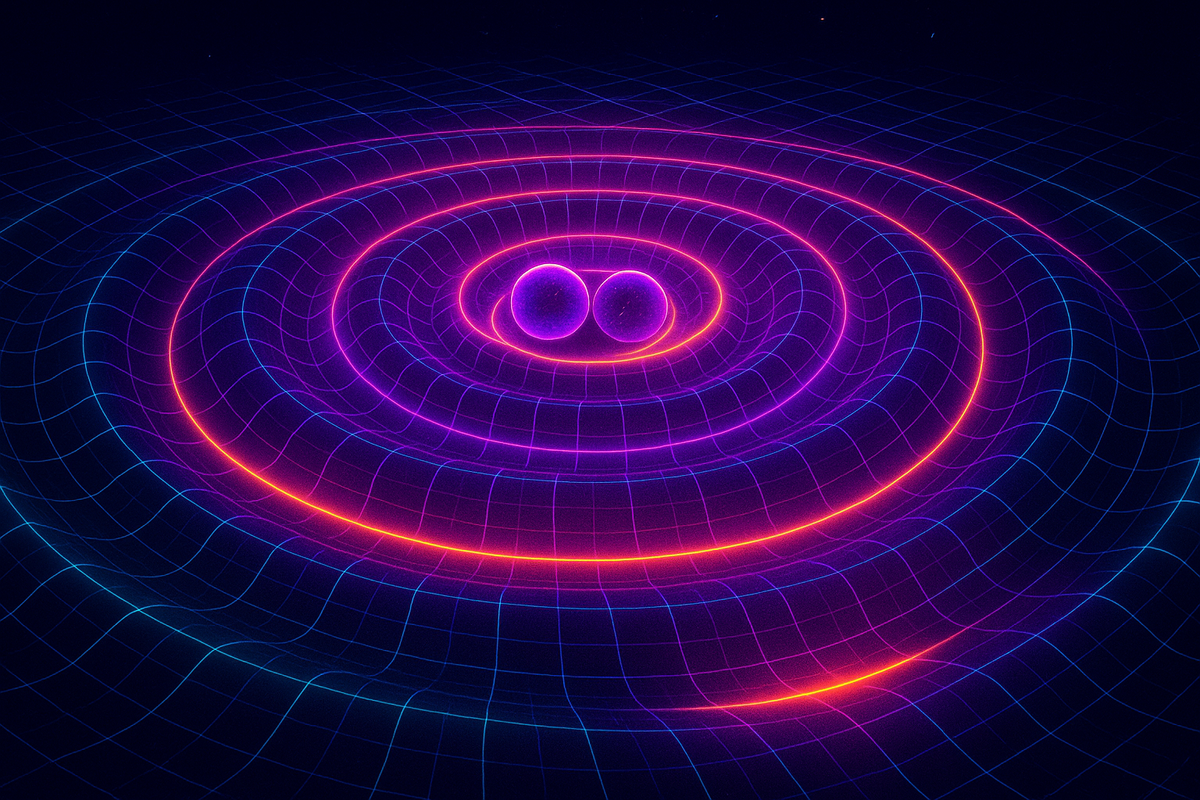
When massive objects accelerate asymmetrically—colliding black holes, merging neutron stars, supernovae—they create ripples that propagate through spacetime at the speed of light. Einstein predicted this in 1916. LIGO detected them for the first time in 2015.
The detection itself is extraordinary. LIGO measures changes in distance smaller than a proton's width across 4-kilometer arms. When a gravitational wave passes through, spacetime itself stretches and compresses, causing one arm to lengthen while the other shortens by these infinitesimal amounts. The signal from the first detection—two black holes merging 1.3 billion light-years away—lasted less than a second but transformed astrophysics.
Since then, LIGO (and its European counterpart Virgo) has detected dozens of events: black hole mergers, neutron star collisions, exotic hybrid mergers. Each detection opens a new window on violent cosmic phenomena. But here's what makes gravitational waves different from every other detection method: they don't get absorbed or scattered. Light can be blocked by dust, attenuated by gas, redshifted beyond recognition. Gravitational waves pass through everything essentially unchanged.
If you want to send a signal that will reach anywhere in the galaxy without degradation, gravitational waves are your medium.
Why Advanced Civilizations Might Care
Traditional SETI assumes aliens broadcast electromagnetic signals—radio or optical beacons designed to be detected. This requires they want to be found and invest resources in transmission. Dysonian SETI looks for waste heat or structural signatures of megaprojects—technosignatures that emerge as byproducts of activity at stellar scales.
Gravitational wave technosignatures could fall into either category—or both.
As Intentional Beacons: If a civilization masters gravitational wave generation at detectable amplitudes, they possess a communication channel that penetrates everything, propagates across cosmic distances undistorted, and reaches any observer with the right detectors. You couldn't hide from it with dust clouds or stellar occlusion. It's a universal announcement system.
As Industrial Byproducts: Any sufficiently large engineering project involving massive objects in accelerated motion generates gravitational waves. If civilizations build on scales comparable to stellar or black hole masses, or harness those objects for energy or computation, the side effects might be detectable. Just as our radio leakage revealed our presence before we tried, megascale engineering might announce itself gravitationally.
The physicist Freeman Dyson—who originated the concept of megastructures—speculated late in his career about "gravitational engineering." If civilizations manipulate black holes, neutron stars, or other compact objects for computation or energy extraction, the gravitational wave spectrum becomes diagnostic of technological processes we can't yet imagine but can look for.
What LIGO Could Actually Detect
Current gravitational wave detectors are sensitive to events involving objects from roughly 1 to 100 solar masses accelerating in the 10-1000 Hz frequency range. Natural astrophysical sources—binary mergers—produce burst signals lasting milliseconds to seconds, with characteristic "chirp" patterns as the objects spiral inward.
So what would artificial sources look like?
Continuous Wave Sources: Imagine a rapidly spinning neutron star with a slight asymmetry—a "mountain" on its surface. This creates a continuous, monochromatic gravitational wave at twice the spin frequency. Natural neutron stars produce these at amplitudes too weak to detect yet. But an engineered object—a spinning mass deliberately imbalanced—could generate stronger, more detectable signals. The signature would be persistent, phase-coherent, and potentially modulated to carry information.
Binary Systems Under Control: Natural binaries merge over millions to billions of years, only producing detectable waves in their final minutes. But an artificially maintained binary—two massive objects kept in close orbit via active stabilization—would radiate continuously. The signal would be steady-state rather than chirping, lasting years rather than seconds. Modulating the orbital parameters could encode information in the waveform's frequency and amplitude.
Burst Signatures with Exotic Profiles: Natural mergers have known waveforms we can template-match. Artificial events might have non-standard profiles: sudden changes in frequency that don't match Newtonian inspiral, amplitude modulation inconsistent with known dynamics, or bursts that repeat on non-astronomical timescales. If you're deliberately creating gravitational waves, you're not constrained by natural orbital mechanics.
Low-Frequency Megastructures: Future space-based detectors like LISA will access lower frequencies (millihertz range), corresponding to much larger masses and longer timescales. At this scale, you're talking about black hole binaries, supermassive black hole mergers, or structures involving stellar-mass objects manipulated over years to decades. This is where Dyson's "gravitational engineering" becomes plausible: megastructures massive enough to warp spacetime detectably as they operate.
The Theoretical Proposals
Several researchers have explored what kinds of technosignatures might appear in gravitational wave data.
Modulated Continuous Waves: In 2018, physicists Marek Abramowicz and colleagues proposed looking for artificial gravitational wave beacons: rotating neutron stars deliberately spun up and imbalanced to radiate at specific frequencies, modulated to encode information. The advantage: once established, such a beacon runs for millennia with minimal intervention, broadcasting omni-directionally. Any civilization with access to gravitational wave generation could announce itself across the galaxy.
Binary Maintenance Signatures: A 2020 paper by SETI researchers proposed identifying binaries that should merge but don't—systems where gravitational wave radiation should drive inspiral on detectable timescales but remain stable. This could indicate active stabilization: engineering that extracts energy while keeping the system in equilibrium. The technosignature isn't a message but a deviation from expected dynamics.
Exotic Waveforms from Unknown Processes: The standard LIGO search pipelines look for templates matching known astrophysical sources. But "unmodeled burst searches" look for transients that don't fit templates—gravitational wave anomalies. Some researchers suggest extending these searches specifically for engineered signatures: pulses with too-sharp edges, frequency sweeps inconsistent with inertial dynamics, or periodic patterns that suggest deliberate timing.
Gravitational Wave Lasers: More speculatively, some theoretical work explores whether advanced civilizations could create coherent, directed gravitational wave beams—essentially lasers but with spacetime distortions instead of photons. This requires manipulating quantum fields in ways we can't yet, but if possible, it represents a fundamentally new communication channel. The signature would be coherent, collimated, and potentially information-dense in ways continuous waves aren't.
The Challenges: Sensitivity and Computational Load
LIGO's sensitivity is extraordinary but limited. Current detectors see stellar-mass binaries merging out to billions of light-years but struggle with continuous waves much weaker than sudden mergers. An engineered source would need to be:
- Massive enough: Involving neutron star or black hole scale masses
- Close enough: Within kiloparsecs for continuous waves, farther for strong bursts
- Loud enough: Matching or exceeding natural astrophysical sources in amplitude
This rules out subtlety. If aliens are communicating via gravitational waves, they're doing it with stellar-scale machinery. That's not inherently implausible—Dyson spheres involve stellar-scale engineering, too—but it narrows the scenarios to Kardashev Type II civilizations or higher.
The computational challenge is equally daunting. LIGO generates petabytes of data annually. Searching for unknown signal types requires enormous computing resources. Researchers have developed machine learning pipelines to flag anomalies, but distinguishing instrumental glitches from candidate technosignatures is non-trivial. Every earthquake, truck rumble, and lightning strike creates noise in the detectors. Gravitational wave SETI requires statistical rigor comparable to particle physics: multiple sigma confidence before claiming detection.
What We're Already Doing
Several groups have begun systematic searches:
The Breakthrough Listen Initiative expanded its scope in 2020 to include gravitational wave data, focusing on unmodeled bursts coinciding with known exoplanet systems or interesting stellar targets. The idea: if a civilization exists around a star we've already identified, check whether anomalous gravitational wave events correlate with that location.
LIGO Collaboration's Open Data: LIGO makes its data publicly available, enabling independent researchers to conduct targeted searches. Amateur astronomers and university groups have developed software to scan for specific waveform types, particularly modulated continuous waves. This crowdsourced approach parallels early radio SETI efforts like SETI@home.
LISA Pathfinder Studies: Planning for the space-based LISA observatory includes explicit technosignature search strategies. LISA's sensitivity to lower frequencies expands the potential signal space to include megastructure-scale engineering—rotating structures, dyson swarms, or black hole manipulation events at timescales of hours to weeks rather than milliseconds.
None of these efforts have claimed a detection. But the searches have only just begun. Gravitational wave astronomy itself is less than a decade old as an operational science.
The Coherence Framing: Spacetime as Communication Substrate
From an AToM perspective, this is an exploration of coherence at the most fundamental physical scale. Gravitational waves are perturbations in the metric structure of spacetime itself—literal distortions in the geometry that determines causal relationships. A technosignature in this domain isn't just a message encoded in a carrier wave. It's a civilization's imprint on the shape of reality's causal fabric.
This suggests a different framing for why advanced civilizations might engage with gravitational wave engineering. It's not just communication. It's coherence maintenance at scales where spacetime structure matters dynamically. If you're engineering systems involving black holes or neutron stars—extracting rotational energy from spinning singularities, using accretion dynamics for computation, harnessing orbital mechanics for energy transport—you're necessarily creating gravitational wave signatures. The technosignature isn't ancillary; it's intrinsic to the system's operation.
This shifts the question from "would they broadcast?" to "would they care that we hear?" If gravitational wave generation is a side effect of stellar-scale engineering rather than deliberate transmission, detection becomes less about finding messages and more about recognizing the dynamics of megaprojects. The signal is the coherence signature of systems whose scale and operational parameters create detectable spacetime curvature.
In this view, gravitational wave technosignatures are to megastructures what radio leakage is to industrial civilization: not a message but a byproduct—one that reveals structure, scale, and operational dynamics to anyone with the capacity to measure it.
The Great Silence in a New Spectrum
LIGO's first detection of gravitational waves was celebrated as confirmation of general relativity and the birth of multi-messenger astronomy. But every new detection channel also reframes Fermi's paradox. We've listened to radio frequencies for decades. We've scanned optical spectra, infrared emissions, exoplanet atmospheres, stellar waste heat. Now we can measure spacetime distortions across cosmic distances.
And so far: silence.
Or rather, exactly the astrophysical sources we'd expect and nothing obviously artificial. This doesn't rule out technosignatures—we've barely begun looking, our sensitivity is limited, and we don't know what we're looking for. But it extends the pattern: each new window on the cosmos finds a universe full of natural wonders and no obvious signs of deliberate engineering at scales we can detect.
The absence of gravitational wave technosignatures (so far) is particularly striking because this channel has advantages over electromagnetic SETI. It penetrates everything. It's omni-directional. It's hard to jam or obscure. If civilizations commonly reach scales where gravitational wave engineering is feasible, and if they persist for cosmologically significant timescales, we might expect to see something.
Maybe we haven't looked carefully enough yet. Maybe civilizations capable of gravitational engineering are rarer or shorter-lived than optimistic estimates suggest. Maybe they engineer in ways that don't produce detectable signatures—or deliberately minimize them. Or maybe we're alone in this corner of the universe, measuring spacetime ripples from dead stars while the galaxy waits for someone to finally learn how to bend reality at will.
What Comes Next
LIGO and Virgo continue to improve sensitivity. Future observatories—LIGO India, KAGRA in Japan, and eventually LISA in space—will expand both the frequency range and directional resolution. More detectors mean better triangulation, which means pinpointing source locations accurately enough to follow up with optical and radio telescopes.
The immediate research frontier involves:
- Developing better waveform templates for engineered sources that don't match natural astrophysics
- Cross-referencing gravitational wave events with exoplanet catalogs to search for coincidences suggesting technological origin
- Using machine learning to identify outlier waveforms that human-designed templates miss
- Coordinating multi-messenger observations so that unusual gravitational wave events trigger electromagnetic follow-up
In the longer term, as more space-based detectors come online, the search space expands to include stellar-mass engineering at system scales: maintenance of compact object binaries, controlled black hole interactions, or even more speculative scenarios like wormhole stabilization (if such things are physically possible).
The field is nascent. Gravitational wave SETI is where radio SETI was in the 1960s: a plausible idea with limited data and rudimentary search strategies. But the advantage we have now is infrastructure. LIGO wasn't built for SETI, but its data is freely available and its sensitivity improves yearly. We're not building new instruments to look for aliens; we're repurposing instruments built to study the universe and asking: what else might be in there?
This is Part 6 of the Technosignatures series, exploring methods and implications of detecting advanced extraterrestrial civilizations.
Previous: Assembly Theory Meets SETI: A Universal Biosignature
Next: The Great Silence: What Fermi's Paradox Actually Implies
Further Reading
- Abbott, B.P., et al. (2016). "Observation of Gravitational Waves from a Binary Black Hole Merger." Physical Review Letters 116, 061102.
- Abramowicz, M.A., et al. (2018). "Gravitational Waves and Their Mathematics." arXiv:1807.10200.
- Siegel, E., et al. (2020). "Could Advanced Civilizations Use Gravitational Wave Detectors to Find Us?" Medium: Starts With A Bang.
- Breakthrough Listen. (2020). "Expanding SETI Search to Gravitational Wave Data." breakthroughinitiatives.org.
- Dyson, F. (2003). "The Search for Extraterrestrial Technology." Perspectives in Biology and Medicine 3, 109-113.
Comments ()