History and Society
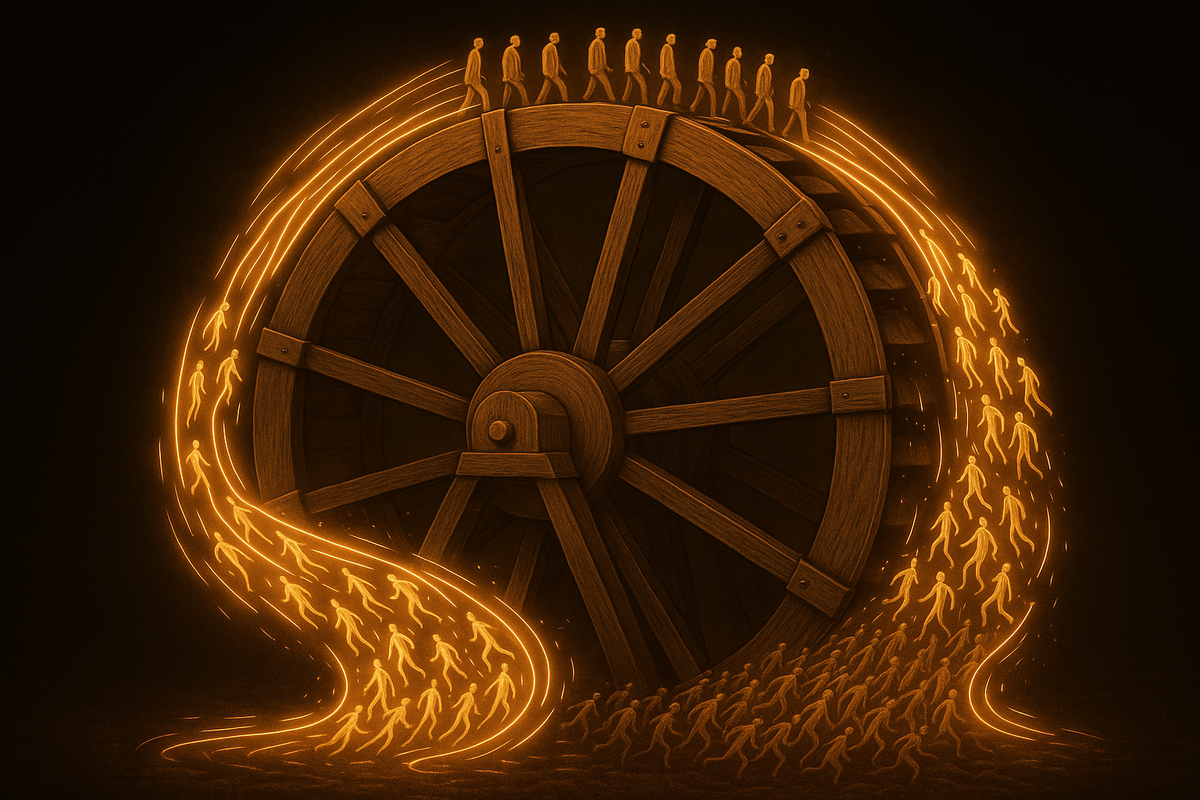
Coherence at civilizational scale.
History is not random noise. It is not fully predictable either. It is the movement of human systems under pressure: population, institutions, resources, elites, stories, technologies, and the felt legitimacy of the social world. When those forces couple well, societies cohere. When they decouple, the symptoms look familiar: polarization, elite conflict, declining trust, fiscal stress, and narrative collapse.
This hub studies how large-scale human systems stabilize, destabilize, and sometimes recover.
Cliodynamics
Cliodynamics follows Peter Turchin’s attempt to make history mathematically legible. Secular cycles, structural-demographic theory, elite overproduction, and the Age of Discord all point to a hard claim: social instability has measurable precursors.
The value is not prophecy. It is diagnosis. If collapse has structure, then recovery may have structure too.
Gene-Culture Coevolution
Gene-Culture Coevolution covers dual inheritance, prestige bias, cultural attractors, religious groups, digital tribes, and the cultural ratchet. Humans are not just animals with culture added on top. We are organisms whose biology and culture continually reshape each other.
This path explains why groups can preserve knowledge across generations, why norms become embodied, and why cultural environments become evolutionary forces.
Why Scale Matters
Individual coherence matters, but no individual lives outside history. Institutions shape attention. Narratives shape possibility. Economic stress changes bodies. Cultural fragmentation changes what can be imagined together.
Read this section when you want to understand the social field around personal experience. The self is real, but it is never only itself.
Comments ()