Detecting Dark Personalities: The Science of Reading People
Dark triad traits leave behavioral and linguistic fingerprints. Reading people for manipulation and deception isn't folk wisdom — it's pattern recognition backed by decades of personality research.
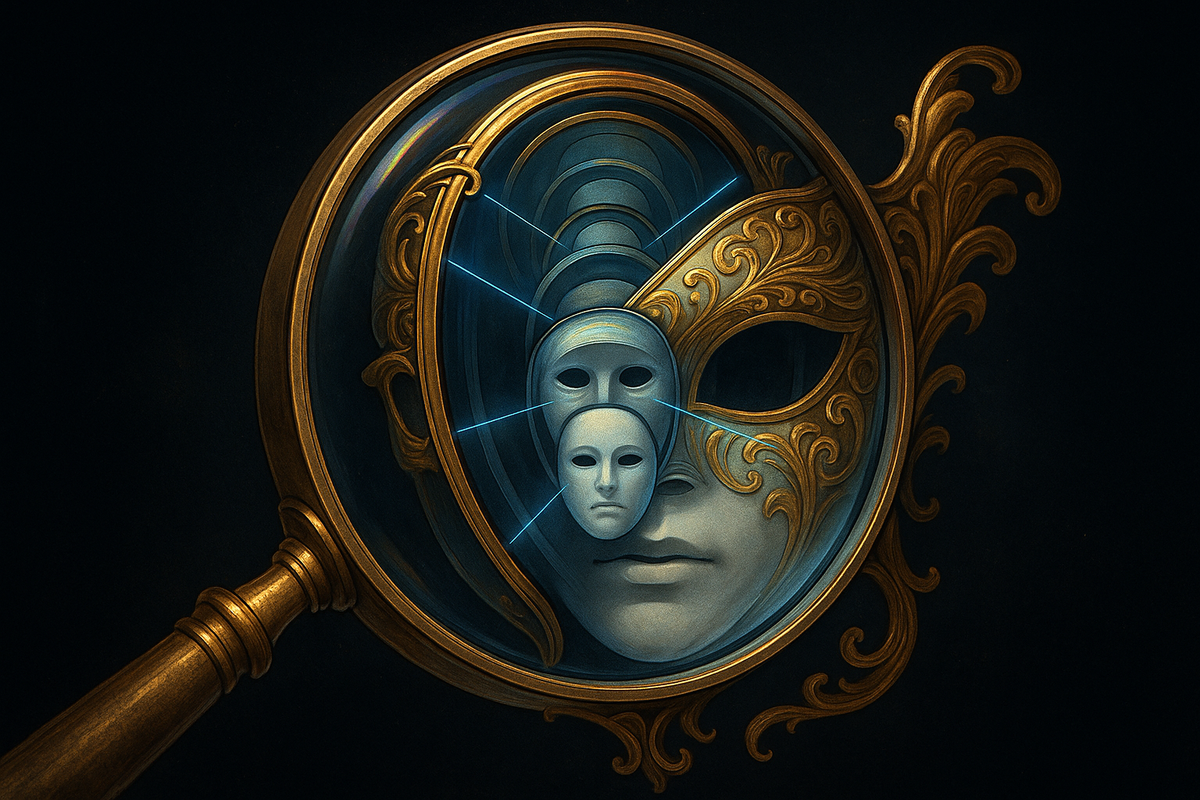
How to Spot Dark Personalities: What the Science Actually Shows
You've met them. The colleague who steals your work while "worrying" about your performance. The partner whose stories don't add up but makes you feel insane for noticing. The boss who charms in meetings but leaves scorched earth behind closed doors.
Dark personality traits aren't subtle. Psychopathy, narcissism, Machiavellianism—they leak everywhere. Behavior patterns, speech, relationships. The problem isn't that these people are criminal masterminds. It's that normal people are socialized to ignore red flags, give unlimited chances, and rationalize exploitation as "maybe I misunderstood."
You didn't misunderstand. Your gut was right.
Decades of research offers something better than instinct: validated behavioral markers that predict dark traits with significant accuracy. Not armchair diagnosis. Pattern recognition backed by controlled studies and replicable findings.
Here's what to look for and why it works.
Why Dark Personalities Are Hard to Spot
Three structural reasons explain the detection problem.
They Make Great First Impressions
High-dark people often nail the initial meeting. Psychopaths score high on superficial charm. Narcissists radiate charisma. Machiavellians mirror your values perfectly.
This isn't luck—it's evolutionary. If dark traits triggered immediate rejection, they'd be extinct. They work because the damage shows up late. After you're invested. After your reputation's tied to theirs. After you've committed.
Research shows psychopathy predicts positive evaluations initially but negative evaluations after prolonged exposure (Fowler et al., 2009). By the time the mask slips, you're caught—job dependencies, shared friends, cognitive dissonance ("they were so great at first, maybe I'm the problem?").
Detection isn't immediate. It's time-dependent. They exploit that window.
Normal People Gaslight Themselves
When someone violates norms, prosocial people blame themselves. Your empathy assumes good intentions. Your guilt internalizes criticism. Politeness norms make calling someone manipulative feel wrong.
High-dark individuals weaponize this. They know you'll rationalize their behavior, give tenth chances, absorb blame. You ignore red flags not because they're hidden—your psychology is wired to forgive first, accuse never.
Dark Traits Fragment Across Contexts
These traits don't show uniformly. A high-psychopathy surgeon is competent in the OR, exploitative at home. A Machiavellian executive is diplomatic in meetings, ruthless behind doors. A narcissist entrepreneur projects vision publicly, rages at staff privately.
You see one slice—the professional mask or social performance. Not the wreckage in low-visibility contexts.
Seven Behavioral Markers That Predict Dark Traits
Research has identified patterns that show up reliably in high-dark populations. Not perfect predictors, but validated signals worth learning. These aren't subtle—once you know what to look for, they're everywhere.
1. One-Way Resource Flow
Takes more than gives. Asks favors constantly, disappears when you need help. Frames extraction as mutual benefit while capturing disproportionate value.
Machiavellianism and psychopathy predict reduced reciprocity in experimental games (Jonason et al., 2015). They defect in trust scenarios, contribute less to shared resources, extract more in negotiations.
Pattern: They harvest your time, energy, money, status. You get charm and promises. Not actual reciprocity.
2. Hot-Cold Cycles
Alternates between warmth and coldness unpredictably. When they're good, they're amazing. When they're cold, you're desperate to fix it. You never know where you stand.
This is intermittent reinforcement—a manipulation tactic documented in abusive relationships and cults. It creates behavioral addiction. You become hypervigilant, constantly trying to earn the good version.
Narcissists use it to extract validation. Psychopaths use it to destabilize you. Machiavellians use it to control without commitment.
3. They're Always the Center of Drama
Constantly mentions conflicts with others. Pits people against each other. Creates chaos that positions them as the protagonist. You hear negative things about others through them—then discover they said the same about you.
Triangulation—using third parties to manipulate—is core to narcissism and Machiavellianism (Kashy & DePaulo, 1996). It destabilizes alliances, harvests sympathy, prevents people from comparing notes.
If someone's relationships are consistently chaotic and always revolve around them, it's not bad luck.
4. Gaslighting
Denies things you know happened. Reframes your emotions as your problem ("you're too sensitive"). Shifts blame when confronted. Uses your doubts against you.
Gaslighting predicts high Machiavellianism and psychopathy (Stark, 2019). It's coherence disruption: by destabilizing your reality, they increase your dependency on their framing.
They're not confused. They know what happened. Your disorientation benefits them.
5. No Long-Term Relationships
Few or no friendships lasting years. Romantic relationships are intense and end dramatically. Doesn't maintain old contacts. Everyone in their past "betrayed" them.
Psychopathy and Machiavellianism predict shorter, less satisfying relationships (Jonason & Kavanagh, 2010). They can't sustain intimacy or reciprocity.
If someone is charismatic and successful but has no sustained close relationships, that gap is diagnostic. Normal people accumulate history. Dark personalities burn through people.
6. Behavior Worsens With Power
Acts worse when they gain status or reduced oversight. Early violations are small—testing your response. Escalates when you don't push back. Gets openly hostile once you're committed.
Dark personalities test boundaries systematically (Babiak & Hare, 2006). Small unethical acts are trial balloons. If you tolerate it, exploitation escalates. If you resist, they find easier targets.
This is why they concentrate in low-accountability environments.
7. You Feel Exhausted After Interactions
Even positive interactions leave you drained. Conversations leave you confused, defensive, doubting yourself. You spend disproportionate mental energy processing their behavior. The relationship feels like work, not connection.
High-dark people are coherence parasites. They stabilize themselves by destabilizing you. Your exhaustion is your nervous system working overtime to resolve contradictions between their words and actions, defend against subtle attacks framed as jokes or concern, manage their unpredictable behavior, compensate for their complete lack of reciprocity.
This isn't social anxiety or introversion. It's a physiological response to exploitation. Your body is screaming the warning your mind keeps rationalizing. That exhaustion isn't weakness—it's detection.
If you consistently feel depleted after time with a specific person, your nervous system knows something your conscious mind is still making excuses for.
Dark Empaths: The Most Dangerous Type
The scariest dark personalities aren't the ones lacking empathy. They're dark empaths—people who understand emotions perfectly but don't feel them.
Cognitive empathy means reading emotional states. Affective empathy means feeling them yourself. Dark empaths have the first, not the second.
They know you're insecure about competence—so criticism comes wrapped as concern. They know you value loyalty—so they position themselves as your only ally. They know you fear abandonment—so withdrawal becomes punishment.
Heym et al. (2021) found dark empaths score high on emotional intelligence and dark traits. Not socially clueless. Emotionally sophisticated manipulators.
Watch for empathy without reciprocity—they read you but never offer vulnerability. Insight used instrumentally—they understand your emotions to extract value, not provide support. Asymmetric disclosure—you share deeply, they deflect. Precision targeting—their criticisms exploit insecurities you never stated.
They're psychological sharpshooters who know exactly where it hurts.
The Fastest Test: Watch How They Treat Service Workers
Most reliable detector: observe how someone treats people who can't benefit them.
High-dark people modulate behavior by strategic value. Charming to superiors and peers who offer status or resources. Dismissive, cold, or cruel to waiters, janitors, assistants, interns, anyone they perceive as low-status or irrelevant.
This isn't occasional frustration or a bad day. It's systematic status-based modulation. The behavior isn't about mood—it's about whether you're useful.
Psychopathy predicts reduced prosocial behavior toward low-status people (Jonason et al., 2012). Narcissism predicts contempt for anyone not providing validation. Machiavellianism predicts total disengagement from non-instrumental relationships.
The test is simple: Watch how someone treats the waiter, the Uber driver, the janitor, the intern. If charm evaporates when the person offers no strategic value, you're not seeing a bad moment. You're seeing the unmasked truth.
Most people are consistently decent to everyone or consistently awkward with everyone. Dark personalities are selectively decent—only when it benefits them.
Language Patterns: What Leaks Through Speech
Dark traits show up in word choice and conversational dynamics.
Narcissism: Increased "I," decreased "we," exaggerated claims ("I'm the best"), superlatives ("always," "never"), name-dropping, monopolizing conversation. Carey et al. (2015) found narcissists use first-person singular pronouns significantly more. Their speech centers them relentlessly.
Machiavellianism: Vague commitments preserving optionality ("we'll see," "probably"), reinterpretable statements ("I never said definitely"), precision extracting your commitments but ambiguity making their own, retroactive "I was joking."
Psychopathy: Passive voice obscuring agency ("mistakes were made"), external attribution for failures ("bad luck," "they didn't understand"), superficial apologies ("sorry you felt that way"), justifications reframing exploitation as necessity ("I had no choice").
Where Detection Matters Most
This isn't paranoia. It's strategic risk assessment in contexts where exploitation costs run high.
Hiring and promotion: Organizations that don't screen for dark traits self-select for toxicity over time. The traits predicting interview success—confidence, charisma, bold claims—overlap significantly with narcissism and psychopathy. The person who crushes the interview might be exactly who you don't want.
Screen with 360-degree reviews revealing how they treat subordinates versus superiors, behavioral interviews probing ethics and relationships, reference checks asking how candidates handle failure and share credit, trial periods with peer feedback loops.
Romantic partners: Dark traits predict intimate partner violence, infidelity, and psychological abuse (Nathanson et al., 2006). Early detection is literal harm reduction.
Watch for love-bombing—intense, rapid intimacy that feels too good too fast. Isolation from friends and family disguised as devotion. Boundary violations framed as passion or protective concern. Hot-cold cycles keeping you off balance. Future-faking—promises about the relationship, the life you'll build, that somehow never materialize.
Business partnerships: Contexts requiring sustained trust over years are precisely where dark traits destroy value most efficiently.
Watch for disproportionate focus on their own equity, credit, or compensation from day one. Resistance to transparency or accountability structures. A pattern of prior partnerships that ended badly—always the other person's fault. Exploiting ambiguity in agreements to extract more than discussed.
False Positives: When It's Not Dark Traits
Context matters. Not everyone showing these behaviors is high-dark.
Trauma: Hypervigilance, withdrawal, boundary rigidity are defensive adaptations, not exploitation. Trauma survivors protect themselves universally. Dark personalities charm selectively and exploit strategically.
Culture and neurodevelopment: Direct confrontation is normative in some cultures, aggressive in others. Limited eye contact correlates with autism, not psychopathy. Reduced expressed emotion can be cultural, not callousness. Dark traits predict harm and exploitation, not just atypical behavior.
Situational vs. trait-level: Everyone occasionally acts selfish, fails to reciprocate, manipulates. Dark traits are stable patterns across time and context. One lie isn't Machiavellianism. Systematic deception across years and relationships is.
Trust the Pattern, Not the Performance
Dark personalities exploit systematically—across targets, over time. Detection isn't one behavior. It's pattern coherence.
Ask:
- Does this recur across contexts? (work, romance, friendships)
- Does it happen with different people? (is everyone the problem?)
- Does it persist over time? (years, not weeks)
- Does confrontation produce change or escalation?
Yes to all four? Trait-level pattern, not misunderstanding.
Your nervous system already knows. Exhaustion, confusion, that sense something's wrong you can't articulate—that's interoceptive detection. Your body tracks patterns your mind rationalizes.
Trust the pattern. Not the performance.
Series: Dark Personality Science | Part: 8 of 10
This is Part 8 of the Dark Personality Science series, exploring the psychology of traits that predict exploitation and harm. Next: "The Light Triad: Psychology's Counter-Model."
Further Reading
- Fowler, K. A., Lilienfeld, S. O., & Patrick, C. J. (2009). "Detecting psychopathy from thin slices of behavior." Psychological Assessment, 21(1), 68-78.
- Jonason, P. K., & Kavanagh, P. (2010). "The dark side of love: Love styles and the Dark Triad." Personality and Individual Differences, 49(6), 606-610.
- Jonason, P. K., Li, N. P., Webster, G. D., & Schmitt, D. P. (2015). "The Dark Triad: Facilitating a short-term mating strategy in men." European Journal of Personality, 23(1), 5-18.
- Babiak, P., & Hare, R. D. (2006). Snakes in Suits: When Psychopaths Go to Work. New York: HarperCollins.
- Heym, N., Firth, J., Kibowski, F., Sumich, A., Egan, V., & Bloxsom, C. A. J. (2021). "Empathy at the heart of darkness: Empathy deficits that bind the dark triad and those that mediate indirect relational aggression." Frontiers in Psychiatry, 12, 697950.
- Kashy, D. A., & DePaulo, B. M. (1996). "Who lies?" Journal of Personality and Social Psychology, 70(5), 1037-1051.
- Stark, C. A. (2019). "Gaslighting, misogyny, and psychological oppression." The Monist, 102(2), 221-235.
- Nathanson, A. M., Paulhus, D. L., & Williams, K. M. (2006). "Predictors of a behavioral measure of scholastic cheating." Personality and Individual Differences, 41(4), 723-733.
- Carey, A. L., Brucks, M. S., Küfner, A. C. P., Holtzman, N. S., Back, M. D., Donnellan, M. B., Pennebaker, J. W., & Mehl, M. R. (2015). "Narcissism and the use of personal pronouns revisited." Journal of Personality and Social Psychology, 109(3), e1-e15.
- Jonason, P. K., Lyons, M., Bethell, E. J., & Ross, R. (2012). "Different routes to limited empathy in the sexes." Evolutionary Psychology, 11(2), 344-364.
Comments ()