Hyperactive Agency Detection: Why We See Minds Everywhere
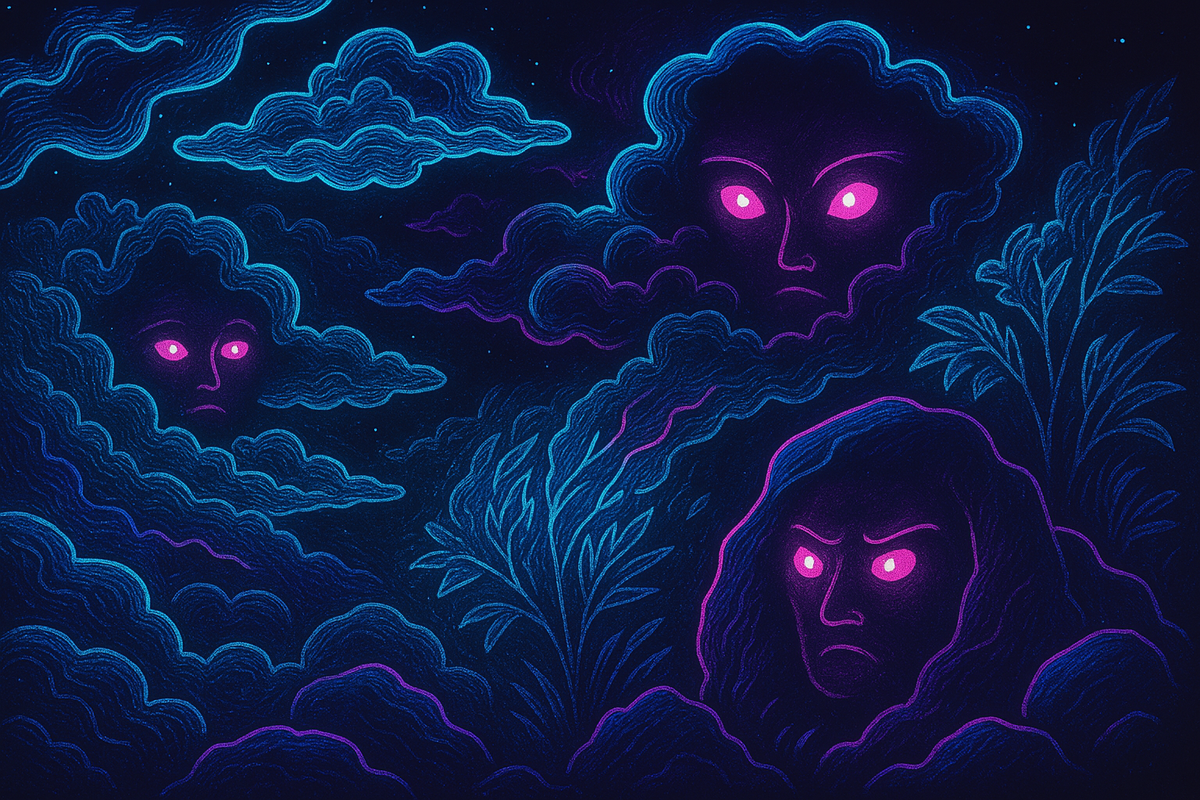
You inherited a nervous system biased toward false positives: it's safer to mistake a shadow for a predator than to miss the real thing. That same over-calibrated agency detector populated the world with gods and spirits.
Hyperactive Agency Detection: Why We See Minds Everywhere
You're alone in your house at night. You hear a creak upstairs. Instantly, your mind generates hypotheses: Someone's up there. An intruder. A ghost.
Statistically, it's almost certainly the house settling, thermal expansion of wood, or wind through a gap. But your brain doesn't go there first. It goes to agent—some intentional entity with goals and the capacity to act on them.
This isn't irrational. It's the result of an evolved cognitive system that anthropologist Stewart Guthrie calls hyperactive agency detection (HADD). And it's responsible for populating every mythology in human history with gods, spirits, demons, ancestors, and invisible forces with minds of their own.
Understanding HADD doesn't debunk mythology. It explains why myths take the particular forms they do—and why we can't seem to stop anthropomorphizing everything from cars to countries to the universe itself.
The Evolutionary Logic of False Positives
Imagine two of your ancestors in the ancestral environment. A bush rustles.
Ancestor A thinks: "Probably just wind. I'll keep doing what I'm doing."
Ancestor B thinks: "Could be a predator! Better run."
Now imagine this scenario plays out 100 times. In 99 cases, it's just wind. Ancestor A saves energy and doesn't waste time fleeing from nothing. Ancestor B burns calories running from imaginary threats.
But in that 100th case, it's actually a leopard.
Ancestor A dies. Ancestor B's genes propagate.
You are descended from Ancestor B. You inherited a nervous system that's biased toward false positives in agency detection. It's better to see agency that isn't there (waste energy fleeing from wind) than to miss agency that is there (get eaten by leopard).
This is the evolutionary origin of HADD: natural selection favored brains that over-attribute intention and agency because the cost of false negatives (missing real threats) vastly exceeded the cost of false positives (seeing threats that don't exist).
The result is a cognitive system that sees minds everywhere—in weather patterns, in the behavior of animals, in random events, in mechanical processes. And when you combine this hyperactive agency detector with cultural transmission mechanisms, you get gods.
From Rustling Bushes to Pantheons
Here's how HADD scales from individual perception to cultural mythology:
Stage 1: Perception
You experience an event with ambiguous causation (thunder, illness, good fortune, drought). Your HADD system activates: "What agent caused this?"
Stage 2: Social Transmission
You share your interpretation with others. "The gods are angry." "Spirits made me sick." "Ancestors blessed the harvest." These agent-explanations transmit better than mechanism-explanations (see the previous article on minimally counterintuitive concepts) because they plug into social cognition machinery.
Stage 3: Cultural Elaboration
Across generations, agent-explanations accumulate detail. The angry god gets a name, a personality, preferences, a mythology. The spirits get organized into hierarchies. The ancestors get ritual calendars. HADD provides the seed; cultural transmission grows the tree.
Stage 4: Institutionalization
Eventually you get full religious systems with elaborate theologies—but at the foundation, it's all HADD detecting agency in natural processes and cultural evolution building on that detection.
This explains why every human culture has populated the world with intentional agents. It's not because some cultures are more rational than others. It's because all humans share the same HADD-equipped cognitive architecture.
The Greeks saw intention in storms (Poseidon's rage). The Norse saw intention in thunder (Thor's hammer). Yoruba tradition sees intention in crossroads (Eshu's domain). Hindu philosophy sees intention in the cosmos itself (Brahman's play). The surface details vary; the underlying pattern—agents everywhere—is universal.
Why Agent-Explanations Feel Satisfying
When something bad happens to you and someone says "bad things happen randomly," it feels unsatisfying. When someone says "the universe is punishing you," it feels wrong but somehow more complete as an explanation.
Why?
Because your brain's primary model for causation is intentional action. You understand the world through the lens of minds with goals acting to achieve them. This is your richest causal framework—more detailed, more predictively useful, more emotionally resonant than any mechanistic model.
When you know someone intended an outcome, you can:
- Predict their future behavior (they'll keep trying to achieve similar goals)
- Negotiate (appeal to their intentions, offer trades)
- Assign moral valence (praise or blame based on intentions)
- Build coalitions (ally with similar intentions, oppose contrary ones)
- Update your own strategy (learn from their success/failure)
Compare this to knowing something happened mechanically: "The rock rolled downhill due to gravity." You can predict future rockslides maybe, but you can't negotiate with gravity, morally evaluate it, or form alliances with it. Mechanistic causation is informationally impoverished compared to intentional causation.
So when your HADD system attributes agency to events—"the gods are testing me," "my ancestors are watching over me," "fate has a plan"—it's not just making stuff up. It's activating your most sophisticated predictive machinery: social cognition.
And once you've attributed agency, you can do all the things you do with other minds: appease, bargain, honor, rebel, form relationships. This is why prayer feels effective even when it doesn't mechanistically cause outcomes. You're engaging your social cognition systems, which are deeply tied to your sense of coherence and efficacy.
The Varieties of Detected Agency
Not all mythological agents are identical. HADD produces different kinds of detected agency depending on what patterns are being explained:
Personalized gods (Zeus, Odin, Shiva)
→ HADD applied to large-scale natural phenomena (weather, war, fertility). Rich intentional psychology because they're explaining complex, variable outcomes that seem strategic.
Nature spirits (kami, nymphs, elementals)
→ HADD applied to localized environments (this mountain, this stream, this forest). Less elaborated psychology because their domain is more constrained.
Ancestors
→ HADD applied to lineage and fortune. Strong intentional attribution because there's actual historical continuity with real agents (your grandmother) that shades into mythic agent (ancestral protection).
Fate/destiny/wyrd
→ HADD applied to the patterns of one's own life. Minimal personalization (rarely has full personality) but strong intentional structure (fate "wants" something, has a plan).
Demons/tricksters
→ HADD applied to adversity and chaos. Intentional malevolence or capricious disruption as explanation for why things go wrong despite your efforts.
Abstract forces (karma, the Tao, dharma)
→ HADD at its most refined: agency without personality, intention without mind. These emerge when theological sophistication tries to preserve the psychological satisfaction of agent-explanation while removing anthropomorphic details.
The pattern is consistent: ambiguous causation + HADD = mythic agent. And the kind of agent you get depends on the domain being explained.
When HADD Goes Into Overdrive
HADD isn't constant. It gets amplified under certain conditions—which explains why mythic experiences cluster around particular contexts.
Isolation and darkness: Your visual system has less information, so your brain relies more on inference. HADD fills gaps. This is why ghost stories happen at night, why forest spirits emerge in the wilderness, why sailors alone at sea see mermaids and sea monsters.
High arousal and uncertainty: When you're stressed, threatened, or uncertain, your prediction error signals spike. HADD activates more readily because the stakes of missing real agency are higher. This is why near-death experiences, combat, and crisis produce supernatural attributions.
Pattern-seeking under ambiguity: When you're trying to make sense of complex patterns (why did my crops fail? why did we win this battle? why am I sick?), HADD provides an answer even when mechanistic causation is unavailable.
Social isolation: Without other humans to reality-check attributions, HADD runs unconstrained. Hermits see visions. Isolated sailors report supernatural encounters. The absence of social feedback allows HADD to elaborate freely.
Ritualized altered states: Fasting, sleep deprivation, rhythmic movement, psychedelics—all reduce top-down constraint on perception and increase sensitivity to ambiguous signals. HADD detects agency in sensory noise. This is why shamanic traditions across cultures use these techniques to contact spirits.
Understanding these triggers doesn't mean the experiences are invalid. It means HADD is a feature of your cognitive architecture that certain conditions amplify. When you fast for days and see a vision of an ancestor, that's not "just" HADD—it's your brain using HADD to construct meaningful experiences under conditions that sensitize that system.
The Social Function of Shared Agency-Attribution
Here's where HADD becomes culturally powerful: when a group shares agent-attributions, they gain coordination advantages.
If everyone in your village believes the harvest depends on appeasing the grain spirit, you have:
- Synchronized ritual (everyone participates in offerings)
- Aligned incentives (no one free-rides on communal effort)
- Shared explanatory framework (harvest fails → we angered the spirit)
- Coordinated response (ritual intensification to restore favor)
The grain spirit might not exist as an external entity. But the shared belief creates real coordination that improves outcomes. Better harvest coordination means better actual harvests, which reinforces belief in the spirit's power. The loop closes.
This is why gods are overwhelmingly social regulators. They care about:
- Sexual norms (Zeus punishes adulterers, biblical commandments regulate sexuality)
- Resource sharing (gods demand offerings, redistribute through feasts)
- Violence (gods of war bless righteous battle, punish oath-breakers)
- Status hierarchies (gods legitimize kings, maintain caste systems)
- Cooperation (moralizing gods reward virtue, punish defection)
HADD provides the cognitive seed: "There are agents watching us." Cultural evolution shapes that detection into forms that solve coordination problems: "The agents care about these specific behaviors and will punish violations."
The result is morally interested gods—not because agency-detection naturally produces moral concern, but because groups that attributed moral agency to supernatural watchers cooperated better and outcompeted groups with amoral spirits.
Modern HADD: Where Did the Gods Go?
If HADD is universal and still active in modern brains, why has explicit god-belief declined in secular societies?
Short answer: HADD hasn't declined. It's been redirected.
You still see agency everywhere. You've just replaced explicit gods with other agent-attributions:
The market → Not a person, but you talk about it like it has intentions. "The market wants lower interest rates." "The market punished that decision." HADD applied to complex economic dynamics.
History → "History will judge us." "History has a direction." Agent-attribution to impersonal process.
Evolution → "Evolution designed this." "Evolution wants genes to propagate." Even biologists who know better use agent-language because HADD makes it cognitively easier.
The universe → "Everything happens for a reason." "The universe is telling me something." HADD without traditional god-framework.
Technology → You curse at your computer when it crashes. You thank your car when it starts in the cold. HADD applied to machines.
Nations and institutions → "America wants democracy." "The corporation doesn't care about workers." Collective entities treated as unified agents with intentions.
You've also maintained HADD in areas where it's least scientifically justified but most psychologically necessary:
Meaning in suffering → "This happened to teach me something." "I was meant to go through this." HADD finding intention in random adversity because mechanistic "you got unlucky" doesn't satisfy.
Luck and fate → "I'm on a hot streak." "Today is my day." HADD detecting agency in statistical variance.
Intuition and gut feelings → "Something is telling me not to trust this person." HADD interpreting your own prediction errors as communications from an agent-like source.
The cognitive architecture hasn't changed. The cultural scaffolding has. But you're still doing what your ancestors did: seeing minds where mechanisms would suffice, because minds are what your brain knows how to model.
HADD and Coherence: The Connection
So how does hyperactive agency detection serve coherence?
Agent-explanations provide narrative closure. When bad things happen, "random chance" leaves your prediction machinery unsatisfied—there's no pattern to extract, no model to update. But "this happened because X agent intended Y" gives you something to work with. It might not be mechanistically accurate, but it's coherently integrated into your world-model.
Agent-attributions enable response. If the drought is random, you're helpless. If the drought is the rain god's displeasure, you can do something: perform the correct ritual, make offerings, change behavior. Even if the ritual doesn't cause rain, the sense of agency it provides reduces the coherence threat of helplessness.
Shared agency creates social coherence. When your community agrees on which agents are real and what they want, you have synchronized prediction models. You can coordinate action, share explanations, maintain collective coherence through aligned beliefs.
HADD populates the world with relationship partners. Coherence isn't just internal—it's relational. By seeing agency in nature, ancestors, gods, you create possibilities for relationship that extend beyond human-to-human interaction. You can have relationship with the forest, the mountain, the river. This is why indigenous animism feels so different from mechanistic materialism: it's a relationally rich universe vs. a relationally impoverished one.
From AToM's perspective, HADD is an evolved bias that trades mechanistic accuracy for relational coherence. It populates your world-model with agents you can relate to, negotiate with, learn from. And for most of human history, the coordination benefits of shared agent-attribution far outweighed the costs of occasionally fleeing from wind.
The question isn't whether HADD is "true." The question is: Which agent-attributions serve your coherence, and which ones undermine it?
Further Reading
- Guthrie, Stewart. Faces in the Clouds: A New Theory of Religion. Oxford University Press, 1993.
- Barrett, Justin L. Born Believers: The Science of Children's Religious Belief. Free Press, 2012.
- Atran, Scott. In Gods We Trust: The Evolutionary Landscape of Religion. Oxford University Press, 2002.
- Bering, Jesse. The Belief Instinct: The Psychology of Souls, Destiny, and the Meaning of Life. W. W. Norton, 2011.
This is Part 3 of the Cognitive Mythology series, exploring how myths function as compression algorithms for coherence instructions.
Previous: Why Myths Stick: The Cognitive Science of Minimally Counterintuitive Concepts
Next: Archetypal Compression: What the Hero, the Trickster, and the Shadow Actually Encode
Comments ()