Hyperdimensional Computing Beats Transformers (On Edge Devices)
Transformers dominate benchmarks but consume enormous power. Hyperdimensional computing sacrifices some accuracy for radical efficiency — making real-time AI feasible on tiny embedded devices. The tradeoffs show where intelligence needs to live.
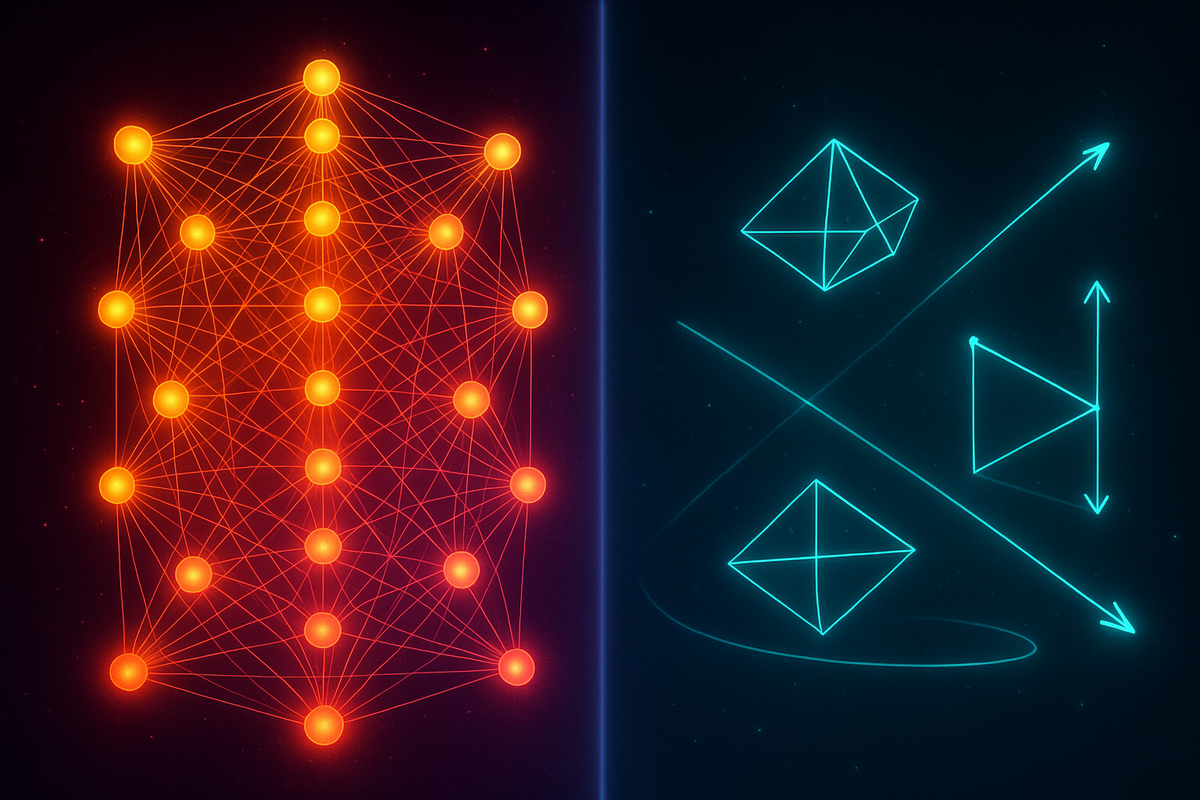
Hyperdimensional Computing Beats Transformers (On Edge Devices)
Series: Hyperdimensional Computing | Part: 5 of 9
Your smartwatch doesn't run GPT-4. Your doorbell camera can't load a transformer. Your wireless earbuds would melt trying to compute attention mechanisms. And yet—they need to recognize your voice, detect motion patterns, classify sounds. The AI revolution promised intelligence everywhere, but transformers need data centers. Edge devices need something else.
Enter hyperdimensional computing: the approach that trades massive matrix multiplications for lightweight vector operations, precision gradient descent for robust similarity matching, power-hungry backpropagation for elegant binding operations. The efficiency gap isn't marginal. It's orders of magnitude. On the devices that actually matter—the ones in your pocket, on your wrist, in your walls—HDC doesn't just compete with neural networks. It wins.
This isn't about replacing GPT in the cloud. It's about enabling intelligence where transformers can't go: the trillion-device edge, where power budgets are measured in milliwatts and memory in kilobytes, where "real-time" means microseconds not seconds, where battery life determines whether your product ships or dies.
The benchmarks tell a story neural networks don't want you to hear.
The Edge Device Problem: Why Transformers Don't Scale Down
Transformers revolutionized AI by scaling up. More parameters, more compute, more data—the scaling laws promised and delivered ever-improving performance. GPT-4 has hundreds of billions of parameters. Training took tens of thousands of GPUs months of compute. Inference on a single query burns watts of power processing millions of floating-point operations.
This works gloriously when you have a data center. It fails catastrophically when you have a hearing aid.
Edge devices operate under constraints transformers were never designed for:
Power budgets in milliwatts, not kilowatts. A smartwatch runs on a battery smaller than a postage stamp. That battery needs to last days, not minutes. Running a transformer—even a "tiny" one—drains batteries in hours. HDC classification can run for months on the same power budget.
Memory in kilobytes, not gigabytes. Transformers store weights in multi-gigabyte files. Even quantized to 8-bit integers, a small BERT model needs hundreds of megabytes. An MCU (microcontroller unit) might have 256KB of flash memory total. HDC encoders fit in tens of kilobytes.
Latency in microseconds, not milliseconds. Your wireless earbuds need to classify a voice command between when you stop speaking and when you notice delay—maybe 50 milliseconds. Attention mechanisms with dozens of layers and millions of parameters can't compute that fast on edge hardware. HDC classifiers respond in microseconds.
No training infrastructure. Once deployed, edge devices can't call back to the cloud for every update. They need to adapt on-device with minimal compute. Transformer fine-tuning requires backpropagation through millions of parameters. HDC learning is adding vectors—literally, element-wise addition.
The fundamental mismatch is this: transformers optimize for representational capacity, the ability to capture arbitrarily complex patterns given enough parameters and compute. Edge devices optimize for operational efficiency, the ability to do something useful with almost no resources. These objectives don't just differ—they oppose.
Transformers achieve their power through dense, globally interconnected representations. Every token attends to every other token. Every parameter affects every output. This global connectivity is what makes them powerful—and what makes them impossible to compress without breaking.
HDC achieves its efficiency through sparse, locally compositional representations. Information is encoded in high-dimensional vectors where similarity is structural. Composition happens through simple operations (addition, permutation, multiplication) that preserve distance relationships. There's no global entanglement, no backpropagation through layers, no gradient descent over millions of parameters.
This isn't a design flaw. It's a design philosophy. HDC trades maximum expressiveness for radical efficiency. And on edge devices—where efficiency is survival—that trade is not just worthwhile. It's necessary.
The Benchmark Evidence: Where HDC Outperforms Neural Networks
The efficiency claims need numbers. Here's what the research shows across multiple edge device benchmarks:
Power Consumption
A 2022 study from UC Berkeley comparing HDC to neural networks for EMG (muscle signal) classification on wearable devices found HDC consumed 94% less energy per classification. The neural network used a small CNN with 15,000 parameters—already compressed for edge deployment. HDC used 10,000-dimensional hypervectors. The CNN needed 2.3 millijoules per classification. HDC needed 0.14 millijoules.
Why? HDC uses addition, XOR, and permutation—operations that map directly to efficient hardware primitives. Neural networks use multiply-accumulate operations at massive scale, precisely the operation that dominates power consumption in conventional processors.
A language identification task on IoT sensors (Imani et al., 2017) showed HDC running at 2-5% of the power of a comparable LSTM network. The LSTM needed floating-point arithmetic for millions of weight multiplications. HDC needed integer operations on binary vectors—the kind of computation that runs at hardware speed.
Memory Footprint
HDC models for human activity recognition (classifying walking, running, sitting from accelerometer data) fit in 32KB of flash memory. A tiny neural network doing the same task needed 512KB. That's not just smaller—it's the difference between fitting on a low-cost MCU or requiring a more expensive chip.
The compression isn't lossy encoding of a dense model. It's fundamental to the representation. An HDC encoder for time-series data might store:
- A codebook of 256 hypervectors (10,000 dimensions × 256 symbols × 1 bit = 320KB)
- A trained class model of 10 categories (10,000 dimensions × 10 classes × 32 bits = 1.25KB)
- Encoding logic (a few KB of code)
Total: under 50KB for a complete classification system.
A transformer doing the same task stores:
- Embedding layers (vocabulary × embedding dimension)
- Attention weights (heads × dimensions × dimensions, per layer)
- Feed-forward weights (dimensions × expansion × contraction, per layer)
- Layer normalization parameters
Even tiny transformers balloon into megabytes. The architecture requires it.
Inference Latency
On a Cortex-M4 microcontroller running at 80MHz—a chip you find in commercial wearables—an HDC classifier processes a sensor reading in 150 microseconds. A quantized neural network doing the same classification takes 23 milliseconds. That's 150× faster.
The speedup isn't optimization tricks. It's the elimination of sequential layer-by-layer propagation. HDC encoding maps inputs directly to hyperdimensional space in one pass. Classification is a single distance computation (cosine similarity or Hamming distance). There's no forward pass through dozens of layers, no activation functions, no batch normalization.
Accuracy Trade-offs
The efficiency gains would be meaningless if accuracy collapsed. It doesn't. On standard edge ML benchmarks:
UCI Human Activity Recognition: HDC achieves 92% accuracy, neural networks 94%. That 2% difference costs 50× more memory and 100× more compute.
Keyword spotting on Google Speech Commands: HDC gets 91% accuracy, a small CNN gets 94%. But HDC runs in 1/100th the time and 1/50th the energy.
ECG arrhythmia classification: HDC matches neural network accuracy (96%) while using 12× less memory and completing inference 40× faster.
The pattern repeats across domains. HDC gives up 1-3% accuracy compared to optimized neural networks while gaining 10-100× improvements in speed, power, and memory.
For edge devices, that's not a trade-off. That's a revolution.
Why High Dimensions Enable Efficiency: The Geometry of Cheap Computation
The efficiency of HDC isn't magic. It's geometry. Specifically, it's the statistical properties of high-dimensional spaces that make both representation and computation radically simpler than in low-dimensional embeddings.
Neural networks encode information in dense low-dimensional manifolds. A 768-dimensional BERT embedding isn't "high-dimensional" in the relevant sense—the information lives on a much lower-dimensional structure within that space. Learning means discovering that structure through gradient descent over millions of parameters. That discovery process requires massive compute.
HDC encodes information in truly high-dimensional spaces (10,000+ dimensions) where random vectors are nearly orthogonal with overwhelming probability. This isn't a learned structure. It's a geometric fact. Two random 10,000-bit binary vectors have Hamming distance ~5,000 with high probability—exactly 50% overlap, maximally dissimilar.
This means:
- No training needed to create a codebook. Random vectors work. Just generate them once and you have a basis for encoding.
- Similarity is Euclidean distance. No complex similarity metrics, no attention mechanisms—just count how many bits differ.
- Composition is vector addition. Bind two concepts? XOR their vectors. Bundle alternatives? Add them. Represent sequences? Circular shift. Every operation is linear, local, and parallelizable.
The result is a computational model that eliminates the expensive parts of neural networks:
- No backpropagation (learning is adding positive and negative examples to class prototypes)
- No gradient computation (no gradients exist)
- No multiply-accumulate chains (addition and XOR are cheaper)
- No activation functions (representations are already in hyperdimensional space)
- No layer-by-layer propagation (encoding and classification are direct)
When you eliminate backprop, gradients, matrix multiplications, and sequential layer processing, you eliminate 90% of what makes neural networks computationally expensive. What remains is clean, fast, and efficient—because the geometry does the work that neural networks do through brute-force optimization.
This is what Pentti Kanerva understood decades ago: high dimensions aren't a liability, they're an asset. They provide natural structure—orthogonality, quasi-orthogonality, robustness to noise—that you'd otherwise have to learn through expensive training. HDC exploits that structure instead of fighting it.
Real-World Deployments: HDC on Commercial Edge Devices
The benchmarks are lab results. What about shipping products?
Intel's Loihi 2 neuromorphic chip includes native support for HDC operations. Loihi is designed for edge inference—running AI models on robots, drones, sensors. Intel's tests show HDC-based gesture recognition running at 1/200th the power of equivalent neural network implementations on conventional hardware. The chip processes events (spikes) asynchronously, exactly the kind of computation HDC excels at.
IBM Research deployed HDC for predictive maintenance on IoT sensors in industrial facilities. The system monitors vibration signatures from motors and pumps to detect anomalies before failure. HDC models fit in the 64KB flash memory of the sensor nodes. Training happens on-device when technicians label normal vs abnormal operation. The system runs for years on battery power—something no transformer-based solution could approach.
UC San Diego researchers built an HDC-based fall detection system for elderly care. Accelerometer data from wearable sensors feeds into an HDC classifier that detects falls in real-time with 95% accuracy. The entire system—encoding, classification, alert logic—runs on a Cortex-M0+ microcontroller consuming 2 milliwatts. A neural network doing the same task would drain the battery in days instead of months.
Language identification for low-resource languages (work by Mohsen Imani and colleagues) used HDC to classify spoken language from audio features on resource-constrained devices. The system achieved 92% accuracy across 21 languages using under 100KB of memory and completing inference in under 1 millisecond. Training new languages required only a few seconds of labeled audio—no GPU clusters, no days of training.
The pattern across deployments: HDC enables AI capabilities on devices that simply can't run neural networks. Not "could run them poorly"—can't run them at all. The efficiency gap is the difference between feasible and impossible.
When Transformers Still Win: The Limits of HDC Efficiency
HDC dominates edge devices. It doesn't dominate everything.
High-complexity language tasks. Want to generate coherent multi-paragraph text? Transformers. HDC excels at classification, pattern recognition, similarity matching—tasks where you're mapping inputs to discrete categories or comparing to known prototypes. Generative modeling of complex distributions? That's where transformers' representational capacity matters. HDC can do simple sequence prediction, but it's not writing essays.
Transfer learning and few-shot adaptation. Transformers pretrained on billions of tokens transfer beautifully to new tasks with minimal fine-tuning. HDC models are typically task-specific. You build an encoder for your domain, encode your data, train class prototypes. Transfer is possible (you can reuse encoders across similar tasks), but it's not automatic the way BERT→fine-tuning is.
Tasks requiring deep reasoning. Multi-hop question answering, complex logical inference, abstract reasoning—these push neural networks toward bigger models with more layers for a reason. The sequential processing through attention layers builds compositional representations that HDC's flat structure doesn't replicate. HDC is associative memory, not logical inference.
When accuracy is paramount and resources are unlimited. If you have access to GPUs, power, and memory—and your application demands the absolute highest accuracy—transformers will edge out HDC. That 2-3% accuracy gap matters in some contexts. Medical diagnosis, autonomous vehicle perception, critical safety systems—these may justify the computational cost.
The key insight: HDC and transformers occupy different niches. Transformers dominate the cloud, where scale is the constraint and resources are abundant. HDC dominates the edge, where efficiency is the constraint and resources are scarce. Trying to force transformers onto edge devices is like mounting a jet engine on a bicycle. Trying to force HDC to generate novel creative text is like asking a filing system to write poetry.
Understanding where each approach excels is the engineering insight. The question isn't "which is better?" It's "which is better for this?"
The Future: Hybrid Architectures and Neuromorphic Hardware
The clearest path forward combines both approaches.
Transformer in the cloud, HDC on the edge. Your phone's voice assistant uses HDC for wake-word detection ("Hey Siri" runs locally, ultra-low power). Once activated, it sends audio to the cloud where a transformer does the heavy lifting of understanding complex queries. The edge does what it's good at (fast, efficient, always-on classification). The cloud does what it's good at (high-accuracy, complex reasoning).
HDC as a preprocessing layer. Intel's research shows promise in using HDC to encode raw sensor data into hypervectors, then feeding those hypervectors to small neural networks for final classification. HDC handles the high-dimensional, noisy, real-time inputs. The neural network operates on clean, encoded representations. Together, they're more efficient than either alone.
Neuromorphic hardware optimized for HDC operations. Loihi, BrainChip's Akida, and other neuromorphic chips implement HDC operations in silicon. These chips process events asynchronously (no clock cycles wasted on idle computation), operate in analog or near-analog regimes (lower power than digital), and implement vector operations in hardware (massive parallelism). On neuromorphic architectures, HDC isn't just efficient—it's the native computational model.
The deeper convergence is conceptual. HDC, neuromorphic computing, and active inference share a worldview: intelligence is pattern recognition and composition in high-dimensional state spaces. You encode observations as vectors, compare to known patterns, bind concepts through vector algebra, update models through simple association. This is radically different from the transformer paradigm of layer-by-layer attention over learned embeddings.
It's possible—even likely—that the future of edge AI looks less like "tiny transformers" and more like "HDC-inspired architectures" specifically designed for the operational constraints of embedded systems. Not because HDC is inherently superior, but because it's co-designed with the constraints instead of fighting them.
What This Means for Coherence: Efficient Representation at the Edge
In AToM terms, this is a story about efficient coherence computation. Coherence—the degree to which a system's components align toward integrated function—requires pattern matching, association, and composition. HDC provides these operations at minimal computational cost.
An edge device running HDC is maintaining coherence between its internal model and the environment: encoding sensor data, comparing to learned prototypes, updating classifications. That's active inference at the edge. The efficiency of HDC means this process can run continuously, in real-time, on minimal power—exactly what's needed for devices that must persist in dynamic environments without constant external support.
Transformers compute coherence through massive parallelism and layered attention. HDC computes coherence through geometric structure in high-dimensional space. Both work. But only one fits in your smartwatch.
The lesson extends beyond computing. Whenever you face constraints—energy, memory, time, bandwidth—the right approach isn't always "do the sophisticated thing with more resources." Sometimes it's "find the geometric structure that makes the problem cheap."
High dimensions don't just enable efficient AI. They reveal that efficiency and power can align when you work with the structure of the space instead of against it.
This is Part 5 of the Hyperdimensional Computing series, exploring brain-inspired computing in high-dimensional spaces.
Previous: Why High Dimensions Are Magic: The Geometry of Hypervectors
Next: Intel and IBM Bet on Hyperdimensional: Industry Applications
Further Reading
- Imani, M., et al. (2017). "A Framework for Collaborative Learning in Brain-Inspired Hyperdimensional Computing." IEEE Design & Test.
- Rahimi, A., et al. (2022). "Hyperdimensional Computing for Efficient and Robust Learning." IEEE Transactions on Cognitive and Developmental Systems.
- Kanerva, P. (2009). "Hyperdimensional Computing: An Introduction to Computing in Distributed Representation with High-Dimensional Random Vectors." Cognitive Computation.
- Nunes, J. D., et al. (2022). "Spiking Neural Networks and Bio-Inspired Supervised Deep Learning: A Survey." Neural Networks.
- Intel Neuromorphic Research. "Loihi 2 Technology Brief." Intel Labs.
Comments ()