The Imaginary Unit i: The Square Root of Negative One
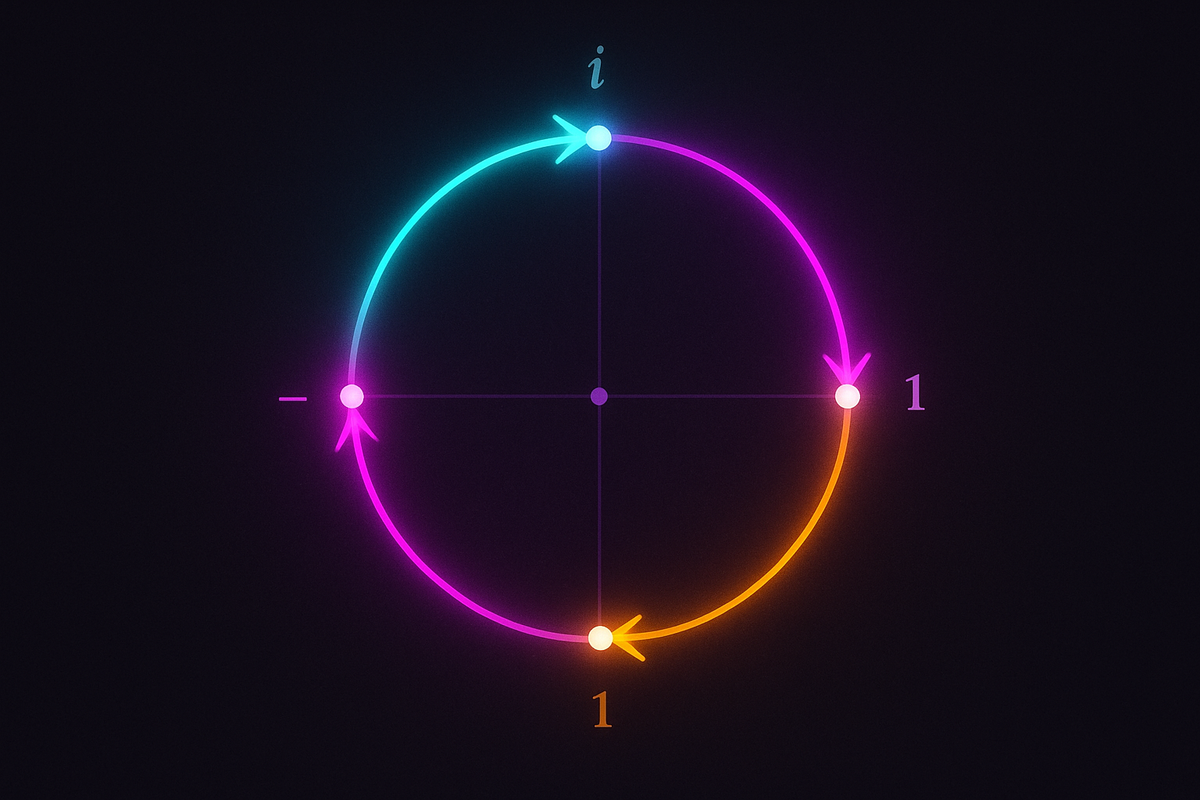
The number i is defined by one property: i² = -1.
That's it. No mysticism. No physical interpretation required. Define a number whose square is -1, call it i, and see what follows.
What follows is extraordinary. The "impossible" number unlocks rotation, oscillation, wave mechanics, and the deepest structures of algebra.
The Definition
i² = -1
Equivalently: i = √(-1).
This is a definition, not a discovery. We're not claiming some existing object secretly squares to -1. We're creating a new mathematical entity with this property.
From this single rule, all of complex arithmetic follows.
Powers of i
What happens when you compute higher powers?
i¹ = i i² = -1 i³ = i² · i = -1 · i = -i i⁴ = i² · i² = (-1)(-1) = 1 i⁵ = i⁴ · i = 1 · i = i i⁶ = i⁴ · i² = 1 · (-1) = -1
The pattern repeats every 4: i, -1, -i, 1, i, -1, -i, 1, ...
For any power n: i^n depends only on n mod 4.
- n ≡ 0 (mod 4): i^n = 1
- n ≡ 1 (mod 4): i^n = i
- n ≡ 2 (mod 4): i^n = -1
- n ≡ 3 (mod 4): i^n = -i
This cyclic behavior is a preview: multiplication by i is rotation by 90°.
Why Squaring Gives Negatives
On the real line, squaring always gives non-negative results. Positive times positive is positive. Negative times negative is positive.
But i is perpendicular to the real line. When you square it, you rotate 180° — flipping the sign.
Think of it geometrically:
- Start at 1 on the real axis.
- Multiply by i: rotate 90° counterclockwise to i.
- Multiply by i again: rotate another 90° to -1.
Two 90° rotations = 180° rotation = multiplication by -1.
i² = -1 is rotation arithmetic.
Negative Square Roots
With i defined, every negative number has a square root:
√(-9) = √(9 · -1) = √9 · √(-1) = 3i
√(-2) = √2 · i = i√2
In general: √(-a) = i√a for a > 0.
Caution: √(ab) = √a · √b only works reliably when a and b are positive. For negatives, be careful:
√(-1) · √(-1) = i · i = -1 ≠ √((-1)(-1)) = √1 = 1
The square root function has subtleties with complex numbers. The "principal square root" is defined carefully to avoid contradictions.
The Imaginary Axis
In the complex plane:
- The horizontal axis is the real axis: 1, 2, -3, π, etc.
- The vertical axis is the imaginary axis: i, 2i, -5i, etc.
Every complex number a + bi is a point: go a units right, b units up.
The number i sits at (0, 1). The number -i sits at (0, -1).
Multiplying by i rotates any complex number 90° counterclockwise:
- 1 → i (real axis to imaginary axis)
- i → -1
- -1 → -i
- -i → 1
Full circle every four multiplications.
Why "Imaginary" Is Misleading
René Descartes called these numbers "imaginary" dismissively. The name stuck, but the attitude was wrong.
Imaginary numbers are no more or less real than negative numbers. Both required mental leaps:
- Negative numbers: "What's less than nothing?"
- Imaginary numbers: "What squares to negative?"
Both have consistent arithmetic. Both are useful. Both are part of mathematics now.
A better name: lateral (sideways from the real line) or quadrature (at 90°). Engineers use j instead of i to avoid confusion with current, but it's the same idea.
Applications
Electrical engineering: AC circuits have voltage V = V₀e^(iωt). The imaginary part represents phase shift.
Quantum mechanics: Wave functions are complex. The imaginary part is essential — interference patterns require it.
Control theory: Transfer functions use complex poles and zeros. Stability depends on whether poles have positive or negative imaginary parts.
Signal processing: Fourier transforms map signals to complex spectra. Real signals have complex representations.
In all these fields, i isn't a trick — it's the natural language.
Algebraic Closure
Here's the deep payoff: adding i to the reals creates a system where every polynomial equation has solutions.
x² + 1 = 0 → x = ±i x³ - 1 = 0 → x = 1, (-1 ± i√3)/2 x⁴ + 1 = 0 → four complex solutions
The Fundamental Theorem of Algebra says every non-constant polynomial with complex coefficients has a complex root. In fact, a degree-n polynomial has exactly n roots in ℂ.
The complex numbers are algebraically closed. You never need to extend further.
What i "Is"
Is i a number? Yes, in the sense that it obeys arithmetic rules consistently.
Is it a quantity? Not in the way 3 apples or -5 degrees are. But neither is √2, really.
i is a mathematical object defined by a rule: i² = -1. Everything else follows from exploring that rule's consequences.
The question "what is i, really?" is like asking "what is 0, really?" These are abstractions. They exist through their relationships, not as physical objects.
Constructing i
Skeptical that you can "just define" something?
Here's a construction. Consider pairs of real numbers (a, b) with these rules:
- (a, b) + (c, d) = (a+c, b+d)
- (a, b) · (c, d) = (ac - bd, ad + bc)
Check that (0, 1) · (0, 1) = (0·0 - 1·1, 0·1 + 1·0) = (-1, 0).
Call (0, 1) by the name "i" and (1, 0) by the name "1". Now (a, b) = (a, 0) + (0, b) = a + bi.
This construction shows complex numbers are just pairs of reals with a specific multiplication rule. Nothing metaphysical required.
Summary
The imaginary unit i is defined by i² = -1.
Powers of i cycle: i, -1, -i, 1, i, ...
Geometrically, multiplying by i rotates 90° counterclockwise.
With i, every negative number has a square root, and every polynomial has solutions.
i isn't imaginary in any meaningful sense. It's a perpendicular direction, extending the real line into the complex plane.
Further Reading
- Nahin, P. An Imaginary Tale. The complete history of i.
- Needham, T. Visual Complex Analysis. Geometric understanding.
- Penrose, R. The Road to Reality. Complex numbers in physics.
This is Part 2 of the Complex Numbers series. Next: "The Complex Plane" — numbers as points in two dimensions.
Part 2 of the Complex Numbers series.
Previous: What Is a Complex Number? When Real Numbers Are Not Enough Next: The Complex Plane: Numbers as Points in Two Dimensions
Comments ()