How Your Immune System Learns: Evolution Running in Real Time
Every time your body encounters a new pathogen, your immune system runs an accelerated evolutionary process to defeat it. V(D)J recombination generates random antibody shapes at birth; somatic hypermutation refines them in real time during infection.
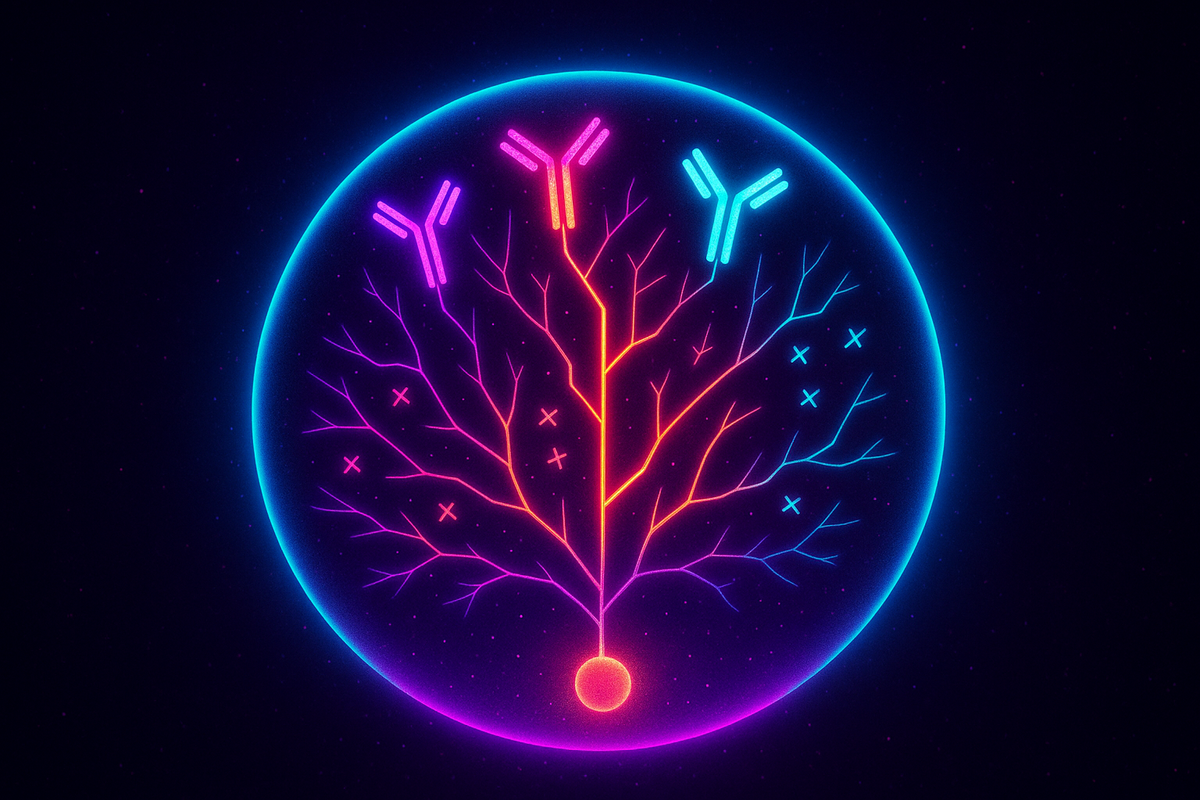
How Your Immune System Learns: Evolution Running in Real Time
Series: New Immunology | Part: 2 of 8 Primary Tag: FRONTIER SCIENCE Keywords: V(D)J recombination, clonal selection, somatic hypermutation, affinity maturation, immune memory
The Generation of Diversity
The core problem: you need antibodies (and T cell receptors) that can recognize any possible molecular shape. But you have roughly 20,000 genes—nowhere near enough to encode the billions of different receptors you need. Evolution's solution: don't encode receptors directly. Encode parts of receptors, then randomly recombine them during immune cell development. This process is called V(D)J recombination. Here's how it works: Your genome contains gene segments in three categories:
- V segments (Variable): ~50 different versions
- D segments (Diversity): ~25 different versions
- J segments (Joining): ~6 different versions
When a B cell develops, molecular machinery randomly selects one V, one D, and one J segment, then physically cuts out all the other DNA and pastes the selected segments together. This recombined DNA encodes one piece of the antibody receptor. The math is multiplicative: 50 × 25 × 6 = 7,500 combinations just from segment selection. But that's just the start. At each junction where segments join, the machinery:
- Deletes random nucleotides from the ends
- Adds random nucleotides (via an enzyme called TdT)
- Then joins the modified ends
This junctional diversity is where most of the variability comes from. Each junction can vary in dozens of nucleotides, and the sequence encodes the part of the receptor that actually contacts antigen. Add junctional diversity to combinatorial diversity, and you get an estimated 10^11 possible receptors (100 billion) from a few hundred gene segments. Far more than enough to cover any molecular shape the universe might throw at you.
Clonal Selection: Evolution's Logic
The repertoire is generated randomly. That means most receptors don't match anything useful. Most T and B cells will never meet their target. This seems wasteful. It's actually brilliant. When a pathogen enters, it's carrying antigens—molecular shapes that some lymphocyte, somewhere in your billions-strong repertoire, will match. The pathogen doesn't know which one; your body doesn't know which one. But the matching cell exists. Clonal selection is the process of finding that cell: 1. Antigen enters and is captured by dendritic cells 2. Antigen is presented in lymph nodes 3. Millions of lymphocytes circulate through, each briefly checking: does my receptor match? 4. The rare cell that matches gets activated 5. That cell divides: one becomes thousands, thousands become millions 6. The clonal army goes to war This is natural selection compressed into days. Random variation (receptor generation) followed by selection pressure (does it match?) followed by differential reproduction (clonal expansion). The cells that fit the environment proliferate; others don't. Burnet and Medawar won the 1960 Nobel Prize for clonal selection theory. It's one of the most important ideas in immunology—the recognition that the immune system doesn't design solutions but selects them from a pre-existing repertoire.
Affinity Maturation: Evolution Within Evolution
But wait—there's another layer. The initial antibodies produced by B cells are often mediocre. They bind the antigen, but not tightly. Evolution can do better. In structures called germinal centers (within lymph nodes and spleen), activated B cells undergo another round of evolution: Somatic hypermutation: An enzyme called AID introduces random mutations into the antibody genes. Not the whole genome—just the antibody genes. And at a rate roughly 1 million times higher than normal mutation rates. This generates diversity within the clonal population. Selection: B cells with mutated receptors compete for limited antigen. Those with higher-affinity receptors—tighter binding—get survival signals. Those with lower affinity don't. Competition selects for better binders. Iteration: This process repeats for weeks. Each cycle, the average antibody affinity increases. By the end, the antibodies are 10 to 1000 times better than what you started with. This is called affinity maturation, and it's why antibody responses improve over time. Your second-week antibodies are dramatically better than your first-week antibodies. The longer the immune response runs, the better the antibodies get. Affinity maturation is evolution operating on a faster timescale than the immune response itself. It's evolution within evolution. Variation, selection, iteration—running in real time inside your lymph nodes.
Memory: What the Immune System Keeps
The final piece: how does the immune system remember? After an infection is cleared, most effector cells die. The army disbands. But a subset become memory cells—long-lived lymphocytes that persist for years or decades, waiting. Memory B cells carry the evolved, affinity-matured antibody genes. They don't secrete antibodies, but they're ready to rapidly differentiate into plasma cells if they meet the antigen again. Memory T cells are similar—they persist in tissues and circulation, primed for rapid response. The second exposure is dramatically faster because: 1. Memory cells are more abundant than naive cells would be for that antigen 2. Memory cells require less stimulation to activate 3. Memory B cells already have affinity-matured receptors—no need to start from scratch 4. Memory cells can become effector cells faster This is why vaccines work. A vaccine provides the first exposure in a safe form. The immune system goes through clonal selection, affinity maturation, and memory formation. When the real pathogen arrives, the memory response is fast and effective. This is also why we don't get childhood diseases twice. Measles, mumps, chickenpox—one infection, lifelong immunity. The memory cells never forget.
What Can Go Wrong
The elegant system has vulnerabilities: Autoimmunity: Random receptor generation means some receptors will recognize self-antigens. The body has mechanisms to delete these (central tolerance) or suppress them (peripheral tolerance), but the mechanisms aren't perfect. Autoimmunity is what happens when self-reactive clones escape suppression. Allergies: The system can generate clones against harmless antigens—pollen, peanuts, dust mites. If these clones are selected and expanded (often with inappropriate Th2 help), you get allergic disease. Immunodeficiency: If the recombination machinery is broken, you can't generate diversity. Severe combined immunodeficiency (SCID)—"bubble boy" disease—results from failures in V(D)J recombination or related processes. Cancer exploitation: Tumors are genetically unstable and generate neoantigens. But they also evolve mechanisms to suppress immune responses. The evolutionary logic works against us when the "pathogen" is part of self. Escape mutants: Pathogens can evolve faster than the immune response adapts. HIV is notorious for this—it mutates so rapidly that by the time affinity-matured antibodies arrive, the virus has already escaped. The immune system's learning capacity is remarkable, but it has limits.
The Design Principles
What principles underlie immune learning? Generate diversity blindly, select intelligently. Don't try to predict what you'll need—generate everything possible, then let the environment choose. This is the same logic as evolution, and it works for the same reason: the future is unpredictable. Distributed computation. No central controller decides which antibody to make. Billions of cells independently make their receptors; selection happens locally through antigen contact. Intelligence emerges from distributed competition. Iterate to improve. The first response doesn't have to be perfect. Affinity maturation allows progressive refinement. Time becomes a resource for improvement. Remember what worked. Don't rebuild from scratch each time. Store successful solutions (memory cells) for rapid deployment. These principles are general. They appear in machine learning (generate candidate solutions, select based on performance, iterate). They appear in cultural evolution (generate ideas, select what works, remember and transmit). The immune system is one implementation of a broader algorithmic logic.
The Molecular Machinery
For those who want the mechanistic details: RAG enzymes (RAG1 and RAG2): The molecular scissors that cut DNA at recombination signal sequences flanking V, D, and J segments. Without RAG, no recombination—no adaptive immunity. TdT (terminal deoxynucleotidyl transferase): Adds random nucleotides at junctions during recombination. The main source of junctional diversity. AID (activation-induced cytidine deaminase): The enzyme that causes somatic hypermutation in germinal centers. It deaminates cytosines in DNA, causing mutations. MHC (major histocompatibility complex): The molecules that present antigen fragments to T cells. Class I MHC presents to CD8+ T cells; Class II presents to CD4+ T cells. Your MHC alleles determine which peptides can be presented. BCR and TCR: B cell receptor and T cell receptor—the randomly generated receptors that recognize antigen. BCR recognizes native antigen; TCR recognizes antigen fragments bound to MHC. The machinery is complex, but the logic is simple: generate, select, remember.
Why This Matters
Understanding immune learning matters for: Vaccine design: Vaccines work by hijacking natural learning processes. Better understanding = better vaccines. Adjuvants, for instance, work partly by enhancing germinal center reactions and affinity maturation. Cancer immunotherapy: Teaching the immune system to recognize tumors requires understanding how clones are selected and expanded. Autoimmune disease: Understanding why self-reactive clones escape tolerance suggests how to restore it. Immunodeficiency treatment: Gene therapy for SCID involves restoring the recombination machinery. Understanding the machinery enables fixing it. Artificial immune systems: Computer scientists have built algorithms inspired by immune learning. The principles are general enough to apply beyond biology.
The Coherence Frame
From a coherence perspective, immune learning is about building specific coherence from general starting conditions. The naive repertoire is general—it can recognize anything, but it recognizes everything poorly. Through selection and affinity maturation, the system converges on specific, high-coherence solutions for particular threats. Memory is the persistence of coherence. Once the system has learned to recognize a threat coherently, it stores that solution for future use. The body becomes increasingly coherent with respect to the threats it has experienced. The immune system isn't just defending—it's accumulating wisdom. Each infection is a learning experience. Each vaccine is a lesson. The immune self becomes richer, more coherent, more capable over time. This is what learning systems do. They start general and become specific. They start naive and become experienced. The immune system does this every time you catch a cold.
Further Reading
- Tonegawa, S. (1983). "Somatic generation of antibody diversity." Nature. (Nobel Prize lecture)
- Burnet, F.M. (1959). The Clonal Selection Theory of Acquired Immunity. Cambridge University Press.
- Victora, G.D. & Nussenzweig, M.C. (2012). "Germinal Centers." Annual Review of Immunology.
- Di Noia, J.M. & Neuberger, M.S. (2007). "Molecular mechanisms of antibody somatic hypermutation." Annual Review of Biochemistry.
This is Part 2 of the New Immunology series, exploring the frontier of how immunity shapes health and disease. Next: "Trained Immunity: Memory Without Memory Cells."


Comments ()