The Language of Immunity: A Synthesis
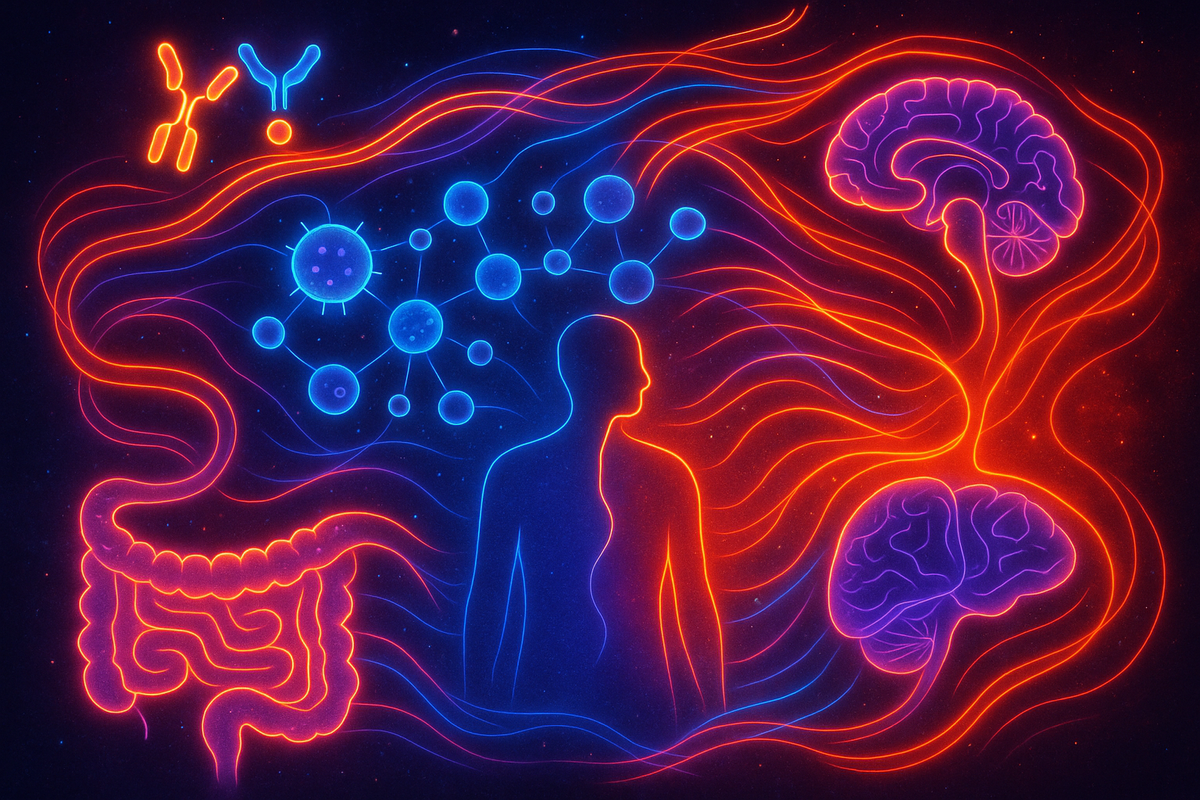
Your immune system is less a military force and more a cognitive one — it learns, remembers, distinguishes self from non-self, and updates its model of the world. This is what immunity as information processing actually looks like.
The Language of Immunity: A Synthesis
Series: New Immunology | Part: 8 of 8 Primary Tag: FRONTIER SCIENCE Keywords: immunology, systems biology, information processing, coherence, self-recognition
The Immune System as Cognitive System
The parallels between immunity and cognition are striking: Both generate hypotheses about the world. The adaptive immune system randomly generates receptors that can recognize any possible antigen—most of which it will never encounter. It's generating hypotheses about what threats might exist, then testing them against reality. Both learn from experience. Clonal selection, affinity maturation, and memory formation are learning processes. The immune system becomes better at recognizing previously encountered threats, just as the brain becomes better at previously performed tasks. Both make decisions under uncertainty. Is this molecule dangerous or harmless? Is this cell infected or healthy? Should we inflame or tolerate? These are classification problems with noisy inputs and uncertain outcomes. Both require integration of information. Dendritic cells integrate signals from pathogens, tissue damage, and environmental context to determine what kind of immune response to instruct. This integration is a form of computation. Both have memory systems. Long-lived memory cells store information about past encounters, enabling faster and more effective responses in the future. The immune system doesn't "think" in any conscious sense. But it processes information. It represents the world. It makes predictions. It learns. In the broadest sense of "cognition" as information processing that produces adaptive behavior, immunity is cognitive.
The Self/Non-Self Problem
The central problem of immunity is the self/non-self discrimination problem: how do you recognize foreign threats while tolerating the body's own tissues? This problem is harder than it seems: Self is not static. Your cells are constantly changing—differentiating, dividing, dying. Tissues remodel. Gene expression shifts. The "self" that must be tolerated is a moving target. Self includes non-self. The microbiome—trillions of bacteria, viruses, and fungi—is technically foreign but must be tolerated. The immune system has to distinguish beneficial symbionts from harmful pathogens, even when they're genetically similar. Threats can look like self. Cancer cells are self-derived. Autoimmune-triggering mimicry occurs when pathogen antigens resemble self-proteins. The discrimination can't rely on simple rules. The system generates its own threats. Random receptor generation creates lymphocytes that could attack self. The discrimination system must filter its own outputs. The solutions—central tolerance, peripheral tolerance, regulatory T cells, checkpoints—are multiple overlapping mechanisms that together maintain self-tolerance. No single mechanism is sufficient. The redundancy suggests how critical the problem is and how easy it is to get wrong.
Coherence as Organizing Principle
Throughout this series, we've used "coherence" as a lens. Let's make explicit what this means for immunity. Coherent immunity is immunity that:
- Accurately discriminates self from non-self
- Responds proportionally to threats
- Resolves inflammation when the threat is cleared
- Maintains appropriate tolerance to beneficial foreign agents
- Remembers past encounters to improve future responses
Incoherent immunity fails along these dimensions:
- Autoimmunity: attacking self as non-self
- Immunodeficiency: failing to attack genuine threats
- Chronic inflammation: failing to resolve responses
- Allergy: attacking harmless non-self
- Failed memory: not learning from past encounters
Health is immune coherence. Disease, in many cases, is the breakdown of that coherence. The coherence frame unifies seemingly disparate conditions:
- Cancer and autoimmunity are both discrimination failures—in opposite directions
- Chronic inflammation and immunodeficiency are both regulation failures—in opposite directions
- Allergy and infection susceptibility are both calibration failures—in opposite directions
The common denominator is that the immune system has lost its accurate mapping between threat and response.
The Immune System as Interface
The immune system occupies a unique position: it's the interface between the organism and its microbial environment. This interface role means immunity is shaped by both internal and external factors: From inside: Genetics, hormones, neural signals, metabolic state, and developmental history all shape immune function. The immune system isn't autonomous—it's embedded in the body. From outside: The microbiome, infections, diet, and environmental exposures continuously calibrate immune responses. The immune system isn't isolated—it's engaged with the world. The gut is where this interface is most concentrated. 70% of immune cells, the microbiome, the largest mucosal surface—all converging. The gut-immune dialogue we explored isn't peripheral to immunity; it's central. This interface function means the immune system integrates information from across biological scales:
- Molecular (pattern recognition, cytokine signaling)
- Cellular (lymphocyte activation, phagocytosis)
- Tissue (inflammation, resolution)
- Organismal (fever, sickness behavior)
- Environmental (microbiome, pathogen exposure)
The immune system is a multi-scale integrator, maintaining coherence between organism and environment.
Therapeutic Implications
The new immunology has transformed medicine: Cancer immunotherapy has produced durable remissions in previously untreatable cancers. Checkpoint inhibitors and CAR-T therapy are already approved; hundreds of other approaches are in development. Autoimmune therapy is evolving from broad suppression toward precision modulation. Biologics targeting specific cytokines or cell populations offer better efficacy with fewer side effects. Tolerance induction approaches are in clinical trials. Vaccine development benefits from understanding how to optimally engage both innate and adaptive immunity—choosing adjuvants, delivery systems, and antigens based on immunological principles. Microbiome interventions exploit the gut-immune connection. Fecal transplant, probiotics, and prebiotics can modulate immune function through the microbiome route. Neurological conditions are being reexamined through the neuroinflammation lens. Depression, Alzheimer's, and other conditions may have immune components addressable with immune-modulating therapies. The common thread: interventions that work with immune logic rather than against it. Not just suppression, but calibration. Not just killing, but reprogramming.
What We Still Don't Know
Immunology remains frontier science. Fundamental questions are open: Why does tolerance fail? We know the mechanisms of autoimmunity in broad strokes, but why a specific individual develops a specific autoimmune disease at a specific time remains poorly predictable. What determines cancer immunogenicity? Some tumors respond dramatically to immunotherapy; others don't. The biomarkers we have are imperfect. Predicting who will respond is a major challenge. How does the microbiome train immunity? The correlations are robust, but the causal mechanisms are often unclear. Which species matter? Through what pathways? What maintains immunological memory? Memory cells persist for decades. How? What maintains their epigenetic state? What determines memory longevity? Can we achieve tolerance induction? The holy grail of autoimmune therapy—specific tolerance without broad immunosuppression—has been pursued for decades without breakthrough success. The field is advancing rapidly, but humility is appropriate. The immune system evolved over hundreds of millions of years. We've been studying it scientifically for about 150. Much remains to be discovered.
The Philosophical Implications
The new immunology raises deep questions about identity and selfhood: What is "self"? The immune system defines self operationally—self is what isn't attacked. But this definition includes the microbiome, includes tissues that change over time, includes cells that will eventually become senescent and need to be eliminated. "Self" in immunological terms is dynamic, contextual, and ecological. Where does "you" end? If your microbiome is essential for your immune function, and your immune function is essential for your health, and your bacteria have their own genomes and their own evolutionary trajectories—where exactly do you stop and your bacteria start? The boundaries are blurry. What is health? The coherence frame suggests health isn't a state but a process—the ongoing maintenance of dynamic equilibrium between organism and environment. You're not healthy; you're healthing—continuously maintaining coherence. What is disease? Many chronic diseases may be better understood as coherence failures than as invasions or breakdowns. The system hasn't been attacked by something foreign; it's lost its ability to regulate itself. These aren't just philosophical musings. They have practical implications for how we approach medicine—treating the whole system rather than isolated symptoms, supporting coherence rather than just fighting enemies.
The Language Metaphor
Throughout, I've used the phrase "the language of immunity." What does that mean? Languages are systems for communicating information. They have:
- Vocabulary: The elements that carry meaning (in immunity: cytokines, receptors, cell types)
- Grammar: The rules for combining elements (in immunity: signaling cascades, cell-cell interactions)
- Semantics: The relationship between symbols and meanings (in immunity: how molecular patterns indicate threats)
- Pragmatics: How context affects interpretation (in immunity: how tissue environment shapes immune response)
The immune system uses molecular language to communicate about the world. Pattern recognition receptors are vocabulary for recognizing threats. Cytokine cascades are grammar for coordinating responses. The whole system is a meaning-making apparatus that interprets the body's relationship with its environment. This isn't just metaphor. The immune system genuinely processes information, represents the world, and communicates between cells. Understanding it requires the tools of information theory as much as molecular biology. The "new immunology" isn't just new facts—it's a new way of seeing immunity as cognition, as language, as coherence maintenance. The paradigm shift is from "defense force" to "information-processing system."
Conclusion
We began this series with a simple observation: the immune system is smarter than we thought. It learns, it remembers, it decides. It's not a military fighting wars but a cognitive system making sense of a complex and dangerous world. The journey has taken us through:
- The two arms of immunity and how they coordinate
- How the adaptive system evolves antibodies in real time
- Trained immunity and the memory of innate cells
- How checkpoint inhibitors release the brakes on cancer
- How CAR-T cells are engineered assassins
- How tolerance fails in autoimmunity
- How the brain has its own immune system
Through it all, one theme: coherence. The immune system maintains the boundary between self and world. It processes information to discriminate threats from safety. It learns and remembers to improve discrimination over time. When this coherence breaks down—in autoimmunity, cancer, chronic inflammation—disease results. The language of immunity is the language of meaning-making at the cellular level. Learning to read and write that language is transforming medicine.
Further Reading
- Davis, M.M. (2020). "A prescription for human immunology." Immunity.
- Medzhitov, R. (2021). "The spectrum of inflammatory responses." Science.
- Pulendran, B. & Davis, M.M. (2020). "The science and medicine of human immunology." Science.
- Cohen, I.R. (2000). Tending Adam's Garden: Evolving the Cognitive Immune Self. Academic Press.
- Pradeu, T. (2012). The Limits of the Self: Immunology and Biological Identity. Oxford University Press.
This concludes the New Immunology series. For more Frontier Science explorations of cutting-edge biology, return to the Series Hub.


Comments ()