Improper Integrals: When Infinity Gets Involved
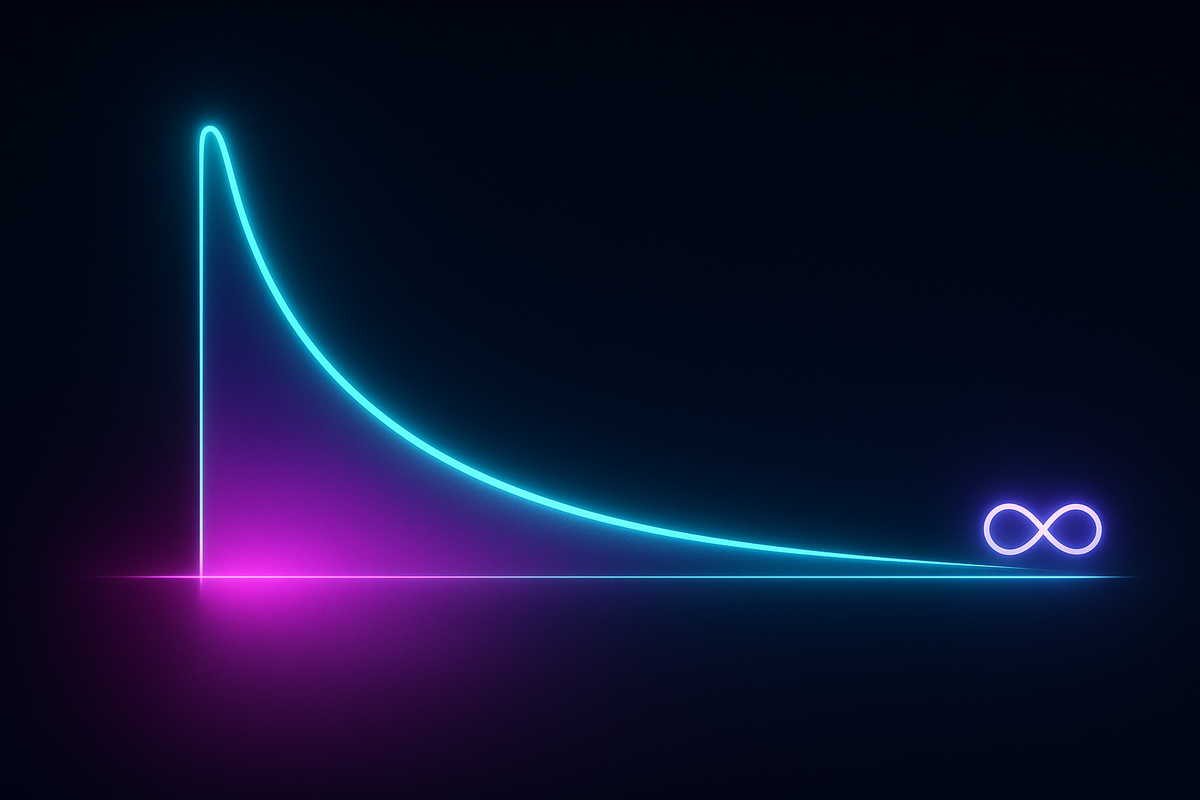
Improper integrals extend integration to cases that seem impossible: infinite intervals or infinite function values.
How can you add up infinitely many things over an infinite range and get a finite answer? Sometimes you can. Sometimes you can't. Improper integrals tell you which.
The trick: replace infinity with a limit.
Two Types of Improper
Type 1: Infinite limits of integration
∫₁^∞ (1/x²) dx — integrating to infinity
∫₋∞^0 eˣ dx — integrating from negative infinity
∫₋∞^∞ e^(-x²) dx — both limits infinite
Type 2: Infinite integrand (vertical asymptote)
∫₀¹ (1/√x) dx — integrand blows up at x = 0
∫₀¹ (1/x) dx — vertical asymptote at x = 0
∫₋₁¹ (1/x²) dx — asymptote inside the interval
Both types require special handling. You can't just plug in infinity.
Type 1: Infinite Bounds
Replace ∞ with a limit.
Definition: ∫ₐ^∞ f(x) dx = lim[t→∞] ∫ₐᵗ f(x) dx
Integrate to a finite bound t, then take the limit as t → ∞.
If the limit exists and is finite, the integral converges. If not, it diverges.
Example: ∫₁^∞ (1/x²) dx
∫₁ᵗ (1/x²) dx = [-1/x]₁ᵗ = -1/t - (-1/1) = 1 - 1/t
As t → ∞: 1 - 1/t → 1
∫₁^∞ (1/x²) dx = 1 — converges.
The infinite region under 1/x² has finite area.
Example: ∫₁^∞ (1/x) dx
∫₁ᵗ (1/x) dx = [ln|x|]₁ᵗ = ln(t) - ln(1) = ln(t)
As t → ∞: ln(t) → ∞
∫₁^∞ (1/x) dx diverges.
The area under 1/x is infinite. Same infinite x-range, but 1/x doesn't shrink fast enough.
The p-Test for Convergence
For ∫₁^∞ (1/xᵖ) dx:
- If p > 1, the integral converges.
- If p ≤ 1, the integral diverges.
This is the threshold. 1/x² (p = 2) converges. 1/x (p = 1) diverges. 1/√x (p = 0.5) diverges even faster.
Think of it as: the function must decay faster than 1/x to have finite area over an infinite interval.
Negative Infinity
For integrals from -∞:
∫₋∞ᵇ f(x) dx = lim[t→-∞] ∫ₜᵇ f(x) dx
Example: ∫₋∞⁰ eˣ dx = lim[t→-∞] [eˣ]ₜ⁰ = 1 - lim[t→-∞] eᵗ = 1 - 0 = 1
The function eˣ decays exponentially as x → -∞, giving finite area.
Both Limits Infinite
Split at any convenient point:
∫₋∞^∞ f(x) dx = ∫₋∞⁰ f(x) dx + ∫₀^∞ f(x) dx
Both parts must converge independently.
Example: ∫₋∞^∞ e^(-x²) dx
This is the famous Gaussian integral. It converges, equaling √π.
The proof uses polar coordinates and is a highlight of multivariable calculus.
Type 2: Vertical Asymptotes
When f(x) → ∞ at a point in [a, b], replace that point with a limit.
Definition: If f blows up at x = a: ∫ₐᵇ f(x) dx = lim[t→a⁺] ∫ₜᵇ f(x) dx
Approach the troublesome point from inside the interval.
Example: ∫₀¹ (1/√x) dx
1/√x → ∞ as x → 0⁺.
∫ₜ¹ x^(-1/2) dx = [2√x]ₜ¹ = 2 - 2√t
As t → 0⁺: 2 - 2√t → 2
∫₀¹ (1/√x) dx = 2 — converges.
Example: ∫₀¹ (1/x) dx
∫ₜ¹ (1/x) dx = [ln|x|]ₜ¹ = 0 - ln(t) = -ln(t)
As t → 0⁺: -ln(t) → ∞
∫₀¹ (1/x) dx diverges.
The function 1/x blows up too fast at 0 for finite area.
p-Test at Zero
For ∫₀¹ (1/xᵖ) dx:
- If p < 1, the integral converges.
- If p ≥ 1, the integral diverges.
This is opposite to the behavior at infinity. Near zero, less singular is better.
Asymptote Inside the Interval
If f has an asymptote at c with a < c < b, split the integral:
∫ₐᵇ f(x) dx = ∫ₐᶜ f(x) dx + ∫ᶜᵇ f(x) dx
Each piece must be evaluated as a limit.
Example: ∫₋₁¹ (1/x²) dx
Split at x = 0: ∫₋₁⁰ (1/x²) dx + ∫₀¹ (1/x²) dx
Each piece diverges (1/x² has p = 2 ≥ 1 at zero).
∫₋₁¹ (1/x²) dx diverges.
Don't be fooled by symmetry. Both pieces are +∞, not canceling.
Comparison Tests
Sometimes you can't evaluate an improper integral explicitly. Comparison helps.
Direct comparison: If 0 ≤ f(x) ≤ g(x) on [a, ∞):
- If ∫ₐ^∞ g(x) dx converges, so does ∫ₐ^∞ f(x) dx.
- If ∫ₐ^∞ f(x) dx diverges, so does ∫ₐ^∞ g(x) dx.
Limit comparison: If lim[x→∞] f(x)/g(x) = L, where 0 < L < ∞:
- f and g either both converge or both diverge.
Example: Does ∫₁^∞ (1/(x² + 1)) dx converge?
Compare to 1/x². For large x: (x² + 1) ≈ x², so 1/(x² + 1) ≈ 1/x².
Since ∫₁^∞ (1/x²) dx converges, so does ∫₁^∞ (1/(x² + 1)) dx.
Common Convergent Forms
Exponential decay: ∫₀^∞ e^(-ax) dx = 1/a (for a > 0)
Gaussian: ∫₋∞^∞ e^(-x²) dx = √π
Rational decay: ∫₁^∞ (1/xᵖ) dx converges for p > 1
Inverse trig type: ∫₀^∞ (1/(1+x²)) dx = π/2
Physical Interpretation
Improper integrals model situations where quantities extend indefinitely:
Total work against a force that decreases with distance (gravity, electrostatics)
Total probability under a probability density function extending to ±∞
Present value of an infinite stream of payments (economics)
Total energy in a wave or field
The convergence question is whether the total is finite — whether the contributions from far away are negligible enough.
The Gabriel's Horn Paradox
The surface generated by rotating y = 1/x (for x ≥ 1) about the x-axis has infinite surface area but finite volume.
Volume: ∫₁^∞ π(1/x)² dx = π ∫₁^∞ (1/x²) dx = π — finite.
Surface area: involves ∫₁^∞ (2π/x)√(1 + 1/x⁴) dx — diverges.
You can fill it with paint but not paint its surface. Infinity is strange.
Summary
Improper integrals extend integration to infinite intervals or infinite integrands.
Method: Replace ∞ or the troublesome point with a variable, integrate normally, take the limit.
Convergence: The limit is finite. Divergence: The limit is ±∞ or doesn't exist.
Key tests:
- 1/xᵖ at ∞: converges if p > 1
- 1/xᵖ at 0: converges if p < 1
- Comparison: bound by known convergent/divergent integrals
Further Reading
- Stewart, J. Calculus. Chapter on improper integrals.
- Apostol, T. Calculus. Rigorous limit treatment.
- Strang, G. Calculus. Free, with applications emphasis.
This is Part 7 of the Integrals series. Next: "Applications of Integration" — volumes, areas, and arc lengths.
Part 7 of the Calculus Integrals series.
Previous: Integration by Parts: The Product Rule in Reverse Next: Applications of Integration: Volume Area and Arc Length
Comments ()