Integration by Parts: The Product Rule in Reverse
The product rule tells you how to differentiate a product. Run it backwards and you get integration by parts — the move that makes integrals like ∫x·eˣ dx solvable.
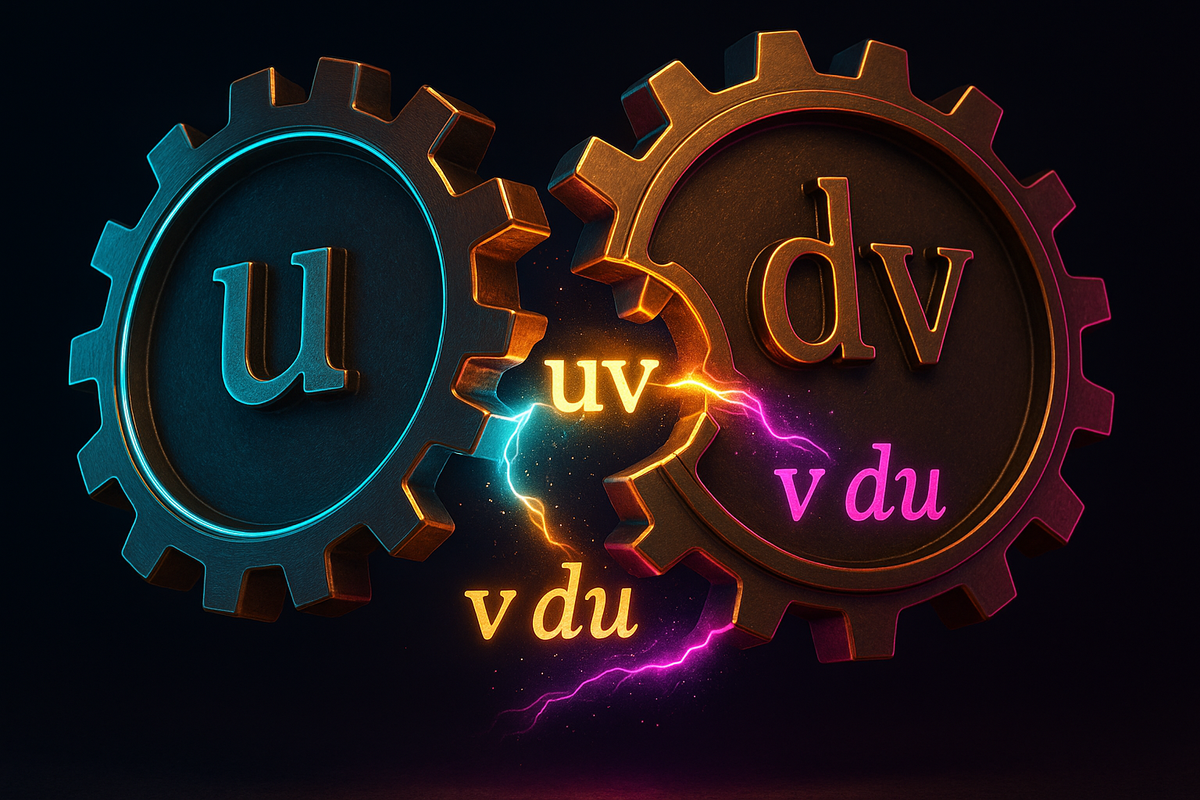
Integration by parts is the product rule, run backward.
The product rule says: d/dx[u·v] = u·(dv/dx) + v·(du/dx).
Rearranging: u·(dv/dx) = d/dx[u·v] - v·(du/dx).
Integrate both sides, and you get the integration by parts formula:
∫ u dv = uv - ∫ v du
This transforms one integral into another — hopefully an easier one.
The Formula
∫ u dv = uv - ∫ v du
Here's what each piece means:
- u — a function you choose from the integrand
- dv — everything else (including dx)
- du — the derivative of u (times dx)
- v — the antiderivative of dv
You pick u and dv. You compute du and v. Then the formula gives you a new integral to solve.
The goal: the new integral ∫ v du should be simpler than the original ∫ u dv.
Example 1: x·eˣ
∫ x · eˣ dx
Substitution doesn't work — there's no chain-rule pattern. But we have a product of x and eˣ.
Choose:
- u = x → du = dx
- dv = eˣ dx → v = eˣ
Apply the formula: ∫ x · eˣ dx = x · eˣ - ∫ eˣ dx = x·eˣ - eˣ + C = eˣ(x - 1) + C
Check: d/dx[eˣ(x-1)] = eˣ(x-1) + eˣ = eˣ·x - eˣ + eˣ = x·eˣ ✓
Choosing u and dv: LIATE
Not all choices work equally well. The LIATE rule helps:
L — Logarithmic (ln x, log x) I — Inverse trig (arctan, arcsin) A — Algebraic (x, x², polynomials) T — Trigonometric (sin, cos, tan) E — Exponential (eˣ, 2ˣ)
Choose u from higher on the list, dv from lower.
For x·eˣ: x is Algebraic, eˣ is Exponential. A comes before E, so u = x.
This isn't a rigid law, but it works most of the time.
Example 2: ln(x)
∫ ln(x) dx
There's only one function, but think of it as ln(x) · 1.
Choose:
- u = ln(x) → du = (1/x) dx
- dv = 1 dx → v = x
Apply the formula: ∫ ln(x) dx = x·ln(x) - ∫ x·(1/x) dx = x·ln(x) - ∫ 1 dx = x·ln(x) - x + C
Check: d/dx[x·ln(x) - x] = ln(x) + x·(1/x) - 1 = ln(x) + 1 - 1 = ln(x) ✓
Example 3: x² · sin(x)
∫ x² · sin(x) dx
Apply integration by parts twice.
First round:
- u = x² → du = 2x dx
- dv = sin(x) dx → v = -cos(x)
∫ x²·sin(x) dx = -x²·cos(x) - ∫ (-cos(x))·2x dx = -x²·cos(x) + 2∫ x·cos(x) dx
Second round (for ∫ x·cos(x) dx):
- u = x → du = dx
- dv = cos(x) dx → v = sin(x)
∫ x·cos(x) dx = x·sin(x) - ∫ sin(x) dx = x·sin(x) + cos(x) + C
Combine: ∫ x²·sin(x) dx = -x²·cos(x) + 2[x·sin(x) + cos(x)] + C = -x²·cos(x) + 2x·sin(x) + 2cos(x) + C
Each application reduces the power of x by one. For xⁿ times trig or exponential, apply n times.
Example 4: The Cycling Trick
∫ eˣ · sin(x) dx
Apply parts twice, and the original integral reappears.
First round:
- u = sin(x) → du = cos(x) dx
- dv = eˣ dx → v = eˣ
∫ eˣ·sin(x) dx = eˣ·sin(x) - ∫ eˣ·cos(x) dx
Second round:
- u = cos(x) → du = -sin(x) dx
- dv = eˣ dx → v = eˣ
∫ eˣ·cos(x) dx = eˣ·cos(x) - ∫ eˣ·(-sin(x)) dx = eˣ·cos(x) + ∫ eˣ·sin(x) dx
Substitute back: ∫ eˣ·sin(x) dx = eˣ·sin(x) - [eˣ·cos(x) + ∫ eˣ·sin(x) dx] ∫ eˣ·sin(x) dx = eˣ·sin(x) - eˣ·cos(x) - ∫ eˣ·sin(x) dx
Let I = ∫ eˣ·sin(x) dx: I = eˣ·sin(x) - eˣ·cos(x) - I 2I = eˣ·(sin(x) - cos(x)) I = (eˣ/2)·(sin(x) - cos(x)) + C
The integral appeared on both sides. Solve algebraically.
Tabular Method (Repeated Parts)
For integrals like ∫ x³·eˣ dx, you need multiple rounds. The tabular method organizes this.
Create two columns: derivatives of u on the left, integrals of dv on the right.
| u and derivatives | dv and integrals |
|---|---|
| x³ | eˣ |
| 3x² | eˣ |
| 6x | eˣ |
| 6 | eˣ |
| 0 | eˣ |
Multiply diagonally, alternating signs (+, -, +, -, ...):
∫ x³·eˣ dx = x³·eˣ - 3x²·eˣ + 6x·eˣ - 6·eˣ + C = eˣ(x³ - 3x² + 6x - 6) + C
This avoids writing out each integration by parts step.
Definite Integrals
For definite integrals, evaluate the uv term at the bounds:
∫ₐᵇ u dv = [uv]ₐᵇ - ∫ₐᵇ v du
Example: ∫₀¹ x·eˣ dx
From earlier: ∫ x·eˣ dx = eˣ(x-1) + C
∫₀¹ x·eˣ dx = [eˣ(x-1)]₀¹ = e¹(1-1) - e⁰(0-1) = 0 - (-1) = 1
Common Patterns
Polynomial × exponential: Use LIATE, apply parts until polynomial disappears.
Polynomial × trig: Same approach, polynomial decreases each round.
Exponential × trig: Apply twice, solve algebraically.
Logarithms: Set u = ln(x), dv = rest. Turns log into 1/x.
Inverse trig: Set u = arctan(x), etc. Turns inverse trig into algebraic.
When Parts Doesn't Help
Some integrands aren't products, or parts makes things worse:
∫ e^(x²) dx — not a product, no closed form ∫ √(sin x) dx — parts doesn't simplify
∫ sec³(x) dx — needs parts combined with trig identity (tricky but doable)
If parts doesn't simplify the integral, try substitution, partial fractions, or trig identities.
The Reduction Formula Perspective
Integration by parts can produce reduction formulas — expressing ∫ fⁿ in terms of ∫ fⁿ⁻¹.
For example, for ∫ sinⁿ(x) dx, parts gives:
∫ sinⁿ(x) dx = -(1/n)sinⁿ⁻¹(x)cos(x) + ((n-1)/n) ∫ sinⁿ⁻²(x) dx
Apply repeatedly until you reach ∫ sin(x) dx or ∫ 1 dx.
Reduction formulas are standard for powers of trig functions.
Summary
Integration by parts transforms ∫ u dv into uv - ∫ v du.
It's the product rule in reverse, useful when the integrand is a product of different function types.
Key insight: choose u so that du is simpler, and dv so that v exists. LIATE guides this choice.
Sometimes apply once, sometimes repeatedly, sometimes solve algebraically when the integral cycles back.
Further Reading
- Stewart, J. Calculus. Many worked examples.
- MIT OpenCourseWare 18.01 — Integration techniques lecture.
- Spivak, M. Calculus. Rigorous treatment of techniques.
This is Part 6 of the Integrals series. Next: "Improper Integrals" — when infinity enters the picture.
Part 6 of the Calculus Integrals series.
Previous: U-Substitution: The Chain Rule in Reverse Next: Improper Integrals: When Infinity Gets Involved
Comments ()