Intel Loihi and the Race for Brain-Like Silicon
Most chips are always on, burning power regardless of activity. Intel's Loihi takes a radically different approach: compute only when neurons fire, just like a brain — and the efficiency gains are dramatic.
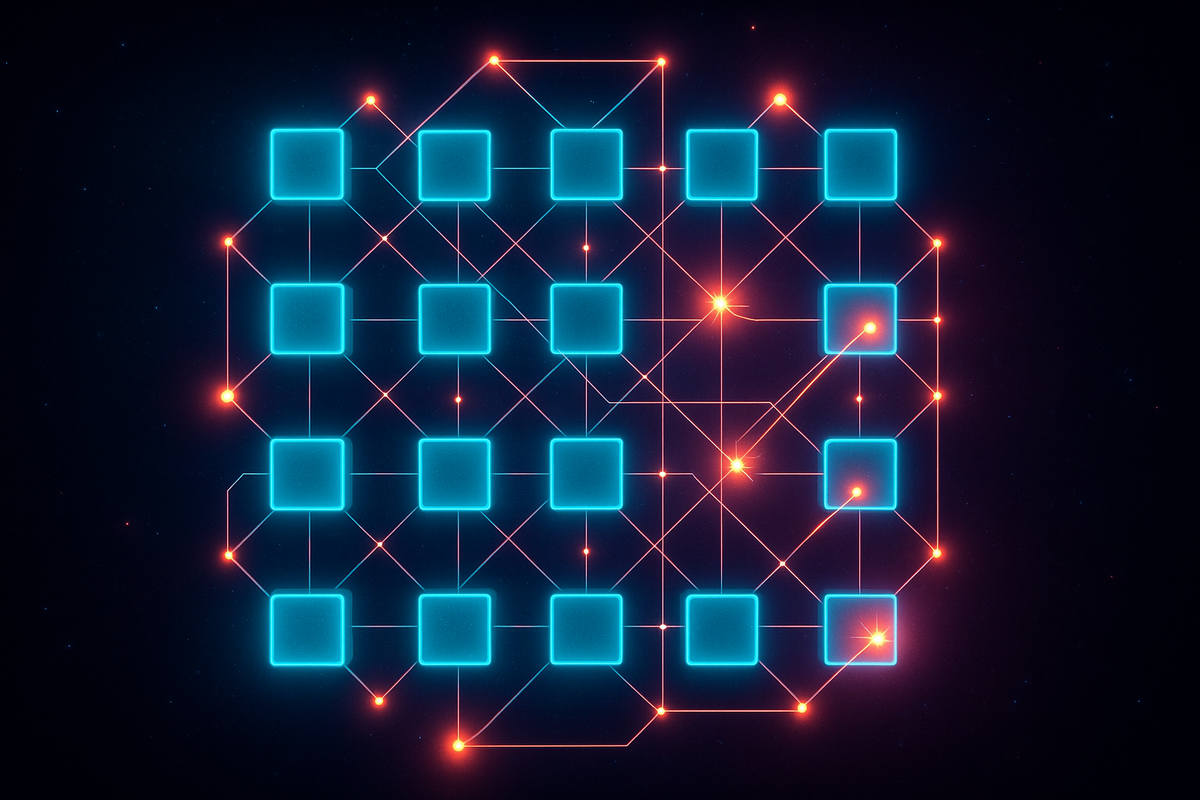
Intel Loihi and the Race for Brain-Like Silicon
Series: Neuromorphic Computing | Part: 3 of 9
In 2017, Intel did something unusual for a chip company obsessed with faster clock speeds and denser transistors. They announced a processor that thinks in spikes, sleeps between events, and gets more efficient the less it computes. The Loihi chip doesn't chase gigahertz. It chases biology.
This wasn't research theater. Intel was making a bet: the future of computation belongs to chips that work like brains, not calculators. Five years later, Loihi 2 arrived with a million neurons on a single die, running at power budgets measured in milliwatts while solving problems GPUs can't touch without burning kilowatts.
The race for brain-like silicon isn't about mimicking neurons for poetry. It's about survival. The current trajectory of AI—larger models, more parameters, exponentially growing energy costs—hits physical limits within a decade. Neuromorphic computing offers the only architecture that scales the way biology does: through efficiency, sparsity, and event-driven computation.
Intel isn't alone. IBM has TrueNorth. BrainChip has Akida. SpiNNaker scales to million-core configurations. But Loihi represents the most aggressive industrial commitment to spiking neural networks as the substrate for artificial intelligence. Understanding its architecture reveals what brain-like computation actually requires at the hardware level.
This is the story of how you build a chip that thinks.
The Problem GPUs Can't Solve
Modern AI runs on graphics processors repurposed for matrix multiplication. GPUs excel at this: they're massively parallel engines for crunching dense numerical arrays. Every neuron connects to every other neuron in a layer. Every value updates synchronously. Every operation executes whether it changes anything or not.
This is the opposite of how biological brains work.
Real neurons fire sparsely—cortical neurons average 1-5 spikes per second in normal conditions. They communicate through discrete events (action potentials), not continuous values. They only consume energy when they spike. Most importantly, they compute asynchronously—no global clock synchronizes a trillion synapses.
GPUs can simulate spiking networks, but it's like using a firehose to water individual plants. You run the entire network forward at every timestep, updating every synapse, checking every neuron, whether anything spiked or not. The energy cost scales with network size and timesteps, not with actual computational work done.
Sparsity doesn't help on GPUs. A network that's 95% inactive still requires 100% of the memory bandwidth and computation cycles.
This matters because the most interesting problems for AI—continuous sensory processing, real-time control, lifelong learning—require always-on systems that can't pause to cool down or recharge. You can't put a GPU in a bird's head. You can put a neuromorphic chip there.
Loihi was designed from first principles to exploit sparsity, operate asynchronously, and consume energy only when neurons spike. It's not a GPU alternative. It's a different computational paradigm entirely.
Architecture Principles: Building Around Events
Loihi's architecture follows what Intel calls the spiking neural network (SNN) model, but the implementation reveals deeper commitments about what computation is when you take biology seriously.
Neuromorphic Cores
The Loihi 2 chip contains 128 neuromorphic cores. Each core houses:
- 1,024 compartments (sub-neuronal computational units)
- 1.5 million synapses (configurable weights and delays)
- Local SRAM for storing synaptic state
- Spike routing fabric for event distribution
These aren't metaphorical "neurons." They're hardware implementations of the leaky integrate-and-fire (LIF) neuron model: incoming spikes add to a membrane potential that decays over time. When the potential crosses a threshold, the neuron fires, sends a spike to downstream neurons, and resets.
But Loihi neurons are more flexible than classical LIF. Each supports:
- Multiple compartments (dendritic computation)
- Configurable learning rules (STDP, reward modulation, custom)
- Stochastic spiking (for sampling and exploration)
- Adaptive thresholds (homeostatic regulation)
This flexibility matters because neuroscience still doesn't know exactly which computational features of biological neurons are essential. Loihi gives researchers programmable primitives rather than hardwired assumptions.
Asynchronous Event Routing
GPUs synchronize on clock edges. Loihi operates on events.
When a neuron spikes, it sends a packet through the mesh routing fabric—a network-on-chip that delivers spikes to target neurons across cores. No global synchronization. No wasted cycles. Spikes propagate at variable delays, enabling temporal coding and dynamic binding.
This is computationally elegant but architecturally challenging. Event-driven systems are harder to design than clocked systems because you can't rely on lockstep progression. Intel solved this with a hierarchical routing scheme:
- Intra-core routing: Spikes within a core use local crossbars (low latency)
- Inter-core routing: Spikes between cores traverse the mesh (configurable topology)
- Off-chip routing: Multiple Loihi chips can connect via high-speed serial links
The result: networks can scale beyond a single chip without losing event-driven efficiency.
Power Proportional to Activity
The defining feature of neuromorphic hardware is power consumption that scales with computational work, not with network capacity.
A GPU with a billion-parameter model draws kilowatts whether it's solving a hard problem or repeating "hello" in a loop. Loihi draws power proportional to spiking activity. An idle network consumes microwatts. A network at 10% activity draws 10% of peak power.
Intel reports Loihi 2 running at 1-100 milliwatts for typical workloads—three orders of magnitude less than GPU equivalents. For always-on systems (edge devices, robotics, wearables), this isn't a nice-to-have. It's the difference between possible and impossible.
This efficiency emerges from event-driven logic: transistors only switch when spikes arrive. Between spikes, circuits sit quiet. No speculative computation. No continuous value propagation. Just waiting for the next spike.
Performance Benchmarks: Where Loihi Wins (and Where It Doesn't)
Neuromorphic chips aren't faster than GPUs at matrix multiplication. They're incomparable. The question isn't speed—it's what kind of computation you're doing.
Constraint Satisfaction and Optimization
Loihi excels at problems where solutions emerge from dynamic search rather than feedforward inference. Consider graph optimization: finding the shortest path, solving traveling salesman variants, constraint satisfaction problems.
On these tasks, Loihi shows 10-100x speedups over GPUs at 1000x lower power. Why? Because the network explores the solution space through spiking dynamics—neurons represent states, spikes encode transitions, and network activity settles into attractors corresponding to solutions.
This is closer to how brains solve problems: not by exhaustive search but by letting dynamics find stable configurations. The hardware becomes the solver. You don't program a solution—you configure network topology and let physics compute.
Real-Time Sensory Processing
Pair Loihi with an event-based camera (like the DVS—dynamic vision sensor), and you get a system where pixels spike only when brightness changes. Most of the visual field, most of the time, stays quiet.
Loihi processes these spike streams in real time with latencies under 1 millisecond. Object tracking, gesture recognition, optical flow—tasks that require continuous frame-by-frame processing on GPUs—become sparse event streams that Loihi handles at microwatt power budgets.
Intel's demonstrations include:
- Gesture recognition at 300 microwatts
- Poker card recognition with 1 millisecond latency
- Continuous learning on visual streams without retraining
The pattern: when input is naturally event-based or sparse, Loihi extracts structure without wasting computation on empty space.
Online Learning and Adaptation
Traditional neural networks require offline training: collect data, train on GPUs, deploy frozen weights. Loihi supports on-chip learning—networks that update synaptic weights based on experience without offloading to a server.
This enables:
- Robots that adapt to new environments in real time
- Wearables that personalize to individual users
- Systems that maintain performance across distributional shift
Learning rules run locally in hardware. Spike-timing-dependent plasticity (STDP) adjusts synapses based on temporal correlations between pre- and post-synaptic spikes. Reward-modulated learning incorporates global signals to guide weight updates.
These aren't differentiable loss functions optimized by backprop. They're local, biologically-plausible rules that nevertheless enable learning. The theory is incomplete—no one knows if STDP can scale to ImageNet-level tasks. But the hardware provides a substrate to find out.
Where GPUs Still Dominate
Loihi doesn't beat GPUs at:
- Dense matrix operations (convolution, transformer attention)
- Tasks requiring gradient-based optimization (backprop)
- Problems already solved with pretrained models that need inference at scale
If your workload is a massive language model responding to prompts, you want GPUs. If your workload is a mobile robot navigating dynamic environments with minimal power, you want Loihi.
The paradigms address different computational ecologies.
The Race Beyond Intel: Who's Building What
Intel leads the industrial charge, but neuromorphic hardware is a frontier with multiple serious contenders.
IBM TrueNorth (2014): 1 million neurons, 256 million synapses, 70 milliwatts. Focused on inference, not learning. Demonstrated real-time object recognition and anomaly detection. IBM has since pivoted to analog in-memory computing rather than pure SNNs.
BrainChip Akida (2021): Commercial neuromorphic chip designed for edge AI. Supports event-based processing and on-chip learning. Targets IoT, automotive, industrial applications. Notable for being the first neuromorphic chip available as IP (intellectual property) for licensing.
SpiNNaker (2018): Not a single chip but a massively parallel architecture scaling to 1 million ARM cores emulating spiking networks. Built at the University of Manchester for brain simulation. Trades efficiency for flexibility—can simulate arbitrary neuron models.
GrAI Matter Labs: Neuromorphic chips with integrated event-based sensing and processing. Focus on always-on audio/visual processing for mobile devices.
Europe's BrainScaleS: Analog neuromorphic hardware running networks 10,000x faster than biological real-time. Explores accelerated evolution of network dynamics for optimization.
The landscape reveals a split: some platforms (Loihi, Akida) target practical deployment, while others (SpiNNaker, BrainScaleS) prioritize neuroscience research. Both matter. We still don't know what computational principles are load-bearing.
The Hidden Coherence: Why Event-Driven Matters for Meaning
Here's where the hardware constraints reveal something deeper about what computation is when it has to persist in the world.
Traditional computing separates memory and processing. You store state in RAM, load it into the CPU, compute, write back. This architecture—the von Neumann bottleneck—scales poorly because data movement dominates energy cost.
Neuromorphic architectures collapse this distinction. Synaptic state is distributed across the network. Processing happens where memory lives. Spikes carry information and trigger computation. There's no separation between data and dynamics.
This is a coherence-preserving architecture in the AToM sense. The system's state—its synaptic configuration, its spiking patterns, its learned associations—remains coupled to its sensory environment through continuous event-driven updates. The network doesn't batch process inputs. It entrains to them.
Consider what happens when you build always-on intelligence:
- The system can't reload context from scratch every time it wakes up
- State must persist across time while remaining plastic enough to update
- Computational work must track actual environmental change, not arbitrary clock cycles
This is what biological brains do. They maintain coherence over time by operating asynchronously, updating locally, and coupling dynamics to events. Event-driven hardware isn't just efficient—it's the architecture required for systems that learn and act continuously in the world.
When Intel built Loihi around events rather than clock ticks, they weren't just optimizing energy. They were building hardware that sustains meaning through temporal coupling. The chip stays synchronized with what matters because spikes arrive when things change, not when a timer expires.
From Research Chip to Ubiquitous Intelligence
Loihi remains a research platform. Intel doesn't sell Loihi chips commercially—they provide access through cloud instances and partnerships. The ecosystem is young. Software toolchains (Lava, NxSDK) are evolving. Standard architectures haven't emerged.
But the trajectory is clear. The first generation proves viability. The second generation (Loihi 2) scales neurons and improves programmability. The third generation will integrate with edge processors, co-packaged with event-based sensors, running in devices you carry.
The path to Edge AGI—artificial general intelligence running on minimal hardware—goes through neuromorphic substrates. You can't fit GPT-scale models in a wristwatch. But you might fit a spiking network that learns your patterns, predicts your needs, and adapts continuously at microwatt power budgets.
This isn't replacing cloud AI. It's enabling the complementary ecology: massive models trained centrally, distilled knowledge deployed in neuromorphic edge devices that personalize and adapt locally. The brain model, not the data center model.
Intel's bet is that within a decade, neuromorphic accelerators will be as ubiquitous as GPUs are today. Not for training foundation models—but for the trillion-device intelligence layer that hasn't been built yet because current hardware makes it energetically impossible.
What Silicon Teaches Us About Neurons
Building neuromorphic hardware forces precision about what features of biological computation are essential versus ornamental.
Loihi's design choices reveal working hypotheses:
- Discrete events matter more than continuous values
- Temporal coding (when spikes arrive) carries as much information as rate coding (how many spikes)
- Local learning rules (STDP) are sufficient for useful adaptation
- Asynchrony enables efficiency and robustness at scale
- Compartmental structure (dendritic computation) improves expressiveness
Some of these will prove right. Some won't. But the engineering constraints—power, latency, scalability—force hard choices that neuroscience can avoid. You can't handwave asynchronous event routing in silicon. Either it works or it doesn't.
This feedback loop—neuroscience informing hardware, hardware testing theory—is already producing insights. Early Loihi experiments showed that noise and stochasticity, initially seen as implementation challenges, actually improve performance on certain tasks by preventing networks from getting stuck in local minima.
Biology tolerates noise. Neuromorphic hardware must as well. This constraint pushes architectures toward robustness through redundancy and statistical coding—principles brains discovered through evolution.
Further Reading
- Davies, M., et al. (2018). "Loihi: A Neuromorphic Manycore Processor with On-Chip Learning." IEEE Micro.
- Orchard, G., et al. (2021). "Efficient Neuromorphic Signal Processing with Loihi 2." IEEE Signal Processing Magazine.
- Davies, M., et al. (2021). "Advancing Neuromorphic Computing with Loihi: A Survey of Results and Outlook." Proceedings of the IEEE.
- Shrestha, S. B., & Orchard, G. (2018). "SLAYER: Spike Layer Error Reassignment in Time." NeurIPS.
- Friston, K. (2010). "The Free-Energy Principle: A Unified Brain Theory?" Nature Reviews Neuroscience. (Connection to event-driven inference)
This is Part 3 of the Neuromorphic Computing series, exploring the hardware foundations of brain-like intelligence.
Previous: Spikes Not Floats: How Biological Neurons Actually Compute
Next: Event-Based Sensing: Cameras That See Like Eyes
Comments ()